How Long Does a Sewer Liner Last? CIPP Lifespan Data, Warranties and Failure Modes
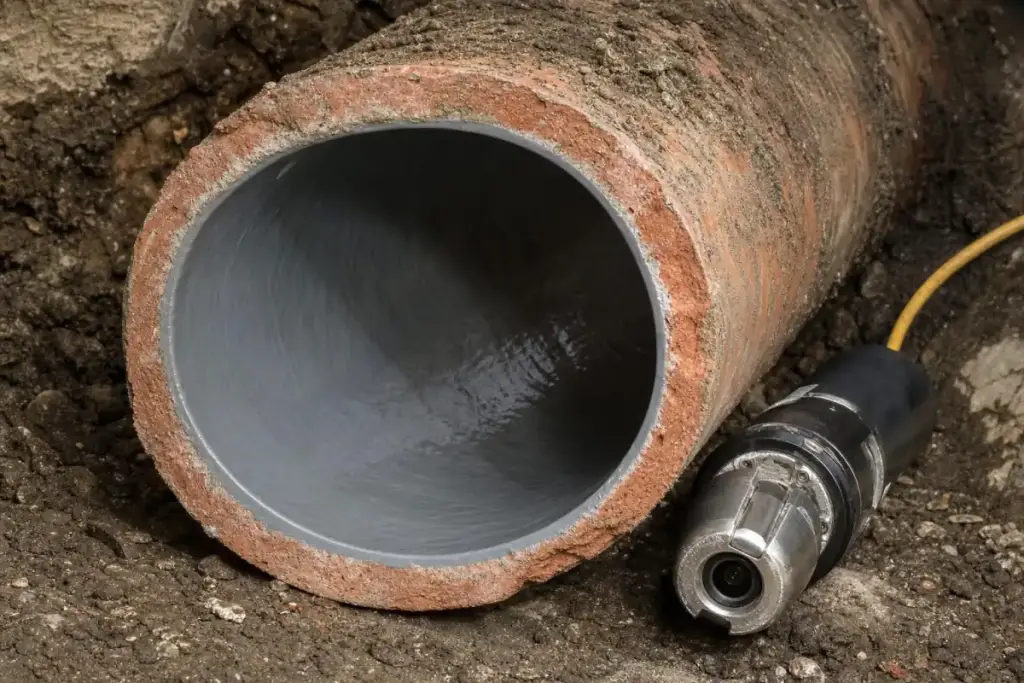
A sewer liner is designed to last 50 years, but that is an engineering design basis, not a promise. EPA-funded researchers who cut 5- to 34-year-old CIPP liners out of city sewers found them in excellent condition, while most lining warranties run 1 to 10 years.
Where the 50-year figure comes from: ASTM F1216 Appendix X1 and a 50% creep factor
The 50 years is the period a liner’s wall thickness is calculated to carry soil, traffic and groundwater loads, not a lab-proven lifespan. ASTM F1216, the practice for inverted resin-impregnated tubes, holds the design equations in Appendix X1, and owners write the 50-year target into their specifications. NASSCO’s CIPP lateral lining performance specification guideline (November 2017) says the liner “shall be designed for 50 years or greater” and sets the inputs: factor of safety 2, soil modulus 1,000 psi, soil density 120 pcf, H20 live load, groundwater at half the depth of cover and 2% ovality.
The same guideline sets the cured material floor at 250,000 psi flexural modulus and 4,500 psi flexural strength, tested to ASTM D790. To reach 50 years, the designer cuts that short-term modulus in half: the long-term creep retention factor is fixed at 50% unless the contractor submits ASTM D2990 creep data. A 2015 University of Waterloo thesis, Short-Term and Long-Term Mechanical Properties of CIPP Liners, tested nine reinforced CIPP products and argued that a flat 0.5 retention factor may not fit newer materials.
What EPA found when it cut 5- to 34-year-old liners out of working sewers
Researchers working under EPA’s Aging Water Infrastructure program pulled 25 liner samples from 11 North American cities between 2009 and 2013, and 18 of them were CIPP. Ages ran from 5 to 34 years.
| Source | Liner age studied | Condition findings |
|---|---|---|
| EPA/600/R-12/004, A Retrospective Evaluation of CIPP Used in Municipal Gravity Sewers (January 2012), Denver and Columbus pilot, per the EPA program summary | Denver: 25 years (8-inch clay) and 22 years (48-inch brick). Columbus: 5 years (8-inch clay) and 21 years (36-inch brick) | Pilot that set the test suite: thickness, annular gap, ovality, specific gravity, flexural and tensile properties, hardness, glass transition temperature |
| Sterling, Alam, Allouche and Condit, Procedia Engineering 165 (2016), pp. 251 to 258 | 5 to 34 years; 25 samples, 18 CIPP, 11 cities | Liners “in excellent condition”; physical tests indicate they should last their 50-year design life “and probably well beyond”; several installation QA/QC gaps noted |
| Alam et al., Cogent Engineering (2018) | 5 to 34 years at 18 locations | Visual inspection and flexural testing were the most useful checks; specific gravity also flagged poorly made liners |
Two limits apply. The oldest sample was 34 years, so no 50-year-old CIPP liner has been retrieved and tested, and the pilot samples came from 8-inch to 48-inch city sewers, not 4-inch house laterals. The data shows a well-made liner holding strength for three decades, and names installation quality as the weak point.
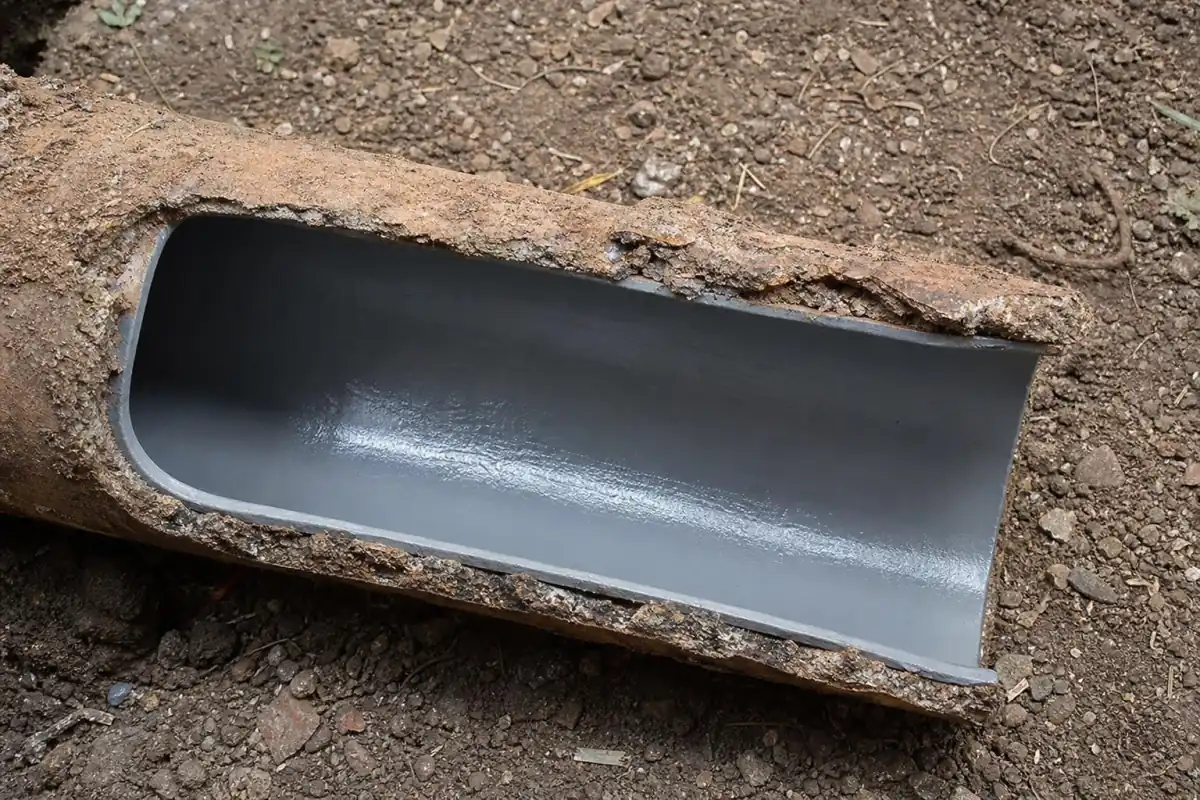
What a lining warranty covers: 1 year in the NASSCO spec, 10 years at Nu Flow
A warranty is a commercial promise, far shorter than the 50-year design life; these are the documents an installer can be held to.
| Document or company | Term | What it covers |
|---|---|---|
| NASSCO lateral lining guideline, section 1.7 (November 2017) | 1 year | Manufacturer: raw materials free of defects for 1 year from installation or owner acceptance, whichever is later. Contractor: installation for 1 year. The owner pays for any warranty camera inspection (section 1.8) |
| Nu Flow, per Plumbing and Mechanical, April 22, 2014 | 10 years standard; 25 years matched on one Florida condo job | The building kept labeled liner samples from each stack in case of a later warranty claim |
| Perma-Liner Perma-Lateral and Flex-Liner, ICC-ES listing PMG-1068 (effective September 2026) | A code listing, not a warranty | Valid only when installed by Perma-Liner trained and certified installers, in 2 to 12 inch pipe, with final video witnessed by the code official |
| City of St. Paul, CIPP Worksheet (April 2024) | Recorded per job | The installer must state the manufacturer, liner type, length of warranty, and planned versus actual liner length and thickness |
The practical rule: get two warranties in writing, the material maker’s and the installer’s, and ask for the post-lining video file. A materials warranty pays nothing for a bad cure or a missed branch, because those are workmanship defects.
Six installation errors that shorten a liner’s life
Every failure mode below traces to the crew, the host pipe or the inspection, not to resin aging. The NASSCO guideline requires the finished liner to be free of foreign inclusions, dry spots, pinholes, major wrinkles and delamination, and PMG-1068 makes the code official confirm on video that the liner is continuous and free of dry spots, lifts and delaminations.
- Wrinkles and fins. A wrinkle is excess tube folded against itself, most visible at bends and size transitions on the final video. NASSCO lists major wrinkles as a defect the contractor repairs at its own expense, so flag one before the last payment.
- Lifts, dry spots and delamination. A lift is liner standing off the host wall instead of pressed tight to it. A dry spot is tube fabric the resin never saturated. Both leave thin, weak wall, and both must be absent on the final video under PMG-1068.
- Uncured or under-cured resin. Ambient-cure epoxy systems need their full cure time; the Maplewood, Minnesota specification for an air-inverted lateral liner says the tube cures within 4 hours without external heat, and NASSCO requires thermoset cool-down to be recorded in the cure log. The same Maplewood spec bars toilets, sinks, dishwashers, washers, tubs and sump pumps from use during installation and cure.
- Branch connections left closed or over-cut. NASSCO requires active connections to be reopened to at least 90% of original capacity, edges brushed smooth, and over-cuts repaired, with a cleanout within 50 feet for external reinstatement.
- Roots at unlined joints. Roots cannot cross a jointless liner wall, but a partial liner leaves joints exposed beyond the end seal, and those joints keep taking roots. Ask whether the job is full length from cleanout to main, which is what St. Paul’s worksheet asks every installer to declare.
- Badly broken or sagging pipe. NASSCO lets the owner order open-cut repair first when pre-lining video shows a broken or collapsed section, misalignment or sag. A liner follows the host pipe, so a belly that holds water stays a belly, and heavily scaled cast iron must be descaled to bare wall first; the cast iron drain lifespan guide covers how to judge that from the camera. When the host is collapsed, pipe bursting or digging replaces lining, as laid out in our comparison of CIPP lining and pipe bursting.
Lining vs digging per year of service on 40 and 80 foot laterals
Lining costs more per foot up front, so the honest comparison divides cost by expected life and then asks what surface restoration does to the dig. Inputs: This Old House (updated March 30, 2026) gives open-trench replacement at $50 to $200 per linear foot and trenchless methods at $60 to $250, and says modern sewer lines last 50 to 100 years by material. Lining is credited with its 50-year design life. Midpoints are $155 per foot for lining and $125 for trenching, before restoration.
| Lateral | Lining range (midpoint) | Lining per year at 50 yr | Open trench range (midpoint) | Trench per year at 50 / 100 yr |
|---|---|---|---|---|
| 40 ft | $2,400 to $10,000 ($6,200) | $124 | $2,000 to $8,000 ($5,000) | $100 / $50 |
| 80 ft | $4,800 to $20,000 ($12,400) | $248 | $4,000 to $16,000 ($10,000) | $200 / $100 |
The break-even works out to a per-foot rule. At midpoints, lining costs $30 per foot more than trenching ($155 minus $125), so once driveway, patio or street restoration over the trench passes $30 per foot of run, about $1,200 on 40 feet or $2,400 on 80 feet, lining is cheaper on day one. If you credit new PVC with the full 100 years, lining wins per year of service only when restoration passes $185 per foot ($7,400 on 40 feet, $14,800 on 80 feet). Our sewer line replacement cost breakdown lists permit, cleanout and concrete add-ons by source.
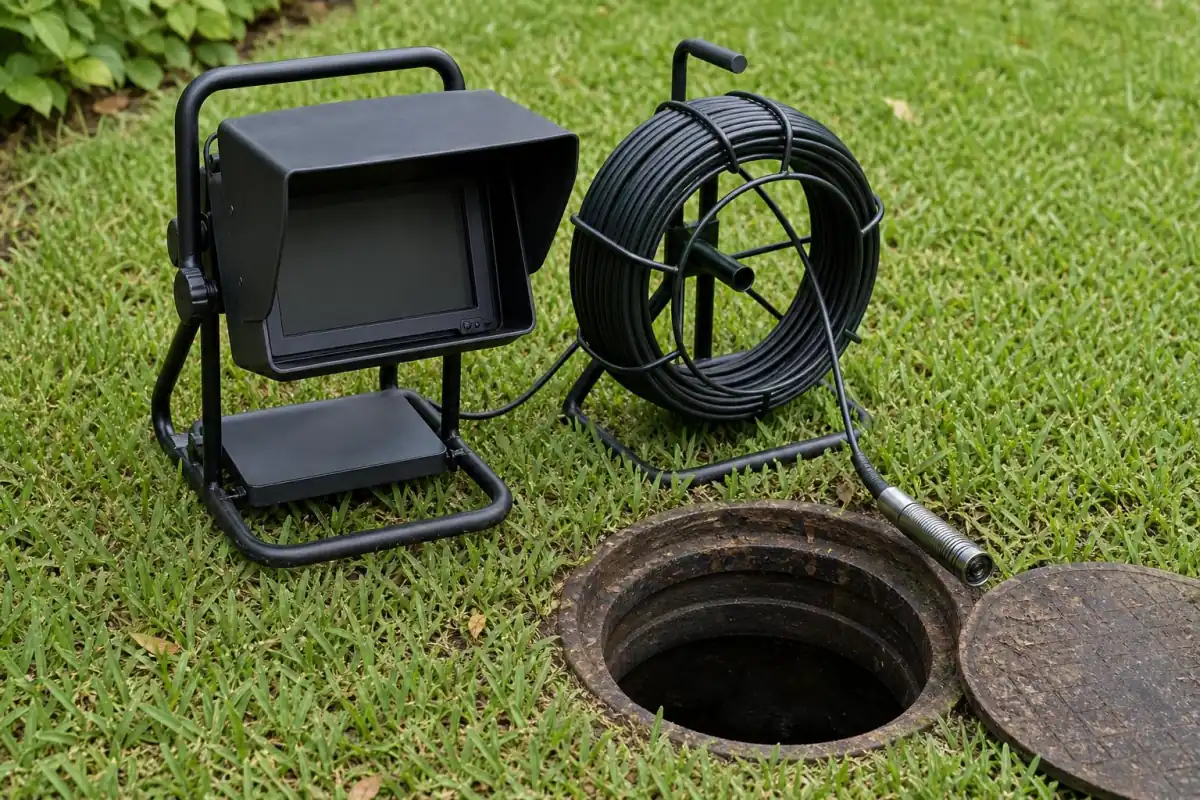
What a city asks for before it accepts a lined lateral
Code officials accept CIPP on a private sewer lateral only with video before and after and a certified installer, because ASTM F1216 is not referenced in the plumbing code itself. PMG-1068 says exactly that: Perma-Liner’s listing rests on an ICC-ES alternate criterion, LC1011, because F1216 is a consensus standard the IPC does not cite, and it requires a label every 20 feet reading “Caution: CIPP Epoxy Lined Pipe” with a warning against flame or heat during later repairs.
Maplewood’s sewer lateral lining policy (April 30, 2010) adds four conditions: the contractor must show why lining beats an open cut, hold a city sewer license plus CIPP certification, use NSF 14 and IAPMO certified materials, and hand the city pre- and post-lining video. The pre-lining camera run must happen within 5 hours of installation, and any liner protruding into the main is cut back robotically. If the liner damages the city main, the contractor repairs it. Ask your sewer department for its form before signing.
Sewer liner questions homeowners ask
Is pipe lining worth it on an old clay lateral?
It is worth it when the clay is cracked or root-ridden but still round and on grade, and the run sits under hardscape. At This Old House midpoints, lining costs about $30 per foot more than digging, so restoration above that figure tips the math toward the liner.
Can roots grow through a CIPP liner?
Roots cannot pass through a continuous cured liner wall, which has no joints. They can still enter at host pipe joints beyond the liner end seal on a partial liner, and at a poorly sealed branch reinstatement, so full-length lining from cleanout to main removes most entry points.
How long does a lateral liner take to cure?
The Maplewood specification for an air-inverted, ambient-cure lateral liner gives up to 4 hours without external heat. Other resin systems follow the maker’s cure schedule, and the Maplewood spec bars every fixture in the house from draining until the cure is done.
Does a liner shrink the pipe enough to matter?
On a 4-inch line, a 3 mm Perma-Lateral wall on each side removes about 6 mm, or roughly 0.24 inch, leaving about 3.76 inches. ICC-ES accepted that because the smooth epoxy surface has less friction loss than the old pipe, restoring equivalent flow capacity.
Who pays for the warranty camera inspection?
Under the NASSCO lateral lining guideline, the owner pays for any warranty CCTV inspection. Schedule one shortly before the 1-year contractor warranty runs out, compare it with the final acceptance video, and send written notice of any wrinkle, lift or closed branch before the term ends.
How we sourced this
We read the NASSCO CIPP lateral lining performance specification guideline (November 2017), ICC-ES listing PMG-1068 for Perma-Liner, the Maplewood lining policy, the St. Paul CIPP worksheet, the EPA retrospective program summary, the published abstracts of the 2016 Procedia Engineering and 2018 Cogent Engineering papers, the Waterloo thesis record and This Old House cost data. The per-year and break-even figures are our arithmetic from those inputs. Site-by-site test values from EPA/600/R-12/004 and a published Perma-Liner warranty term could not be opened and were left out.