How Long Do Water Pressure Regulators Last? PRV Lifespan, Failure Signs and Replacement Cost
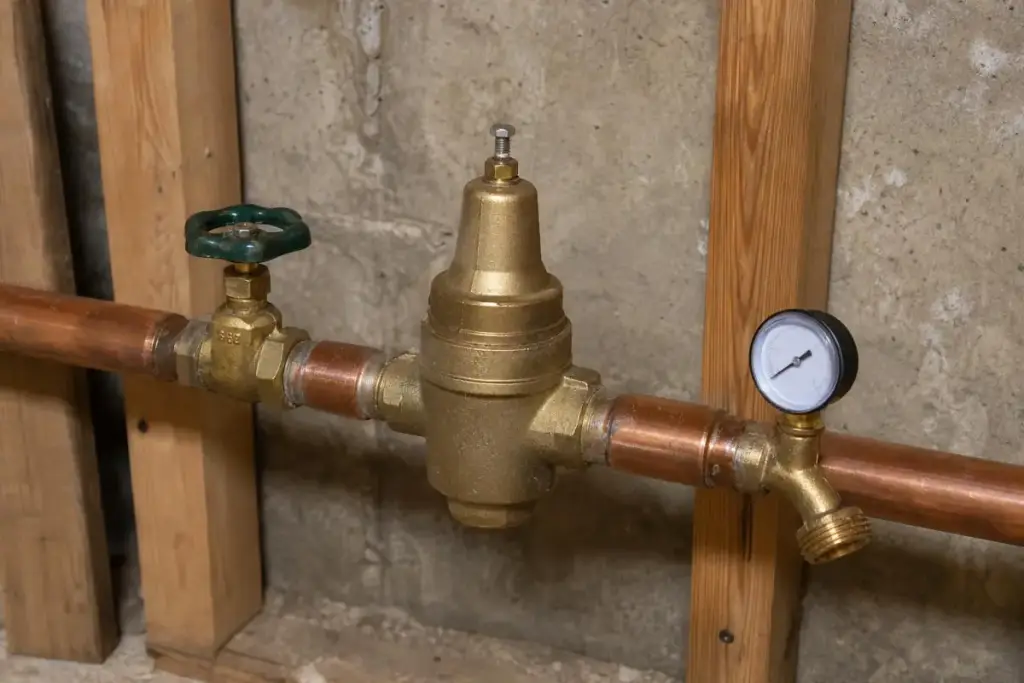
Water pressure regulators last 10 to 15 years in most homes, according to Rainbow Municipal Water District, which has seen them fail at 3 years and still work at 20. Hard or dirty water shortens that, and Walnut Creek Special Utility District budgets 5 to 10 years.
What utilities and makers say about PRV lifespan
No manufacturer prints a service life in years; the figures come from water utilities, and the makers instead require yearly inspection. The table lists what each named source states in writing.
| Source | What it says about life or upkeep |
|---|---|
| Rainbow Municipal Water District FAQ (California) | Most commonly 10 to 15 years; failures seen at 3 years and working units at 20 years when maintained; repair is “no more challenging” than fixing a kitchen faucet |
| Walnut Creek SUD, Water Pressure Issues (Texas) | Maintenance or replacement usually needed between 5 and 10 years; check house pressure at least once a year |
| City of San Diego PRV rebate FAQ | As a PRV ages it becomes hard or impossible to adjust, and then a new valve should be installed |
| Watts IS-25AUB instructions (LF25AUB-Z3) | Test at least once per year; corrosive water conditions can make the valve ineffective; one-year limited warranty |
| Zurn Wilkins IS70XL, Rev. C 4/16 | Annual inspection and maintenance required “to ensure proper performance and maximum life” |
The spread between 5 and 20 years tracks water quality more than brand. Watts names corrosive water, and Rainbow compares the valve to a faucet because grit on the seating area is what fails first, so a house on hard or sandy supply belongs at the short end of the range.
Inside the valve: which part wears out first?
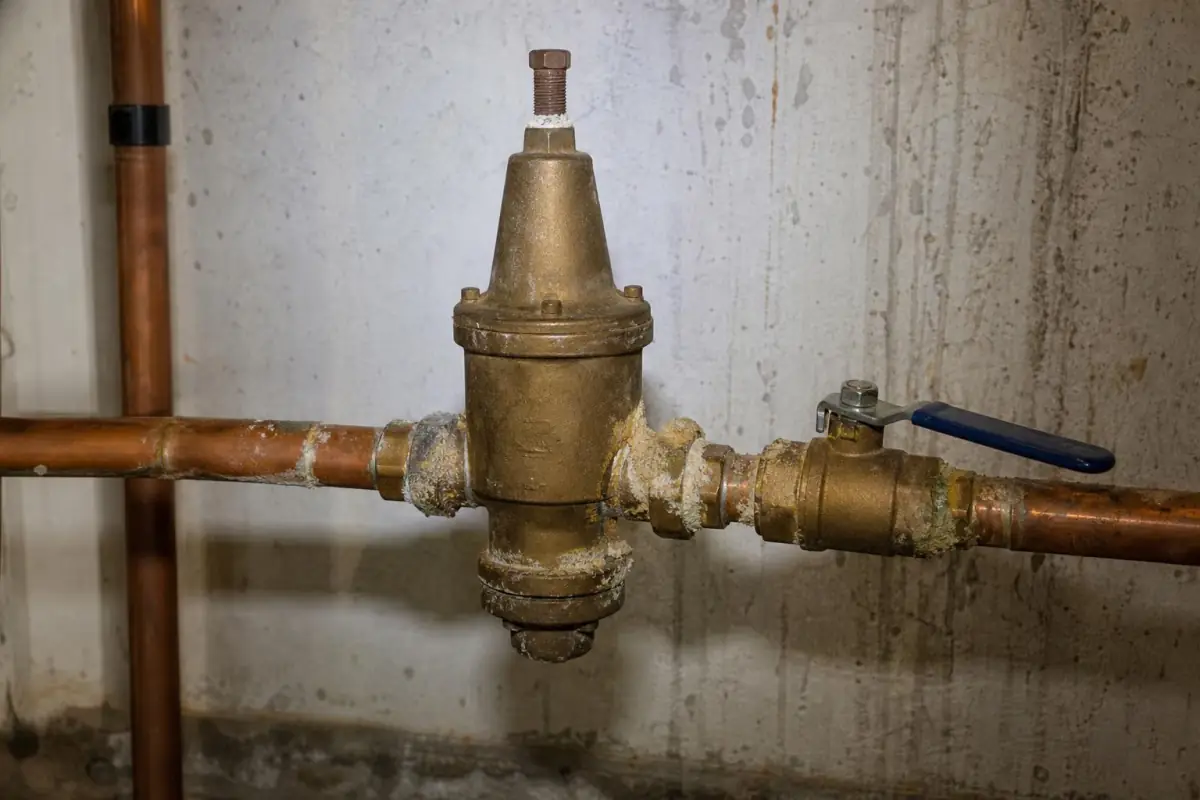
The parts that wear are the rubber ones: the seat disc, the diaphragm and the O-rings, which is why every repair kit is built around them. Watts lists its 3/4 inch kit, ordering code 0864943, as diaphragm, O-ring, union gasket, strainer, strainer plug gasket, bottom plug gasket, disc and seat, per the Watts LF25AUB-Z3 product page.
The spring pushes down, house pressure under the diaphragm pushes up, and the disc closes against the seat when the two balance at the setting, 50 psi from the factory on both the Watts LF25AUB-Z3 and the Zurn 70XL. A nicked disc or seat lets water past while no tap is open, which is the slow creep that ends a valve’s working life. For the full operating principle, see how a pressure reducing valve works.
Signs your pressure regulator is going bad, and the fix for each
Each symptom below maps to a specific cause listed in the Zurn IS70XL troubleshooting chart or the Watts IS-25AUB instructions, and to a test that separates a worn valve from a problem the valve did not cause.
| Symptom | Test | Likely fault | Fix |
|---|---|---|---|
| Pressure higher in the morning than at the setting | Max reading gauge overnight, then open a cold tap for a second | Drops at once to the setting: thermal expansion. Stays high: grit on the seal ring or a worn seal ring or stem O-ring (Zurn) | Expansion tank for the first; flush by opening 1 or 2 fixtures wide, then rebuild kit (Zurn RK34-70XL, Watts 0864943 for 3/4 in) |
| Reading above 80 psi static that the screw will not lower | Turn the screw counterclockwise a full turn with a tap open | Spring and seat no longer regulating; San Diego notes old valves stop responding to adjustment | Replace the valve |
| Weak flow at every fixture | Static gauge reading near setting but flow drops when 2 taps run | Strainer screen clogged with debris (Zurn item 3C) | Shut off inlet, pull the strainer plug, clean the screen; raise the setting gradually |
| Chatter or banging when a tap opens | Listen at the valve while one fixture runs | Worn seat washer or loose seal ring (Zurn item 4B) | Rebuild kit; Zurn allows a temporary fix by flipping the seal ring |
| Hum or whistle | Occurs only at high flow | High water velocity, small pipe or an undersized valve (Zurn item 4A) | Correct sizing; Watts recommends two valves in series for very high supply |
| Water heater relief valve drips after heating cycles | Max reading gauge shows a spike toward 150 psi | Closed system with no expansion control, not a PRV defect | Expansion tank or relief valve per IPC 607.3 |
Kit prices seen on retail listings in November 2026: the Zurn RK34-70XL ranged from about $73 to $117 across SupplyHouse and Zoro, while the Watts page for the 3/4 inch LF25AUB-RK kit (0864943) shows no price and sends buyers to a distributor. Homewyse put a non-discounted 3/4 inch brass reducing valve at $91.90 to $105.73 in May 2026, so a kit can cost more than a cheaper whole valve.
The overnight gauge test that proves a PRV has failed
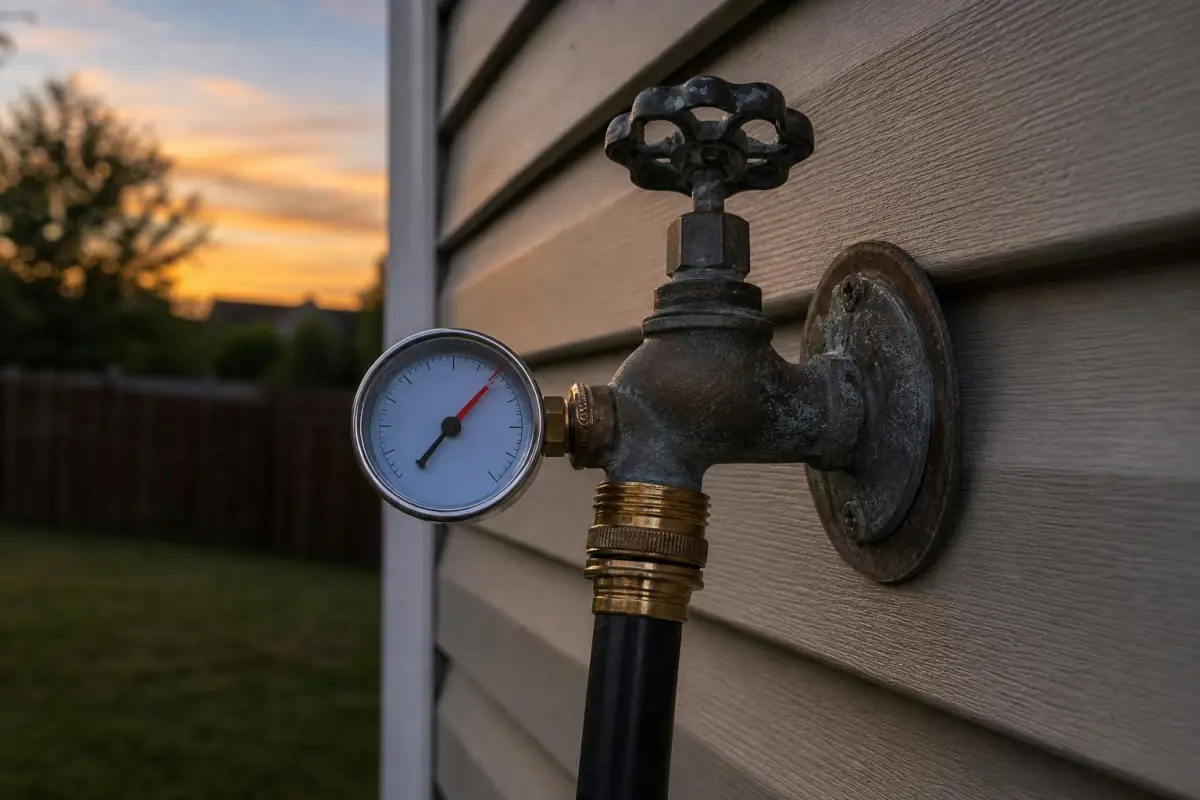
A gauge that records its highest reading is the only way to catch creep, because a normal gauge reads correctly by the time you look. Watts sells the 276H300 for this, and its IS-25AUB sheet says it “registers the highest pressure reading over the period of time it is left on the system.”
- Thread the gauge onto a faucet that is downstream of the PRV, such as the washer box or the water heater drain. A front sillcock is often teed ahead of the valve, since IPC 604.8 exempts service lines to sillcocks and outside hydrants, and it would show street pressure.
- Note the static reading with no water running. Over 80 psi already fails the code limit; see normal household water pressure for the 40 to 60 psi target band.
- Leave the gauge 8 hours or overnight while the water heater cycles, then read the drag needle.
- Open a cold tap briefly. Watts says a rise caused by thermal expansion is relieved at once and the system returns to the set pressure; a reading that stays high points to the seat or disc.
The 2021 IPC Section 604.8 requires an ASSE 1003 or CSA B356 valve with strainer where static pressure within the building exceeds 80 psi, which is why a creep above 80 psi is a code issue and not only a nuisance. Local amendments differ: Chicago’s code uses 100 psi.
How much water a heater pushes back against a failed bypass
A 50 gallon heater warmed from 50 to 140 degrees F has to put about 0.84 gallon somewhere, and in a closed system with a failed bypass and no tank that water ends up at the relief valve. The table computes that volume from standard water density figures.
| Tank size | Heated 50 to 120°F | Heated 50 to 140°F |
|---|---|---|
| 40 gal | 0.45 gal (7.2 cups) | 0.67 gal (10.7 cups) |
| 50 gal | 0.56 gal (9.0 cups) | 0.84 gal (13.4 cups) |
| 80 gal | 0.90 gal (14.4 cups) | 1.34 gal (21.5 cups) |
Inputs: density 999.70 kg/m³ at 50°F, about 988.6 at 120°F and 983.2 at 140°F, per USGS water density tables; expansion equals cold density divided by hot density, minus 1, which gives 1.13 and 1.68 percent. Water barely compresses, so a few cups trapped in rigid pipe is enough to lift pressure from 50 psi toward the 150 psi relief point. The Watts bypass keeps outlet pressure within 10 psi of supply pressure, but Watts states that it “will not prevent the pressure relief valve from opening” above 150 psi, and IPC 607.3 still requires expansion control where a heater’s cold supply passes through a PRV. Sizing and pre-charge are covered on our thermal expansion tank page.
What a failed regulator costs in extra water
At an open faucet or hose with no flow limiter, flow rises with the square root of pressure, so a regulator stuck open at 100 psi pushes about 29 percent more water per minute than one holding 60 psi. This is a labeled estimate from the orifice relation Q2 = Q1 × √(P2 ÷ P1), with 60 psi as the base.
| Static pressure | Flow vs 60 psi | If 5.0 gpm at 60 psi (input) |
|---|---|---|
| 50 psi | 0.91× | 4.6 gpm |
| 80 psi | 1.15× | 5.8 gpm |
| 100 psi | 1.29× | 6.5 gpm |
| 120 psi | 1.41× | 7.1 gpm |
The 5.0 gpm base is an input to replace with your own bucket test. Showerheads and lavatory faucets are capped by 10 CFR 430.32 at 2.5 gpm at 80 psi and 2.2 gpm at 60 psi, so the extra shows up mainly at hose bibs, tub spouts and irrigation. The Watts ES-LF25AUB spec sheet cites a water-saving test in which cutting supply pressure from 80 to 50 psi saved 30 percent, higher than the 21 percent the square-root rule predicts.
Replacement cost, and when a rebuild beats a new valve
Homewyse estimated the national average to install a pressure regulator valve at $549 to $656 per valve in May 2026, against roughly $73 to $117 for a Zurn rebuild kit plus your time. Rebuild when the body is intact and kits for that model are still stocked; replace when the screw no longer moves the pressure, the body leaks, or the valve is older than its kit line.
A homeowner can do either job: San Diego’s FAQ says owners may install a PRV themselves, while Watts’s instructions say the valve should be installed by a licensed contractor under local code, and many towns require a permit. The Zurn kit needs a 1-1/8 inch socket to pull the 3/4 inch cartridge and a 1-3/8 inch socket for the 1 inch, per IS70XL. The steps for installing a replacement pressure reducing valve, including union ends and gauge setting, follow the same shutoff and flush sequence.
Pressure regulator lifespan questions
Can a pressure regulator last 20 years?
Yes. Rainbow Municipal Water District reports regulators still working properly at 20 years when regularly maintained, and also failures at 3 years. Watts and Zurn both call for inspection at least once a year, and a rebuild kit that replaces the seat, disc and diaphragm resets most of the wear.
Should I replace my PRV just because it is 10 years old?
Not on age alone. Leave a maximum reading gauge on a downstream faucet overnight. If the needle stays within a few psi of the setting and the adjusting screw still moves the reading, the valve is regulating. Replace or rebuild when it creeps, will not adjust, or the strainer cleaning does not restore flow.
Does a bad pressure regulator cause high or low water pressure?
Both. A dirty or worn seat lets pressure creep above the setting, which is the first problem on the Zurn IS70XL troubleshooting chart. A clogged strainer screen or a setting that has drifted low causes weak flow at every fixture, and Zurn lists cleaning the screen as the fix.
Is it cheaper to rebuild or replace a water pressure regulator?
The parts favor a rebuild, since a 3/4 inch Zurn RK34-70XL kit listed near 73 to 117 dollars in November 2026 against a 549 to 656 dollar installed replacement estimate from Homewyse. The rebuild only makes sense when the body is sound and the valve is a model whose kits are still sold.
Why does my water heater relief valve drip after I installed a new PRV?
The new valve closed the system. Heating 50 gallons from 50 to 140 degrees F adds about 0.84 gallon of volume, and with no expansion tank that water has nowhere to go, so pressure rises until the relief valve opens near 150 psi. IPC 607.3 requires expansion control in this case.
How we sourced this
Read in November 2026: Watts IS-25AUB installation instructions and ES-LF25AUB spec sheet (2023), the Watts LF25AUB-Z3 and 0864943 kit pages, Zurn Wilkins IS70XL Rev. C 4/16 and REG-70XL, IPC 2021 Sections 604.8 and 607.3, utility pages from Rainbow MWD, Walnut Creek SUD and the City of San Diego, Homewyse cost data dated May 2026, and 10 CFR 430.32. Computed: expansion volumes from water density and the square-root flow estimate. Kit prices come from retail listings and change often. Cash Acme literature and Angi or HomeGuide cost pages could not be opened and were left out.