How Does a Toilet Know When to Stop Filling? The Float, the C.L. Mark and a 1/2 Inch Rule
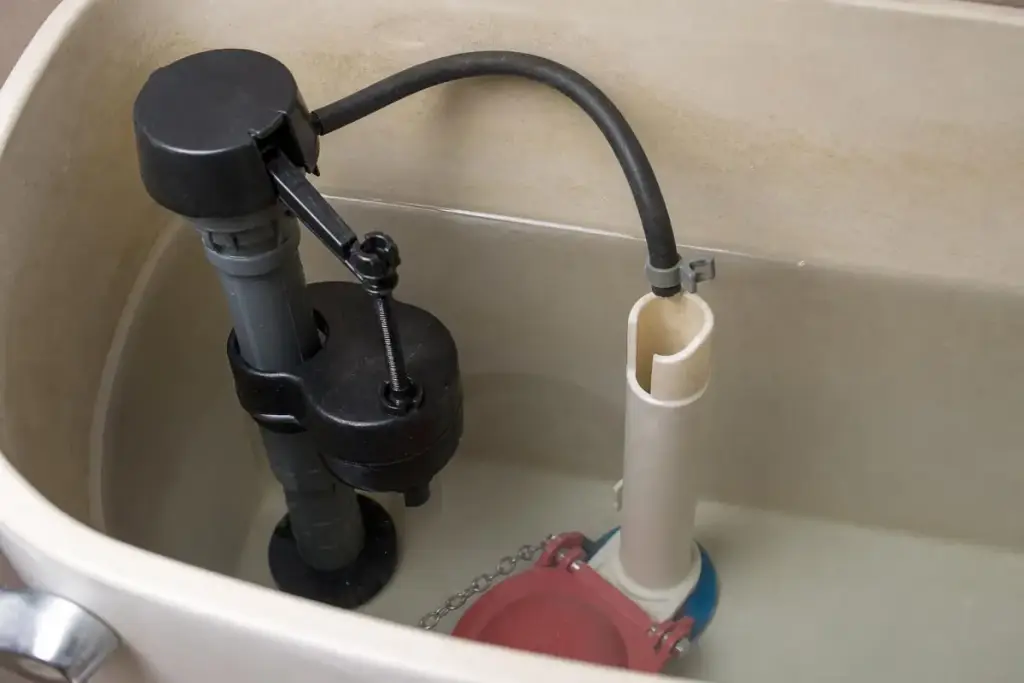
A toilet knows when to stop filling because a float rides up with the tank water and, at the height you set, closes the fill valve. On a Fluidmaster 400A that shutoff point is about 1/2 inch below the top of the overflow pipe, while a refill tube tops up the bowl.
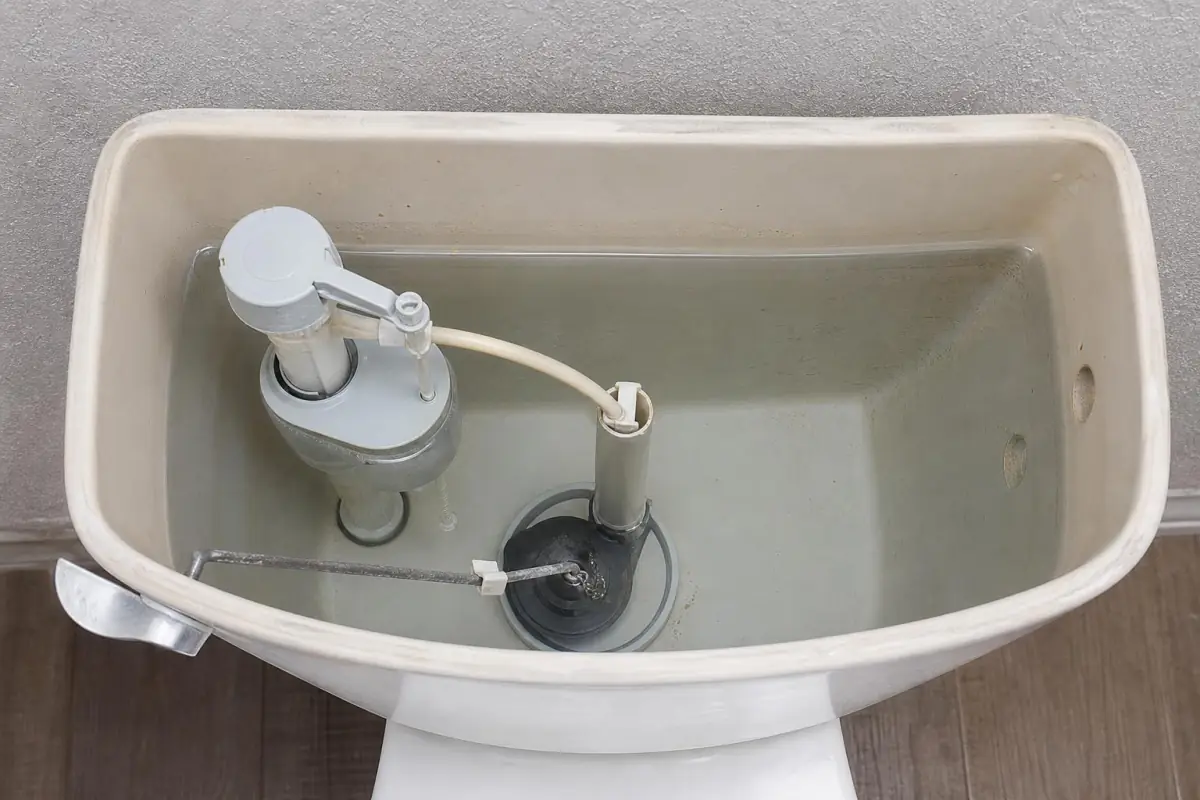
Every gravity toilet repeats the same loop. The flush drops the tank level, the float falls, the valve opens, and incoming water raises the float until its linkage pushes a seal back against the valve inlet. On a Fluidmaster 400A the float cup lifts a lever on the valve cap, and the “setting” is simply how high on the valve that cup may climb before the lever seals the inlet. For a labeled map of the surrounding pieces, see every named toilet tank part.
What closes the valve: float arm, float cup or factory-set height?
Five valve layouts from Fluidmaster, Korky and Windon Bay do the same job, and the layout decides how you change the shutoff level. Adjustment steps below come from each maker’s own sheet.
| Valve type | How it senses the level | How the shutoff level is changed | Documented example |
|---|---|---|---|
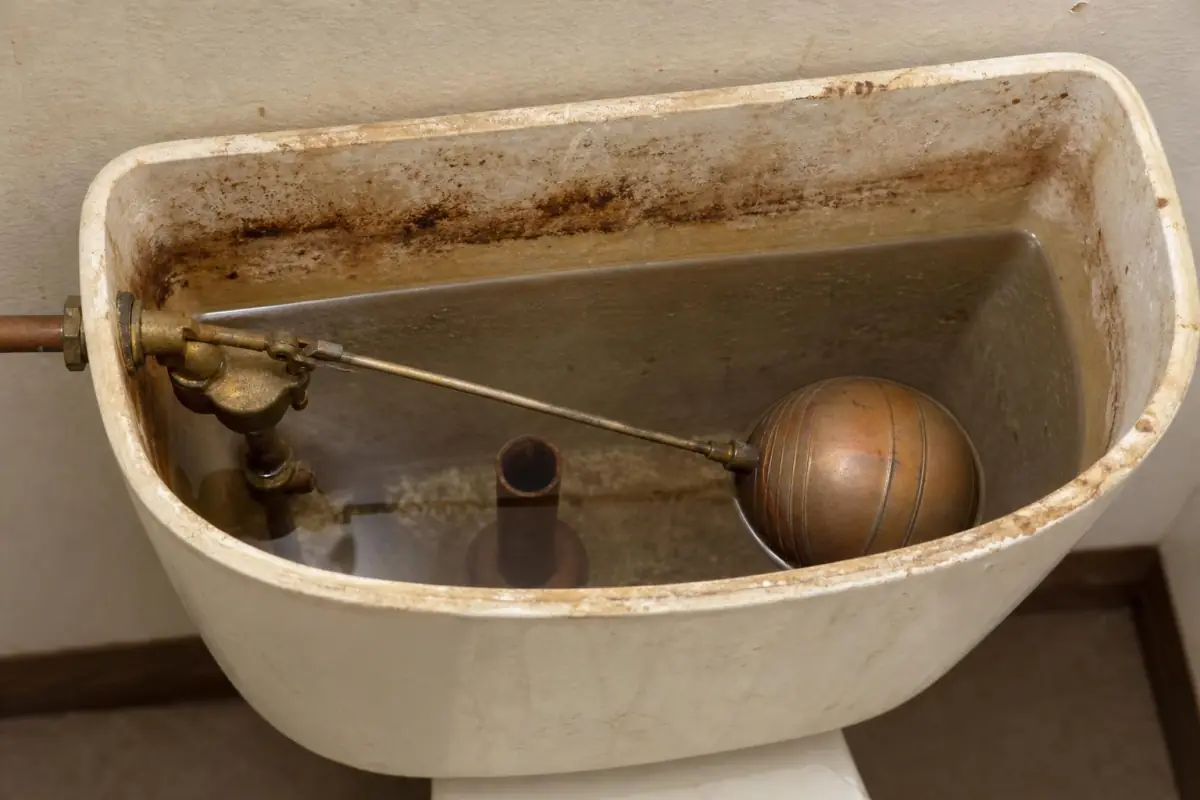
| Ballcock with float arm | A hollow ball on a horizontal rod rises and levers a plunger or diaphragm shut | No current maker sheet we read covers it; swapping to a float-cup valve set to the 400A dimensions replaces the guesswork | Older brass and plastic tanks |
| Float cup on a screw rod | A cup slides up the valve body and lifts a lever on the cap | Turn the level screw: 8 twists move the cup 1/2 inch, clockwise raises | Fluidmaster 400A sheet, part 4-743 |
| Float cup plus refill clamp | Same cup and screw; a roller clamp throttles bowl refill | Screw for tank level, clamp numbers for bowl level, “0” means no refill to bowl | Fluidmaster PerforMAX 400ARHRFCS sheet, part 4-2304 |
| Fixed-height valve | Float shuts off at the water level line marked on the valve | Slide the whole valve so its water line sits about 1/2 inch below the overflow, then lock it | Korky QuietFILL instructions |
| Top-dial valve | Internal float, level set by a rotating cap | 24 indicator dots; counterclockwise raises, clockwise lowers; ships at lowest level; rated 30 to 120 psi | Windon Bay W87750 / W87751 sheet |
The practical reading: if your valve has a visible screw rod beside the cup, it is a 400A-style valve and the fix for a wrong level is a screwdriver. If the Korky body has no screw, the level only moves by releasing and resliding the valve, so a twist of the cap does nothing. Floatless valves that sense pressure through a diaphragm near the tank bottom also exist, but we found no maker sheet giving their adjustment steps, so they are left out of the table.
Where should the water stop, and what is the C.L. mark for?
Fluidmaster sets the stop point at 1/2 inch below the top of the overflow pipe, and Korky gives the same “about 1/2 inch”. The 400A sheet lists three numbers that work together: the top of the overflow pipe at least 1 inch below the tank lever hole, the water level below the overflow top, and the critical level (C.L.) mark 1 inch above the overflow top.
The C.L. mark is the backflow line. The anti-siphon part of the valve must stay above any water the tank could ever hold, and since a stuck float can raise the water only as high as the overflow rim, the mark goes 1 inch above that rim. Fluidmaster’s sheet calls it “a requirement of the Universal Plumbing Code” and Korky labels it “Code Requirement”. The code reference is IAPMO’s Uniform Plumbing Code, which the sheet misnames. The product standard behind these valves is ASSE 1002, Anti-Siphon Fill Valves for Water Closet Tanks, now published jointly as ASME A112.1002 and CSA B125.12, which sets dimensional and performance rules against back-siphonage. Cut a valve shank so short that C.L. falls below the 1 inch line and the install no longer matches the maker’s code setup.
How long should the tank take to refill at 2 to 4 gpm?
Refill time is flush volume divided by valve flow rate, so a 1.28 gpf toilet at 3 gpm needs 25.6 seconds and a 1.6 gpf toilet needs 32.0 seconds. The gpf figure is the whole cycle volume that passes the fill valve, tank plus bowl refill, so it is the right numerator.
| Valve flow rate | 1.28 gpf (WaterSense level) | 1.6 gpf (federal maximum) | 3.5 gpf (older tank) |
|---|---|---|---|
| 0.5 gpm | 153.6 s | 192.0 s | 420.0 s |
| 2.0 gpm | 38.4 s | 48.0 s | 105.0 s |
| 2.5 gpm | 30.7 s | 38.4 s | 84.0 s |
| 3.0 gpm | 25.6 s | 32.0 s | 70.0 s |
| 3.5 gpm | 21.9 s | 27.4 s | 60.0 s |
| 4.0 gpm | 19.2 s | 24.0 s | 52.5 s |
Inputs: seconds = gpf / gpm x 60. The flow rates are inputs, not a rating for any one valve: Fluidmaster’s 747 Series data sheet publishes a range from 0.50 gpm at 2.6 psi to 8 gpm at 150 psi, and 2 to 4 gpm sits inside it. The 1.28 gpf column is the EPA WaterSense label ceiling; 1.6 gpf is the current federal standard EPA names on the same page.
What the table means for you: a 1.28 gpf tank that takes 2 minutes or longer is running near 0.6 gpm, which points to a partly closed stop, a scaled supply line or grit in the valve cap rather than a float problem. The arithmetic assumes constant flow at the stated rate, so read each figure as a benchmark, not a promise.
The bowl takes its share through the refill tube at the same time. On the 747 data sheet the standard down tube sends 7% to 33% of flow to the bowl depending on the colored insert, and 12% to 44% with the high refill tube. The PerforMAX sheet warns that too much refill overfills the bowl and siphons the excess down the trapway, which is what its roller clamp corrects.
Why does the toilet keep filling when nobody flushed?
A tank that refills on its own every few minutes is losing water past the flapper, and the float is doing its job by reopening the valve. Fluidmaster’s 400A troubleshooting panel says a valve that “turns on and off by itself” means “the tank is losing water”, and its first fixes are to clean the flapper and drain seat, then replace the flapper or flush valve.
Split the two causes in 15 minutes. Mark the water line with a pencil, shut the stop valve clockwise, and wait: if the line drops, the leak is downstream at the flapper or flush valve gasket, as described in the EPA WaterSense Fix a Leak guidance using a few drops of food coloring and a 10 minute wait. If the level holds but the valve still hisses with the stop open, the valve seal is not closing.
EPA adds that a flapper should be checked periodically and replaced at least every 5 years. The refill tube is a third suspect. Fluidmaster warns “Do not shove refill tube down overflow pipe”: a tube pushed below the water line siphons tank water into the bowl, so the float keeps dropping. Clip it on the right side of the overflow pipe with the tube in a slight arch, as the 400A sheet draws it.
If water pours steadily into the open overflow pipe, the opposite fault exists: the float is set too high or the seal cannot close. Turn the 400A screw counterclockwise until the line sits 1/2 inch below the overflow top; if water still reaches the rim, the seal is worn.
What fixes a valve that will not shut off or fills slowly?
Most shutoff and slow-fill faults on a 400A are grit or a worn seal under the cap, and Fluidmaster’s sheet covers both without removing the valve. Turn the water off, hold the shaft, twist the cap and lever 1/8 of a turn counterclockwise to free it, then hold a cup upside down over the open valve and turn the water on and off a few times to flush debris out.
If the float cup does not drop when you flush, Fluidmaster says to replace the seal with a genuine Fluidmaster 242, and its sheet also says to replace a water supply connector that is worn or over 5 years old. The 400A sheet adds that a partial blockage may sit at the shutoff valve or in the supply line, and our slow filling toilet checklist walks the stop valve and supply line first.
Replace the whole valve when the body is cracked, the seal is not sold for it, or it is an old ballcock that will not hold a level. Shut the stop clockwise, flush and sponge out the tank, undo the coupling nut and locknut, and drop in the new valve set 3 inches above the overflow as above, hand-tightening the locknut. Our guide to how a toilet fill valve is built and replaced has the full sequence, and the Fluidmaster fill valve models page sorts the 400A, PerforMAX and PRO45 variants.
Stop and call a plumber when the stop valve itself will not turn or weeps at the stem, because every step in the 400A sheet starts by turning that valve clockwise and replacing it means shutting the house supply. Ask for the fill valve and supply line in the same visit, and ask whether the price includes the stop valve.
Toilet fill and shutoff questions
Why does my toilet keep filling after I flush?
Either water is leaving the tank or the valve cannot close. If water spills into the open overflow pipe, lower the float to 1/2 inch below the rim or replace the valve seal. If the level drops with the supply off, the flapper or flush valve gasket is leaking and the float keeps reopening the valve.
Can a toilet tank overflow onto the floor if the float sticks?
Not on a correctly set toilet. Fluidmaster requires the top of the overflow pipe to sit at least 1 inch below the tank lever hole, so a stuck float sends the extra water down the overflow pipe into the bowl and the toilet runs nonstop instead of flooding.
How many turns raise the water level on a Fluidmaster 400A?
Fluidmaster says 8 twists of the adjustment screw move the float cup 1/2 inch. Turn it clockwise to raise the level and counterclockwise to lower it, then flush and check where the water stops against the overflow pipe.
What is the C.L. mark on a toilet fill valve?
C.L. stands for critical level, the line that must sit above the overflow pipe so tank water can never be pulled back into the supply. Fluidmaster and Korky both place it 1 inch above the top of the overflow pipe and call it a code requirement.
Does the refill tube control when the tank stops filling?
No. The float alone closes the valve. The refill tube only sends part of the incoming water down the overflow pipe to top up the bowl, and on the PerforMAX a roller clamp sets how much, with 0 meaning no bowl refill at all.
How we sourced this
We read the Fluidmaster 400A installation sheet (part 4-743, Grev. 6), the PerforMAX 400ARHRFCS sheet (part 4-2304), the Fluidmaster 747 Series data sheet, the Korky QuietFILL instructions, the Windon Bay W87750 sheet and EPA WaterSense pages. The refill-time table is our arithmetic from gpf and an input flow rate. No maker publishes a gpm rating for the 400A, QuietFILL or PerforMAX, so none is claimed. Floatless valve adjustment steps and current part prices were left out because no maker document or store page we could open confirmed them.