How Long Do Cast Iron Pipes Last? Drain Stack Lifespan by Location, House Age and Warning Signs
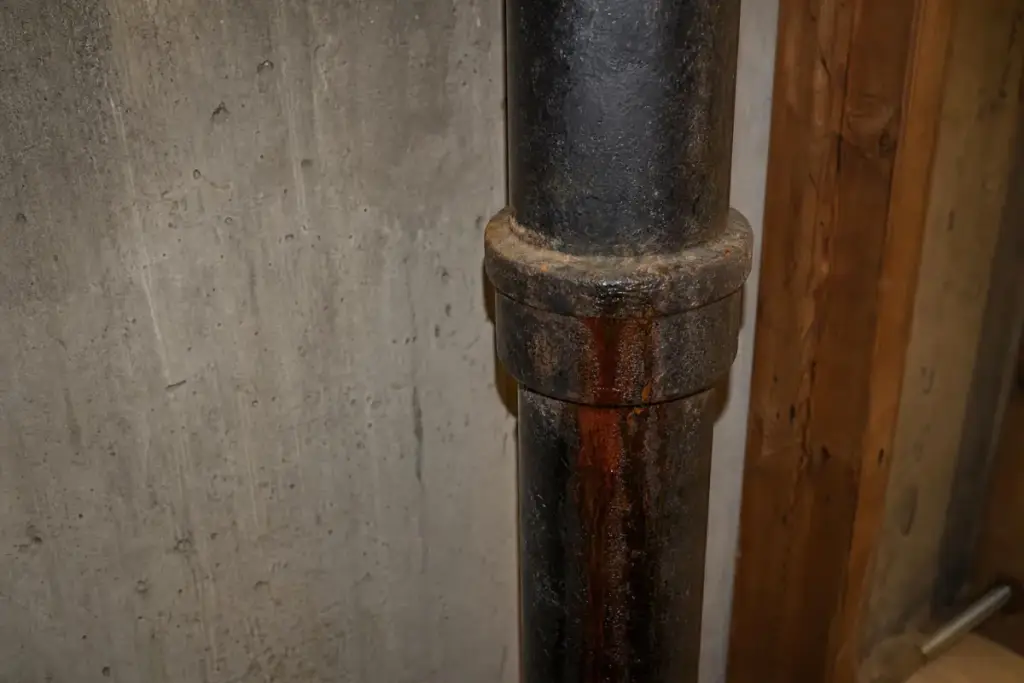
Cast iron drain pipes last about 50 to 60 years below ground and about 60 years above ground, according to the InterNACHI life expectancy chart, while a 2007 NAHB study gives 100 years. Under-slab and buried runs fail first, usually along the pipe floor.
Which sources give which cast iron lifespan, and what each one covers
Four named sources put a number on cast iron drain life, and only one of them separates pipe above ground from pipe below ground. The table lists the figure exactly as each document prints it.
| Source | Figure | What the figure applies to |
|---|---|---|
| InterNACHI Standard Estimated Life Expectancy Chart for Homes | 60 years | Cast-iron waste pipe, above ground (stack and exposed branch lines) |
| InterNACHI, same chart | 50 to 60 years | Cast-iron waste pipe, below ground (under slab and buried building sewer) |
| NAHB and Bank of America Home Equity, Study of Life Expectancy of Home Components, February 2007 | 100 years | “Cast Iron Waste Pipe,” one figure for all locations; the study lists the Cast Iron Soil Pipe Institute among its sources |
| Fannie Mae Multifamily Property Condition Assessment instructions, Appendix F | 50+ years | The whole “Sanitary Waste and Vent System” in apartment buildings, any material |
| CISPI Cast Iron Soil Pipe and Fittings Handbook (2006 edition) | No design life stated | Reports that more than 535 US water and gas utilities run cast iron mains over 100 years old; those are pressure mains, not house drains |
The InterNACHI, NAHB and Fannie Mae tables are reproduced together in Appendix C of the Port of Seattle SEA-SIPP technical report, which is where the exact wording above was checked. The practical reading: 50 years is the age at which inspection becomes routine, and 100 years is a best case drawn largely from the pipe industry’s own data.
Why an above-grade stack outlasts under-slab and buried cast iron
Pipe below grade gets 50 to 60 years on the InterNACHI chart against 60 above grade because it is attacked from both sides and cannot be seen. A vertical stack drains completely between flushes, stays dry outside, and shows a weeping joint as a rust stain you can spot on a basement wall.
Horizontal runs under a slab hold a film of water and settled solids along the floor at all times. The CISPI handbook says over 95 percent of US soils are non-corrosive to cast iron, but it names the exceptions: soils high in decomposing organic matter such as swamps and peat, alkali soils, and salt-bearing tidal marsh soils. For buried pipe in corrosive ground, CISPI points to a loose polyethylene wrap per ASTM A674 and AWWA C105, which also carry a 10-point soil corrosivity scale.
The buried lateral from the foundation to the street falls in InterNACHI’s same 50 to 60 year below-ground band, and it is usually the first run a camera reaches from an outdoor cleanout. Replacing that segment is a separate job priced on its own, covered in our sewer line replacement cost breakdown.
What makes the bottom of a cast iron drain rot first
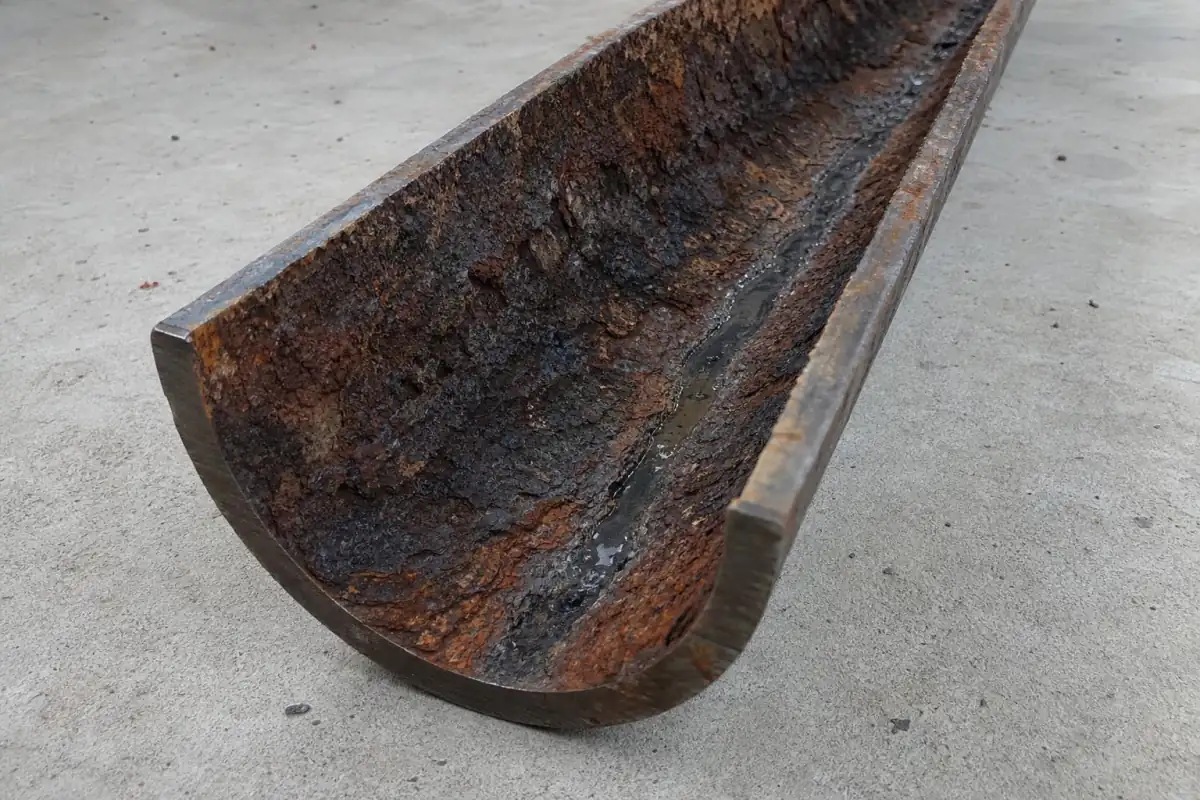
The floor of a horizontal drain, the invert, fails first because it is the only surface that stays wet and carries settled solids every day. In Plumbing and Mechanical (December 2024), engineer John Rattenbury, PE, explains that low flows let solids settle, those deposits set up localized corrosion cells that cause pitting, and corrosive wastewater strips the iron and leaves a graphite structure that is “soft and crumbly.” Plumbers call the resulting trough along the floor channel rot.
Hydrogen sulfide is often blamed for that trough, but the federal research puts H2S damage at the top of the pipe. EPA’s Detection, Control, and Correction of Hydrogen Sulfide Corrosion in Existing Wastewater Systems (EPA 832-R-92-001, September 1992) says H2S gas turns to sulfuric acid in the presence of moisture and oxygen, attacks ferrous metal directly, and that “the most vulnerable pipe areas” are the crown and walls above the wastewater level, with peak rates 1.5 to 2.0 times the average at the crown. A drain can suffer both: acid pitting overhead and wet graphitic corrosion underneath.
How old are the cast iron drains in a 1950, 1960, 1970 or 1980 house?
Subtract the year the house was finished from 2026 and compare the result with the source ranges; original pipe in a 1950, 1960 or 1970 house is already past InterNACHI’s 50-year low end for buried pipe. The table assumes the drains are original and were installed the year the house was finished.
| House finished | Pipe age in 2026 | vs InterNACHI below ground (50 to 60) | vs InterNACHI above ground (60) | Years left to NAHB 100 | Joint type the CISPI timeline allows |
|---|---|---|---|---|---|
| 1950 | 2026 minus 1950 = 76 | 16 years past the high end | 16 years past | 24 | Lead and oakum hubs only |
| 1960 | 2026 minus 1960 = 66 | 6 years past the high end | 6 years past | 34 | Lead and oakum or rubber compression gasket |
| 1970 | 2026 minus 1970 = 56 | Inside the range, 6 years past the low end | 4 years short | 44 | Hub and spigot or hubless banded |
| 1980 | 2026 minus 1980 = 46 | 4 years short of the low end | 14 years short | 54 | Hubless banded, if cast iron was used at all |
The joint column comes from two CISPI handbook statements: before the late 1950s the caulked lead and oakum joint was “the only method” for hub and spigot pipe, and roughly 1.5 billion No-Hub couplings have been installed since 1961. A 1980 house may hold no cast iron at all; Insurance Journal’s 2022 reporting describes cast iron drains as common in homes built before 1975.
The decision rule that follows: at 56 years or more, book a camera inspection of the under-slab runs and the lateral before buying, refinancing or laying new flooring, and judge the pipe by the footage rather than the calendar.
Hub and spigot with lead and oakum vs no-hub with bands
The two joint styles age differently, so identify yours before reading any footage. A hub and spigot joint is a bell on one pipe end packed with oakum fiber and sealed with molten lead; CISPI gives caulking lead a 621°F melting point and a 790°F to 830°F pour temperature. CISPI calls the caulked joint flexible and root-proof, and says the rubber compression joint that replaced it can deflect up to 5 degrees without leaking.
Hubless pipe has plain ends joined by a neoprene gasket under a 300-series stainless shield and worm-gear clamps, built to the CISPI 310 coupling standard. Modern hubless pipe and fittings are made to CISPI 301 and ASTM A888, hub and spigot pipe to ASTM A74, and those are the standards a replacement section must meet if you stay with iron. Stainless bands also make spot repairs simpler, which matters when cutting out a cast iron section of a stack that must be supported above and below the cut.
Signs your cast iron drain is failing, and what a camera shows for each
Each warning sign points to a different defect, and the sewer camera confirms which one you have. Use the third column to check that the inspection report matches the symptom.
| Sign you notice | Likely cause | What the camera or eye shows |
|---|---|---|
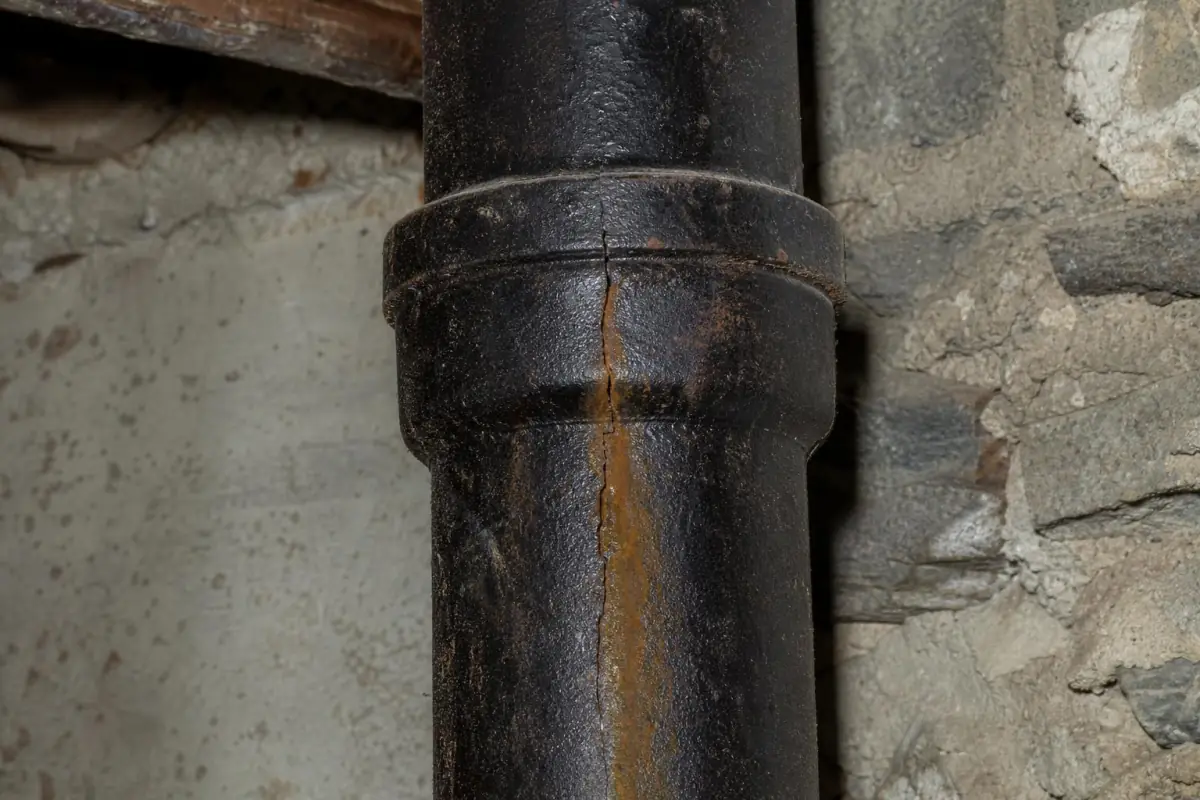
| Rust weeping or white crust at a hub | Lead joint loosened by movement, or a pinhole near the bell | From outside: stain below the joint; inside: offset or open gap at the hub |
| Vertical crack on the stack or a horizontal run | Graphitized wall split under load or settlement | Hairline seam along the pipe length, often seeping on the stack exterior |
| Channel rot | Floor graphitized and eroded by constant wet flow | Trough or missing strip along the invert, soil or void visible below |
| Slow drains in several fixtures | Scale and tubercles shrinking the bore | Knobby rust deposits on the walls and a narrowed opening |
| Sewer smell with full traps | Gas escaping through a crack, open joint or rotted floor | Breach upstream of the fixture; check that every trap holds water before booking |
| Roaches or drain flies near floor drains or slab cracks | Insects entering from soil or sewer through a breach | Holes, open joints or channel rot under the slab |
Ask for the inspection in writing with footage distances from the cleanout, so each defect can be found again at the same footage for a quote. When repair is on the table, our guide to what cast iron pipe replacement costs breaks down spot repair, under-slab reroutes and whole-house jobs.
Descale and line, or replace?
Descale and line when the pipe still has a continuous floor, and replace when long stretches are open to the soil, bellied or collapsed. Lining starts with mechanical descaling to bare wall; cured-in-place lining by inversion is governed by ASTM F1216, whose design appendix covers both partially and fully deteriorated host pipe. A liner cannot correct a sag that holds standing water, and every branch reconnection must be reinstated from inside the pipe.
In Florida, the money question is insurance. In People’s Trust Insurance Co. v. Gunsser (Fla. 6th DCA, No. 6D23-492, November 9, 2023), the court held that rust and corrosion count as an “act of nature” under the policy’s water damage exclusion, and that a limited water damage endorsement capped at $10,000 per occurrence covered the water damage but not the cost of tearing out and replacing the slab to reach the pipe. Carrier Management’s July 2022 report calls cast iron drainpipes the latest target in Florida property claims, with plaintiff firm ads aimed at homes more than 45 years old. If you are choosing a new material for the replacement, our cast iron vs PVC pipe comparison covers noise, fire rating and code acceptance.
How we sourced this
Lifespan figures were read from the InterNACHI chart, the 2007 NAHB and Bank of America study and Fannie Mae’s Appendix F as reproduced in the Port of Seattle SEA-SIPP Appendix C. Joint history, soil corrosivity and standards come from the 2006 CISPI handbook and the CISPI standards page. Corrosion zones come from EPA 832-R-92-001 and Rattenbury in Plumbing and Mechanical. The age table is our arithmetic. InterNACHI’s separate Florida chart could not be opened and is not used. Claims that buried cast iron fails at 25 years appear only on contractor and law firm pages and were left out.
Cast iron pipe lifespan questions
Should I replace the cast iron pipes in a 1960s house?
Not on age alone. A house finished in 1960 has drains 66 years old in 2026, past InterNACHI’s 50 to 60 year below-ground range but well short of the 100 years in the 2007 NAHB study. Order a camera inspection of the main line first and replace only the runs that show floor loss, cracks or offset joints.
Can cast iron drain pipes last 100 years?
Some do. The 2007 NAHB and Bank of America study gives cast iron waste pipe 100 years, and the CISPI handbook says over 95 percent of US soils are non-corrosive to cast iron. Dry, vertical, above-grade stacks get closest to that figure, while horizontal runs under a slab rarely do.
How can I tell if my house has cast iron drains?
Look at the main stack where it passes through the basement or garage. Cast iron is black or rust brown, heavy, and holds a magnet. A raised bell at each joint means hub and spigot pipe, and stainless bands with worm-gear clamps mean hubless pipe made after 1961.
Does homeowners insurance pay to replace failed cast iron pipe?
Usually not the pipe itself. Florida’s Sixth District Court of Appeal held in People’s Trust v. Gunsser in 2023 that corrosion counts as an act of nature under a water damage exclusion and that the $10,000 limited water damage endorsement did not cover slab tear-out. Read your exclusions for wear and tear, rust and corrosion.
Is lining cast iron as good as replacing it?
Lining buys time on pipe that still has a floor. Cured-in-place liners installed to ASTM F1216 can be designed for partially or fully deteriorated host pipe, but the line must be descaled first and the plumber must confirm the run is not bellied or collapsed. Missing floor over long stretches usually means replacement.