Sewer Cleanout Full of Water? What It Means and the Next 3 Checks
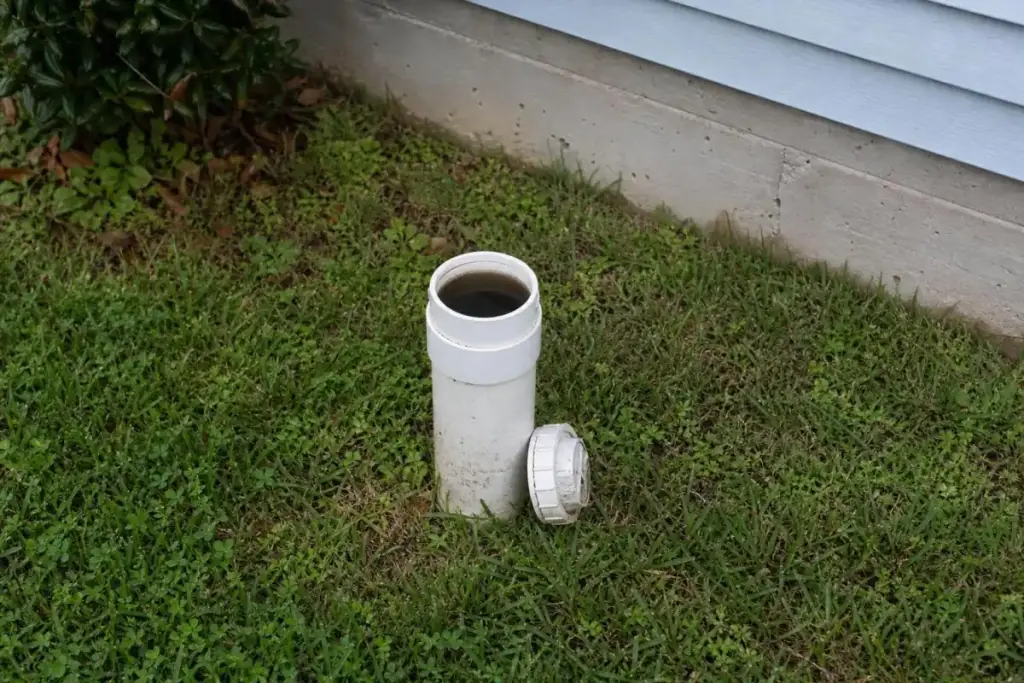
Your clean out is full of water because the sewer line is blocked somewhere downstream of that cleanout, between it and the street sewer or septic tank. If the cleanout is dry while house drains back up, the clog is upstream, inside the house. Stop running water now: a 4 inch line holds only 0.65 gallons per foot.
Is any water in a cleanout normal?
A film or thin stream along the bottom of the horizontal pipe is normal, because the cleanout riser is a capped branch off a working drain and every 1.6 gallon flush passes under it. What is not normal is water standing up inside the vertical riser, above the top of the horizontal pipe, because that pipe is then running full.
The one fitting that holds water by design is a house trap, the U-shaped fitting older city homes have on the building drain. Philadelphia Water’s March 2026 responsibility diagram calls it the curb trap, the portion of pipe that traps sewer gases from entering the property, paired with a vent pipe it also names the Fresh Air Inlet. If your cleanout plug sits on top of a trap like that, a pool at a steady level with every drain in the house running fast is the trap seal, not a clog.
Measure it: push a yardstick down the riser, note the depth to water, and check again in 8 hours. A level that climbs is a line filling behind a stoppage.
Open the cap slowly: a full riser is under pressure
A cleanout plug holding back a full line carries the weight of every foot of water above it, at 1 psi for each 2.31 feet of water. If sewage has backed up 8 feet up the stack to a first-floor tub, a 4 inch plug in the basement holds about 3.5 psi, roughly 43 pounds of force spread over its 12.6 square inch face, and it will spray once the threads let go.
Turn the plug a quarter turn at a time with a pipe wrench on the raised square head, stand to the side, and stop as soon as water weeps at the threads so it drains under control. Outdoors, a riser full to the brim needs no opening at all to diagnose it: the clog is downstream. A plug that cracks or strips on the way out needs a matching replacement cleanout cap or plug before the next rain, or storm water will run straight into the line.
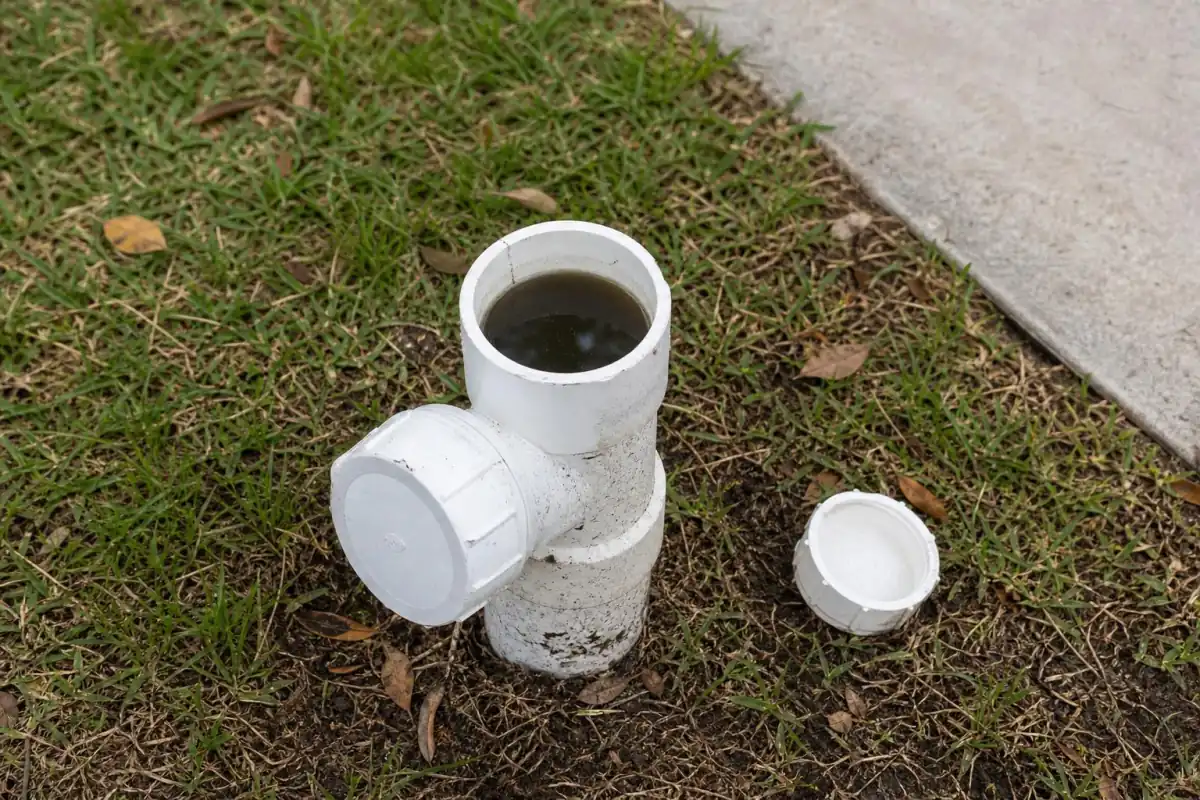
Check 1: which cleanout is full, the house one or the two-way at the property line?
The full cleanout closest to the street sets the boundary: the blockage sits between that riser and the next opening downstream that is dry. Minnesota’s code, as Minneapolis Public Works describes it, provides at least two cleanouts on the building drain, one near the base of the stack and one near where the building drain becomes the building sewer, and the International Residential Code groups its cleanout rules under Section P3005.2, with local amendments. Some lots add a two-way cleanout near the property line, a fitting with one opening aimed toward the house and one aimed toward the street.
A full house cleanout with a dry two-way cleanout puts the clog in your yard run, point B. Both full puts it past the property line, point C or D. A cable fed into the street-facing opening of a two-way reaches C and D; the house-facing opening only reaches back toward B. If you cannot find either opening, the guide to where the main cleanout usually sits lists the usual spots by foundation type.
How much water is standing in the pipe, and how long until the lowest drain overflows?
A 4 inch sewer holds 0.653 gallons per foot when full, so the distance to the clog tells you how much sewage the plumber will release and how much more water the house can send before something overflows. The table uses a 4.00 inch inside diameter: 3.1416 x 2 in x 2 in x 12 in per foot, divided by 231 cubic inches per gallon.
| Clog distance downstream of the house wall | Gallons standing in that 4 in run | Gallons to fill it plus 20 ft of 4 in drain inside | Full 1.6 gal flushes before the lowest drain overflows | Minutes of a 2.5 gpm shower |
|---|---|---|---|---|
| 10 ft | 6.5 | 19.6 | 12 | 7.8 |
| 25 ft | 16.3 | 29.4 | 18 | 11.8 |
| 50 ft | 32.6 | 45.7 | 28 | 18.3 |
Inputs: 20 feet of 4 inch building drain inside the house, the lowest drain opening just above the top of that pipe as with a basement floor drain, a 1.6 gallon per flush toilet and a 2.5 gallon per minute shower, the federal toilet limit EPA WaterSense cites and the federal showerhead limit. A clog 10 feet out leaves room for about 7 minutes of showering before the floor drain spills; a clog 50 feet out buys about 18 minutes. A partial clog lets some water seep past, so treat each figure as the margin when the clog is total.
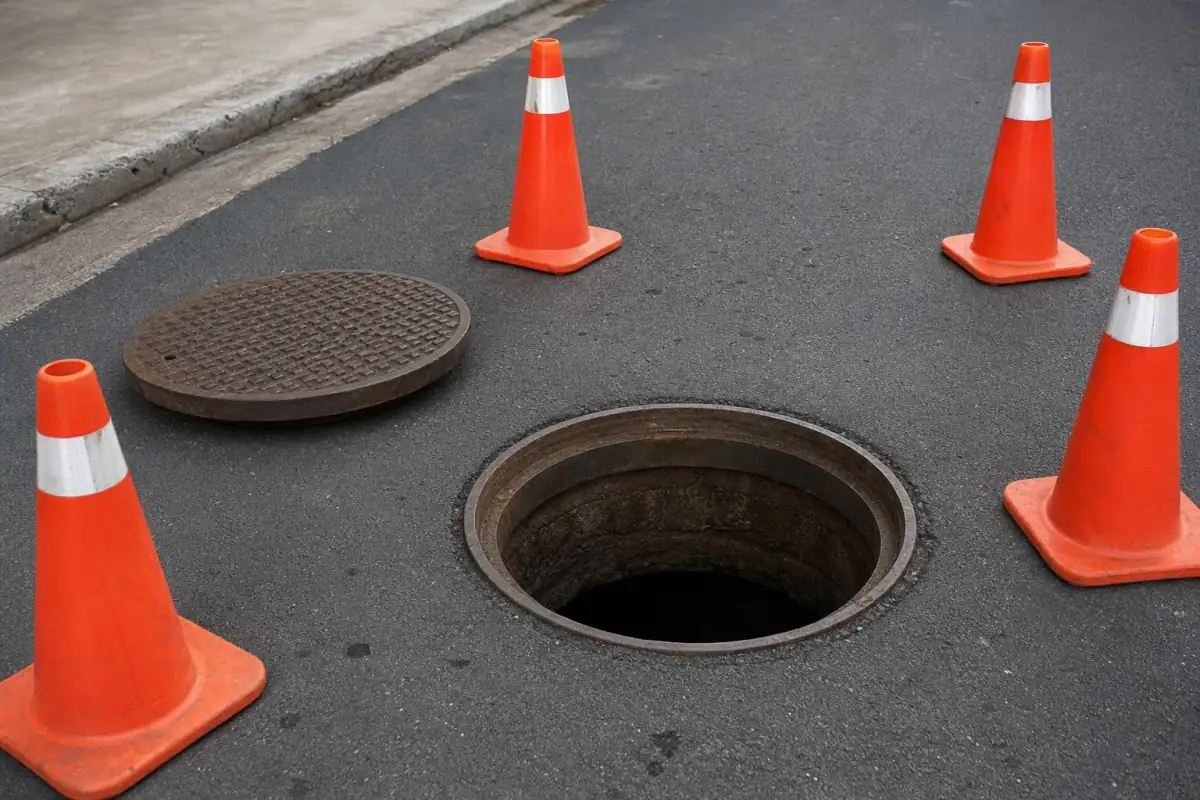
Check 2: is the city main blocked or only your lateral?
The main is the likely culprit when neighbors on the same block back up at the same hour, or when the riser keeps rising while the house sends it nothing. Ownership usually runs to the main, not to the property line. Los Angeles County Public Works says the owner is responsible for the entire length of the lateral, including the part under the street, under County Code 20.24.080, and notes laterals run 4 to 6 inches while the district’s main is typically at least 8 inches. Seattle Public Utilities says you own the side sewer until it connects to the public sewer pipe. Philadelphia’s diagram puts even the slant, the tap into the city sewer, on the customer, and NYC DEP issues a Notice to Repair when the private service line caused the backup.
Call the city before the plumber digs at the curb. Seattle’s backup handout lists calling SPU at (206) 386-1800, calling Puget Sound Energy at 1-888-225-5773 before clearing the side sewer so a cable does not damage a gas line, and filing a claim for reimbursement if the cause was a City issue. Chicago dispatches crews through the 311 Water in Basement request, which asks whether the water is dirty or clean, which fixture it is coming from and how many inches have backed up. Chicago told CBS Chicago in July 2021 that for repeated backups a licensed sewer contractor must have a Department of Water Management House Drain Inspector present while the line is rodded and videoed; a resident who paid about $6,500 without that inspector lost eligibility for the Private Drain Program.
Check 3: on a septic system, is the tank inlet or the tank itself the problem?
Open the inlet-end lid and compare the liquid level with the outlet pipe. Minnesota rule 7080.1920 requires a tank’s inlet invert to sit at least 2 inches above its outlet invert, so a working tank shows liquid level with the bottom of the outlet and a dry inlet pipe above it.
Liquid at the outlet level, 2 or more inches below a dry inlet, with a full house cleanout places the clog between the cleanout and the tank, in the pipe or the inlet baffle, and a cable from the cleanout can reach it. Liquid over the inlet pipe means the tank cannot discharge, which points at the outlet baffle, an effluent filter or the drain field, and no amount of snaking from the house end will drop the cleanout level.
Decision table: what the cleanout shows, whose pipe, next step, cost
| What you see | Where the blockage is | Usually whose | Next step and typical cost (Fixr, Jan. 2025) |
|---|---|---|---|
| Cleanout dry, inside drains back up (A) | Upstream, between the backed-up fixtures and the cleanout | Owner | Clear the branch from a fixture or stack cleanout; backed-up drain $150 to $300 |
| Riser part full, level drops slowly with no water use | Partial downstream clog: roots, grease or a belly | Owner | Snake toward the street, $150 to $375; ask for the footage of the stoppage |
| House cleanout full, two-way at the property line dry (B) | Yard run between the two cleanouts | Owner in the 4 cities above | Rod from the house cleanout; unclogging a sewer line $250 to $800 |
| Both cleanouts full, neighbors fine (C) | Private line between property line and main | Owner in Los Angeles County, Seattle, Philadelphia and NYC | City call first in Seattle and Chicago, then rod or jet, $250 to $1,000 |
| Both full, neighbors also backing up (D) | Public main | City | Report it (Seattle 206-386-1800, Chicago and NYC 311); do not hire a contractor for the main |
| Septic: cleanout full, tank liquid at outlet level | Pipe to tank or inlet baffle | Owner | Snake from the cleanout to the tank; cleaning with a video inspection $300 to $600 |
| Steady pool in a trap fitting, all drains fast | No blockage, trap seal | None | Leave it; keep the plug tight |
Costs come from Fixr’s sewer line cleaning cost guide, updated January 31, 2025, which also lists plumber labor at $75 to $150 per hour, cleanout replacement or installation at $1,000 to $3,500 and section replacement at $1,000 to $20,000. Ask for the after-hours rate as a flat dollar figure before a night or weekend dispatch.
When the clog comes back: roots, bellies and backwater valves
A cleanout that refills within weeks of rodding points to a pipe defect, not a one-time plug. Seattle’s handout tells owners to have the rooter write down the distance in feet where the blockage was found and mark that spot on the ground, and warns that cameras cannot see under water, so a camera run belongs after the line is drained. Roots at the same footage twice and a belly that holds water on video are the two findings that justify a line that stays clogged after snaking being dug or lined instead of rodded again.
A backwater valve on the building sewer changes the reading: when the street side surcharges the flap closes, so the house-side cleanout fills from your own fixtures even with no clog in your pipe. Seattle makes the owner responsible for maintaining that valve, and a flap held open by a rag or root mass lets the main back up into the house. When the camera shows a collapse or long sag, compare the dig price against a full sewer line replacement cost before paying for a spot repair at Fixr’s $1,000 to $20,000 section range.
Cleanout full of water: quick answers
Should a sewer cleanout have any water in it?
A thin stream along the bottom of the pipe is normal, because every 1.6 gallon flush passes that point. Water standing up inside the vertical riser is not normal unless the fitting sits on a house trap, where a fixed pool is the trap seal Philadelphia Water lists as the curb trap.
Why is my cleanout full of water only after heavy rain?
Rain can fill a combined or leaky public sewer until it pushes back up your lateral, so the cleanout fills while your own line is clear. Seattle Public Utilities asks residents to report backups at (206) 386-1800 even when they suspect extreme rainfall is the cause.
Can I just leave the cap off so the water drains into the yard?
No. An open 4 inch cap spills raw sewage onto the ground, lets rainwater into the line and leaves the clog in place. Put the cap back, stop using water and get the line cleared through that same opening, then replace a cracked cap before the next rain.
Will a cleanout full of water clear by itself?
A partial clog can drain down overnight, but the roots, grease or belly that caused it stay put and the next load of laundry refills the riser. A 50 foot lateral full of water holds about 33 gallons waiting on that clog, so have the line snaked or jetted and the distance to the stoppage written down.
Who pays if the clog is at the property line?
In Los Angeles County, Seattle, Philadelphia and New York City, 4 places with published rules, the owner pays for the private line all the way to the public main, so a clog at the property line is still usually your bill. The city pays only when its main is the blocked pipe.
How we sourced this
We read lateral responsibility pages from Los Angeles County Public Works, Seattle Public Utilities (side sewer maintenance page and backup handout), Philadelphia Water (customer responsibility diagram dated 03/2026), NYC DEP and Chicago’s 311 Water in Basement service, plus a July 2021 CBS Chicago report quoting the city on its Private Drain Program, Minneapolis Public Works on cleanout locations, Minnesota rule 7080.1920 on septic tank inverts and Fixr’s January 2025 cost guide. Pipe volumes, overflow margins and plug pressure are our arithmetic with the inputs shown. City of Los Angeles pages refused automated access, so Los Angeles rules here are the County district’s. We found no dated primary source for after-hours multipliers or for which cities clear a main at no charge, so the page gives neither.