Well Water Testing: What to Test, How Often, and What It Costs
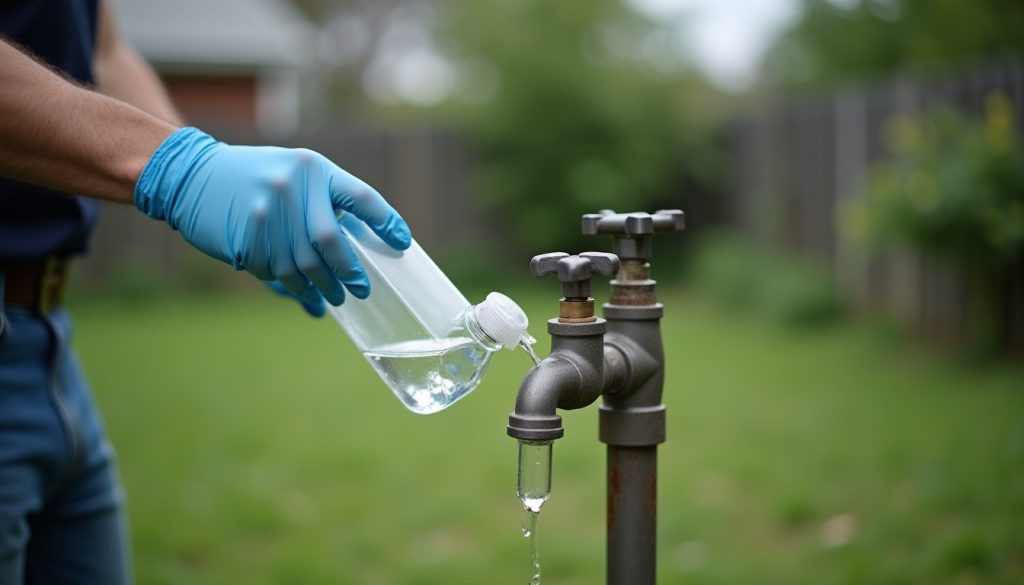
Well water testing belongs on your calendar once a year: send a sample to a state-certified lab for total coliform and E. coli, nitrate, pH and total dissolved solids, then add arsenic, lead, and local contaminants.
Key Takeaways
- About 23 million U.S. households rely on private wells, and EPA drinking water rules do not cover them, so the owner is the only one testing, per the EPA private wells program.
- The CDC and EPA both recommend testing at least once a year for total coliform bacteria, nitrate, total dissolved solids, and pH.
- A USGS study of about 2,100 domestic wells (sampled 1991 to 2004) found roughly 1 in 5 had at least one contaminant above a human-health benchmark.
- USGS estimates just over 2 million people drink domestic well water with arsenic above the EPA limit of 10 parts per billion.
- Public lab packages for bacteria plus nitrate ran about $40 to $61 on published 2024 to 2026 fee schedules (Maine CDC, Marathon County WI); broader panels ran $125 to $230.
- Bacteria samples must reach the lab within 30 hours of collection, per Wisconsin DNR and Montana DEQ sampling instructions.
What should you test well water for?
Every well water testing plan starts with four annual basics from the CDC: total coliform bacteria (with E. coli if coliform shows up), nitrate, pH, and total dissolved solids. Then add arsenic and lead at least once, plus anything your county health department flags locally, such as uranium, radon, manganese, fluoride, pesticides, or PFAS near airports and industrial sites. If coliform turns up positive, shocking a well with bleach walks through disinfection and retesting, while well water versus city water weighs the ongoing responsibilities of managing your own supply. Weighing whether to stick with your current well or start fresh ties directly into well drilling cost. Before comparing drilling quotes, it’s worth checking whether iron buildup and staining is driving the decision to replace the well in the first place.
The basics are cheap screens for the most common failures. Coliform shows surface water or septic effluent getting in, nitrate tracks fertilizer and septic loading, and pH and TDS flag corrosive or mineral-heavy water.
Arsenic and lead are the two metals most homeowners skip and most often regret skipping. Arsenic comes from bedrock, so a well can be clean of bacteria and still fail. Lead usually comes from the plumbing itself: older brass fittings, solder joints, and submersible pump parts.
- Every year: total coliform and E. coli, nitrate, pH, TDS.
- At least once, then every few years: arsenic, lead, hardness, iron, manganese, fluoride.
- Where local geology or land use calls for it: uranium, radon, pesticides, volatile organics, PFAS.
How often should you test well water?
Test well water at least once a year for coliform, nitrate, pH, and TDS, the schedule both the CDC guidelines for testing well water and the EPA recommend. Test sooner after flooding, any well repair, a change in taste, color, or smell, a nearby septic failure, or a new baby or pregnancy in the house, since infants under 6 months are most sensitive to nitrate.
Spring is a smart time for the annual bacteria test. Some state health departments also suggest a broader panel every few years on top of the annual basics.
Any time the well is opened, retest. That includes pulling a pump, replacing a pressure tank, or switching between types of well pumps, because tools and pipe dropped down the casing can carry bacteria in with them.
| Trigger | What to test | Why |
|---|---|---|
| Annual check | Coliform/E. coli, nitrate, pH, TDS | CDC and EPA baseline |
| Flood or standing water near the wellhead | Coliform/E. coli, nitrate | Surface water may have entered the casing |
| Pump, tank, or well repair | Coliform/E. coli | Work inside the casing can introduce bacteria |
| Pregnancy or infant in the home | Nitrate, nitrite | Infants under 6 months face the highest nitrate risk |
| New taste, odor, stain, or cloudiness | Coliform plus iron, manganese, sulfur, TDS | Change signals a new source or a failing seal |
| Buying or selling a home | Full panel incl. arsenic and lead | Some lenders and states require it |
Where do you get well water testing done?
Use a state-certified drinking water laboratory, not a store test strip. Every state runs a certification program, and the EPA keeps a directory of state certification programs and certified labs. Many county health departments sell sample kits, take drop-offs, and forward samples to the state public health lab for a fixed fee.
Certified labs use approved methods and detection limits low enough to read against EPA numbers. That matters for arsenic and lead, where limits sit in parts per billion.
Home kits have one fair use: a quick screen for hardness, pH, or iron between lab tests. A home strip that reads “no bacteria” or “lead safe” is not a result your lender, your health department, or your pediatrician will accept.
How much does well water testing cost?
A basic well water test for bacteria and nitrate through a public lab often runs about $40 to $61, based on published fee schedules from Maine CDC and Marathon County, Wisconsin. Single tests for arsenic or lead ran $35 to $52 at the Wisconsin county labs we checked, and broader home-sale panels ran $125 to $230. Private labs and regional prices vary.
| Public lab | Package or test | Published fee |
|---|---|---|
| Maine CDC (state lab) | Basic safety: coliform/E. coli, nitrate, nitrite | $40 |
| Maine CDC (state lab) | Comprehensive home-sale panel incl. arsenic, lead | $125 |
| Marathon County, WI | Coliform/E. coli plus nitrate | $61 |
| Marathon County, WI | Arsenic or lead (each) | $52 |
| Oneida County, WI | Coliform, nitrate, arsenic kit bundle | $82 |
| Kenosha County, WI | Bacteria, nitrate, fluoride bundle | $80 |
| Monroe County, NY | Base package: coliform, lead, nitrate, nitrite, arsenic, turbidity | $230 |
Some health districts run free nitrate screening events, and a few states subsidize tests for new wells or for households with infants. Call your county environmental health office before paying a private lab.
How do you collect a well water sample?
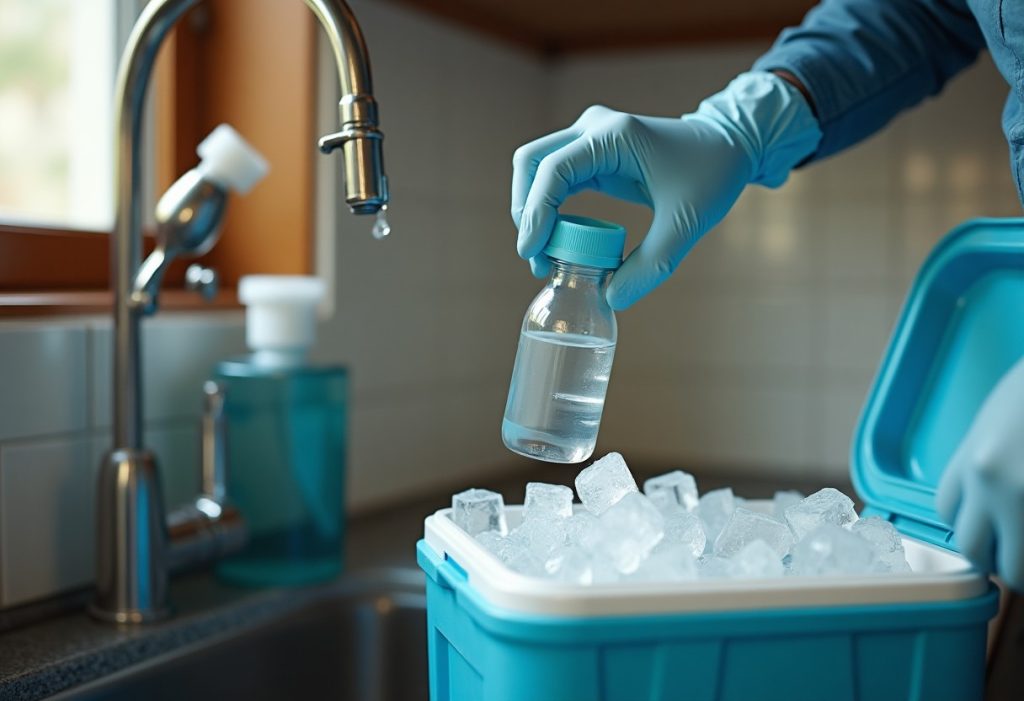
Collect a bacteria sample from a cold-water tap with no aerator, disinfect the spout, run the water 2 to 3 minutes, then fill the sterile lab bottle without touching the inside or the faucet. Keep it cold and get it to the lab within 30 hours, per Wisconsin DNR coliform sampling instructions. A lead sample follows different rules.
- Pick a day early in the week so the sample does not sit in a closed lab over the weekend.
- Choose a cold-water tap that does not leak and is not a swivel or pull-out faucet. Skip any tap after a softener or filter unless the lab asks for treated water.
- Remove the aerator, screen, or hose attachment.
- Disinfect the end of the spout with isopropyl alcohol or unscented household bleach. Do not wipe it afterward.
- Run the cold water at full flow for 2 to 3 minutes, then turn it down to a pencil-width stream for about 1 minute.
- Uncap the bottle without touching the inside of the cap or the rim, fill to the line, and cap it right away. Do not rinse the bottle; many contain a preservative.
- Label it, refrigerate if it will be more than a few hours before drop-off, and deliver within 30 hours.
Lead is the reverse. For lead, labs usually want a first-draw sample: water that sat in the pipes unused for at least 6 hours, often overnight, collected from the kitchen tap before anyone runs it. That method mirrors the one EPA uses for public systems, because it catches lead leaching from fixtures and fittings inside the house rather than from the aquifer.
How do you read well water test results against EPA limits?
Compare each result to the EPA Maximum Contaminant Level (MCL) listed in the National Primary Drinking Water Regulations. The limits legally bind only public systems, but they are the benchmark labs print on private well reports. Watch the units: mg/L equals parts per million, and µg/L equals parts per billion, 1,000 times smaller.
Bacteria results come back as present or absent. Any E. coli means the water is unsafe to drink until you fix and retest. Total coliform present with no E. coli means a pathway exists for surface contamination, even if the bacteria detected are not themselves harmful.
| Contaminant | EPA limit | Type | What a high result usually means |
|---|---|---|---|
| E. coli | Zero (any positive fails) | Primary (MCL) | Fecal contamination from septic, manure, or surface water |
| Total coliform | Goal of zero | Primary (MCLG) | A pathway for surface water: cracked cap, failed casing seal |
| Nitrate (as N) | 10 mg/L | Primary (MCL) | Fertilizer, manure, or septic loading |
| Nitrite (as N) | 1 mg/L | Primary (MCL) | Fresh contamination, often alongside nitrate |
| Arsenic | 10 µg/L (ppb) | Primary (MCL) | Natural bedrock source; does not change with weather |
| Lead | 15 µg/L action level; goal of zero | Treatment technique | Corrosive water attacking brass, solder, or pump parts |
| Uranium | 30 µg/L | Primary (MCL) | Granite or other uranium-bearing bedrock |
| Fluoride | 4.0 mg/L (2.0 secondary) | Primary and secondary | Natural geology in parts of the West and Southwest |
| pH | 6.5 to 8.5 | Secondary (guidance) | Below 6.5: corrosive water, blue-green stains, lead risk |
| Total dissolved solids | 500 mg/L | Secondary (guidance) | Salty or mineral taste, scale |
| Iron / manganese | 0.3 mg/L / 0.05 mg/L | Secondary (guidance) | Orange or black staining, metallic taste |
Hardness has no federal limit. The USGS classes water at 0 to 60 mg/L as calcium carbonate as soft, 61 to 120 as moderately hard, 121 to 180 as hard, and above 180 as very hard. Hard water is a scale and appliance issue, not a health issue.
Which regional contaminants should you add to a well water test?
Add tests based on what sits under and around your well. The USGS found inorganic contaminants such as radon and arsenic were the ones most often above health benchmarks in its private well study, and their spread follows geology. Your county health department is the best source for the local short list, and many publish maps of known problem areas.
| Add-on test | Where it often shows up | Typical source |
|---|---|---|
| Arsenic | New England, the Upper Midwest, and parts of the West, per USGS mapping | Natural bedrock and glacial deposits |
| Uranium and radon | Granite and other crystalline bedrock regions | Natural radioactive minerals |
| Nitrate and pesticides | Row-crop and livestock areas | Fertilizer, manure, field runoff |
| Manganese | Widespread in groundwater nationwide | Natural minerals, low-oxygen aquifers |
| PFAS | Near military bases, airports, landfills, and some factories | Firefighting foam, industrial discharge |
| Volatile organics | Near gas stations, dry cleaners, fuel tanks | Leaking tanks and solvent spills |
For PFAS, EPA set enforceable limits of 4.0 parts per trillion for PFOA and PFOS in April 2024. Ask the health department about known PFAS sites before ordering that pricier test.
What should you do if your well water test fails?
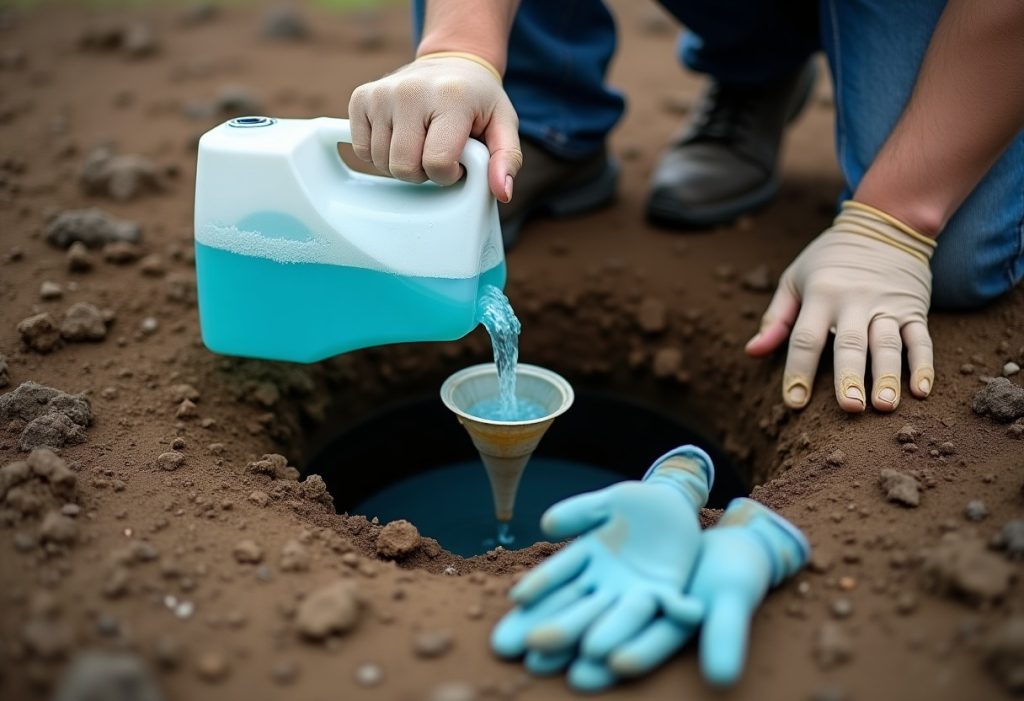
Stop drinking the water for the failed contaminant and switch to bottled water for drinking, cooking, and infant formula. For bacteria, inspect the well cap and casing, shock-chlorinate the well, and retest once the chlorine is gone. For nitrate, arsenic, or lead, retest to confirm, find the source, and choose treatment rated for that contaminant.
A bacteria hit usually points to a physical defect. Look for a loose or vented cap without a screen, a cracked casing, ground that slopes toward the wellhead, or a septic field too close. Shock chlorination without fixing the entry point often fails again.
Chemical failures need treatment matched to the contaminant. A reverse osmosis system under the kitchen sink is the usual point-of-use answer for arsenic, nitrate, uranium, and lead in drinking water. Iron, manganese, sulfur smell, and sediment often call for a whole house water filter at the pressure tank so every fixture gets treated water.
Low pH needs its own fix. Corrosive water under 6.5 eats copper and brass, which raises lead and copper levels at the tap, so a calcite or soda-ash neutralizer may solve two failures at once. After treatment goes in, test water downstream of the equipment.
Is well water riskier than city tap water?
Well water is not automatically worse, but nobody else checks it. A city utility must test on a federal schedule under the Safe Drinking Water Act and report violations, while a private well owner gets no testing, no treatment, and no notice. That gap, not the water itself, is the main risk, which is why annual well water testing matters.
Studies cited by public health researchers show that, at best, about half of private well owners test with any regularity, and few test every year. If you are weighing the trade-offs on municipal supply, our guide on whether tap water is safe to drink covers what utilities test for and what they miss.
How we sourced this
We reviewed the top-ranking well water testing pages and People Also Ask questions in October 2026, then went to primary sources: CDC private well testing guidelines, the EPA Private Wells program and National Primary Drinking Water Regulations, USGS domestic well studies, Wisconsin DNR and Montana DEQ sampling instructions, and published fee schedules from Maine CDC and county labs in Wisconsin and New York (2024 to 2026). We cited the subset that carried a specific number. Fees change often and vary by state, so treat the cost table as a sample of public labs, not a national average. We excluded vendor pricing and home test kit claims.
Frequently asked questions
How often should well water be tested?
Test well water at least once a year for total coliform bacteria, nitrate, pH, and total dissolved solids, the schedule the CDC and EPA recommend. Test again right away after flooding, well or pump repairs, a change in taste or smell, or a pregnancy or new baby in the home. Arsenic, lead, and other metals can usually be tested every few years once you have a clean baseline.
How much does it cost to test well water?
A bacteria and nitrate package at a public lab often costs about $40 to $61, based on Maine CDC and Marathon County, Wisconsin fee schedules. Single arsenic or lead tests ran $35 to $52 at Wisconsin county labs, and full home-sale panels ran $125 to $230. Private labs, PFAS tests, and pesticide screens cost more, and prices vary by state.
Can I test my well water myself?
You can collect the sample yourself, and that is how most well testing works: the lab mails or sells a sterile bottle and you follow its instructions. Home test strips are fine for a quick hardness or pH check, but they cannot reliably measure bacteria, arsenic, or lead at EPA limits. Use a state-certified lab for any result you plan to act on.
What is the most common contaminant in well water?
Coliform bacteria often cause failed routine tests, usually from a damaged cap, cracked casing, or surface runoff. In its study of about 2,100 domestic wells, the USGS found naturally occurring inorganic contaminants, especially radon and arsenic, were the ones most often above human-health benchmarks. Nitrate is a frequent problem in farm country.
Should I test well water before buying a house?
Yes. Ask for a full panel covering coliform and E. coli, nitrate, nitrite, arsenic, lead, pH, and any local contaminants, and have it collected by a neutral party or the lab rather than the seller. Some lenders and some states require a water test on homes served by a private well before closing, so ask early.
Where can I get my well water tested for free?
Free testing is limited, but it exists. Some county and district health departments run free nitrate screening days, and some states subsidize tests for new wells, households with infants, or areas with known contamination. Start with your county environmental health office, which can also tell you the cheapest certified lab and which local contaminants to add.
What should I do if my well tests positive for E. coli?
Stop drinking the water and boil it or use bottled water for drinking, cooking, brushing teeth, and formula. Inspect the well cap and casing for damage, have the well shock-chlorinated, and retest once the chlorine has flushed out. If E. coli comes back, a licensed well contractor should find and repair the entry point.
How do I know if my well water is unsafe?
Unsafe signs show up through testing, not taste alone. Any E. coli result means the water is unsafe until fixed and retested. Total coliform present signals a pathway for surface contamination. Results above EPA limits for nitrate, arsenic, lead, uranium, or fluoride also mean the water failed. New taste, odor, staining, or cloudiness, plus flooding or recent well repairs, should prompt retesting right away.


