Iron in Well Water: Signs, Health Facts and How to Remove It
Iron in well water is a stain and taste problem, not usually a health risk: above EPA’s 0.3 mg/L guideline it turns fixtures orange, and the right fix depends on the iron’s form and level.
Key Takeaways
- EPA’s 0.3 mg/L iron standard is a non-enforceable guideline for color, taste, and staining, not health.
- USGS Circular 1332 sampled about 2,100 domestic wells and found iron above 0.3 mg/L in 19 percent and manganese above its 0.05 mg/L guideline in 21 percent.
- The Minnesota Department of Health says iron in water does not usually present a health risk; NDSU Extension flags hemochromatosis as the exception.
- Form decides treatment: clear water that rusts on standing is ferrous iron, red water at the tap is ferric, and slime means iron bacteria (MDH).
- Penn State Extension limits softeners to dissolved iron under 5 mg/L and calls for oxidation plus filtration above 10 mg/L.
- Iron bacteria need shock chlorination close to, but not above, 200 ppm, according to the Minnesota Department of Health.
What are the signs of iron in well water?
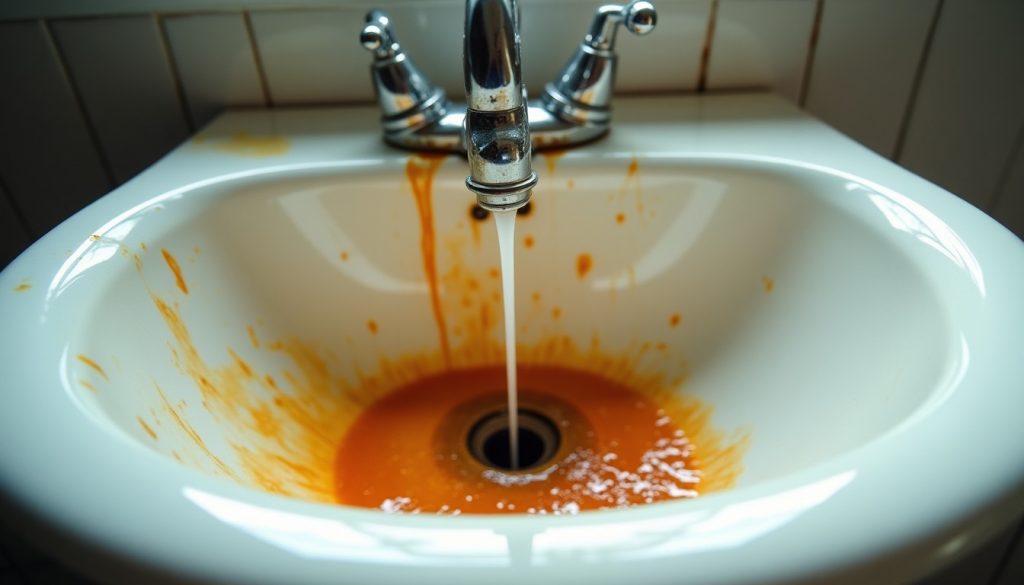
The clearest signs of iron in well water are orange, red, or yellow-brown stains on sinks, toilets, and laundry, a metallic taste, and water that runs clear but turns cloudy or rusty after it sits. The Minnesota Department of Health adds two kitchen clues most guides skip: tea and coffee that show a rainbow sheen in bright light, and potatoes that turn black.
EPA’s list of iron effects above its guideline matches what homeowners report: rusty color, sediment, metallic taste, and reddish or orange staining.
- Stains. Orange streaks under faucet drips, toilet bowl rings, and rust-tinted laundry.
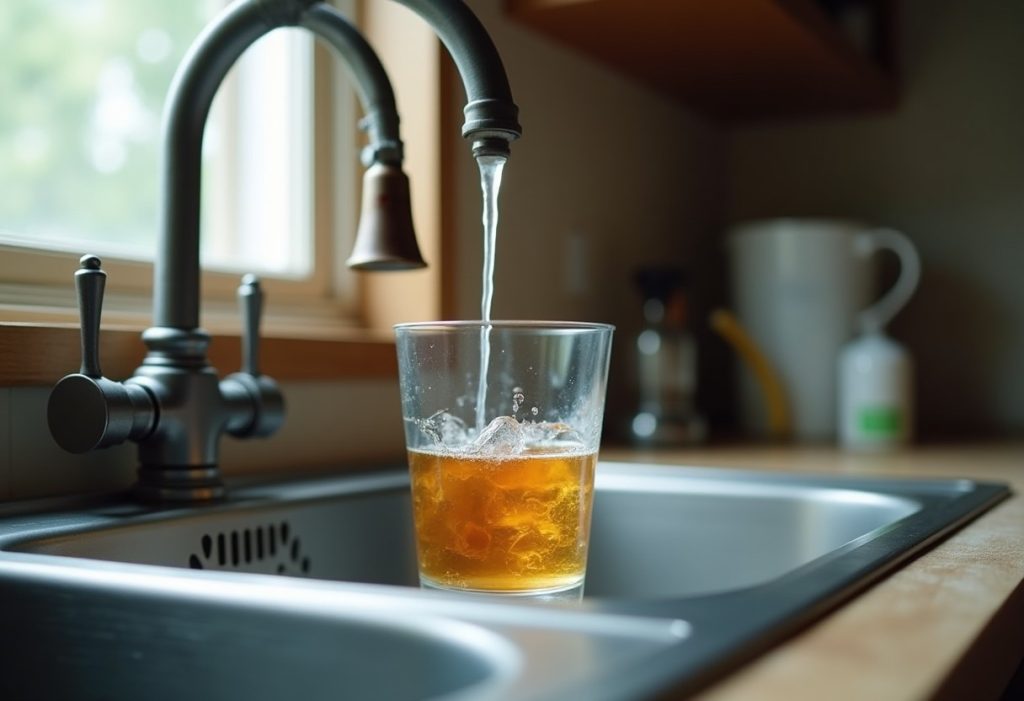
- Color that changes. Clear in the glass, then yellow, orange, or brown as it stands.
- Red water at the tap. Orange or cloudy the moment it leaves the faucet.
- Slime and odor. Rusty, yellow, brown, or gray slime inside the toilet tank, plus swampy, oily, cucumber, or sewage smells, which the Minnesota Department of Health ties to iron bacteria.
- Clogs. MDH notes iron can clog wells, pumps, and appliances.
Black stains usually point to manganese. If the color comes and goes, or you are on a public supply, a rusting water heater or main sediment may be the cause. Our guide to brown water from a faucet walks through how to tell those sources apart.
What forms of iron show up in well water?
Iron in well water shows up in four practical forms. Ferrous, or clear-water, iron is dissolved and invisible at the tap. Ferric, or red-water, iron is already rust. Organic iron is bound to natural organic matter. Iron bacteria are living organisms that feed on iron and leave slime. Each form needs a different fix, so naming it comes before buying equipment.
| Form | What you see | What it means for treatment |
|---|---|---|
| Ferrous (clear-water) iron | Clear from the tap; turns yellow, orange, or brown as it stands | Dissolved; needs a softener or oxidizing filter, by level (Penn State) |
| Ferric (red-water) iron | Red, orange, or cloudy the moment it leaves the faucet | Already particles; iron filters handle up to 10 to 15 mg/L (MDH) |
| Organic iron | Yellow or brown tint tied to natural organic compounds | MDH says common methods may not work; it recommends distillation or reverse osmosis |
| Iron bacteria | Slime in toilet tanks, feathery growths, oily sheen, swampy or cucumber odor | A living colony; needs shock chlorination (MDH, NDSU) |
Penn State Extension gives the simplest field test. Water that is clear at first but forms orange-brown or black particles over time carries dissolved iron and manganese. Particles present from the start mean the iron has already oxidized.
Why some wells carry so much more than others comes down to chemistry. USGS researchers write that iron and manganese are common in most aquifer materials but are mobilized under low dissolved oxygen and low pH. Penn State adds that natural iron is more common in deeper wells, where water has spent longer in contact with rock.
Is iron in well water harmful to your health?
Iron in well water is not harmful at the levels found in most wells. EPA classes iron as a secondary contaminant, and it states that secondary contaminants are not considered to present a risk to human health at their guideline levels. The Minnesota Department of Health puts it plainly: iron in water does not usually present a health risk.
MDH notes that most of the iron your body absorbs comes from food, not water, and that iron levels in water are usually below 10 mg/L.
Three caveats are worth acting on.
- Hemochromatosis. NDSU Extension says neither iron nor manganese in drinking water presents a hazard to the general population, with one exception: people with hemochromatosis, a condition of excess body iron. Ask a doctor whether to treat the water.
- Bacteria. MDH warns that some harmful organisms require iron to grow, so iron in the water may make harmful bacteria harder to get rid of. Test for coliform bacteria along with iron.
- Manganese. Iron’s companion metal has a stricter 0.05 mg/L aesthetic guideline and a non-enforceable 0.3 mg/L health advisory, per Penn State Extension. Iron rarely travels alone, so test for both.
How common is iron in well water?
Iron in well water is common across the country. In USGS Circular 1332, which sampled about 2,100 domestic wells in 48 states between 1991 and 2004, iron was detected in about half of the wells and topped EPA’s 0.3 mg/L guideline in 19 percent. Manganese topped its 0.05 mg/L guideline in 21 percent of wells.
USGS found elevated iron and manganese in samples from nearly all principal aquifers, so no region gets a pass. Penn State’s survey found excessive iron in 17 percent of Pennsylvania private supplies, close to the national share.
One pattern matters for treatment. USGS found about 14 percent of wells more acidic than EPA’s 6.5 to 8.5 pH range, mostly in eastern crystalline-rock and coastal plain aquifers. Greensand and birm need pH near 6.8 or higher, so acidic wells may need pH correction before an iron filter performs.
How do you test well water for iron?
Test well water for iron through a certified lab, not just a strip kit. Ask for iron, manganese, pH, and hardness on the same sample, because Penn State and NDSU Extension tie every treatment choice to those four numbers. The Minnesota Department of Health recommends an accredited laboratory, and a lab result in mg/L is what you need to size a system.
- Call your county health office for a list of certified labs.
- Order iron, manganese, pH, and hardness, plus coliform bacteria, since MDH says iron can make harmful bacteria harder to remove.
- Sample raw water from a tap ahead of any softener or filter.
- Note what you saw: clear at first, red at the tap, or slimy.
- Retest after treatment to confirm iron is under 0.3 mg/L.
Lab fees are modest. Public lab packages for bacteria and nitrate ran about $40 to $61 on Maine CDC and Marathon County, Wisconsin fee schedules, and broader panels ran $125 to $230. Our well water testing guide covers what to test and how often.
How do you remove iron from well water?
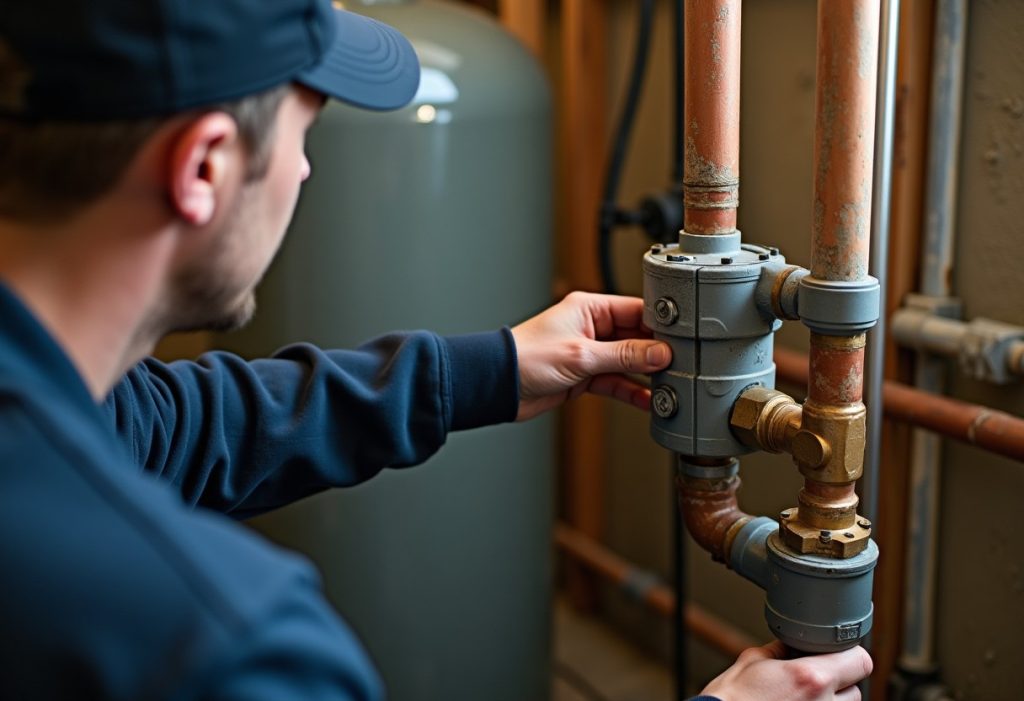
Remove iron from well water by matching the method to the iron form and the lab number. Penn State and NDSU Extension put softeners at dissolved iron under 2 to 5 mg/L, manganese greensand at roughly 3 to 10 mg/L of combined iron and manganese, and chlorination or other oxidation plus filtration above 10 mg/L. Rust particles need a filter, and organic iron may need reverse osmosis.
| Iron level and form | Best-fit treatment | Typical installed cost |
|---|---|---|
| Ferric (red-water) particles | Sediment filter for rust; iron filter up to 10 to 15 mg/L (MDH) | $150 to $400 for a basic sediment filter (Angi 2026) |
| Ferrous, under 1 mg/L, dissolved oxygen 4 mg/L or more | Catalytic carbon filter (Penn State Extension) | Part of a whole house stack; carbon, iron, and UV systems $1,500 to $4,000 (Angi 2026) |
| Ferrous, under 2 to 5 mg/L, hard water, pH above 6.7 | Ion exchange water softener (Penn State, NDSU) | $600 to $6,000, typical near $1,500 (Aquasana, Culligan, Homewyse 2026) |
| Iron and manganese 3 to 10 mg/L combined, pH 6.8 or higher | Manganese greensand or birm oxidizing filter; air injection units oxidize iron ahead of a media bed | $1,500 to $4,000 for a whole house iron system (Angi 2026) |
| Above 10 mg/L | Chlorination with about 20 minutes of contact, then filtration; aeration for ferric iron (NDSU, MDH) | Custom quote; adds a feed pump and retention tank to the filter cost |
| Organic iron | Reverse osmosis or distillation (MDH) | Custom quote |
| Iron bacteria | Shock chlorination near 200 ppm (MDH) | $80 to $200 for a well contractor or plumber visit (Angi) |
Water softeners for low ferrous iron
A water softener removes small amounts of dissolved ferrous iron through the same ion exchange that removes hardness. Penn State Extension recommends it only for dissolved iron under 5 mg/L, pH above 6.7, and hardness of 3 to 20 grains per gallon. NDSU notes some models are limited to 2 mg/L, and MDH says manufacturers claim up to 10 mg/L.
A softener makes sense mainly when the house also has hard water. If it does, our water softener cost breakdown shows prices by type and capacity.
Oxidizing filters: greensand, birm, and air injection
Oxidizing filters convert dissolved ferrous iron into particles and trap them in one tank. Penn State recommends manganese greensand for combined iron and manganese of 3 to 10 mg/L, and MDH rates greensand for ferrous iron up to 10 to 15 mg/L. Greensand is regenerated with potassium permanganate, and NDSU warns it will probably not filter iron well if pH is below 6.8.
Birm works on a similar principle without a chemical feed but needs pH of at least 6.8 for iron and 7.5 for manganese, per Penn State. Air injection systems, which add air to oxidize iron before a media bed, fall under the aeration methods MDH lists for higher iron levels.
Chlorination plus filtration for high iron
Chlorination plus filtration is the standard answer for iron above 10 mg/L. A feed pump injects chlorine, the water sits in a retention tank for roughly 20 minutes so iron particles can form, and a filter catches them, according to NDSU Extension. The best oxidation rate for iron comes at a pH of about 8.0, and about 8.5 for manganese.
MDH lists hydrogen peroxide as an alternative oxidant. Either chemical also suppresses iron bacteria in the lines.
Sediment filters for ferric iron
A sediment filter catches ferric iron that is already rust, which is why it is the cheapest first step when water is red at the tap. It does nothing for dissolved ferrous iron until that iron has been oxidized. Well setups often mount it as the first stage of a whole house water filter near the pressure tank.
Polyphosphate feeders, listed by Penn State and NDSU for iron under 2 mg/L, keep iron from staining but do not remove it.
How do you get rid of iron bacteria in well water?
Get rid of iron bacteria in well water with shock chlorination, not a filter. The Minnesota Department of Health says the well should first be pumped until clear or physically cleaned, then dosed with chlorine close to, but not above, 200 ppm, because stronger solutions disinfect less well. Iron bacteria are not known to cause disease, but MDH says they can create conditions where disease-causing organisms grow.
- Bypass treatment equipment such as the softener and iron filter so strong chlorine does not reach the media.
- Pump the well until clear or have a well contractor physically clean it, as MDH advises.
- Add chlorine to reach about 200 ppm in the well, and no more.
- Run each tap until you smell chlorine, then let the solution stand for the contact time your state health department specifies.
- Flush and retest. Run water until the chlorine smell is gone, then test for coliform bacteria before drinking.
NDSU Extension says shock chlorination is required to eliminate iron bacteria. If slime returns, repeat it or add continuous chlorination ahead of the iron filter.
How we sourced this
We reviewed the top-ranking pages for “iron in well water,” “how to remove iron from well water,” and “is iron in well water harmful” in October 2026, then checked each claim against primary sources. Cited: EPA secondary drinking water standards, USGS Circular 1332 (about 2,100 domestic wells sampled 1991 to 2004), Penn State Extension, NDSU Extension, and two Minnesota Department of Health well pages. Cost ranges come from Angi 2026 data and Aquasana, Culligan, and Homewyse softener pricing as compiled in our existing cost guides; treat them as national ballparks. We excluded seller claims of regional exceedance rates that we could not trace to a USGS table.
Frequently asked questions
Is iron in well water harmful?
At the levels found in most wells, no. EPA classes iron as a secondary contaminant, so its 0.3 mg/L guideline covers color, taste, and staining rather than health. The Minnesota Department of Health says iron in water does not usually present a health risk. NDSU Extension names one exception, people with hemochromatosis, who should ask a doctor about removing it.
How do I get rid of iron in my well water?
Test first, then match the method to the form and level. Penn State Extension puts water softeners at dissolved iron under 5 mg/L, manganese greensand at about 3 to 10 mg/L of combined iron and manganese, and chlorination or other oxidation plus filtration above 10 mg/L. Rust particles need a sediment or iron filter, and organic iron may need reverse osmosis.
Does a water softener remove iron from well water?
A softener removes small amounts of dissolved ferrous iron through ion exchange. Penn State Extension recommends it for dissolved iron under 5 mg/L with pH above 6.7, and NDSU says some models handle only 2 mg/L. Red water that already holds rust particles needs a filter instead.
What does iron bacteria in well water look like?
Iron bacteria leave sticky rusty, yellow, brown, or gray slime in toilet tanks and fixtures, feathery growths in standing water, and an oil-like rainbow sheen. The Minnesota Department of Health also lists swampy, oily, cucumber, or sewage smells, strongest after water sits unused. They are not known to cause disease, but they clog wells and pipes.
Can you drink well water with high iron?
Usually yes, from a health standpoint, though it may taste metallic and stain fixtures. Test for coliform bacteria and manganese at the same time, because the Minnesota Department of Health warns iron can make harmful bacteria harder to remove and USGS found manganese above its guideline in 21 percent of domestic wells.
Why does my well water turn orange after sitting?
Water that comes out clear and turns orange or brown in a glass, tub, or toilet tank carries dissolved ferrous iron. Once it meets air, the iron oxidizes into rust particles you can see. Penn State Extension uses this clue to identify the dissolved form, which a sediment filter cannot catch until it is oxidized.
Does boiling water remove iron?
No. Boiling kills bacteria, but it does not remove dissolved metals such as iron and manganese. As water evaporates during boiling, the iron left behind ends up slightly more concentrated in the pot. Removing iron takes ion exchange, oxidation plus filtration, or reverse osmosis, matched to your lab report.
How much does it cost to remove iron from well water?
It depends on the method. A basic sediment filter runs about $150 to $400 installed, and a whole house carbon, iron, and UV system about $1,500 to $4,000, per Angi 2026 data. A water softener runs about $600 to $6,000 installed, near $1,500 for a typical unit, per Aquasana, Culligan, and Homewyse. Chlorine injection systems for high iron usually need a custom quote.


