Water Softener vs Water Filter
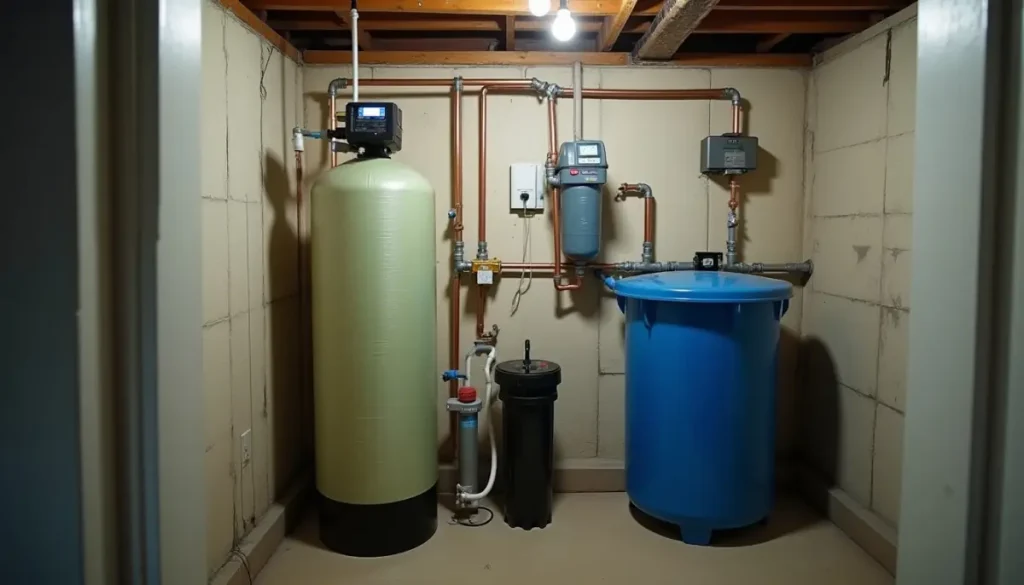
Water softener vs water filter comes down to one job each: a softener swaps calcium and magnesium for sodium to stop scale, while a filter removes particles or chemicals, so a water test decides which you need.
Key Takeaways
- A softener uses ion exchange and is certified under NSF/ANSI 44; it does not remove chlorine, lead or PFAS.
- Filters are certified by job, per NSF and ANSI: 42 for taste, odor and chlorine, 53 for health contaminants like lead, 58 for reverse osmosis, 401 for emerging compounds.
- USGS calls water above 180 mg/L (about 10.5 gpg) very hard and 0 to 60 mg/L soft, measured as calcium carbonate.
- Softening adds about 50 mg/L of sodium per 100 mg/L of hardness removed, per Alberta Agriculture, which is about 30 mg per glass at 15 gpg.
- Installed softeners run about $500 to $6,000, with most homes near $1,500, per HomeAdvisor; Angi puts whole house filters at about $300 to $2,500.
- In a combo system, a sediment pre-filter goes first and a reverse osmosis unit goes last, after the softener.
What is the difference between a water softener and a water filter?
A water softener changes the chemistry of the water, while a water filter removes things from it. The softener traps calcium and magnesium on resin beads and releases sodium or potassium in their place. A filter catches particles, adsorbs chemicals or pushes water through a membrane, depending on the media inside. Neither one does the other’s job.
That split matters because the symptoms look alike to most homeowners. White crust on a showerhead points to hard water, which a softener fixes. A swimming pool smell, rusty grit or a lab result showing lead points to a filter, and a softener will not touch it.
A third product muddies the comparison. Salt-free “softeners” are really conditioners that keep hardness in the water but change how it forms scale; we break down salt-free conditioners versus true softeners separately. They are not filters either.
| Factor | Salt-based water softener | Water filter |
|---|---|---|
| How it works | Ion exchange on resin beads | Mechanical screening, adsorption (carbon), membrane (RO) or reactive media |
| Main target | Calcium and magnesium (hardness) | Sediment, chlorine, taste and odor, lead, VOCs, PFAS, iron, arsenic, depending on type |
| NSF/ANSI standard | 44 | 42, 53, 58, 401 or 62, depending on the claim |
| What it adds | Sodium (or potassium with KCl pellets) | Nothing, in normal operation |
| Ongoing upkeep | Salt refills, occasional resin cleaning | Cartridge or media changes, RO membrane swaps |
| Drain needed | Yes, for regeneration brine | Only for RO and backwashing media tanks |
Does a water softener filter water?
A water softener does not filter water in the way most buyers mean. It removes hardness ions by exchange, and its NSF/ANSI 44 certification covers hardness reduction, brine accuracy, softening capacity and material safety. It is not tested for chlorine, bacteria, lead or PFAS, so a softener alone cannot make questionable water safe.
There is one overlap. A softener can strip small amounts of dissolved (clear water) iron. Alberta Agriculture’s Water Softening fact sheet says a fully automatic softener can readily remove up to 3 mg/L of iron, provided you clean the resin with an iron-out product on a schedule.
Push past that level and iron fouls the resin and cuts its capacity sharply, per the same fact sheet. Homes on well water with heavy iron, iron bacteria or manganese usually need a dedicated iron filter ahead of the softener.
What does each type of water filter remove?
Each filter type removes a different class of problem, and the NSF/ANSI number on the box tells you which. Sediment filters catch sand and rust flakes. Activated carbon handles chlorine, taste, odor and some organic chemicals. Reverse osmosis removes dissolved solids, including hardness at the tap. Specialty media target iron, manganese, arsenic or other single contaminants.
According to the American National Standards Institute, NSF/ANSI 53 covers more than 50 health-related reduction claims, including lead, Cryptosporidium, VOCs and chromium. NSF/ANSI 401 covers up to 15 emerging compounds found at trace levels, such as some pharmaceuticals and pesticides. A carbon filter that only carries NSF/ANSI 42 is an aesthetic filter, not a health filter.
| Filter type | What it removes | Certification to look for | Removes hardness? |
|---|---|---|---|
| Sediment (spun or pleated cartridge) | Sand, silt, rust flakes | NSF/ANSI 42 (particulate) | No |
| Activated carbon (block or GAC) | Chlorine, chloramine (catalytic carbon), taste, odor, some VOCs | NSF/ANSI 42; 53 or 401 for health claims | No |
| Reverse osmosis (point of use) | Total dissolved solids, lead, arsenic, nitrate, PFOA and PFOS when certified | NSF/ANSI 58 | Yes, at that one tap |
| Iron and manganese media (birm, greensand, air injection) | Iron, manganese, some hydrogen sulfide | NSF/ANSI 42 (iron, manganese claims) | No |
| Arsenic or specialty adsorptive media | Arsenic, fluoride or a single named contaminant | NSF/ANSI 53 or 58, check the listing | No |
| Ion exchange softener (for comparison) | Calcium, magnesium, small amounts of iron | NSF/ANSI 44 | Yes, whole house |
If you want a single system for every tap, start with our whole house water filter guide, which covers sizing, flow rate and cartridge versus tank designs.
Do I need a water softener or a filter?
You need a softener if a test shows hardness above about 7 gpg and you see scale, spots or soap scum. You need a filter if the test shows sediment, chlorine taste, iron, lead, arsenic, nitrate or PFAS. You need both when the report shows hardness plus any of those. Buy the system that answers the test, not the sales pitch.
The U.S. Geological Survey classifies water as soft at 0 to 60 mg/L, moderately hard at 61 to 120 mg/L, hard at 121 to 180 mg/L and very hard above 180 mg/L, all as calcium carbonate. Alberta Agriculture recommends softening once hardness passes 100 mg/L, about 6 gpg.
City water customers can start with the utility’s annual Consumer Confidence Report, which lists hardness and regulated contaminants. Well owners have no such report, so a certified lab test is the only reliable starting point. Alberta Agriculture advises testing hardness, iron, sodium and sulfate before buying a softener.
| Problem you see or test for | Softener, filter or both | Which system |
|---|---|---|
| White scale on fixtures, spotty dishes, soap scum | Softener | Salt-based ion exchange, sized to hardness and household use |
| Chlorine or chemical taste and smell | Filter | Activated carbon, NSF/ANSI 42 |
| Sand, grit or cloudy water from a well | Filter | Sediment pre-filter |
| Orange stains, metallic taste (iron over 3 mg/L) | Filter, often plus softener | Iron filter ahead of the softener |
| Lead from old service lines or solder | Filter | NSF/ANSI 53 or 58 certified for lead |
| Arsenic, nitrate or high TDS | Filter | Reverse osmosis, NSF/ANSI 58 |
| PFAS detected | Filter | Carbon or RO certified under NSF/ANSI 53 or 58 for PFAS |
| Hard water plus chlorine taste | Both | Sediment, carbon, then softener |
| Hard water plus lead or arsenic | Both | Softener whole house, RO at the kitchen sink |
How much sodium does a water softener add to drinking water?
A salt-based softener adds roughly 8.6 mg of sodium per liter for every grain per gallon it removes. That figure comes from Alberta Agriculture’s rule of about 50 mg/L sodium per 100 mg/L of hardness, multiplied by 17.1 mg/L per grain. At 15 gpg, the water picks up about 128 mg/L, or roughly 30 mg in an 8 ounce glass.
Here is the arithmetic. 15 gpg times 17.1 equals 256.5 mg/L of hardness. Half of that, per Alberta Agriculture’s 50 to 100 ratio, is about 128 mg/L of sodium. An 8 ounce glass holds 0.237 liters, so 128 times 0.237 equals about 30 mg.
For scale, the FDA sets the Daily Value for sodium at 2,300 mg. Two liters of 15 gpg softened water a day adds about 256 mg, about 11 percent of that figure. For most healthy adults that is minor, but it is not zero.
Alberta Agriculture flags 20 mg/L of sodium as the point where people on sodium-restricted diets should check with a physician, and nearly any softened hard water passes that. Three fixes work.
- Leave the kitchen cold tap on hard water by plumbing it ahead of the softener.
- Switch the brine tank to potassium chloride pellets, which swap in potassium instead of sodium at a higher price per bag.
- Add an NSF/ANSI 58 reverse osmosis unit at the kitchen sink, which strips most of the sodium back out.
How much does a water softener vs a water filter cost?
An installed water softener usually costs about $500 to $6,000, and most homeowners pay around $1,500 for a whole house system, per HomeAdvisor. Angi 2026 data puts a whole house filter at about $300 to $2,500 installed. Under-sink carbon and RO units cost less because they treat one tap.
Running costs differ as much as the sticker prices. A softener burns salt, about $10 to $20 a month for most households in our full water softener cost breakdown. A whole house filter needs replacement cartridges or media, about $150 to $500 a year per Angi, with changes every 3 to 12 months.
| Upkeep task | Softener | Sediment or carbon filter | Reverse osmosis |
|---|---|---|---|
| Routine consumable | Salt or KCl pellets, checked monthly | Cartridge or media, every 3 to 12 months | Pre-filters on the maker’s schedule |
| Major part | Resin bed, replaced when capacity drops | Tank media on backwashing units | Membrane, on the maker’s schedule |
| Water use | Brine flush on each regeneration | None for cartridges | Reject water to drain |
Can you use a water softener and water filter combo, and which goes first?
Yes, a water softener and filter combo is common, and order matters. The usual sequence is sediment pre-filter first, then any iron filter, then a carbon filter, then the softener, with an RO unit at the kitchen sink last. Each stage protects the next, so grit never reaches the resin and the RO membrane gets soft water.
- Sediment pre-filter. Catches sand and scale flakes that would score softener valves and clog resin.
- Iron or specialty filter. Needed on wells with iron above the roughly 3 mg/L a softener can handle, per Alberta Agriculture.
- Whole house carbon filter. Many installers put this ahead of the softener so the resin sees less chlorine; some makers specify the reverse, so follow the installation manual.
- Water softener. Treats everything downstream, including the water heater and appliances.
- Point-of-use RO. Sits under the kitchen sink, removes the added sodium and any remaining dissolved contaminants.
Leave outdoor hose bibs on unsoftened water. Alberta Agriculture notes that softened water is usually harmful to plants because of its sodium, and there is no reason to spend salt on lawn water.
One code point: the softener’s regeneration drain needs an air gap at the standpipe or floor drain, and some states and counties restrict brine discharge to septic systems or sewers. Check local code before the plumber cuts in.
How we sourced this
We reviewed the top-ranking pages for this query and their People Also Ask questions in October 2026, then went to primary sources. Cited sources are the USGS Water Science School page on hardness, Alberta Agriculture’s Water Softening fact sheet (Agdex 716 D32), NSF’s standards update on NSF/ANSI 44, 53, 55 and 58, ANSI’s summary of the NSF/ANSI drinking water standards, the FDA sodium Daily Value, and HomeAdvisor and Angi cost data. Manufacturer blog posts were read for SERP coverage only and are not cited for figures. Sodium values in the chart are our arithmetic from the Alberta Agriculture ratio and the 17.1 mg/L per grain conversion. Maintenance intervals are typical ranges, not guarantees.
Frequently asked questions
Does a water softener filter water?
Not in the usual sense. A softener runs water through resin beads that swap calcium and magnesium for sodium or potassium. It is certified under NSF/ANSI 44 for hardness reduction, not for chlorine, lead or PFAS. It can take out small amounts of dissolved iron, up to about 3 mg/L per Alberta Agriculture, but it is not a contaminant filter.
Do I need a water softener or a filter?
Test the water first. If hardness tops roughly 7 gpg (120 mg/L, the top of the USGS moderately hard class) and you see scale, spots or soap scum, you need a softener. If the test shows chlorine taste, sediment, lead, arsenic or PFAS, you need a filter matched to that problem. Many homes on hard municipal water need both.
Can you use a water softener and water filter together?
Yes, and it is a common setup. The usual order runs sediment pre-filter first, then any iron or carbon filter, then the softener, with a reverse osmosis unit at the kitchen sink last. Each stage protects the next one, so the softener resin and the RO membrane last longer and stay effective.
Which comes first, water softener or filter?
A sediment pre-filter always comes first because sand and grit foul softener resin and valves. Most installers also put a whole house carbon filter ahead of the softener so chlorine reaches the resin at lower levels. A reverse osmosis system goes after the softener, usually under the kitchen sink, because soft water is easier on the membrane.
Is softened water safe to drink?
For most people, yes, but it carries added sodium. Alberta Agriculture puts the increase at about 50 mg/L of sodium per 100 mg/L of hardness removed, and advises people on sodium-restricted diets to talk to a physician when water exceeds 20 mg/L. A bypassed cold tap or an RO unit at the kitchen sink fixes this.
Does a water softener remove lead, chlorine or PFAS?
No. Lead reduction is a health claim under NSF/ANSI 53 or 58, chlorine reduction falls under NSF/ANSI 42, and PFAS claims sit under NSF/ANSI 53 and 58. A softener certified to NSF/ANSI 44 is tested for hardness reduction. If a test finds any of these, add a filter certified for that exact contaminant.
How much sodium does a water softener add?
About 8.6 mg per liter for every grain per gallon removed, using Alberta Agriculture’s rule of 50 mg/L sodium per 100 mg/L hardness and 17.1 mg/L per grain. At 15 gpg that works out to about 128 mg/L, or roughly 30 mg in an 8 ounce glass. Potassium chloride pellets avoid the sodium entirely.
Is a water softener and filter combo worth it?
It is worth it when a lab test shows both hard water and a contaminant problem. A combo costs more up front, and you maintain two systems, salt for the softener plus cartridges or media for the filter. If your test shows only one problem, buy only the system that fixes it and skip the bundle.
What is better, water filtration or water softener?
Neither is better outright because they solve different problems. A softener uses ion exchange to remove calcium and magnesium and stop scale, while a filter removes sediment, chemicals, or contaminants depending on its media. A water test should decide which you need. Many homes on hard municipal water with chlorine, lead, or other issues need both systems together.
Is it healthy to drink water from a water softener?
For most people, yes, but it adds sodium. Alberta Agriculture puts the increase at about 50 mg per liter of sodium for every 100 mg per liter of hardness removed, and advises people on sodium restricted diets to talk to a physician once water exceeds 20 mg per liter. A bypassed cold tap or a reverse osmosis unit at the kitchen sink fixes this.