Whole House Water Filter: Types, Sizing, and Cost
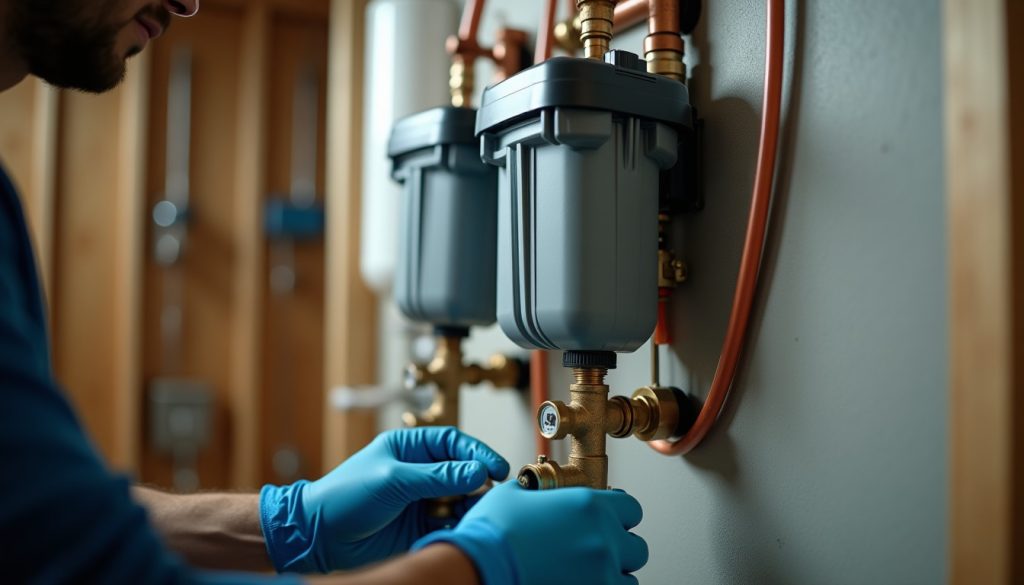
A whole house water filter installs on the main line where water enters the home, so every tap, shower, and appliance gets treated water, unlike a point-of-use filter that treats one fixture.
Key Takeaways
- A whole house (point-of-entry) filter treats all incoming water; a point-of-use filter treats only one tap, like an under-sink or reverse osmosis unit (Atlantic Blue Water Services).
- A whole house water filter typically costs $300 to $2,500 installed, with equipment alone around $1,500 to $4,500 for multi-stage systems (Angi 2026 data).
- Plan on $150 to $500 a year for replacement cartridges and media; filters get swapped every 3 to 12 months (Angi 2026 data).
- Chloramine on city water needs catalytic carbon, not standard carbon, and runs at a slower flow rate (All Filters; Pure Water Gazette).
- Size by peak flow: about 9 to 12 GPM for a 1-to-3-bathroom home and 12 to 15 GPM for 4 to 6 bathrooms (industry sizing guidance).
- Look for NSF/ANSI 42 (chlorine, taste), 53 (lead, cysts, VOCs), and 58 (reverse osmosis) certification to verify a maker’s claims (NSF).
What is a whole house water filter?
A whole house water filter is a treatment system plumbed into the main water line at the point it enters your home, which is why it is also called a point-of-entry (POE) system. Every fixture downstream gets filtered water: kitchen, bathrooms, showers, laundry, and the water heater. Most systems are one or more large tanks or big-body cartridges sized to your home’s flow. Sizing those tanks correctly matters less if you’re unsure whether you need a softener or a filter in the first place.
Inside, water passes through one or more stages of media. A sediment stage catches grit, then a carbon stage strips chlorine and taste, and optional stages handle well-water iron or bacteria. The system runs continuously with no tap to turn on, and you maintain it by swapping cartridges or backwashing media on a schedule. Before swapping cartridges becomes routine, check cloudy tap water to rule out a harmless cause before assuming your media needs attention.
Whole house filter vs point-of-use: which do you need?
The split comes down to what you want treated. A whole house (point-of-entry) filter treats all the water in the home, so it protects plumbing and appliances and handles bathing and laundry. A point-of-use (POU) filter, like an under-sink or reverse osmosis unit, treats only the water at one tap, usually the kitchen for drinking and cooking.
Whole-house systems shine at high-volume, low-difficulty jobs: chlorine taste, sediment, and well-water iron across the whole house. Point-of-use systems shine at removing dissolved contaminants like lead, nitrate, or fluoride from drinking water, where a small reverse osmosis membrane does a thorough job that a whole-house carbon tank cannot. Many homes run both: a carbon filter at the main line and a reverse osmosis unit under the kitchen sink.
The choice is not either-or. Match the tool to the contaminant and the tap that matters. If your only concern is safer drinking water, a point-of-use filter is cheaper. If chlorine smell in the shower or scale from hard water and scale bothers you, that is a whole-house or softener job.
What are the main whole house water filter types?
Whole house water filter types are defined by the media inside and the contaminant each stage targets. Real systems stack two or three of these in series: a pre-filter, a main media, and sometimes a disinfection stage. The table below pairs each type with what it removes, where it sits in the train, its upkeep, and rough cost.
| Filter type | What it removes | Stage | Lifespan / maintenance | Cost |
|---|---|---|---|---|
| Sediment pre-filter | Sand, silt, rust, particulates | Stage 1 (protects later media) | Cartridge every 3 to 6 months | $150-$400 installed alone |
| Activated carbon (GAC or block, often with KDF) | Chlorine, taste, odor, VOCs; KDF adds some heavy metals | Main stage | Cartridge 6 to 12 months; tank media several years | Core of a $1,500-$4,000 multi-stage system |
| Catalytic carbon | Chloramine (chlorine plus ammonia), hydrogen sulfide | Main stage on chloraminated city water | Media lasts several years; runs at slower flow | Comparable to carbon, sized larger |
| Iron and sulfur (oxidizing / air injection) | Iron, manganese, rotten-egg sulfur smell | Dedicated stage for well water | Media 5 to 10 years; periodic backwash | Higher; well-specific build |
| UV disinfection | Bacteria and viruses (does not remove particles or chemicals) | Final polishing stage | Lamp replaced yearly | Add-on to a filter train |
| Whole-house reverse osmosis | Dissolved solids, nitrate, fluoride, salts | Standalone point-of-entry | Membrane 2 to 5 years; wastes some water | Highest; uncommon for whole homes |
Two points trip people up. Standard activated carbon strips free chlorine well but struggles with chloramine, so cities that use chloramine call for catalytic carbon instead. And UV kills microbes but filters nothing, so it always sits after a sediment and carbon stage that clear the water first.
Do you need a whole house water filter on city water or a well?
Test your water before you buy anything. The right filter, or no filter at all, depends on what is actually in your water, and that differs sharply between a municipal supply and a private well.
On city water, your utility already treats to EPA national drinking water standards and mails you an annual Consumer Confidence Report listing what is in it. A whole-house filter here is a choice for taste, chlorine or chloramine smell, or appliance protection, not a safety requirement. Read the report, then match a filter to the specific complaint.
On a private well, the picture changes. The EPA does not regulate private wells, so no one checks your water but you. The CDC recommends testing a private well at least once a year for bacteria, nitrate, and local contaminants of concern, plus after any flooding or nearby drilling. Well results commonly point to iron, sulfur, sediment, or bacteria, which is why well systems often stack an oxidizing iron filter, sediment, and UV. Let a state-certified lab result, not a sales pitch, choose the media. Before choosing media, check public water system violation records to see how your area’s municipal supply compares. Checking your municipal report may explain black specks in water, a common follow-up question after reviewing local water quality data.
What size whole house water filter do you need?
Size a whole house water filter by peak flow in gallons per minute (GPM), not by household headcount. If several fixtures run at once and the filter cannot keep up, pressure drops across the whole house. Count bathrooms and simultaneous demand, then pick a system rated at or above that flow.
As a rough guide, a 1-to-2-bathroom home needs about 9 to 10 GPM, a 3-to-4-bathroom home about 12 GPM, and a 5-to-6-bathroom home about 15 GPM, with high-flow radial cartridge bodies handling up to 20 GPM. The chart shows the ranges commonly quoted for sizing.
Chloramine changes the math. Catalytic carbon needs contact time, so it runs at a slower flow than chlorine carbon; makers rate the same tank lower for chloramine. That means you often step up a tank size when your city uses chloramine, per sizing guidance from the trade. When in doubt, oversize slightly rather than starve your fixtures.

How much does a whole house water filter cost to buy and maintain?
A whole house water filter typically costs $300 to $2,500 installed, according to Angi 2026 data, though the range is wide because it tracks how many stages you buy. Equipment alone runs about $1,500 to $4,500 for multi-stage systems, before labor. Simpler builds cost far less than well-water systems that stack iron removal and UV.
Here is how the tiers break down, per Angi 2026 cost data:
- Basic sediment filter: $150 to $400 installed.
- Carbon or carbon-plus-KDF system for chlorine and taste: mid-range, the core of most builds.
- Multi-stage system with carbon, iron filter, and UV: $1,500 to $4,000 installed.
- Whole-house reverse osmosis: the highest tier and uncommon in homes.
Then there is upkeep. Replacement cartridges and media run $20 to $200 each, swapped every 3 to 12 months, so annual maintenance lands around $150 to $500. Bake filter changes into your seasonal plumbing maintenance checklist so a clogged sediment cartridge does not quietly choke your water pressure.
Is a whole house water filter the same as a water softener?
No. A whole house water filter and a water softener do different jobs and are not interchangeable. A filter removes contaminants like chlorine, sediment, iron, and chemicals. A softener removes only the calcium and magnesium that cause hard-water scale, using ion exchange, and does almost nothing for taste or chlorine.
If your problem is scale on fixtures, spotty glasses, and soap that will not lather, that is hardness, and a softener or conditioner is the fix. If your problem is a chlorine smell, cloudy sediment, or rotten-egg well water, that is a filter’s job. Homes with both hard and chlorinated water often install a softener and a filter in series, since neither covers the other’s work.
If you are weighing hardness treatment, our guide to water softener vs a conditioner compares the feel and upkeep of each, and what a water softener costs covers the dollars. A filter will not stop scale, and a softener will not remove chlorine, so pick by the problem you actually have.
How we sourced this
Installed cost ranges ($300-$2,500 total, $150-$400 for a sediment filter, $1,500-$4,000 for a multi-stage carbon-iron-UV system, $150-$500 annual maintenance) and the 3-to-12-month cartridge interval come from Angi 2026 cost data. Point-of-entry versus point-of-use definitions draw on Atlantic Blue Water Services. NSF/ANSI standard descriptions (42 for aesthetic claims, 53 for health contaminants, 58 for reverse osmosis, 401 for emerging contaminants) come from NSF. The chloramine-versus-carbon point and catalytic-carbon behavior come from All Filters and Pure Water Gazette sizing notes. GPM sizing bands (9-12 GPM for 1-3 baths, 12-15 for 4-6, up to 20 radial) are common industry sizing figures and are approximate. Regulatory points come from the US EPA (public water systems, private wells unregulated) and the CDC (annual private-well testing). We consulted about a dozen sources and cited the primary standards bodies and government agencies where a claim could carry one. Costs vary by region, water chemistry, and installer; treat ranges as planning figures and test your water before buying.
Frequently asked questions
What does a whole house water filter do?
A whole house water filter installs on the main water line where it enters the home, so every tap, shower, toilet, and appliance gets filtered water. Depending on the media, it can reduce chlorine, chloramine, sediment, iron, sulfur smell, and other contaminants. It is called a point-of-entry system because it treats water at the point it enters the house, not at one fixture.
Whole house filter or under-sink filter, which do I need?
It depends on your goal. A whole house (point-of-entry) filter protects plumbing and appliances and treats bathing and laundry water, which suits chlorine taste, sediment, or well-water iron. A point-of-use filter, like an under-sink or reverse osmosis unit, treats only drinking and cooking water at one tap and removes dissolved contaminants like lead or nitrate more thoroughly. Many homes use both.
What are the main types of whole house water filters?
The common stages are a sediment pre-filter for sand and rust, activated carbon (often with KDF media) for chlorine and taste, catalytic carbon for chloramine on city water, an iron and sulfur system for well water, and an optional UV lamp for bacteria. Whole-house reverse osmosis exists but is rare and expensive. Most systems combine two or three stages.
Do I need a whole house water filter?
Test your water first. On municipal water your utility already treats to EPA drinking-water standards, so a filter is a choice for taste, chlorine, or appliance protection, not a requirement. On a private well, the EPA does not regulate your water, so the CDC recommends testing yearly. The test result, not a salesperson, should decide whether you filter and what media you need.
What size whole house water filter do I need?
Size a whole house filter by peak flow in gallons per minute, not by household size alone. A 1-to-2-bathroom home typically needs about 9 to 10 GPM, a 3-to-4-bathroom home about 12 GPM, and a 5-to-6-bathroom home about 15 GPM. Undersizing drops water pressure across the house. Chloramine filters need a slower flow, so they run larger for the same home.
How much does a whole house water filter cost?
A whole house water filter typically costs $300 to $2,500 installed, per Angi 2026 data, and equipment alone runs about $1,500 to $4,500 for multi-stage systems. A basic sediment filter is $150 to $400 installed, while a carbon, iron, and UV system runs $1,500 to $4,000. Budget $150 to $500 a year for replacement cartridges and media.
Is a whole house water filter the same as a water softener?
No. A filter removes contaminants like chlorine, sediment, and iron. A water softener removes the calcium and magnesium that cause hard water and scale, using ion exchange, and does little for taste or chemicals. They do different jobs, and homes with both hard water and chlorine often install a softener and a filter in series. A filter will not stop scale, and a softener will not remove chlorine.
What NSF certifications should a whole house filter have?
Look for the NSF/ANSI standard that matches your goal. NSF/ANSI 42 covers aesthetic claims like chlorine, taste, odor, and chloramine. NSF/ANSI 53 covers health-related contaminants like lead, cysts, and VOCs. NSF/ANSI 58 covers reverse osmosis systems, and 401 covers emerging contaminants like pharmaceuticals. A certification proves the maker’s claims were independently verified.


