What Size Tankless Water Heater Do I Need?
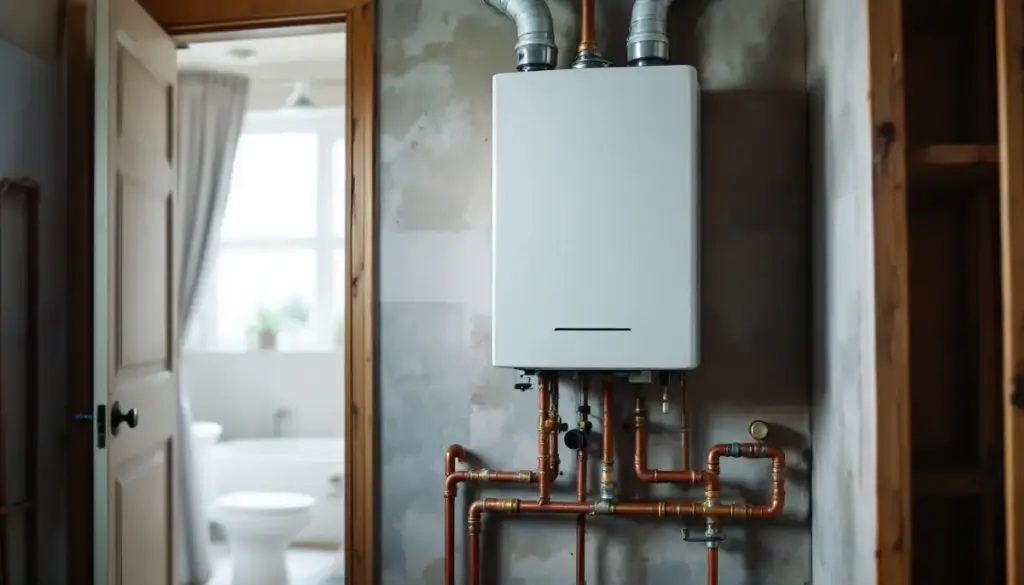
What size tankless water heater do I need for most homes? A gas unit near 199,000 Btu/h, which Rinnai rates at 4.8 gpm with 42°F groundwater and 7.9 gpm with 72°F groundwater at a 120°F setpoint.
Key Takeaways
- Size by peak flow, not house size. A 2.5 gpm shower (the federal limit in 10 CFR 430.32) plus a 2.2 gpm kitchen faucet is a 4.7 gpm peak.
- Temperature rise is setpoint minus groundwater. The U.S. Department of Energy defaults to 50°F in and 120°F out, a 70°F rise.
- Headline gpm is a warm-water number. Navien rates the 199,900 Btu/h NPE-240A2 at 11.2 gpm at a 35°F rise but 5.6 gpm at 67°F.
- Rinnai’s groundwater map gives a 199,000 Btu/h unit 4.8 gpm with 42°F water and 7.9 gpm with 72°F water.
- Whole-house electric is a warm-climate tool. Stiebel Eltron’s Tempra 36 Plus draws 150 A and needs at least 300 A service.
- WaterSense showerheads cap at 2.0 gpm per EPA, so swapping two 2.5 gpm heads cuts a two-shower peak by 1.0 gpm.
What size tankless water heater do I need?
You need a unit whose flow at your winter temperature rise meets or beats your peak simultaneous hot water draw. For most 1 to 2 bath homes that is one 160,000 to 199,000 Btu/h gas unit. Cold-climate homes with 3 or more baths often need two 199,000 Btu/h units, and electric units only cover whole houses where groundwater runs warm. Before wiring an electric model into a cold-climate panel, check electric tankless amperage and breaker requirements against your service capacity.
The math has three steps: peak gpm from fixture ratings, temperature rise from your groundwater, then the flow-versus-rise row on the maker’s spec sheet. Skip the rise and you buy from the box number, which assumes a mild 35°F rise.
This differs from tank water heater sizing by first-hour rating. A tankless unit stores nothing, so only the flow it can heat at once counts.
How many gpm does your house draw at its busiest moment?
Add the rated flow of every hot fixture that can run at the same time. The Department of Energy’s own example is a 0.75 gpm faucet plus a 2.5 gpm showerhead, a 3.25 gpm peak. Most real homes land between 3.5 and 8 gpm once you count two showers and a kitchen faucet, because federal law caps showerheads at 2.5 gpm and kitchen faucets at 2.2 gpm.
| Fixture | Federal maximum | WaterSense maximum | Typical in use (Stiebel Eltron) |
|---|---|---|---|
| Showerhead | 2.5 gpm at 80 psi | 2.0 gpm | 1.5 gpm (range 1.5 to 2.5) |
| Kitchen faucet | 2.2 gpm at 60 psi | No WaterSense criteria (EPA) | 1.5 gpm (range 1.0 to 2.2) |
| Bathroom (lavatory) faucet | 2.2 gpm at 60 psi | 1.5 gpm | 0.5 gpm (range 0.5 to 1.0) |
| Dishwasher, clothes washer | No flow standard | Not covered | Measure it (see step 4) |
Federal limits come from 10 CFR 430.32; WaterSense figures from EPA’s showerhead and bathroom faucet pages. Typical-use flows come from the Stiebel Eltron Tempra sizing guide.
- Pick your worst realistic moment, such as two showers plus the kitchen sink at 7 a.m.
- Read the gpm stamped on each showerhead face or aerator rim. Older heads made before 1994 may not meet the 2.5 gpm cap.
- Add them. Use rated numbers, not the lower typical ones, so the unit has margin.
- For a dishwasher or washer, or any fixture with no marking, time a fill into a 1-gallon bucket. DOE recommends this bucket test for unknown flow rates. A 20-second fill means 3 gpm.
- Write down the total. That is your design flow.
What temperature rise should you size a tankless water heater for?
Size for setpoint minus your coldest incoming water temperature. DOE uses 120°F as the setpoint for most uses and assumes 50°F incoming water unless you measure, a 70°F rise. Rinnai’s groundwater map shows actual zones from 35°F in the far north to 77°F at the tip of Florida, so the rise can swing from about 43°F to 85°F depending on your ZIP code.
| Rinnai map zone (example area) | Groundwater | Rise to 120°F | 199,000 Btu/h max flow | 160,000 Btu/h max flow |
|---|---|---|---|---|
| Upper Midwest, northern New England (Minneapolis) | 42°F | 78°F | 4.8 gpm | 3.2 gpm |
| Midwest middle band (St. Louis) | 52°F | 68°F | 5.6 gpm | 3.6 gpm |
| Mid-South | 62°F | 58°F | 6.6 gpm | 4.3 gpm |
| Gulf Coast | 67°F | 53°F | 7.1 gpm | 4.7 gpm |
| South Florida (Miami) | 72°F | 48°F | 7.9 gpm | 5.1 gpm |
Flows are from Rinnai’s North America groundwater temperature map (2022). Rinnai notes zones shift with season and local conditions, and lists Hawaii at 75°F and Alaska at 35°F to 42°F. Measure your own cold tap in January if you can.
Showers do not draw pure hot water, which buys some margin. The hot share of a mixed shower is (shower temperature minus groundwater) divided by (setpoint minus groundwater). At 105°F with 42°F water that is 63 divided by 78, about 81% hot. With 72°F water it falls to about 69%. Rinnai’s shower counts assume this 105°F mix and 2 gpm heads.
How do you read a tankless water heater flow chart?
Find the row for your rise on the spec sheet and read across to the model. Navien’s NPE-A2 sheet lists the 199,900 Btu/h NPE-240A2 at 11.2 gpm at a 35°F rise, 8.7 gpm at 45°F and 5.6 gpm at 67°F. Its commercial guide adds 3.9 gpm at a 100°F rise. The box number is the 35°F row.
Sources: Navien NPE-A2/S2 specification sheet (35°F, 45°F, 67°F rows) and the Navien NPE-2 commercial application guide (100°F example). Navien publishes 67°F, not 70°F, as its cold-water row.
No chart for your exact rise? Use the physics check. Flow in gpm is roughly input Btu/h times efficiency, divided by 500 times the rise (500 is 8.33 pounds per gallon times 60 minutes). For the NPE-240A2 at 0.95 and a 67°F rise, that gives about 5.7 gpm, close to Navien’s 5.6. At a 78°F rise the same math gives about 4.9 gpm, in line with Rinnai’s 4.8 gpm for its 199,000 Btu/h class.
Also note the minimum: Navien lists 0.5 gpm to fire the burner, so a trickle at a bathroom faucet may stay cold. Rinnai lists the RX199iN at 15,000 to 199,000 Btu/h with an 11.1 gpm maximum.
What size tankless water heater for a 1-2 bath vs a 3-4 bath home?
A 1 to 2 bath home usually needs one 199,000 Btu/h gas unit in cold climates and can get by with a 160,000 Btu/h unit in warm ones. A 3 to 4 bath home in a 42°F zone typically needs two 199,000 Btu/h units, while the same house in South Florida can often run on one. The worked examples below use a 120°F setpoint and Rinnai’s flow figures.
| Household scenario | Peak gpm | Rise | Unit size |
|---|---|---|---|
| 1-2 bath, Minneapolis (42°F): one 2.5 gpm shower plus 2.2 gpm kitchen faucet | 4.7 | 78°F | One 199,000 Btu/h (4.8 gpm). A 160,000 unit gives 3.2 gpm, too small. |
| 1-2 bath, Miami (72°F): same fixtures | 4.7 | 48°F | One 160,000 Btu/h (5.1 gpm), or a 36 kW electric unit |
| Family of 4, 2 bath, St. Louis (52°F): two 2.0 gpm WaterSense showers plus 1.5 gpm bathroom faucet | 5.5 | 68°F | One 199,000 Btu/h (5.6 gpm) |
| 3-4 bath, Minneapolis (42°F): two 2.5 gpm showers plus kitchen faucet | 7.2 | 78°F | Two 199,000 Btu/h units (about 9.6 gpm combined) |
| 3-4 bath, Miami (72°F): three 2.0 gpm showers plus kitchen faucet | 8.2 (6.3 hot after mixing) | 48°F | One 199,000 Btu/h (7.9 gpm); Rinnai rates it for 6 showers at 72°F |
The last row shows why mixing matters. Three 105°F showers draw only about 69% hot water at 72°F groundwater, so the true hot load is near 6.3 gpm. If one unit falls short by under 1 gpm, swap two 2.5 gpm heads for 2.0 gpm WaterSense models before buying a second heater.
Two units also cost more to buy and install. Before choosing, check what a tankless water heater costs installed, and for a big cold-climate house weigh our tankless vs tank comparison, since a large tank or hybrid can be cheaper than a cascaded pair.
Can an electric tankless water heater run a whole house?
Only in warm groundwater zones, and only with a large electric service. DOE says a 70°F rise is typically possible at 5 gpm through gas units but 2 gpm through electric ones. Stiebel Eltron’s largest Tempra, the 36 kW Tempra 36 Plus, delivers 7.5 gpm at 72°F groundwater but 3.9 gpm at 42°F, both at 105°F output.
| Stiebel Eltron model | Amp draw | Minimum service | Flow, 42°F water | Flow, 72°F water |
|---|---|---|---|---|
| Tempra 24 / 24 Plus | 100 A | 150 A | 2.6 gpm | 5.0 gpm |
| Tempra 29 / 29 Plus | 120 A | 200 A | 3.1 gpm | 6.0 gpm |
| Tempra 36 / 36 Plus | 150 A | 300 A | 3.9 gpm | 7.5 gpm |
Figures are from the Stiebel Eltron Tempra sizing guide, calculated for 105°F water at 240 V. Stiebel says to go up one model size on 208 V service. Note the 105°F basis is 15°F cooler than the 120°F gas examples above.
The power math explains the gap. 36 kW is about 122,800 Btu/h, roughly 61% of a 199,900 Btu/h gas burner. Heating 42°F water to 120°F, a 78°F rise, that works out to about 3.1 gpm, barely more than one full-flow shower. A home on a 100 or 200 A panel falls short of the 300 A Stiebel lists, so the service itself may need an upgrade before the heater goes in.
What happens if a tankless water heater is too small or too big?
Too small and the second shower goes lukewarm, or the unit throttles flow to hold temperature. Too big mostly costs money, since a 199,000 Btu/h unit modulates down to its minimum firing rate (15,000 Btu/h on Rinnai’s RX199iN). The real risk of a big unit is the gas supply it needs, not its water output.
Undersizing looks like a broken heater. If the water runs hot with one fixture open and fades when a second opens, the unit is at capacity, not failing. If hot water drops out at low flow or throws error codes, troubleshoot with our guide to a tankless water heater not working before you replace anything.
A 199,000 Btu/h burner only reaches its rated flow if the gas line feeds it. Navien’s sheet calls for 3.5 to 10.5 inches water column natural gas supply pressure at a 3/4 inch inlet, and the NPE-240A2 vents through 2 inch pipe. Your installer sizes the gas pipe from your local fuel gas code tables using pipe length and every appliance on the line, so get that check in the quote.
How we sourced this
We read the top-ranking sizing guides for this query, then built every number from primary documents: the Navien NPE-A2/S2 specification sheet and NPE-2 commercial application guide, Rinnai’s 2022 North America groundwater temperature map and RX199iN product page, Stiebel Eltron’s Tempra sizing guide (its DHX Select guide was consulted for zone temperatures, not cited), EPA WaterSense showerhead and bathroom faucet pages, the text of 10 CFR 430.32, and the Department of Energy’s Energy Saver sizing page (the live page was offline in October 2026, so we read the archived version). We excluded retailer and calculator-site flow figures that we could not trace to a manufacturer document. Worked-example arithmetic and the 500 constant check are our own calculations from those published numbers.
Frequently asked questions
What size tankless water heater do I need for a family of 4?
Most families of four in a 2-bath home need a 199,000 Btu/h gas unit. Two WaterSense showers at 2.0 gpm plus a 1.5 gpm bathroom faucet add up to 5.5 gpm. With 52°F groundwater and a 120°F setpoint, Rinnai’s chart gives a 199,000 Btu/h unit 5.6 gpm, just enough. In a 42°F zone the same unit drops to 4.8 gpm, so stagger showers or add a second unit.
How many gpm tankless water heater do I need?
Add the rated flow of every hot fixture that runs at the same moment. A federal-limit showerhead is 2.5 gpm and a kitchen faucet 2.2 gpm, so one shower plus dishes is 4.7 gpm. Then check the unit’s flow at your winter temperature rise, not its headline number. Navien’s NPE-240A2 delivers 11.2 gpm at a 35°F rise but only 5.6 gpm at 67°F.
Is a 199,000 BTU tankless water heater enough for 2 showers?
Usually yes. Rinnai’s groundwater chart rates a 199,000 Btu/h unit for 3 simultaneous 2 gpm showers even with 35°F to 42°F groundwater, assuming a 120°F setpoint and 105°F at the showerhead. In 72°F groundwater the same unit supports 6. Two 2.5 gpm showers plus a running kitchen faucet in a cold zone can exceed it.
Can an electric tankless water heater supply a whole house?
In warm climates, often yes. In cold ones, rarely. Stiebel Eltron rates its 36 kW Tempra 36 Plus at 7.5 gpm with 72°F groundwater but 3.9 gpm with 42°F groundwater, both at 105°F output. It draws 150 amps and Stiebel Eltron calls for at least 300 amp electric service, which many older homes do not have.
What happens if a tankless water heater is too small?
When demand passes the unit’s capacity at your rise, it either lets the outlet temperature fall or, on models with flow control, throttles the flow to hold the setpoint. Either way the second shower runs lukewarm or weak. The fix is fewer simultaneous fixtures, lower-flow heads, a second unit, or a larger one with an upgraded gas line.
How do I find my groundwater temperature?
Run the cold tap for a few minutes in winter and hold a thermometer in the stream, a method the Department of Energy suggests. If you cannot measure, use a manufacturer zone map. Rinnai’s map runs from 35°F in the far north to 77°F at the southern tip of Florida. The DOE default is 50°F when you have nothing better.
Should I size a tankless water heater for 120°F or 140°F?
Size for 120°F unless an appliance needs hotter water. The Department of Energy uses 120°F for most uses and 140°F only for dishwashers without internal heaters, and warns that 140°F raises scald risk. Going from 120°F to 140°F adds 20°F to the rise, which on a 199,000 Btu/h unit cuts deliverable flow by roughly a fifth or more.