Toilet Tank Sweating: Why It Happens and How to Stop It
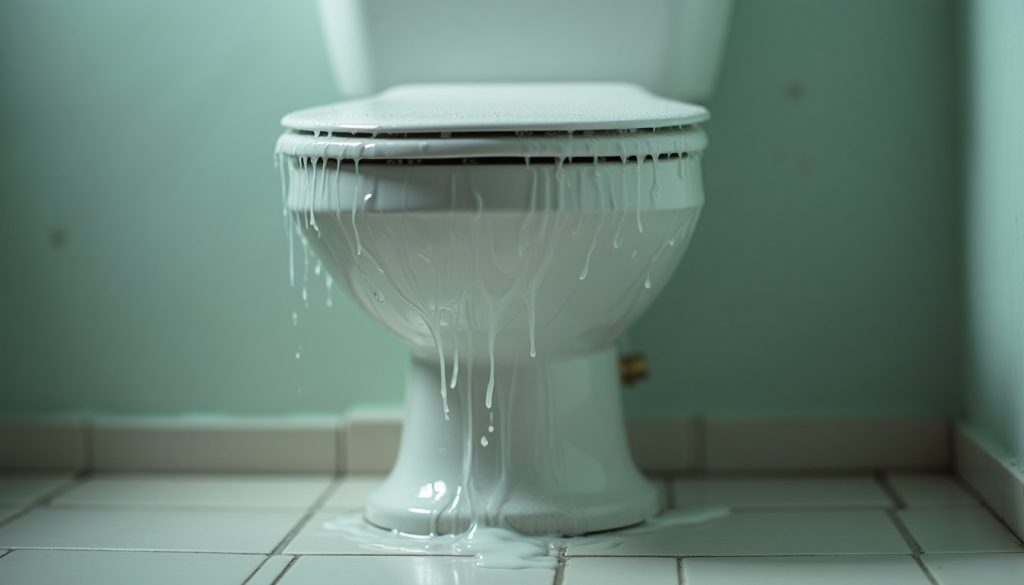
Toilet tank sweating happens when cold refill water chills the porcelain below the dew point of warm, humid bathroom air, so the fix is drier air, a tank that stops refilling, an insulated tank, or warmer tank water.
Key Takeaways
- A 75°F bathroom at 50% relative humidity has a dew point near 55°F, so any tank surface colder than that collects water (Magnus formula, as used in National Weather Service dew point calculators).
- The Home Ventilating Institute (HVI) recommends running the bath fan for 20 minutes after using the bathroom and sizing it at 1 CFM per square foot for rooms up to 100 square feet.
- The EPA recommends keeping indoor humidity below 60%, ideally 30% to 50%, and drying wet materials within 24 to 48 hours to keep mold from growing.
- A running toilet keeps the tank cold all day. EPA WaterSense says food coloring that reaches the bowl within 10 minutes means a leak.
- Watts sells the Series WAS anti-sweat valve, which mixes hot water into the cold supply to temper the tank water.
- Kohler builds an Insuliner tank liner into Cimarron, Wellworth, and Highline tanks, and American Standard sells a lined Colony 3 tank, both aimed at condensation.
What causes toilet tank sweating?
Toilet tank sweating is condensation. Every flush refills the tank with water straight from the cold line, and that water cools the porcelain wall. When the outer surface drops below the dew point of the bathroom air, moisture in the air turns to liquid on the tank, beads up, runs down, and drips off the bottom edge onto the floor.
Two numbers decide whether it happens. One is how cold the tank surface gets, which depends on the supply water temperature and how often the tank refills. The other is the dew point of the room, which rises with both air temperature and relative humidity.
That is why a tank can look dry at noon and drip after the evening shower. The same physics explains why cold water pipes sweat in a humid basement.
When is toilet tank sweating worst?
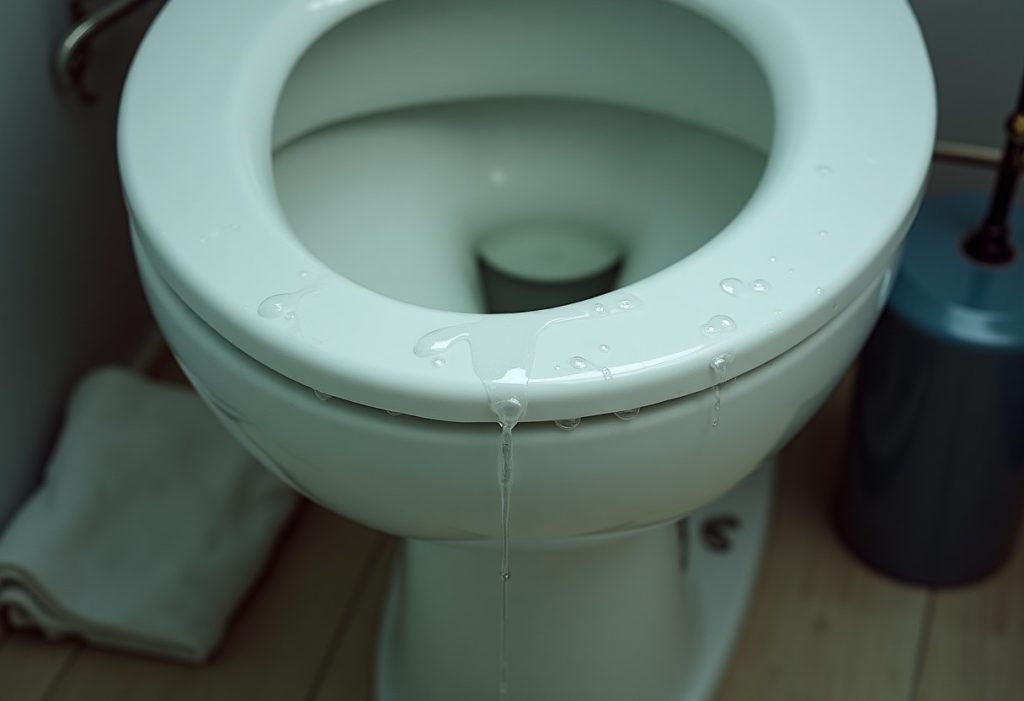
Toilet tank sweating peaks in humid summer weather, right after showers, and any time the toilet runs. Summer air carries more moisture, a hot shower can push a small bathroom close to 100% relative humidity in minutes, and a toilet that keeps refilling never lets the tank warm up. Stack all three and the floor stays wet.
The chart shows how fast the dew point climbs in a 75°F bathroom. At 40% humidity the air would need a surface below about 49°F to condense. At 70% the threshold is about 65°F, warmer than the supply water in much of the country during the cooling season.
Source: dew points calculated by The Plumbing Brief with the Magnus approximation used in National Weather Service dew point calculators, at a fixed 75°F air temperature, rounded to the nearest degree.
Read it as a rule of thumb. If your tank water sits at 55°F, the tank will start to sweat once a 75°F room passes roughly 50% humidity. Bring the room back toward the 30% to 50% band the EPA recommends and the sweating usually fades on its own.
Is it toilet tank condensation or a leak?
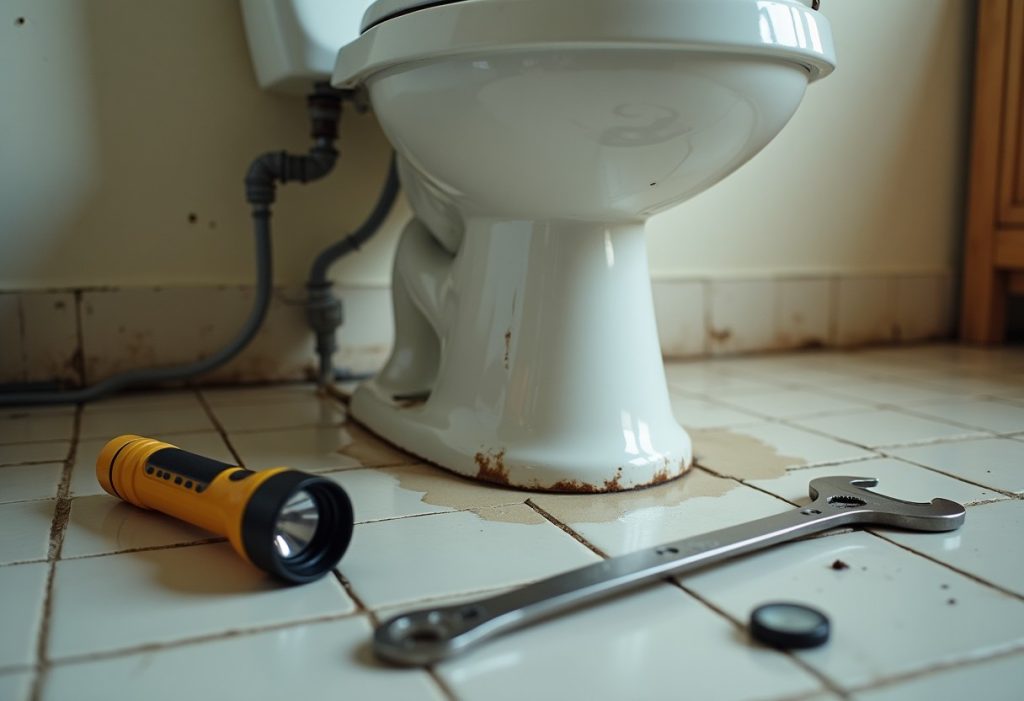
Condensation forms evenly over the tank below the waterline and disappears when you wipe it and the room dries out. A leak shows up in one spot, keeps coming back even in dry air, and often appears after a flush. A ten minute check with a towel, a flashlight, and food coloring tells you which one you have.
- Dry everything. Wipe the tank, bowl, supply line, shutoff valve, and floor completely dry with a towel.
- Watch where water returns. Beads that come back across the whole tank face point to sweat. A single drip line from one corner points to a leak.
- Check the tank bolts. Run a dry tissue under the two or three bolts that hold the tank to the bowl. A wet tissue after a flush means worn bolt washers or a failing tank-to-bowl gasket.
- Check the supply line. Wrap tissue around the compression nut at the shutoff valve and the coupling nut under the tank. Wet tissue means a loose nut or a worn supply line.
- Check the base. Water that appears at the floor line after a flush, with a dry tank above it, usually means the wax ring has failed.
- Run the dye test. EPA WaterSense says to put a few drops of food coloring in the tank and wait 10 minutes. Color in the bowl means the flapper is leaking.
If the drip traces back to the tank itself, a hairline crack, or the bolts, work through our guide to a toilet tank that is actually leaking before treating it as sweat.
Where is the water on the floor around the toilet coming from?
Water on the floor around a toilet has five common sources, and its location usually names the culprit. Sweat drips from the front and sides of the tank. Leaks pool at the back near the bolts or supply, or seep out from under the base. Use the table to match the spot to the likely cause and the fix.
| Where the water is | Likely cause | Fix |
|---|---|---|
| Beads all over the tank below the waterline, drips off the bottom edge | Condensation (sweat) | Lower humidity with the bath fan, fix any running toilet, add a liner or anti-sweat valve |
| Drip from under the tank at the bolts, after a flush | Worn tank bolt washers or tank-to-bowl gasket | Replace the bolt kit and gasket |
| Wet supply line, shutoff valve, or coupling nut | Loose compression nut or aging supply line | Snug the nut a quarter turn, replace the braided supply line |
| Water seeping from under the base, dry tank above | Failed wax ring or a rocking toilet | Pull the toilet, replace the wax ring, shim if needed |
| Constant trickle in the bowl and a tank that sweats nonstop | Running toilet from a worn flapper or fill valve | Replace the flapper (WaterSense says at least every five years) or fill valve |
| Water on one side, crack line visible in the porcelain | Cracked tank | Replace the tank, since cracks in vitreous china cannot be reliably sealed |
Base leaks deserve fast attention. If the water starts at the floor line, our guide to a toilet leaking at the base walks through the wax ring swap and the flange check.
How do you stop toilet tank sweating for good?
Stop toilet tank sweating by working from the cheapest fix up. First dry the air with the exhaust fan, then stop any running toilet, then insulate the tank from the inside, and only then add an anti-sweat valve or a new insulated-tank toilet. Most bathrooms are fixed by the first two steps, which cost little or nothing.
- Run the exhaust fan longer. HVI recommends leaving the bath fan on for 20 minutes after using the bathroom, and a timer switch makes that automatic. Check the size too. HVI’s rule is 1 CFM per square foot for bathrooms up to 100 square feet, and for larger rooms 50 CFM for each shower.
- Fix a running toilet. A flapper that leaks makes the tank refill with cold water around the clock. Replace the flapper or fill valve and the tank can warm toward room temperature between flushes.
- Dry the house air. Run central air or a dehumidifier in muggy weather and aim for the EPA’s 30% to 50% band.
- Install a tank liner kit. Foam panels glued to the inside walls of a drained, fully dried tank keep the cold water off the porcelain. The bond fails if the tank is damp, so let it dry overnight.
- Add an anti-sweat valve. A tempering valve blends some hot water into the fill line so the tank water sits above the dew point. This needs a hot line within reach.
- Use a drip tray as a stopgap. A plastic tray that clips under the tank catches drips and protects the floor while you work on a real fix.
Does an anti sweat toilet valve work?
An anti sweat toilet valve works by mixing hot water into the cold fill line, so the tank refills with tempered water warm enough to stay above the room’s dew point. Watts describes its Series WAS valve as preventing condensation on the outside of the toilet and tempering the water inside the tank. It is the most direct fix when ventilation is not enough.
The Watts WAS anti-sweat valve has a cast brass body with compression or IPS connections. Other versions come from B and K Industries and Homewerks, and the Homewerks valve lists built-in check valves to keep hot and cold from crossing over plus adjustable temperature.
Three practical points before you buy:
- You need hot water nearby. Most installs tee off a vanity hot line. A toilet on an outside wall with no hot line close by turns this into a bigger job.
- Pick an adjustable model. Being able to throttle or shut off the hot side lets you turn it down in dry months and save water heating energy.
- It is not a shower valve. A thermostatic mixing valve holds a set outlet temperature for scald protection. An anti-sweat valve only takes the chill off the fill water, and local code may set rules for cross-connections, so check before you cut in.
Should you buy an insulated-tank toilet?
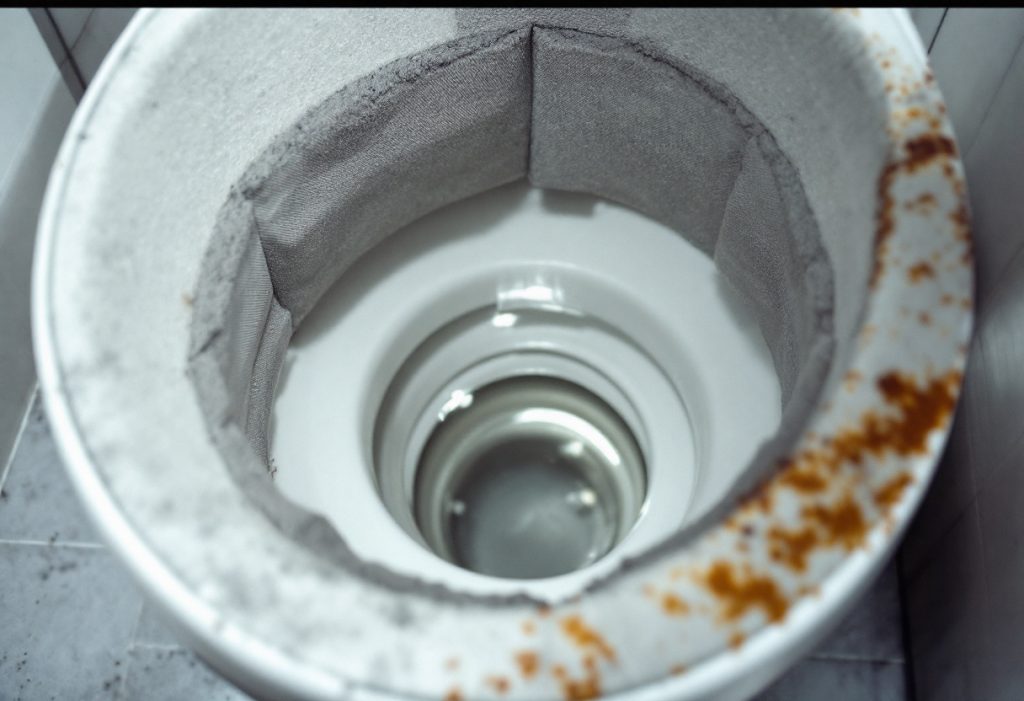
An insulated-tank toilet makes sense when you are replacing the toilet anyway and the bathroom sweats every summer. Major makers build a liner into select tanks at the factory, which keeps cold water off the porcelain wall without any field gluing. It does not help a room that is simply too humid, so fix the ventilation as well.
Kohler’s spec sheets for the Cimarron K-4421-U tank list an Insuliner tank liner that minimizes condensation on the tank, and the same liner appears on Wellworth and Highline tanks such as the K-44467-U. American Standard’s Colony 3 lined tank uses a lining to reduce condensation on the outside.
Why does water on the floor around a toilet matter?
Water on the floor around a toilet matters because a slow daily drip keeps the same patch of floor wet for months. That moisture wicks under vinyl and into seams, swells particleboard underlayment, softens the subfloor around the flange, and can loosen the wax ring seal. The repair bill grows quietly while the drip looks harmless.
The EPA says wet materials dried within 24 to 48 hours usually will not grow mold. A sweating tank resets that clock every day, so the area around the base never fully dries. Watch for these signs:
- Dark staining or lifting at the vinyl or tile grout line in front of the bowl.
- A floor that flexes when you stand next to the toilet.
- A toilet that rocks, which can break the wax ring seal and start a real leak.
- A musty smell that comes back after cleaning.
Any of those means pulling the toilet to check the flange and subfloor.
How we sourced this
We reviewed the top ranking guides for toilet tank sweating and the People Also Ask questions in October 2026, then cited primary sources only. Ventilation guidance comes from the Home Ventilating Institute. Humidity and drying guidance comes from the EPA mold guide. Leak testing and household leak figures come from EPA WaterSense. Product claims come from Watts, Kohler, and American Standard pages. Dew points are our calculation with the Magnus approximation at 75°F. We excluded installed prices, because no primary source we found publishes current costs for anti-sweat valves or liner kits.
Frequently asked questions
Is it normal for a toilet tank to sweat?
A little sweating on a hot, sticky day or right after a long shower is normal physics, not a defect. Cold refill water chills the porcelain, and humid air condenses on it. It stops being normal when the tank drips every day, when it sweats in a dry room, or when the floor stays wet long enough to stain, soften, or smell.
How do I stop my toilet tank from sweating?
Work from cheapest to most involved. Run the exhaust fan during the shower and for 20 minutes after, as the Home Ventilating Institute advises. Fix any running toilet so the tank stops refilling with cold water. If it still drips, add a foam tank liner kit, then consider an anti-sweat valve that blends hot water into the fill line.
Can a sweating toilet damage the floor?
Yes. A tank that drips a few ounces a day keeps the floor around the base wet for weeks at a time. Water can wick under vinyl, swell particleboard or plywood underlayment, soften the subfloor near the flange, and feed mold. The EPA says damp materials should be dried within 24 to 48 hours to keep mold from growing.
Does a running toilet make the tank sweat more?
It does. A toilet that leaks past the flapper refills all day, so fresh cold water keeps chilling the tank and the porcelain never warms to room temperature. Put a few drops of food coloring in the tank and wait 10 minutes, as EPA WaterSense advises. Color in the bowl means a leaking flapper that is wasting water and feeding the sweat.
Are anti sweat toilet valves worth it?
They are worth it when the bathroom stays humid despite good ventilation and a hot water line runs nearby. The valve blends a small amount of hot water into the cold fill line so the tank water sits above the dew point. The tradeoffs are plumbing work, a little water heating energy, and a valve you should turn down in dry months.
Will a toilet tank cover stop condensation?
A fabric tank cover absorbs some moisture and hides beads on the outside, but it does not stop the porcelain from getting cold. In a very humid room the cover gets damp, drips anyway, and can grow mildew. An inside liner that insulates the tank wall, or warmer tank water from an anti-sweat valve, addresses the cause instead.
Why is my toilet sweating in winter?
Winter supply water is often colder than summer water, so the tank surface drops further below room temperature. If a whole house humidifier, long hot showers, or drying laundry push bathroom humidity up, the dew point rises to meet that cold porcelain. Turn the humidifier down, run the bath fan, and check that the toilet is not running.


