Thermostatic Mixing Valve: How It Works, ASSE Standards, Scald Data, and Cost
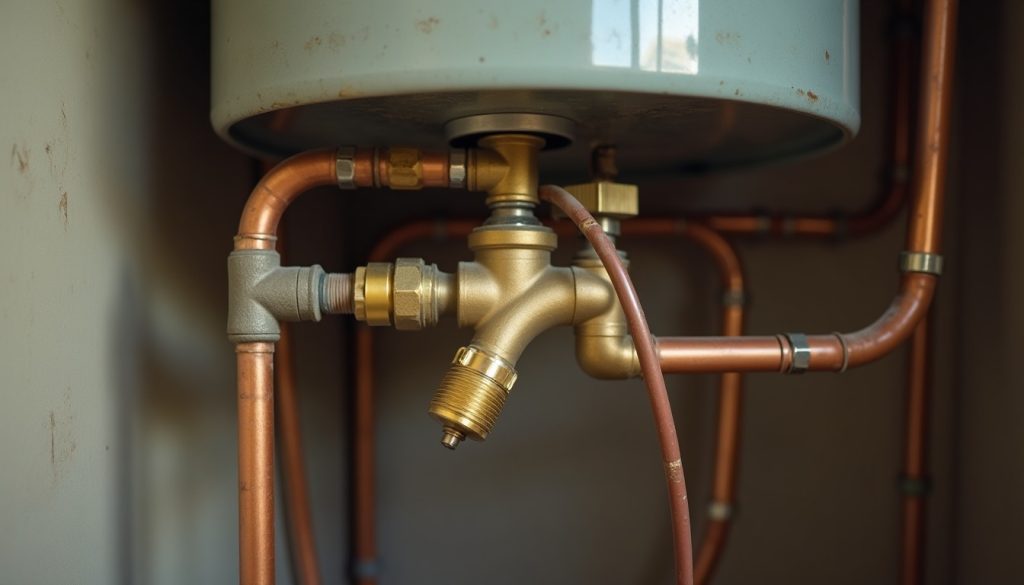
A thermostatic mixing valve blends hot and cold water to a fixed safe temperature, so you can store water at 140°F to curb Legionella and still deliver about 120°F at the tap.
Key Takeaways
- The CDC says Legionella grows best between 77°F and 113°F and advises storing hot water above 140°F (CDC Legionella Control Toolkit).
- At 140°F, water can cause a third-degree burn in about 5 seconds; at 122°F it takes about 5 minutes (CPSC data cited by A.O. Smith).
- U.S. hospitals logged 52,088 emergency visits and 7,270 admissions for tap water scalds in 2016 to 2018, per a 2023 study in Injury Prevention.
- ASSE 1017 valves go at the water heater; ASSE 1070 valves go at the fixture and cap output at 120°F; ASSE 1016 covers shower valves (Caleffi, Watts).
- The International Plumbing Code (Section 613.1) requires ASSE 1017 temperature-actuated mixing valves to be installed at the hot water source.
- Raising a 50-gallon tank from 120°F to 140°F behind a mixing valve yields roughly 31% more shower-temperature water (Plumbing Brief mixing calculation).
What is a thermostatic mixing valve?
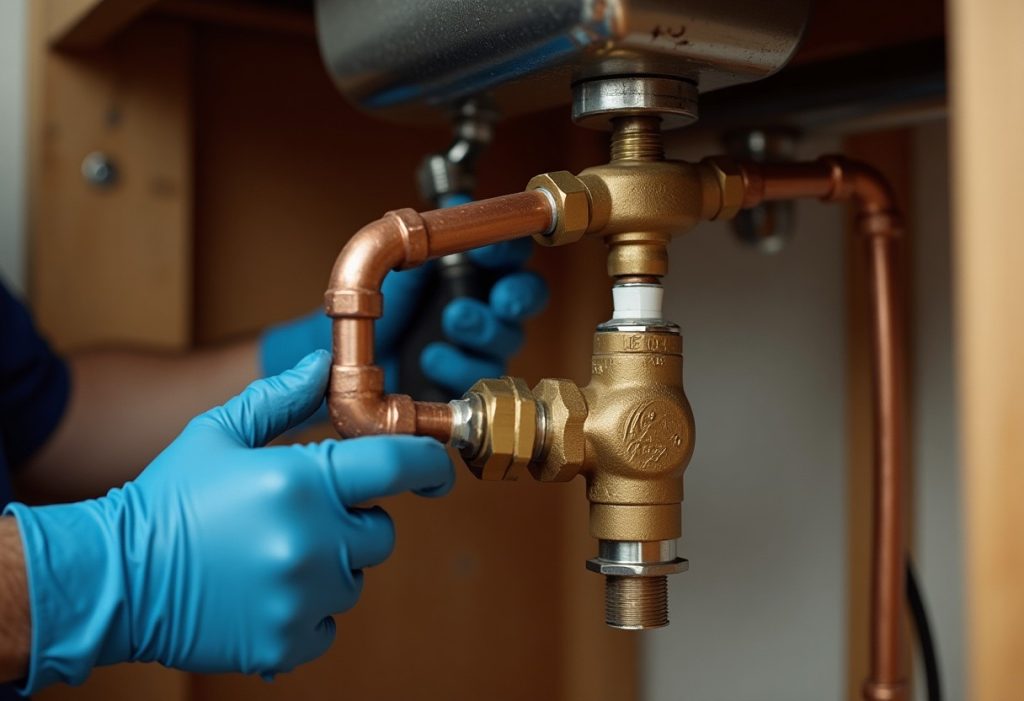
A thermostatic mixing valve is a three-port valve with a hot inlet, a cold inlet, and one mixed outlet. A temperature-sensing element inside it adjusts how much hot and cold water passes so the outlet holds a set temperature, even when the incoming hot water or the demand changes. Plumbers also call it a tempering valve or an anti-scald valve.
It sits in the same family as the other blending and control devices covered in our guide to the main types of plumbing valves, but its job is narrow.
You will find two broad versions in homes. A whole-house valve sits at the water heater outlet and tempers everything that leaves the tank. A point-of-use valve sits near a single sink, tub, or group of fixtures and limits temperature right before the water reaches skin.
How does a thermostatic mixing valve work?
A thermostatic mixing valve works through a sensing element, usually a wax capsule or bimetal coil, that sits in the mixed water stream. When the outlet runs hot, the element expands and pushes a shuttle that narrows the hot port and opens the cold port. When the outlet cools, the element contracts and the shuttle moves back. The correction happens continuously, in seconds.
The setpoint comes from a cap or knob that preloads the element against a spring. Most residential valves lock it with a cap or set screw so nobody can spin it to scalding.
- Hot water enters from the water heater outlet at storage temperature, often 130 to 140°F or higher.
- Cold water enters from a tee off the cold supply, typically 40 to 70°F depending on season and region.
- The element reads the blend in the mixing chamber and repositions the shuttle.
- Tempered water exits to the house plumbing at the setpoint, commonly near 120°F.
Why store water at 140°F and temper it at the tap?
Because the temperature that kills Legionella is hot enough to burn people. The CDC says Legionella grows best between 77°F and 113°F and recommends storing hot water above 140°F, with circulating hot water not falling below 120°F. A thermostatic mixing valve resolves the conflict: the tank stays hot enough for bacteria control, and the faucet stays cool enough for skin.
The CDC guidance appears in its Legionella control toolkit for potable water systems, which is written for building water management programs. Single-family homes are lower risk, but households with someone the CDC flags as higher risk (aged 50 or older, a current or former smoker, or living with chronic lung disease or a weakened immune system) often store water hotter for the same reason.
The U.S. Department of Energy recommends 120°F for most household water heaters, mainly for energy and scald reasons. Our breakdown of the right water heater temperature setting covers that tradeoff in detail. A mixing valve is what lets you choose 140°F storage without accepting 140°F at the tap.
How fast does hot water scald at each temperature?
Faster than most people expect, and the curve is steep. Water at 122°F takes about 5 minutes to cause a third-degree burn on adult skin, while 140°F does it in about 5 seconds and 154°F in about 1 second. Those figures come from a 1978 Consumer Product Safety Commission memo built on the Moritz and Henriques burn research, as reproduced in A.O. Smith Technical Bulletin 34.
Bars are drawn to scale. The 140°F bar barely registers, which is the whole case for a mixing valve on a hot tank. Children and older adults burn faster than these adult-skin figures.
| Water temperature | Time to a third-degree burn (adult skin) | What it means at the tap |
|---|---|---|
| 116°F | About 45 minutes | Comfortable bath range; very low scald risk |
| 122°F | About 5 minutes | Near the common 120°F mixing valve setpoint |
| 131°F | About 25 seconds | A child stuck in a tub can be badly burned |
| 140°F | About 5 seconds | Legionella storage target; unsafe untempered |
| 149°F | About 2 seconds | Common on overheated or failed thermostats |
| 154°F | About 1 second | Severe hazard at any fixture |
The human cost shows up in hospital data. A 2023 study in Injury Prevention, summarized by BMJ, counted 52,088 emergency visits, 7,270 admissions, and 110 hospital deaths from tap water scalds in 2016 to 2018. The average emergency visit cost $572 and the average inpatient stay cost $28,431, about $78.8 million a year in direct care. The authors pointed to thermostatic mixing valves as a prevention measure.
ASSE 1017 vs 1070 vs 1016: which thermostatic mixing valve standard applies?
The listing on the valve decides where it can legally go. ASSE 1017 covers point-of-distribution valves installed at the water heater. ASSE 1070 covers point-of-use temperature limiting devices at sinks, lavatories, and tubs, capped at 120°F. ASSE 1016 covers the anti-scald valves built into individual showers and tub-shower combinations. One valve type does not substitute for another.
The trap many installers fall into is assuming a 1017 valve at the heater handles scald protection everywhere. Caleffi’s technical team notes that 1017 valves can be adjusted well above 120°F, up to about 150°F on some models, and that they are not designed to provide anti-scald service at fixtures. A 1070 device, by contrast, cannot be set above 120°F.
| Standard | Where it goes | Outlet range and accuracy | Cold-supply failure test | Typical use |
|---|---|---|---|---|
| ASSE 1017 | Point of distribution: water heater or boiler outlet | Adjustable range of at least 105 to 120°F; plus or minus 3 to 7°F by valve size (Watts) | None required | Whole-house tempering; lets the tank run at 140°F |
| ASSE 1070 | Point of use: sinks, lavatories, tubs, small fixture groups | Cannot be set above 120°F (Caleffi); plus or minus 7°F (Watts) | Flow must drop to a trickle before 120°F | Tub fillers, public hand sinks, final scald barrier |
| ASSE 1016 | Inside individual shower and tub-shower valves | 120°F maximum limit stop; plus or minus 3.6°F for Type P and T/P | Under 0.5 gpm within 5 seconds before 120°F | Every new residential shower valve |
| ASSE 1069 | Gang showers and group fixtures | About 100 to 115°F, installer adjusted (Watts) | Reduced flow required | Gyms, dorms, institutional showers |
Figures come from the Watts ASSE standards comparison and IAPMO’s ASSE guidelines for temperature control devices. Standard editions update over time, so check the current listing on the valve itself. For the shower side, our comparison of pressure-balance and thermostatic shower valves explains Type P, Type T, and Type T/P in depth.
Where should a thermostatic mixing valve be installed?
A whole-house thermostatic mixing valve belongs on the hot outlet of the water heater, within a few feet of the tank, with a cold branch teed from the cold supply before the heater. Point-of-use valves go under the sink, behind the tub filler, or in an access panel near the fixture. Every valve needs to stay accessible for adjustment, testing, and cartridge service.
- Shut off the water and the heater. Turn the gas valve to pilot or switch off the breaker, close the cold supply, and drain pressure from a nearby faucet.
- Cut in the hot inlet. Connect the tank’s hot outlet to the valve’s hot port, usually marked H.
- Tee the cold inlet. Run a branch from the cold supply line to the port marked C, upstream of any heater inlet connections.
- Add check valves if the valve lacks them. Many residential models have integral checks; without them, hot and cold can cross over between fixtures.
- Pipe the mixed outlet to the house. Keep a heat trap or downward loop between the tank and valve if the manufacturer calls for one, to limit thermosiphoning.
- Set and verify. Restore water and power, run the nearest tap for a couple of minutes, read it with a thermometer, and adjust the cap until it reads the target.
Homes with a recirculation loop need extra care: pipe the return per the valve maker’s diagram, or the loop can overheat the mixed side.
Does code require a thermostatic mixing valve?
Model codes require temperature limiting at specific fixtures, not a mixing valve on every water heater. Showers need an ASSE 1016 valve with a 120°F limit, and bathtub fillers generally need an ASSE 1070 device limiting water to 120°F. Where a building uses a central tempering valve, the IPC requires it to meet ASSE 1017 and sit at the hot water source. Local amendments vary.
Some states and cities go further. Several jurisdictions have adopted or debated amendments that require a mixing valve when a heater is set above 120°F or on every new water heater install, so the rule in your area may be stricter than the model code. Our rundown of water heater code requirements covers the expansion tank, T&P valve, drip pan, and permit rules that apply on the same job.
- Public hand-washing sinks: the IPC calls for tempered water through an ASSE 1070 device, limited to a maximum of 110°F in many adopted editions.
- Single-family homes: in many areas a mixing valve is optional unless the tank is set above 120°F or the local code says otherwise.
How much does a thermostatic mixing valve cost, and how long does it last?
A residential whole-house thermostatic mixing valve is a modest part, and labor drives most of the bill. In one documented DIY install by the Learn to DIY channel, the valve cost about $107 and the job took roughly 90 minutes. Expect a plumber’s invoice to add hourly labor plus any local permit fee for water heater work.
The valve also buys back capacity. With 55°F inlet water and a 105°F shower, the standard mixing equation shows a 50-gallon tank at 140°F delivers roughly 31% more shower-temperature water than at 120°F, which can delay an upgrade to a bigger tank.
| Tank temperature | Hot share of a 105°F mix (55°F inlet) | Shower-temperature gallons from 50 stored gallons |
|---|---|---|
| 120°F | About 77% | About 65 gallons |
| 130°F | About 67% | About 75 gallons |
| 140°F | About 59% | About 85 gallons |
Valve life depends mostly on water hardness. Scale builds on the shuttle and seats, and the element can drift after years of cycling. Watch for these signs:
- Lukewarm water even though the tank is hot, often a stuck shuttle or crossed check valve.
- Temperature that swings when another fixture opens.
- Tap readings well above the setpoint, which means the valve is no longer limiting and needs service or replacement.
Test the outlet temperature at the nearest tap at least once a year, and more often in hard-water areas.
How we sourced this
We consulted 14 sources and cited 9: the CDC Legionella Control Toolkit for potable water, A.O. Smith Technical Bulletin 34 (which reproduces 1978 CPSC burn-time data from the Moritz and Henriques research), the 2023 Injury Prevention tap water scald study via BMJ, the Watts ASSE standards comparison, IAPMO’s ASSE guidance for temperature control devices, Caleffi technical commentary on ASSE 1017 and 1070, the Learn to DIY install demonstration, U.S. Department of Energy water heating guidance, and the International Plumbing Code. Burn times are for adult skin; we used one dataset throughout. The 31% capacity figure is our own calculation from the standard mixing equation with stated inlet and shower temperatures. The $107 valve price is a single documented install, not a market average. We excluded patents, unsourced contractor blogs, and non-U.S. codes. Research window: September to October 2026.
Frequently asked questions
Do I need a thermostatic mixing valve on my water heater?
You need one if you store water above about 120°F, which many homes do to curb Legionella or stretch tank capacity. The CDC advises storing hot water above 140°F, and at 140°F water can cause a third-degree burn in about 5 seconds. A thermostatic mixing valve at the heater lets you keep the tank hot while sending tempered water to the house. Some jurisdictions also require one on new installs.
What temperature should a thermostatic mixing valve be set to?
Most homes set the outlet near 120°F, the figure the U.S. Department of Energy recommends for household hot water. Go lower, around 110 to 115°F, if young children or older adults with thin skin live there. Keep the tank itself at or above 140°F if Legionella control is the reason you installed the valve. Always confirm the setting with a thermometer at the nearest tap after adjusting.
Can a thermostatic mixing valve fail?
Yes. Scale and sediment can stick the internal shuttle, and the thermostatic element can drift over years of cycling, which shows up as lukewarm water, temperature swings, or water that runs too hot. Point-of-use valves listed to ASSE 1070 are tested to cut flow to a trickle if the cold supply fails, but point-of-distribution ASSE 1017 valves carry no such test. Check outlet temperature at least once a year.
What is the difference between a mixing valve and a tempering valve?
In everyday plumbing talk the two names describe the same job: blending hot and cold water to a lower, steadier outlet temperature. Tempering valve usually means a valve at the water heater, while mixing valve can also mean a point-of-use device under a sink or tub. What matters on the job is the ASSE listing on the valve, 1017 for distribution or 1070 for point of use.
Does a thermostatic mixing valve give you more hot water?
It stretches usable hot water when you raise the tank temperature. With 55°F inlet water and a 105°F shower, 50 gallons stored at 120°F yields about 65 gallons of shower-temperature water, while the same tank at 140°F yields about 85 gallons, roughly 31% more, by the standard mixing equation. The valve keeps the tap temperature safe while the tank runs hotter. Colder inlet water reduces the gain.
Where is a thermostatic mixing valve located?
A whole-house valve sits on the hot outlet of the water heater, usually within a few feet of the tank, with a cold branch teed in from the supply line. Point-of-use valves sit under a sink, behind a tub filler, or in a utility chase close to the fixture they serve. A shower’s own anti-scald protection lives inside the shower valve body in the wall.
Can I install a thermostatic mixing valve myself?
Many homeowners can physically install a residential valve with sweat, PEX, or threaded union fittings in an hour or two. The catch is that work on a water heater often requires a plumbing permit, and some jurisdictions only let licensed plumbers pull it. The valve must also be the right ASSE listing, piped to the manufacturer’s diagram, and checked with a thermometer at the tap after setup.
Is a pressure-balance valve the same as a thermostatic mixing valve?
No. A pressure-balance shower valve reacts to changes in hot and cold supply pressure, such as a toilet flush, but does not read temperature. A thermostatic valve reads the mixed water temperature with a wax or bimetal element and adjusts the blend. ASSE 1016 covers both types for showers, labeled Type P for pressure balance, Type T for thermostatic, and Type T/P for combination valves.