Schedule 40 vs Schedule 80 PVC: Pressure Ratings, Wall Thickness, and Which to Use
Schedule 40 vs Schedule 80 PVC comes down to wall thickness. Both share the same outside diameter, but Schedule 80’s thicker wall raises the pressure rating about 40 to 56 percent by size and narrows the bore.
Key Takeaways
- ASTM D1785 sets the same outside diameter for both schedules at each size, such as 0.840 inch for 1/2-inch pipe, so the two fit the same fittings.
- Harvel rates 1/2-inch PVC at 600 psi in Schedule 40 and 850 psi in Schedule 80 at 73 degrees F, and both ratings fall as pipe size rises.
- Charlotte Pipe multiplies PVC pressure ratings by 0.62 at 100 degrees F and 0.22 at 140 degrees F, the top service temperature for PVC.
- Charlotte Pipe rates threaded PVC at 50 percent of a solvent-cemented system, and Harvel says only Schedule 80 or heavier wall should be threaded.
- Boshart says Schedule 40 and 80 PVC fittings should carry no more than 60 percent of the rating of the matching pipe.
- Using Harvel’s inside diameters, 1/2-inch Schedule 80 has about 24 percent less flow area than Schedule 40, and 2-inch about 13 percent less.
What is the difference between Schedule 40 and Schedule 80 PVC?
The difference between Schedule 40 and Schedule 80 PVC is the wall. Both are made to the same outside diameter under ASTM D1785, so a 2-inch pipe in either schedule measures 2.375 inches across the outside. Schedule 80 adds wall to the inside, which raises the pressure rating, adds weight, and leaves a smaller hole for water.
The schedule number is a wall thickness class, not a pressure class. That is why a single schedule carries a different psi rating at every size. Bigger pipe with the same schedule has a wall that is thin relative to its diameter, so the rating drops.
Both schedules use the same rigid PVC compound. Charlotte Pipe’s Schedule 40 pressure pipe submittal calls for cell class 12454 under ASTM D1784, NSF 61 for drinking water, and a 140 degree F operating limit. For the wider family of PVC products, see our guide to PVC pipe types and uses.
Is gray PVC always Schedule 80?
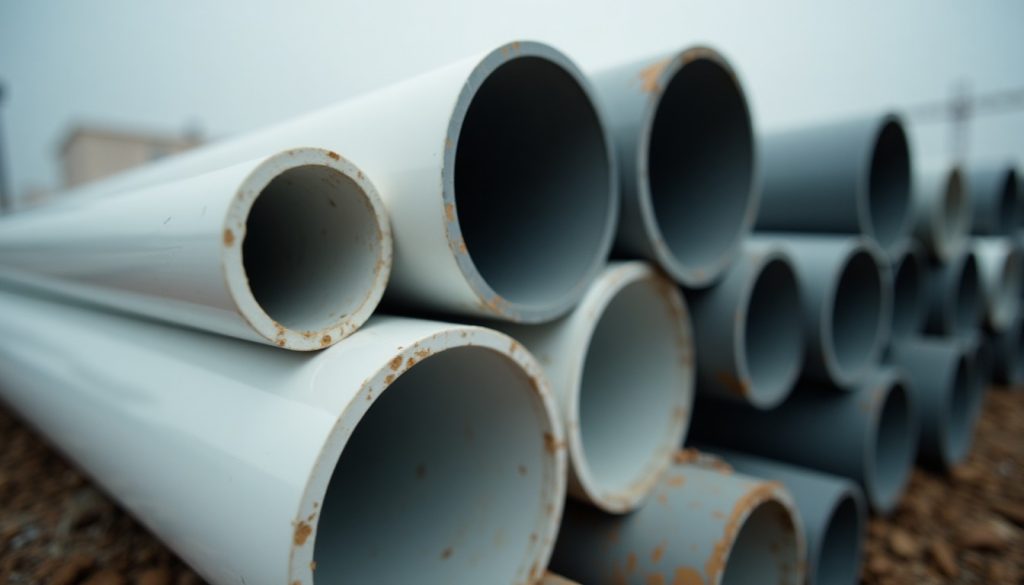
Gray PVC is not always Schedule 80. Gray for Schedule 80 and white for Schedule 40 is a common factory habit, not a rule written into ASTM D1785. Harvel’s published data lists both white and dark gray as colors for its PVC pipe, so the color alone tells you nothing certain.
Gray electrical conduit adds to the confusion. Conduit is made to UL 651 for wiring and is not pressure-rated water pipe, even when it says Schedule 40 or 80. The only reliable check is the print line, which lists size, schedule, the ASTM standard, and the NSF mark for potable use.
What is the Schedule 40 vs 80 PVC pressure rating by size?
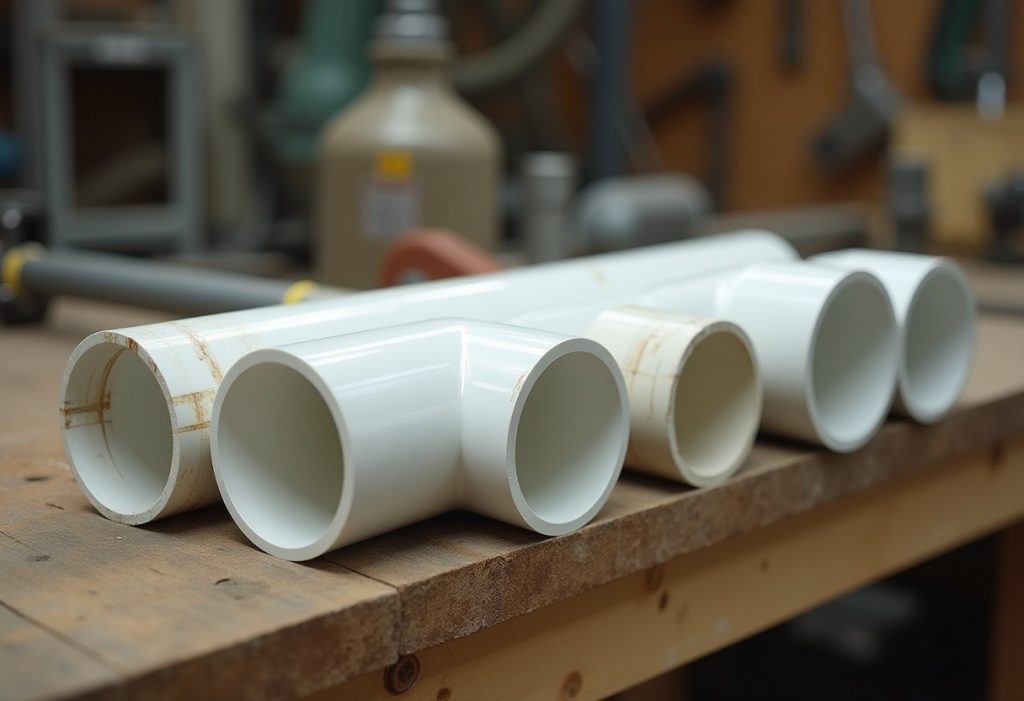
Schedule 80 PVC carries roughly 40 to 56 percent more pressure than Schedule 40 at the same size, based on Harvel’s maximum working pressure table for water at 73 degrees F. A 1/2-inch pipe runs 600 psi in Schedule 40 and 850 psi in Schedule 80. At 4 inches the pair drops to 220 and 320 psi.
The ratings fall as size rises, with one quirk. Harvel lists 2-1/2-inch pipe slightly higher than 2-inch in both schedules (300 vs 280 psi in Schedule 40), because the ASTM wall jumps at that size. Nominal size is a name, not a measurement, so check our plumbing pipe sizes chart if the numbers below look off from a tape measure.
| Nominal size | Outside diameter (both) | Schedule 40 min. wall / max psi | Schedule 80 min. wall / max psi |
|---|---|---|---|
| 1/2 in | 0.840 in | 0.109 in / 600 psi | 0.147 in / 850 psi |
| 3/4 in | 1.050 in | 0.113 in / 480 psi | 0.154 in / 690 psi |
| 1 in | 1.315 in | 0.133 in / 450 psi | 0.179 in / 630 psi |
| 1-1/4 in | 1.660 in | 0.140 in / 370 psi | 0.191 in / 520 psi |
| 1-1/2 in | 1.900 in | 0.145 in / 330 psi | 0.200 in / 470 psi |
| 2 in | 2.375 in | 0.154 in / 280 psi | 0.218 in / 400 psi |
| 3 in | 3.500 in | 0.216 in / 260 psi | 0.300 in / 370 psi |
| 4 in | 4.500 in | 0.237 in / 220 psi | 0.337 in / 320 psi |
| 6 in | 6.625 in | 0.280 in / 180 psi | 0.432 in / 280 psi |
| 8 in | 8.625 in | 0.322 in / 160 psi | 0.500 in / 250 psi |
Source: Harvel PVC Schedule 40 and 80 dimension tables, plain-end pipe, water at 73 degrees F, solvent-cemented joints.
These are water ratings for a pipe with glued joints, not a promise for every system. Charlotte Pipe warns never to test with, carry, or store compressed air or gas in PVC, because a failure can be explosive. The psi table covers water only.
How much does heat lower Schedule 40 and Schedule 80 PVC pressure ratings?
Heat cuts PVC pressure ratings fast. Charlotte Pipe’s technical manual multiplies the 73 degree F rating by 0.88 at 80 degrees F, 0.62 at 100 degrees F, 0.40 at 120 degrees F, and 0.22 at 140 degrees F. Above 140 degrees F, PVC is not recommended for pressure at all, in either schedule.
Both schedules derate by the same factor, so Schedule 80 keeps its lead in psi but loses most of its margin on hot days. A 2-inch Schedule 80 line rated 400 psi on paper drops to about 88 psi carrying 140 degree F water. That is why hot water supply lines use CPVC, PEX, or copper instead of PVC.
| Water temperature | Charlotte Pipe factor | 1 in Sch 40 | 1 in Sch 80 | 2 in Sch 40 | 2 in Sch 80 |
|---|---|---|---|---|---|
| 73°F | 1.00 | 450 psi | 630 psi | 280 psi | 400 psi |
| 100°F | 0.62 | 279 psi | 391 psi | 174 psi | 248 psi |
| 120°F | 0.40 | 180 psi | 252 psi | 112 psi | 160 psi |
| 140°F | 0.22 | 99 psi | 139 psi | 62 psi | 88 psi |
Pipe ratings from Harvel multiplied by Charlotte Pipe’s PVC temperature correction factors. Sun-baked pipe on a roof or in a pump house can run warmer than the water inside it, so plan with the higher number.
Can you use Schedule 40 fittings on Schedule 80 pipe?
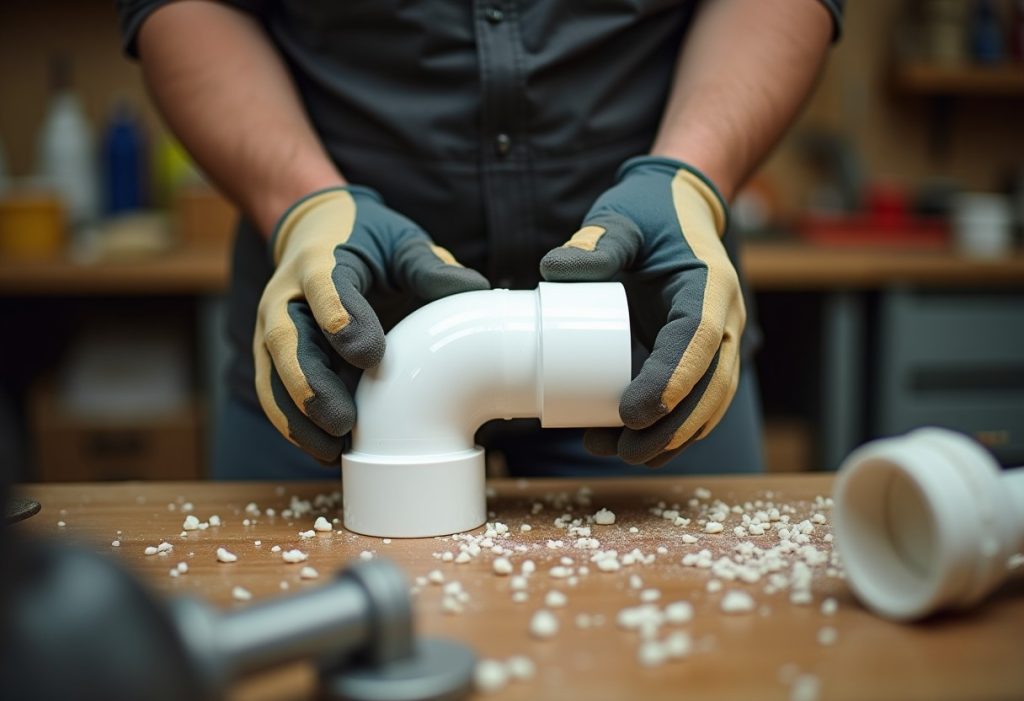
You can use Schedule 40 fittings on Schedule 80 pipe, since the shared outside diameter means the pipe slides into either socket. The joint will glue and hold. The problem is pressure, because the run is only as strong as its weakest part, and the Schedule 40 fitting sets the ceiling.
Charlotte Pipe’s technical manual says the system must always be de-rated to the pressure rating of the lowest rated component. Fittings sit lower than pipe to begin with. Boshart’s guidance says Schedule 40 and 80 PVC fittings should carry no more than 60 percent of the rating of the equivalent pipe, which puts a 2-inch Schedule 80 fitting near 240 psi against 400 psi for the pipe.
The working rules for mixing schedules:
- Schedule 40 fittings on Schedule 80 pipe are fine for low-pressure work such as drains, conduit sweeps, or gravity lines.
- On a pressure main or pump discharge, match the fittings to the pipe or rate the whole run as Schedule 40.
- Schedule 80 fittings on Schedule 40 pipe also fit, but do not raise the pipe’s rating.
- Use the same primer and cement on both. Charlotte Pipe specifies ASTM F656 primer and ASTM D2564 cement.
Read the cement can for the pipe sizes and schedules it is rated for. Our step-by-step guide to gluing PVC pipe covers priming, dry fits, and cure times.
Can you thread Schedule 40 PVC pipe?
You should not thread Schedule 40 PVC pipe. Harvel says only Schedule 80 or heavier walls should be threaded, because cutting a thread into a Schedule 40 wall leaves too little plastic at the root. Even on Schedule 80, threading cuts the pressure rating in half.
Charlotte Pipe rates Schedule 40 and Schedule 80 molded or cut threads at 50 percent of a solvent-cement system. A 1-inch Schedule 80 pipe rated 630 psi glued drops to about 315 psi threaded, before any temperature derating. Harvel also does not recommend threaded PVC joints above 110 degrees F and points to flanges, unions, or grooved couplings where a joint must come apart.
Molded female threads on Schedule 40 fittings are a different case. Male adapters and threaded fittings are made for the job, but the same half-rating logic applies to the threaded joint. Use PTFE tape or a sealant labeled safe for PVC, since some pipe dopes attack the plastic.
Does Schedule 80 PVC reduce water flow, and does it cost more?
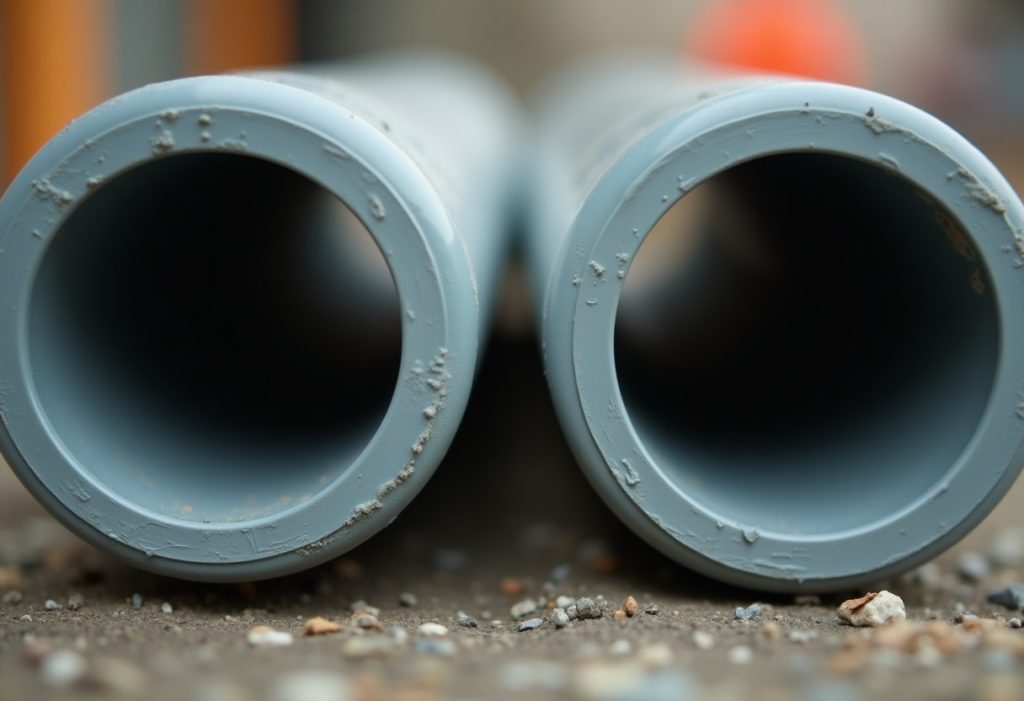
Schedule 80 PVC does reduce flow, because the thicker wall shrinks the inside diameter. Using Harvel’s average inside diameters, 1/2-inch Schedule 80 has about 24 percent less flow area than Schedule 40, 1-inch about 17 percent less, and 2-inch about 13 percent less. The gap narrows as pipe size grows.
Inside surfaces are equally smooth. Harvel lists a Hazen-Williams C factor of 150 for its PVC, so the loss comes from the smaller bore, not roughness. At the same water speed, less area means less water per minute, and at the same flow, water moves faster with more friction loss per foot.
On a long irrigation main or pump suction line, the narrower bore can push you up a pipe size.
Schedule 80 also costs more, though the gap depends on size, brand, and supplier. Weight is a fair proxy for the extra resin. Harvel lists 2-inch Schedule 40 at 0.720 pounds per foot and Schedule 80 at 0.984, about 37 percent heavier. Schedule 80 fittings and threaded parts add to the bill, so price both before you specify the heavier pipe across a whole job.
When should you use Schedule 40 vs Schedule 80 PVC?
Use Schedule 40 PVC for most residential cold water pressure work, irrigation, pool circulation, and drains, where its ratings sit well above street pressure. Use Schedule 80 where the pipe will be threaded, hit, buried under traffic, exposed to chemicals, or run at higher pressure and temperature. The table below sorts common jobs.
| Job | Usual choice | Why |
|---|---|---|
| Lawn irrigation mains and laterals | Schedule 40, or Class 200 or Class 160 pipe (ASTM D2241) | Pressure class pipe has thinner walls and a bigger bore, with its psi class printed on the pipe |
| Pool and spa circulation lines | Schedule 40, often with Schedule 80 at pump and heater connections | Threaded nipples and exposed equipment pads favor the thicker wall |
| House drains, waste, and vents | Schedule 40 solid wall DWV, or cellular core pipe (ASTM F891) | Gravity flow, so pressure ratings do not apply; cellular core is not for pressure |
| Exposed outdoor or garage runs | Schedule 80, painted | More wall for impact; paint blocks UV |
| Industrial, chemical, and process lines | Schedule 80 | Higher ratings, threading, chemical resistance margin |
| Hot water above 140°F | Neither (use CPVC, PEX, or copper) | PVC is not rated above 140°F |
Which schedule should you use for drains?
For drains, the schedule’s pressure rating barely matters, because a drain runs at atmospheric pressure. Most house drains use Schedule 40 solid wall pipe or cellular core pipe with a foam middle layer, and Schedule 80 is rarely worth the cost. If you are still choosing the drain material, our PVC vs ABS drain pipe comparison covers code limits and cost.
Which schedule handles sunlight better?
Neither schedule is UV-proof, but sunlight damage is shallow. Charlotte Pipe says UV reaction occurs only at the exposed surface, 0.001 to 0.003 inch deep, and lowers impact strength. A Schedule 80 wall leaves more sound plastic behind that layer, which helps on exposed runs that can be bumped.
The fix for both is paint. Charlotte Pipe recommends latex (water-based) paint for aboveground PVC and warns against petroleum-based or oil-based enamels. Harvel likewise recommends a light colored acrylic or latex paint and says its standard PVC compound contains titanium dioxide as a UV inhibitor.
How we sourced this
We consulted about a dozen manufacturer, distributor, and reference pages and cited 6. Dimensions and 73 degree F pressure ratings come from Harvel’s Schedule 40 and 80 PVC tables as distributed by Professional Plastics; outside diameters follow ASTM D1785. Temperature factors, threading rules, the compressed air warning, the lowest-component rule, and UV guidance come from Charlotte Pipe’s technical manual, its PVC Schedule 40 submittal, and its UV article. The 60 percent fitting ceiling comes from Boshart’s knowledge base. Flow-area and weight comparisons are our own math from Harvel’s published inside diameters and weights. We excluded distributor blogs and pages that gave single, size-free psi numbers. Ratings vary by manufacturer and local code; confirm against the print line and your supplier’s current data. Reviewed October 2026.
Frequently asked questions
Is Schedule 80 PVC stronger than Schedule 40?
Yes. At the same nominal size, Schedule 80 has a wall about 35 to 55 percent thicker, so it carries a higher pressure rating and resists impact and crushing better. Harvel rates 1-inch Schedule 80 at 630 psi against 450 psi for Schedule 40 at 73 degrees F. Both lose strength as water temperature rises, and neither is rated above 140 degrees F.
Can you use Schedule 40 fittings on Schedule 80 pipe?
They fit, because both schedules share the same outside diameter, so a Schedule 40 socket accepts Schedule 80 pipe. The catch is pressure. A system is only as strong as its weakest part, and Charlotte Pipe says to de-rate the whole run to its lowest-rated component. On a high-pressure line, use Schedule 80 fittings so the joint does not become the weak link.
Can you glue Schedule 40 PVC to Schedule 80 PVC?
Yes. Both are the same PVC compound and the same outside diameter, so the same primer and solvent cement bond them. Charlotte Pipe specifies primer meeting ASTM F656 and cement meeting ASTM D2564 for its pressure pipe. The finished joint carries the rating of the weaker part, so a mixed run should be treated as Schedule 40 for pressure.
What is the PSI rating of Schedule 40 PVC?
It depends on size. Harvel rates Schedule 40 PVC at 600 psi for 1/2 inch, 450 psi for 1 inch, 280 psi for 2 inch, 220 psi for 4 inch and 160 psi for 8 inch, all for water at 73 degrees F. Those numbers fall with heat, to 22 percent of the listed value at 140 degrees F per Charlotte Pipe.
Is gray PVC always Schedule 80?
No. Gray is a common color for Schedule 80 and white is common for Schedule 40, but color is a manufacturer convention, not the rule. Harvel lists both white and dark gray for its PVC pipe, and gray electrical conduit is a separate product that is not rated for water pressure. Read the printed line on the pipe for the schedule and standard.
Is Schedule 80 PVC UV resistant?
Neither schedule is immune to sunlight. Charlotte Pipe says UV exposure lowers impact strength, though the damage reaches only 0.001 to 0.003 inch into the surface. A thicker Schedule 80 wall leaves more sound material under that layer, but the fix for both is the same, a coat of water-based latex paint. Oil-based paints are not recommended.
What is Schedule 80 PVC used for?
Schedule 80 PVC goes where pressure, impact, or threads matter. That includes industrial and chemical process lines, exposed runs that can get hit, pump and equipment connections that need threaded nipples, and higher-pressure mains. Homeowners rarely need it for irrigation or drains, where Schedule 40 or pressure-class pipe carries the load at lower cost.
Which schedule PVC is the strongest?
Schedule 80 PVC is stronger than Schedule 40. At the same nominal size, Schedule 80 has a wall about 35 to 55 percent thicker, giving it a higher pressure rating and better resistance to impact and crushing. Harvel rates 1-inch Schedule 80 at 630 psi versus 450 psi for Schedule 40 at 73 degrees F. Both lose strength as temperature rises, and neither is rated above 140 degrees F.