Dielectric Union: What It Does and When You Need One
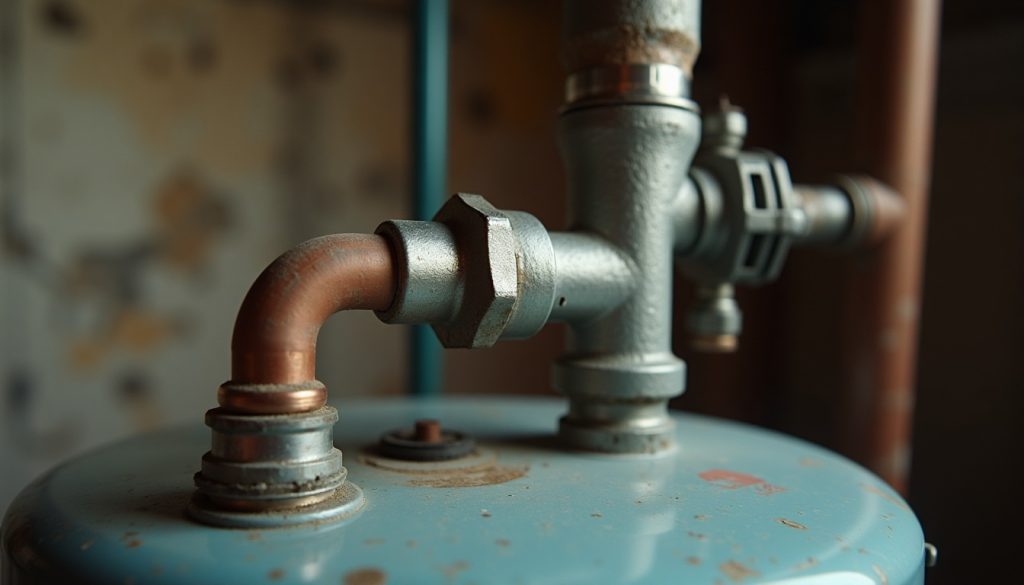
A dielectric union is an insulated pipe union that stops galvanic corrosion where copper meets steel, and you need one (or an approved brass or dielectric fitting) wherever copper tubing joins galvanized steel.
Key Takeaways
- Galvanized steel sits at 1.20 V and copper at 0.35 V on the anodic index published by Engineers Edge, a 0.85 V gap that drives the steel side to corrode.
- Engineers Edge recommends no more than 0.25 V of difference between joined metals in normal environments and 0.15 V in harsh ones.
- The International Plumbing Code accepts a brass fitting, a dielectric fitting, or a dielectric union for copper to galvanized steel joints; the California Plumbing Code requires any dielectric union installed to meet ASSE 1079 or IAPMO PS 66.
- A typical no-lead union, the Boshart DU-NL series, is rated to 250 PSI and 180°F, with a nylon insulator and silicone rubber gasket.
- Penn State’s Office of Physical Plant calls dielectric unions “proven sources of leaking fittings” and tells its contractors to swap them for dielectric nipples.
- A.O. Smith tells installers soldering copper to its heaters to use dielectric unions, and warns that the tank’s inlet and outlet contain non-metallic parts that solder heat can damage.
What is a dielectric union and what does it do?
A dielectric union is a two-piece pipe union with a steel half, a brass or copper half, and a plastic sleeve plus rubber gasket that keep the two metals from touching. It lets you join galvanized or black steel to copper without a metal-to-metal electrical path, which is what slows galvanic corrosion at the joint. It also comes apart with a wrench, so you can swap a water heater without cutting pipe.
Boshart’s spec sheet for its DU-NL series lists five parts: a no-lead brass solder end (C89550), a galvanized steel threaded end, a galvanized steel nut, a nylon insulator, and a silicone rubber gasket. The nylon sleeve keeps the steel nut off the brass shoulder, and the gasket seals the face.
The plastic and rubber parts are also the weak point, since they age under heat. Our guide to plumbing fittings compares unions with couplings and adapters.
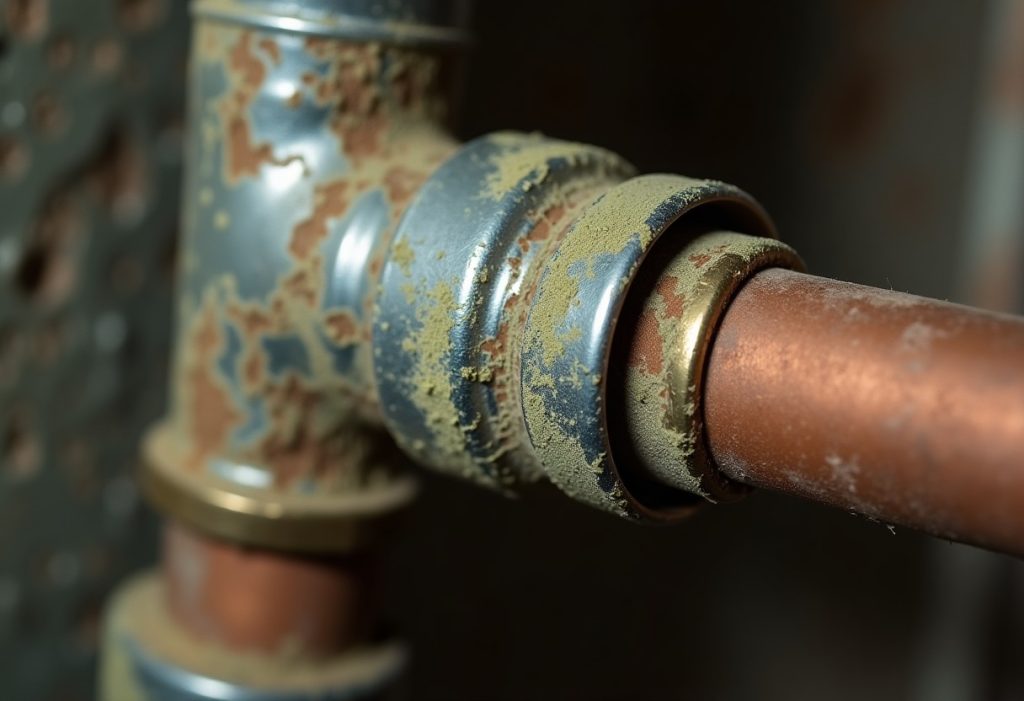
How does galvanic corrosion happen between copper and steel?
Galvanic corrosion happens when two different metals touch while sharing an electrolyte, which in a house is the water inside the pipe. The metals act like a weak battery. The more active metal (zinc coating and steel) becomes the anode and gives up material, while the more noble metal (copper) becomes the cathode and is protected. The bigger the voltage gap between them, the faster the anode corrodes.
Engineers use an anodic index to rank that gap. On the Engineers Edge galvanic compatibility table, copper reads 0.35 V, brass and bronze 0.40 V, plain carbon steel 0.85 V, hot-dip galvanized steel 1.20 V, and zinc 1.25 V. Copper joined straight to a galvanized nipple produces a 0.85 V difference, more than three times the 0.25 V the same table allows for normal environments.
Higher numbers corrode first, and heat speeds the reaction. Boshart’s spec sheet states plainly that “as fluid temperature increases the rate of corrosion also increases,” which is why the hot outlet of a water heater is the joint that usually fails first. Your tank uses the same chemistry on purpose: the water heater anode rod is a magnesium or aluminum bar that corrodes so the steel tank does not.
Are dielectric unions required by plumbing code?
Dielectric unions are rarely required by name. The International Plumbing Code requires joints between copper or copper-alloy tubing and galvanized steel pipe to be made with a brass fitting, a dielectric fitting, or a dielectric union, so a union is one of three accepted options. Codes based on the Uniform Plumbing Code regulate the union’s quality where one is installed. Local amendments can be stricter.
The IPC language appears in the section titled “Copper or copper-alloy tubing to galvanized steel pipe” (numbered 605.24.1 in the edition quoted in contractor guidance; the number can shift between code cycles). Locally adopted versions such as the Chicago Plumbing Code call for a “brass converter fitting or dielectric fitting.”
The California Plumbing Code Section 605.15 reads: “Dielectric unions where installed at points of connection where there is a dissimilarity of metals shall be in accordance with ASSE 1079 or IAPMO PS 66.” California goes further only for state-regulated buildings (DSA-SS, HCD, and OSHPD occupancies), where its amendment says dielectric unions “shall be used at all points of connection where there is a dissimilarity of metals.”
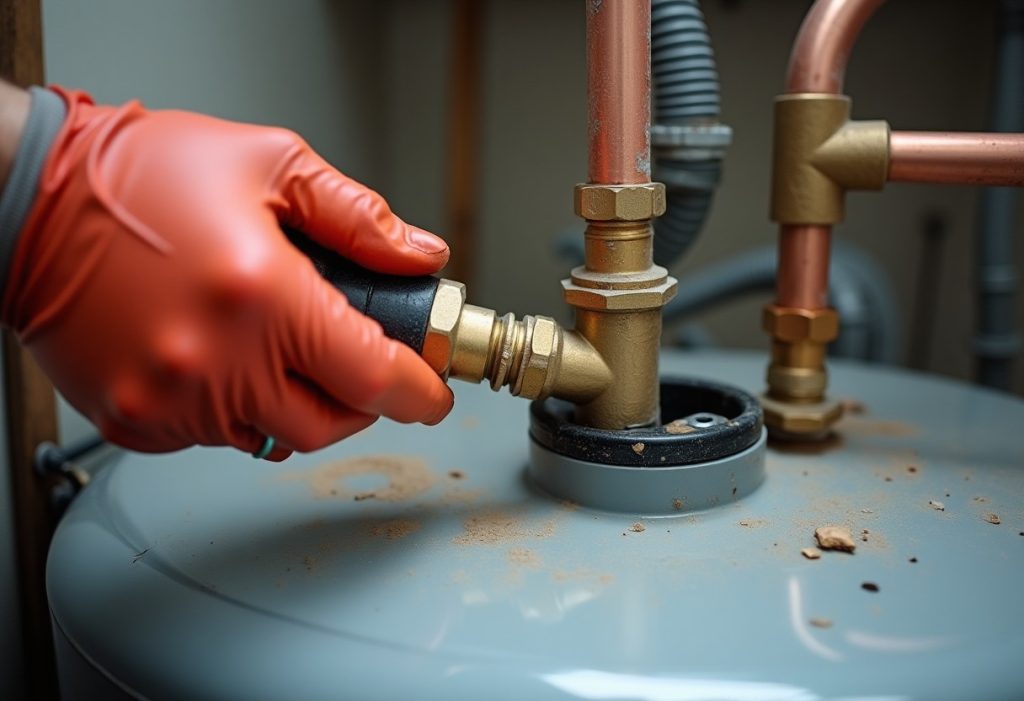
Do you need a dielectric union on a water heater?
You need some form of isolation on a water heater whenever copper supply lines meet the tank’s steel nipples, and a dielectric union is the most common way to get it. You do not need a separate union if the connection already has a dielectric flex connector, a lined dielectric nipple, or plastic supply pipe. The goal is no bare copper touching bare steel.
A.O. Smith’s installation help for its heaters sold at Lowe’s says it directly: “If you are soldering copper pipes, use dielectric unions to connect the pipes to the water heater.” The same page notes that many flexible connectors come with built-in dielectric fittings and lists copper, PEX, and CPVC as acceptable supply pipe.
It also warns: “Do not solder pipes while they are attached to the water heater. The water heater’s inlet and outlet connections contain non-metallic parts which could be damaged.”
Dielectric union vs brass nipple: which one should you use?
Many plumbers prefer a brass nipple or a lined dielectric nipple over a dielectric union because nipples have no gasket to weep and no plastic sleeve to crush. A dielectric union still makes sense where you want a serviceable break in the line. Code generally accepts all three, so the choice comes down to leak risk, local practice, and whether the joint needs to come apart.
The strongest institutional voice against unions is Penn State’s Office of Physical Plant. Its technical bulletin OPP TB-232116.100, as quoted by InspectAPedia’s dielectric fitting code summary, states that “dielectric unions are proven sources of leaking fittings, and should be avoided,” with the fix to “remove the dielectric fitting, and replace with a dielectric nipple.”
The brass nipple works differently from a union. It does not insulate. Brass at 0.40 V sits 0.05 V from copper, so the copper side of the joint is well matched, and some jurisdictions accept a 6-inch brass nipple between the steel tank fitting and the copper line. The steel to brass thread still forms a galvanic pair; the nipple trades full isolation for a joint with nothing soft to fail.
| Option | How it isolates | Pros | Cons | Code status |
|---|---|---|---|---|
| Dielectric union | Nylon sleeve and rubber gasket separate steel and brass halves | Full electrical break; comes apart for heater swaps | Gasket can weep; steel half can rust shut and restrict flow; must solder off the union | Named in IPC; must meet ASSE 1079 or IAPMO PS 66 under California code |
| Dielectric (lined) nipple | Plastic liner keeps water off the steel and blocks the metal path at the threads | No gasket to fail; fits in a tight space; preferred in Penn State’s bulletin | Liner can be damaged by solder heat; not serviceable like a union | Counts as a dielectric fitting under IPC |
| Brass nipple or brass converter fitting | No insulation; brass is 0.05 V from copper on the anodic index | Solid metal, nothing to crush or age; cheap | Steel to brass pair remains; length rules vary by jurisdiction | IPC accepts a brass fitting; some areas specify 6 inches |
| Flex connector with dielectric washer | Plastic or rubber washer and lined nut separate hose from steel nipple | No soldering at the tank; absorbs movement | Must say dielectric on the package; hose life is shorter than rigid pipe | Accepted where listed; A.O. Smith notes many include dielectric fittings |
| PEX or CPVC transition | Plastic pipe carries no current | Eliminates the galvanic path entirely | Needs a brass adapter at the steel thread; CPVC and PEX have temperature limits near the heater | A.O. Smith lists PEX and CPVC as acceptable supply pipe |
If you are replacing old steel lines anyway, our galvanized vs copper pipe comparison covers lifespan and repipe tradeoffs, which can remove the dissimilar joint altogether.
How do you install a dielectric union correctly?
Install a dielectric union by threading the steel half onto the steel nipple, soldering the copper half to the copper line while it is separated from the union, and joining them only after the solder joint cools. Keep the nylon sleeve and gasket in place and do not overtighten the nut. Heat and over-torque are the two mistakes that turn a dielectric union into a leak.
- Shut off power or gas to the heater, close the cold supply valve, and open a hot faucet to relieve pressure.
- Take the union apart. Set the nylon sleeve and gasket aside where flux and heat cannot reach them.
- Wrap or dope the male threads only (A.O. Smith’s instruction), then thread the steel half onto the tank nipple and tighten with two wrenches so the nipple does not turn in the tank.
- Slide the steel nut onto the copper line first, then solder the brass half to the copper away from the heater. A.O. Smith warns against soldering pipes while they are attached to the heater.
- Let the joint cool fully. Check that the nylon sleeve is seated inside the nut and the gasket sits flat on the face.
- Draw the halves together and tighten the nut until snug. Crushing the gasket squeezes it out of the joint and can crack the nylon sleeve.
- Restore the electrical bonding jumper if one was removed, refill the tank with a hot faucet open to purge air, and check for drips before restoring power or gas.
Match the union to the job. Boshart’s DU-NL spec sheet rates the series to 250 PSI and 180°F and is not suitable for natural gas, propane, steam, or glycol. Check the rating on whatever union you buy against the system it serves, since a boiler loop or a solar thermal loop can run hotter or carry glycol.

What are the signs of galvanic corrosion at a dielectric union or steel joint?
The signs of galvanic corrosion at a copper to steel joint are white or greenish crust on the fitting, orange rust weeping from the steel threads, rusty hot water from the tap, reduced hot water flow, and a slow drip at the union nut. Heavy buildup usually shows up on the steel side first, because steel and zinc are the metals giving up material.
- Crust at the joint. White zinc salts or green copper salts around the fitting mean water has been seeping and evaporating.
- Rust stains on the steel nipple. The galvanized coating is gone and bare steel is corroding.
- Rusty hot water only. Points to the tank side; check the nipples, unions, and the anode rod together.
- Weak hot water pressure at every fixture. The steel half of an old union can rust inward and narrow the waterway.
- A drip at the union nut. Usually a hardened or crushed gasket; replacement gaskets and insulators are sold for some lines, including Boshart’s.
Crust on a joint between bare copper and a bare steel nipple means there is no isolation at all, a frequent find where copper plumbing was added onto an older galvanized system.
Does a dielectric union break the electrical ground?
Yes, a dielectric union can interrupt the electrical continuity of metal water piping, because the insulator that stops galvanic current also stops fault current. Electrical codes generally require metal water piping to be bonded to the electrical system, so installers often add a bonding jumper across the water heater’s hot and cold connections. Check with your local electrical inspector before relying on the piping as a bonding path.
InspectAPedia’s code summary notes that jumper wires across dielectric fittings keep the plumbing bonded for safety. A reader comment there flags the tension: the jumper reconnects the two metals electrically, which partly undoes the isolation.
Never remove an existing jumper to stop corrosion. It is a shock-safety measure, and a bonding problem is a job for a licensed electrician.
How we sourced this
We consulted the Engineers Edge galvanic compatibility table (anodic index values and allowable voltage differences), California Plumbing Code Section 605.15 as published on GoCodebook, International Plumbing Code wording on copper to galvanized steel joints as quoted in code commentary and the Chicago Plumbing Code, A.O. Smith’s installation help pages, Boshart’s DU-NL dielectric union spec sheet, and Penn State’s OPP TB-232116.100 as quoted by InspectAPedia. We could not open the ICC’s own code viewer or the National Electrical Code text, so we describe bonding rules in general terms and give no NEC section numbers. Review covered sources available in October 2026. Retail listings and forums were read for context only.
Frequently asked questions
Do I need a dielectric union on my water heater?
Only if copper piping connects to the steel nipples on the tank and no other isolating fitting is in the path. A.O. Smith tells installers to use dielectric unions when soldering copper to the heater. Flexible connectors with a built-in dielectric washer, factory-lined nipples, and PEX or CPVC supply lines already break the metal contact, so a separate union is often unnecessary.
Can I use a brass nipple instead of a dielectric union?
In many areas, yes. The International Plumbing Code accepts a brass fitting in place of a dielectric fitting for copper to galvanized steel joints, and some jurisdictions accept a 6-inch brass nipple at water heaters. Brass sits close to copper on the galvanic series, so the copper side stays protected. Confirm with your local inspector, since amendments vary by state and city.
Do dielectric unions go bad?
They can. The nylon insulator and rubber gasket age with heat, and the steel half can rust from the inside, which narrows the waterway and can start a slow drip at the nut. Penn State’s facilities engineers call dielectric unions proven sources of leaking fittings. A union that weeps, shows heavy crust, or chokes hot water flow is due for replacement.
Which side of a dielectric union goes on the water heater?
The threaded steel half goes on the steel tank nipple, and the brass or copper sweat half goes on the copper line. Match metal to metal on each side so the only dissimilar contact is blocked by the insulating sleeve and gasket. Solder the copper half while it is separated from the union, then reassemble once the joint has cooled.
Can you use a dielectric union on a gas line?
Generally no, unless the product is listed for it. Boshart’s spec sheet for its DU-NL series states the unions are not suitable for natural gas, propane, steam, or glycol transfer. Gas piping follows the fuel gas code and the appliance maker’s instructions, and gas connections often use listed flexible connectors instead. Check the label and listing before using any union on fuel gas.
Do I need a dielectric union with PEX or CPVC?
No. PEX and CPVC are plastic, so they cannot carry a galvanic current between copper and steel. A PEX line threaded to a steel tank nipple through a brass adapter already has no copper touching steel. A.O. Smith lists copper, PEX, and CPVC as acceptable supply piping, and plastic lines remove the need for a separate isolating union.
Do flexible water heater connectors need a dielectric union?
Usually not. A.O. Smith notes that many flexible connectors come with built-in dielectric fittings, typically a plastic or rubber washer and lined nut that keep the stainless or copper hose from touching the steel nipple. Check the packaging for the word dielectric. A plain flex connector without that feature should be paired with a dielectric nipple or union where copper meets steel.
Do you need a dielectric union between brass and copper?
No. On the anodic index, brass reads 0.40 V and copper reads 0.35 V, a gap of only 0.05 V, well inside the 0.25 V limit Engineers Edge allows in normal environments. Because the two metals are closely matched, brass fittings are accepted by the International Plumbing Code in place of a dielectric fitting where copper meets galvanized steel, so no separate dielectric union is required for a brass to copper joint.