Main Water Shut Off Valve Replacement Cost (2026)
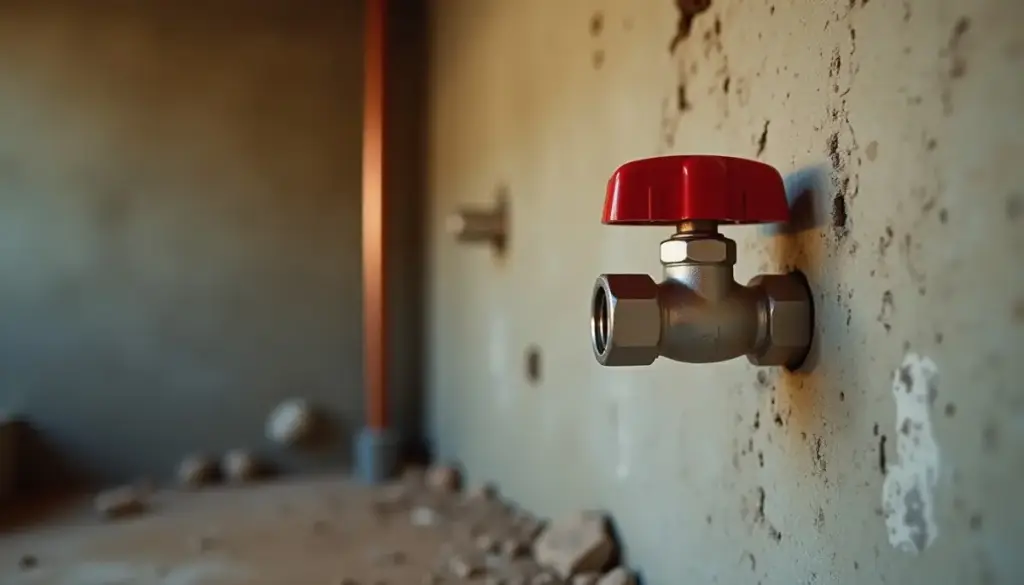
Main water shut off valve replacement cost averages $500 per Angi, with most homeowners paying $375 to $600; an easy basement valve can come in under $350, while a buried or vaulted valve can pass $1,000.
Key Takeaways
- Angi puts the average at $500 ($375 to $600), rising to $875 when a trench is needed.
- HomeGuide reports $250 to $600, with most homeowners spending about $425 for materials and labor, and says accessible basement or meter valves often cost $350 or less.
- The valve is the cheap part. A 3/4 inch Apollo 77FLF-204-01 full-port lead-free brass solder valve listed at $32.36 at AF Supply in October 2026.
- Someone has to stop water at the street first. The Munroe Falls (Ohio) Water Department charges $25 for a curb stop shut-off in business hours and $50 after hours, with 48 hours of notice.
- Do not assume the utility owns the curb stop. Platte Canyon Water and Sanitation District in Colorado says the homeowner owns both the meter pit and the curb stop valve.
- HomeGuide prices a water pressure regulator replacement at $300 to $650, which makes the same-visit PRV swap the most common add-on.
How much does main water shut off valve replacement cost in 2026?
Main water shut off valve replacement cost runs $375 to $600 for most homes, with a $500 average, according to Angi’s 2026 guide. HomeGuide’s range is $250 to $600 with a $425 typical spend. Fixr lists $250 to $1,000 including labor. The spread comes almost entirely from where the valve sits and how the water gets shut off upstream of it. Whether that upstream shutoff involves the service line itself often shapes decisions around trenchless water line replacement.
The Angi cost guide and the HomeGuide cost guide agree on the middle of the market. An open basement valve on 3/4 inch copper is a one to two hour job, HomeGuide says. The Fixr water main cost page shows the wider $250 to $1,000 band.
Why does valve location change the cost to replace a main water valve?
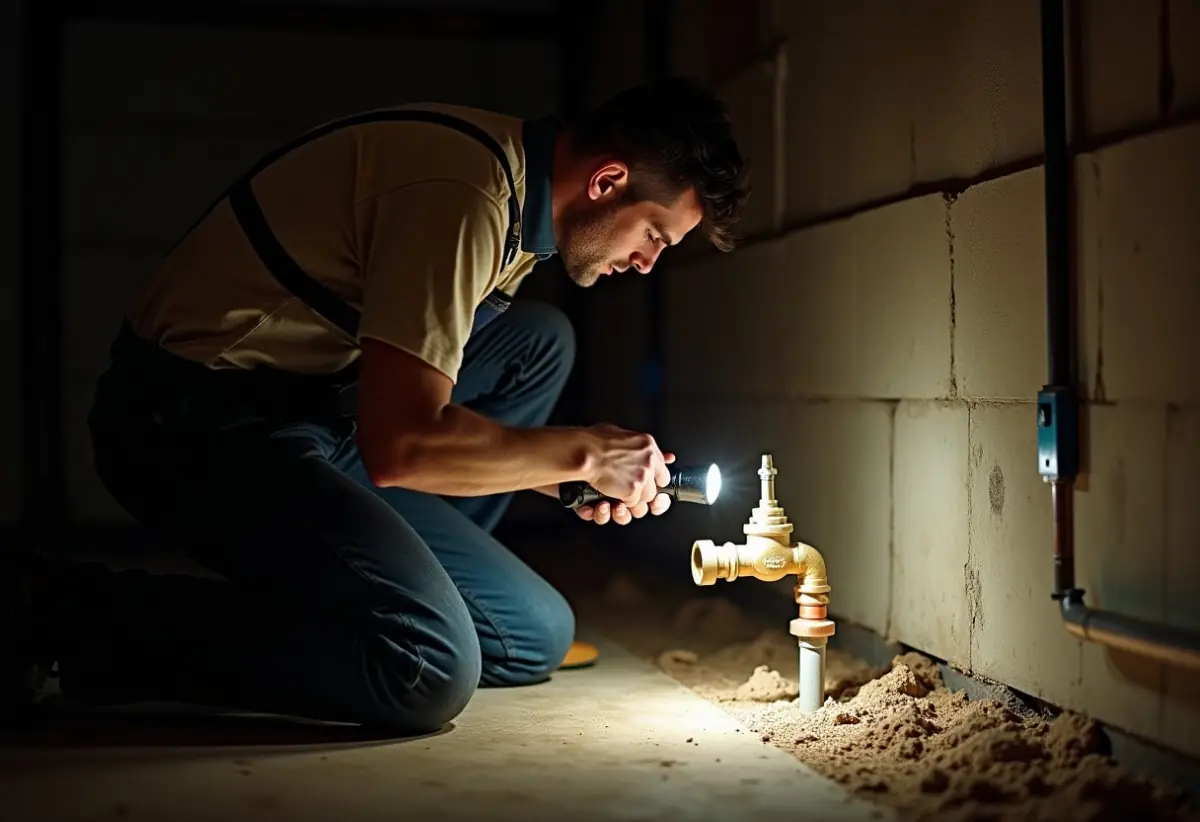
Location sets the labor hours, and labor is most of the bill. Angi’s national figures run from $180 to $220 for a valve with basement access up to $240 to $1,000 for a deep buried one, with meter, vault and shallow buried valves in between. Digging, pumping and confined space add the hours.
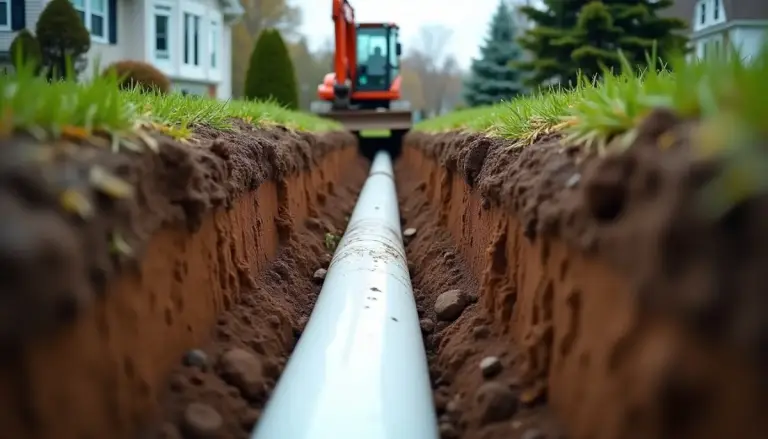
HomeGuide says deep buried or vaulted valves may cost $1,000 or more, and trenching runs $5 to $12 per linear foot, or $500 to $1,200 for a 100 foot trench.
HomeGuide quotes $75 to $150 per hour for scheduled work and $100 to $350 or more per hour for nights, weekends and holidays. A valve that seizes during a burst pipe gets billed at the emergency rate, so replace a stiff valve on your own schedule.
| Scenario | Typical cost | What drives it |
|---|---|---|
| Basement or utility room valve, open access | $180 to $220 (Angi); often $350 or less (HomeGuide) | One to two hours of labor, a $13 to $55 valve (listings below), plus the street shut-off |
| In-ground valve at the water meter | $180 to $500 (Angi) | Digging out the meter pit, cold wet working conditions, utility coordination |
| Valve in a vault or meter box | $200 to $750 (Angi) | Confined space, pumping out water, longer reach to the fittings |
| Shallow buried valve | $210 to $420 (Angi) | Hand digging a short hole, backfill and sod repair |
| Deep buried valve or trench needed | $240 to $1,000 (Angi); $875 average with trench | Trenching at $5 to $12 per foot (HomeGuide), frozen ground in winter |
| Emergency or after-hours replacement | Labor at $100 to $350+ per hour (HomeGuide) | Night, weekend and holiday rates; after-hours utility fee where charged |
| Valve plus new pressure regulator | Add $300 to $650 (HomeGuide) | Second valve body, gauge test, same shut-off and drain-down |
What does the valve itself cost by size and connection type?
A quality full-port main valve costs about $13 to $55 in 3/4 inch or 1 inch, so parts are a small slice of a $500 bill. Angi quotes $10 to $20 for a basic ball valve and HomeGuide $10 to $50 for most brass main valves. Lead-free, name-brand full-port valves from supply houses sit at the top of those ranges or slightly above.
Match the valve to the pipe size, not the house. Residential services are commonly 3/4 inch or 1 inch, and a full-port valve keeps the bore the same size as the pipe, so it does not choke flow the way a standard-port valve can. Apollo’s 77FLF-200 series is a lead-free, full-port forged brass valve rated for potable water, and its 77CLF-A Contractor Series uses a dezincification resistant bronze body with RPTFE seats.
| Connection | Example valve | Listed price (Oct 2026) | Tooling and trade-off |
|---|---|---|---|
| Sweat (solder), 3/4 in copper | Apollo 77FLF-204-01, full-port lead-free DZR brass | $32.36 at AF Supply; $47.76 at Cooney Brothers | Torch, flux, lead-free solder; pipe must be bone dry |
| Sweat (solder), 1 in copper | Apollo 77CLF-205-01A, full-port lead-free bronze, 600 psi CWP | $55.11 at SupplyStop | Same as above; 5 year warranty listed by Cooney Brothers |
| Push-fit, 3/4 in copper, PEX or CPVC | SharkBite 3/4 in brass push-to-connect ball valve | $28.97 at Home Depot; $28.98 at Lowe’s (SharkBite Max) | No flame and no dry pipe needed; fastest in a wet trench |
| PEX press, 3/4 in | SharkBite UCP22462Z PEX press brass ball valve | $13.33 at ToolUp | Needs a PEX press tool and matching jaws |
Who shuts off the water at the curb, and what does that cost?
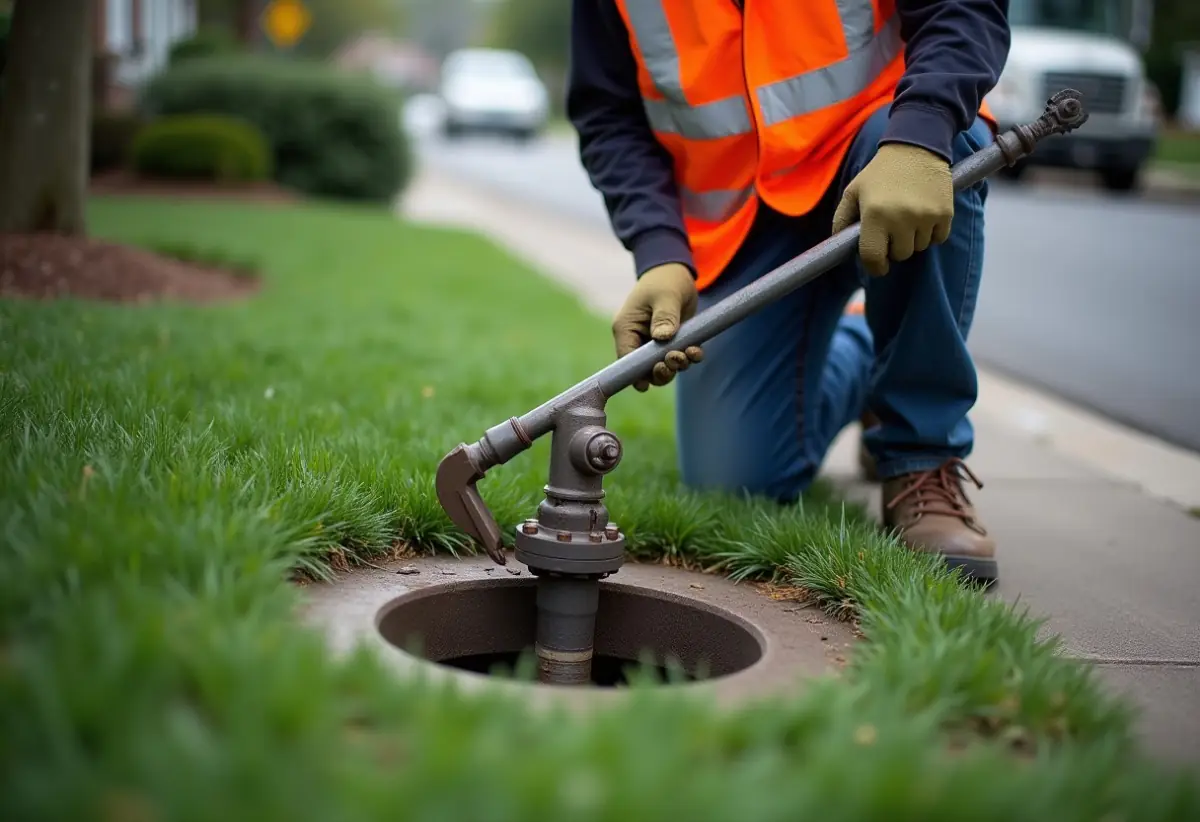
Your water utility usually operates the curb stop, the valve near the property line that feeds your service line, and many charge a small fee to do it. Munroe Falls, Ohio, charges $25 during business hours (7:30 am to 3:30 pm) and $50 for an after-hours call out, and asks for 48 hours of notice except in emergencies.
The Munroe Falls Water Department FAQ tells residents with a corroded main valve to call a licensed plumber first, then schedule the curb shut-off. For the house-side steps that come before and after, our guide on how to shut off water to your house covers both the main valve and the curb box.
The curb stop sits deep. Platte Canyon Water and Sanitation District describes a 3 to 4 inch diameter lid over a tube that drops to a valve about 4-1/2 to 6 feet down, operated with a long valve key. Keep 2 to 5 feet clear around the box, the district says.
Is the main shut-off valve the homeowner’s or the utility’s responsibility?
The house-side main valve is almost always yours, and the curb stop may be yours too. HomeGuide says homeowners own the service line from the property line to the house. Utility rules on the meter and curb stop differ, so read your utility’s service rules before you assume a free repair.
Munroe Falls puts the owner’s responsibility immediately after the curb stop, including all shut-off valves on either side of the meter. The meter belongs to the utility, but the customer must protect it from damage, including freezing. Platte Canyon goes further and says the homeowner owns the meter pit and the curb stop valve itself.
That split matters when the curb stop will not turn. Platte Canyon says that if its operators cannot work the valve, the homeowner must have a licensed plumber fix or replace it, turning a basement job into an excavation job.
Why do old gate valves fail, and when should you replace the main valve?
Old gate valves fail because a multi-turn wheel raises and lowers a metal gate on a threaded stem, and years without use let mineral scale and corrosion freeze that stem or stop the gate from seating. Angi’s warning signs include leaks at the valve, a handle that sticks, water that will not fully shut off and visible blue, white or brown residue.
A ball valve instead turns 90 degrees to rotate a ported ball, which is why HomeGuide calls it the most reliable main shut-off. Our comparison of a ball valve vs gate valve walks through the internal parts that wear.
Replace the main valve when you see any of these, per Angi’s list:
- Drips at the stem or body with the valve open or closed
- Blue, white or brown crust on the valve
- A handle that sticks or will not turn without a wrench
- Water still trickling at a faucet after the valve is fully closed
- Grinding or squealing noises when the valve moves
- A bent, cracked or broken body or handle
- No record of when it was last replaced
Age is a trigger on its own. HomeGuide puts average main valve life at 10 to 20 years, and the Munroe Falls utility tells residents to turn the valve occasionally to keep corrosion from building up.
Should you add a pressure reducing valve during the same visit?
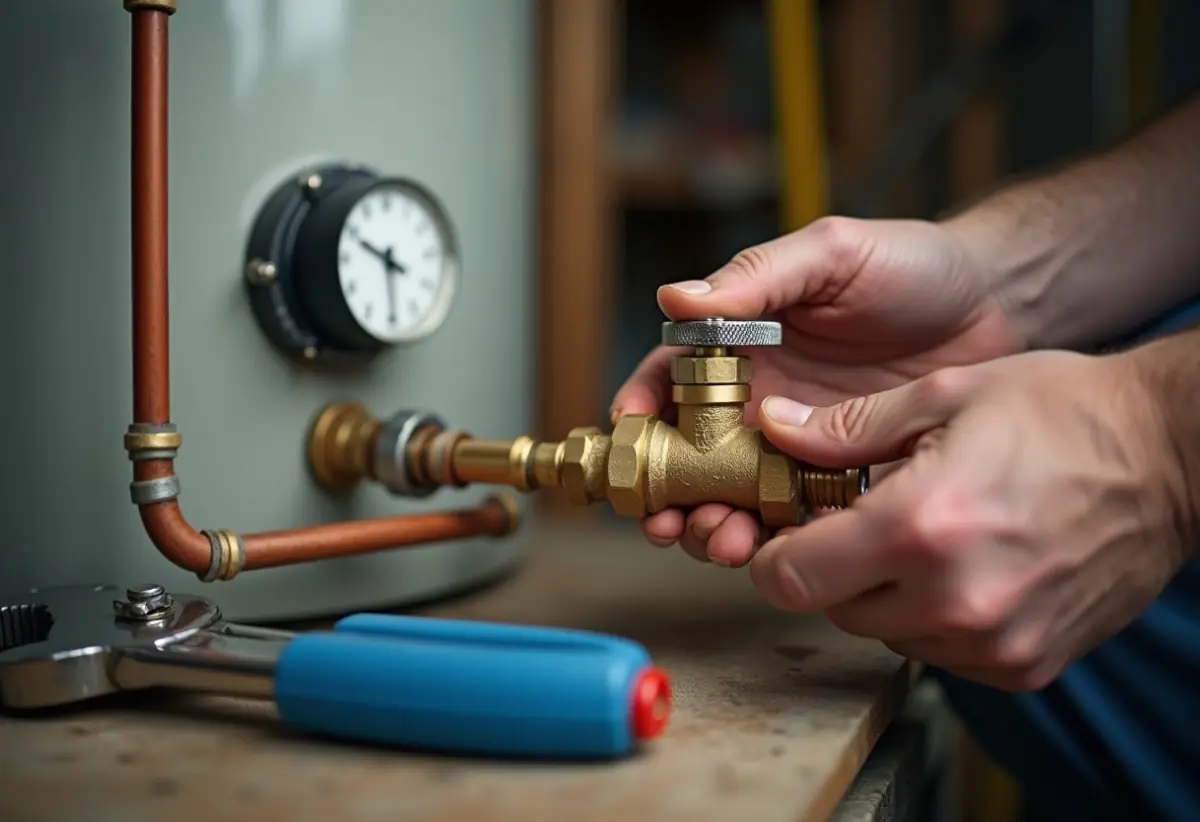
Yes, if your static pressure tests high or the existing regulator is near the end of its life, because the water is already off and drained. HomeGuide prices a water pressure regulator replacement at $300 to $650 for materials and labor as a standalone job, and much of that is the trip and the shut-off you are already paying for.
A screw-on pressure gauge at a hose bib tells you whether you need one. Model plumbing codes such as the IRC cap static pressure inside the home at 80 psi and call for a regulator when the street pressure runs higher, though local adoptions vary. Our explainer on the pressure reducing valve covers sizing, setpoints and the expansion tank that often comes with it.
Ask for both on one written quote: one drain-down, one permit where required and one inspection.
Can you replace a main water shut off valve yourself?
Yes, if the utility shuts the curb stop and the valve sits in an open basement on copper or PEX, but check whether your city requires a licensed plumber and a permit first. HomeGuide puts permit fees at $30 to $500, and Angi at $50 to $500. HomeGuide’s one to two hour estimate for an accessible valve is a fair DIY target once the curb stop is closed.
Steps for a basement replacement after the utility closes the curb stop:
- Book the curb shut-off (Munroe Falls asks for 48 hours of notice) and ask the utility to confirm the curb stop closes.
- Buy a lead-free, full-port ball valve that matches the pipe size and connection: 3/4 inch or 1 inch, sweat, push-fit or PEX press.
- After the curb stop is closed, open the lowest faucet in the house and a second-floor faucet to drain and vent the lines.
- Cut the pipe on both sides of the old valve with a tubing cutter, with a bucket underneath.
- For sweat joints, clean, flux and solder with the ball fully open so heat spares the PTFE seats. For push-fit, deburr and mark insertion depth.
- Seat the new valve with the handle where you can reach and turn it a full 90 degrees.
- Close the house faucets, then have the utility reopen the curb stop slowly while you watch every new joint.
- Flush air and debris at a faucet, then cycle the new valve twice to confirm it shuts tight.
Hand it off when the valve is buried, in a meter pit, on galvanized steel, or when the curb stop will not close. Our step-by-step on how to replace a shut off valve shows the same cut, prep and connect techniques on smaller fixture stops.
How we sourced this
We consulted eight sources in October 2026 and cited seven: Angi and HomeGuide 2026 cost guides, Fixr, the Munroe Falls (Ohio) Water Department, Platte Canyon Water and Sanitation District (Colorado), Apollo product pages, and retailer listings captured October 29, 2026 (prices exclude tax and shipping). We excluded cost pages with no named data source. Ranges are national, not local.
Frequently asked questions
Who is responsible for the main water shut-off valve?
The homeowner, in most cases. HomeGuide says owners maintain the service line from the property line to the house, and Munroe Falls, Ohio, makes owners responsible for every valve on either side of the meter. Some districts, such as Platte Canyon in Colorado, also assign the curb stop to the owner.
How long does it take to replace a main water shut-off valve?
About one to two hours when the valve is easy to reach, according to HomeGuide. A valve behind cabinetry, in a meter pit or buried in the yard can take several hours or multiple days. Add the utility’s notice period for the curb shut-off, which is 48 hours in Munroe Falls.
Can a plumber replace the main shut-off valve without the city turning off the water?
Only if there is a working valve upstream that the plumber can legally operate. In most homes that is the curb stop, which the utility controls, so the plumber has to book a shut-off. Some plumbers freeze the pipe with a pipe-freezing kit instead, but that is a judgment call your plumber should explain before quoting the job.
How long does a main water shut-off valve last?
Ten to 20 years on average, according to HomeGuide, depending on material and quality. Corrosion, sediment and worn internal parts can shorten that. A gate valve left unturned for years is the most likely to seize or leak at the stem, so replace it at the first sign of a leak.
Does homeowners insurance cover main shut-off valve replacement?
Sometimes, but often only through an add-on. HomeGuide says many insurers exclude the main water service line from standard policies and sell it as extra coverage. Angi says service line coverage may pay up to $3,000 for repair or replacement. Check your policy for a service line endorsement.
What type of valve is best for a main water shut-off?
A full-port, lead-free ball valve. It closes with a quarter turn, keeps the full pipe bore open and tolerates years without use better than a multi-turn gate valve. HomeGuide calls ball valves the most reliable option. Examples include the Apollo 77FLF-204-01 for 3/4 inch copper and the Apollo 77CLF-205-01A for 1 inch copper.
Do I need a permit to replace my main water shut-off valve?
Often yes. HomeGuide says many cities require a plumbing permit for this job and puts permit fees at $30 to $500, while Angi gives $50 to $500. Some cities also limit the work to licensed plumbers, so ask whether the quote includes the permit and inspection.