Faucet Aerator: Flow Rates, Sizes, and How to Clean One
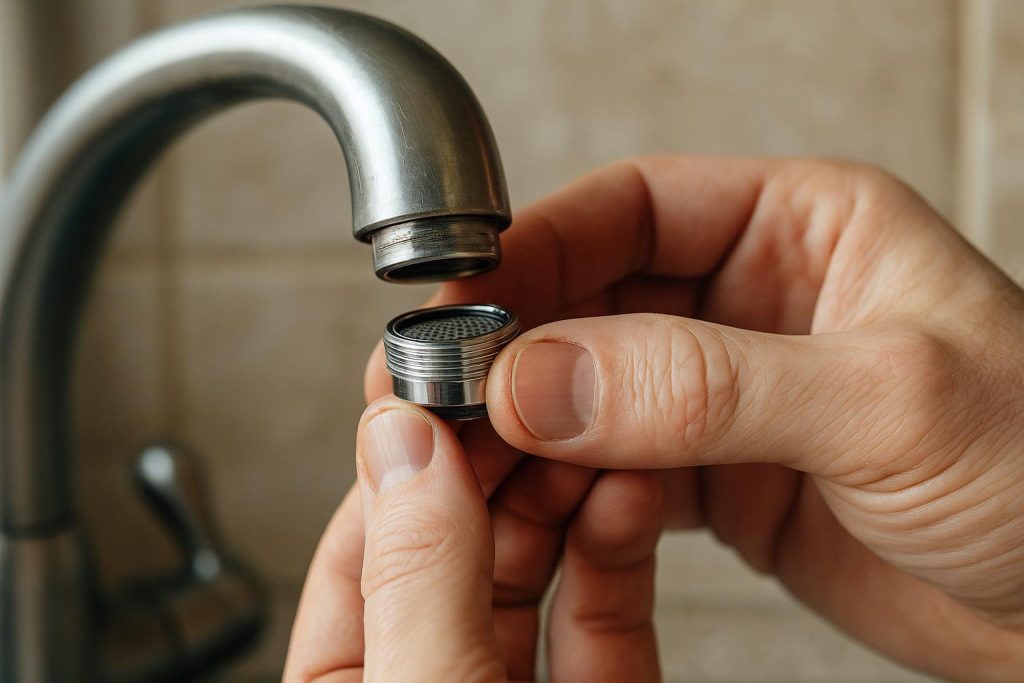
A faucet aerator is the small screened tip on your spout that mixes air into the water, so the stream feels full, splashes less, and uses fewer gallons per minute. A clogged one is the top reason a single faucet runs weak.
Key Takeaways
- Federal rules cap lavatory faucets at 2.2 gallons per minute at 60 psi, set by the ASME A112.18.1 standard and enforced by the U.S. Department of Energy.
- A WaterSense labeled bathroom faucet or aerator uses no more than 1.5 gallons per minute, at least 30 percent less than the 2.2 standard, per EPA WaterSense.
- Swapping old faucets and aerators for WaterSense models saves the average family about 700 gallons of water a year, EPA says (EPA WaterSense).
- When one faucet alone runs weak, a clogged aerator full of mineral scale is the most common cause; test the faucet with the aerator off to confirm.
- The most common male aerator thread is regular size at 15/16 inch-27; junior and tom thumb sizes are smaller, and dual-thread units fit male or female spouts (Neoperl).
- A twist-on WaterSense aerator can cost just a few dollars, the cheapest way to cut a faucet’s water use (EPA WaterSense).
What is a faucet aerator and what does it do?
A faucet aerator is the small threaded fitting at the very tip of a faucet spout, holding a screen and a flow restrictor. It splits the single stream into many fine streams and pulls in air, so the water leaves soft, full, and nearly splash-free. That air is what lets the faucet feel strong while passing fewer gallons per minute.
Three jobs happen at once. The screen and insert shape the water and trap grit. The mixed-in air gives the stream body without more water. And the flow restrictor behind the screen limits the rate, which is how a 1.5 gallon-per-minute aerator can feel close to a 2.2 gallon-per-minute one.
Most kitchen and bathroom faucets made since the mid-1990s ship with an aerator already screwed on. It is a wear part, cheap and replaceable, not a fixed piece of the faucet. That matters because the aerator is usually the first thing to check when one fixture acts up, long before you touch the valve or the supply lines.
What flow rate should a faucet aerator be?
It depends on the fixture, but the federal ceiling is 2.2 gallons per minute at 60 psi for both lavatory and kitchen faucets, under the ASME A112.18.1 standard the Department of Energy enforces. WaterSense pulls bathroom faucets down to 1.5 gallons per minute or less. Kitchen aerators often sit at 1.5 to 1.8, and low-flow aerators reach 1.0 or below.
Old faucets predating the 1992 Energy Policy Act often ran 3 to 5 gallons per minute, so an aerator swap on an older sink is a large, cheap cut. The flow rate is usually stamped right on the side of the aerator, as a number like 1.5, 1.8, or 2.2 followed by GPM.
The table below lines up the common aerator types, what each is good for, and how the stream feels. Match the flow to the sink: a bathroom lavatory rarely needs more than 1.5, while a kitchen used to fill pots may want 1.8 so you are not standing at the sink waiting.
| Aerator type | Typical GPM | Best use | Feel | Notes |
|---|---|---|---|---|
| Standard (federal max) | 2.2 | Kitchen faucets needing fast fill | Full, aerated, some splash | Legal ceiling for new faucets at 60 psi |
| WaterSense bathroom | 1.5 or less | Bathroom lavatory sinks | Soft, full, low splash | EPA label; at least 30% below 2.2 |
| Kitchen aerated | 1.5 to 1.8 | Kitchen sinks, balance of flow and savings | Full, aerated | Common factory default on new kitchen faucets |
| Spray vs aerated | 1.5 to 2.2 | Rinsing dishes and produce | Wide spray of separate droplets | Spray covers more area; aerated feels softer |
| Laminar | 1.0 to 2.2 | Hospitals, healthcare, clear-stream look | Solid clear stream, no air | No aerosol spray; limits airborne bacteria |
What are the faucet aerator sizes and thread types?
Aerators come in a few standard diameters and two thread directions. The size names are regular, junior, and tom thumb, going from large to small, and each is sold in a male version (threads on the outside of the spout tip), a female version (threads inside the spout), or dual-thread that fits either. Hidden or cache aerators recess up inside the spout for a clean look.
Regular is by far the most common on standard home faucets. The male regular thread is 15/16 inch-27, and the matching female is about 55/64 inch-27. Junior sizes step down near 13/16 inch, and tom thumb is smaller still, often found on compact or European-style faucets. Neoperl, a major aerator maker, lists these as metric M24, M21.5, and M16.5 threads respectively.
| Size | Male thread | Metric (Neoperl) | Where you find it |
|---|---|---|---|
| Regular | 15/16 inch-27 | M24 x 1 | Most standard US kitchen and bath faucets |
| Junior | ~13/16 inch-27 | M21.5 x 1 | Smaller or some bathroom faucets |
| Tom thumb | smaller than junior | M16.5 x 1 | Compact and many European-style faucets |
| Cache / hidden | recessed insert | varies by spout | Modern spouts with no visible aerator |
The quickest way to get the right part is to bring the old aerator to the store, or set a coin against the spout tip: a US nickel is close to regular size and a penny is close to junior. If you cannot tell male from female, look at the spout tip, outside threads mean you need a female aerator and inside threads mean you need a male one. When in doubt, a dual-thread unit covers both.
How do you remove and clean a clogged faucet aerator?
A clogged aerator is the most common reason a single faucet loses pressure, and cleaning it is a ten-minute job with no special tools. Mineral scale, rust flakes, and grit collect on the fine screen and choke the flow. Unscrew the aerator, clear the debris, soak the parts in vinegar to dissolve the scale, and reassemble. Flow almost always returns.
- Close the drain. Put a rag or stopper over the drain so no small parts fall down it.
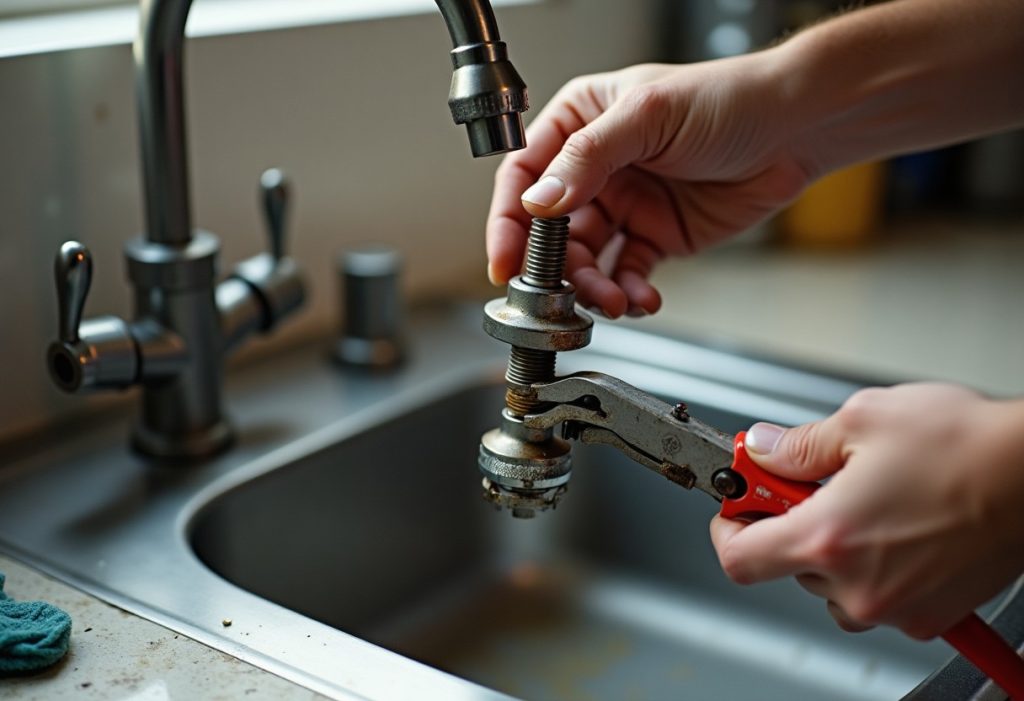
- Unscrew the aerator. Turn it counterclockwise by hand. If it is stuck, wrap the housing in a cloth or tape to protect the finish and use pliers or an adjustable wrench gently.
- Lay out the parts in order. Note the stack of screen, flow restrictor, and washer so you can rebuild it the same way. A quick photo helps.
- Rinse and soak. Flush the screen under running water to clear loose grit, then soak the parts in plain white vinegar for a few hours to dissolve hard mineral scale.
- Scrub and rinse. Work the screen with an old toothbrush, poke any blocked holes clear, and rinse everything well.
- Reassemble and hand-tighten. Stack the parts in order, thread the aerator back on by hand, then snug it just past hand-tight. Run the faucet and check for drips.
Before you even pull it apart, test whether the aerator is the culprit: unscrew it fully and run the faucet. If the flow surges back to normal, the aerator was choked and a clean or swap fixes it. If the flow is still weak with the aerator off, the problem is upstream, which points to the fixture valve, a kinked supply, or whole-house low water pressure. Whole-house pressure trouble can mimic other fixture quirks, so it helps to rule out frost-free faucet problems before chasing valves further.
Is a faucet aerator causing your low water pressure?
If one faucet runs weak while the rest of the house is normal, the aerator is the first suspect, not your pressure. Whole-house pressure problems show up at every fixture at once. A single slow faucet is almost always a local blockage, and the aerator screen is where debris lands first, especially after any work on the water main or water heater stirs up sediment.
Scale builds faster on homes with hard water, where dissolved calcium and magnesium leave chalky deposits on the screen. Rust flakes from old galvanized pipe or a corroding water heater land there too. A fresh pipe repair or a utility main flush can send a slug of grit straight into every aerator in the house at the same time.
Rule the aerator in or out before you blame anything bigger. Remove it and test the flow. If that clears it, you are done. If not, read up on the other causes of low water pressure such as a failing pressure-reducing valve, a partly closed shutoff, or a hidden leak. If the faucet also drips or the handle is loose, that is a separate issue covered in fixing a leaky faucet.
When should you replace a faucet aerator?
Replace an aerator when cleaning no longer restores flow, when the threads are stripped or cross-threaded, or when the screen is torn or badly corroded. Aerators cost only a few dollars, so once a vinegar soak stops working, a new one is cheaper than fighting a worn part. It is also the single easiest way to lower a faucet’s water use.
Swapping to a WaterSense labeled 1.5 gallon-per-minute aerator is the cheapest water-saving move in the house, and EPA says replacing old faucets and aerators saves the average family about 700 gallons a year. Because the aerator threads on by hand, you get that cut without replacing the faucet or calling anyone.
If the faucet body itself is worn out, leaking from the base, or you simply want a new look, a new aerator will not help and it is time for replacing the whole faucet. When you are shopping, the spout style and mounting also decide which aerator fits, so it helps to understand the broader faucet types before you buy.
How do you choose the right faucet aerator?
Pick by three things: the flow rate you want, the thread size and gender of your spout, and the stream style. Set the flow to the sink, 1.5 gallons per minute for a bathroom and up to 1.8 for a hard-working kitchen. Match regular, junior, or tom thumb threads to the spout, or buy dual-thread to be safe. Then choose aerated, spray, or laminar for feel.
For most bathrooms, a WaterSense labeled regular aerator at 1.5 gallons per minute is the simple default: it saves water, the EPA label confirms performance was tested, and it costs a few dollars. For a kitchen, many people prefer a switchable aerated-and-spray model so they can rinse a full sink or fill a pot without swapping parts.
Laminar aerators are the right call where aerosol spray is a concern, such as healthcare settings, because they produce a clear solid stream with no air mixed in. For a standard home sink, an aerated unit feels softer and splashes less, which is why it is the common choice. Whatever you pick, note the GPM stamped on the side so your next replacement matches.
How we sourced this
Flow-rate figures come from EPA WaterSense bathroom faucet guidance (1.5 gallons per minute at 60 psi, at least 30 percent below standard, about 700 gallons saved per household per year, a few dollars for a twist-on aerator) and the U.S. Department of Energy, which enforces the 2.2 gallon-per-minute federal maximum for lavatory and kitchen faucets at 60 psi set by the ASME A112.18.1 standard. The 2.5 gallon-per-minute origin traces to the 1992 Energy Policy Act, with the 2.2 lavatory limit from the 1994 ASME revision; pre-1994 flow ranges of roughly 3 to 5 gallons per minute reflect that history. Aerator size and thread data (regular 15/16 inch-27 male, junior near 13/16 inch, tom thumb, and the metric M24 / M21.5 / M16.5 equivalents) reflect Neoperl product specifications, a major aerator manufacturer. Cleaning steps reflect standard trade practice. We cited primary government and manufacturer sources and excluded vendor marketing claims and unverified GPM ranges.
Frequently asked questions
What does a faucet aerator do?
A faucet aerator is the small screened tip that screws onto the end of a faucet spout. It breaks the single water stream into many fine streams and mixes in air, which cuts splashing, makes the flow feel soft and full, and limits how many gallons per minute come out. That air mixing is how an aerator saves water without the stream feeling weak.
Why is only one faucet suddenly low on pressure?
When a single faucet runs weak while the rest of the house is fine, a clogged aerator is the most common cause. Mineral scale, rust flakes, and debris collect on the screen and choke the flow. Unscrew the aerator and test the faucet without it; if pressure jumps back, the aerator is the problem, so clean or replace it.
How do you clean a clogged faucet aerator?
Unscrew the aerator by hand or with a cloth-wrapped pliers, take the parts out in order, and rinse the screen. Soak the pieces in plain white vinegar for a few hours to dissolve mineral scale, then scrub gently with an old toothbrush and rinse. Reassemble in the same order and hand-tighten. This fixes most low-flow aerators.
What size faucet aerator do I need?
Measure the thread or match a replacement to the old part. The most common male thread is regular size at 15/16 inch-27, with junior at about 13/16 inch and the smaller tom thumb size below that. Male threads are on the outside of the spout, female threads on the inside. A dual-thread aerator fits both, and hidden or cache aerators recess inside the spout.
What is the difference between an aerated and a laminar faucet aerator?
An aerated aerator mixes air into the water for a soft, full, slightly cloudy stream and less splash, which is the standard type. A laminar aerator makes a clear, solid stream with no added air. Laminar flow splashes a bit more but does not spray fine droplets, so many hospitals and healthcare settings prefer it to limit airborne bacteria.
What is the maximum flow rate for a faucet aerator?
Federal rules cap lavatory faucets at 2.2 gallons per minute at 60 psi, set by the ASME A112.18.1 standard and enforced by the Department of Energy. A WaterSense labeled bathroom faucet or aerator uses no more than 1.5 gallons per minute at 60 psi, at least 30 percent less, and low-flow aerators go down to 1.0 gallons per minute or less.
When should you replace a faucet aerator instead of cleaning it?
Replace it when the housing threads are stripped or cross-threaded, the screen is torn or corroded, or a vinegar soak no longer restores full flow. Aerators cost only a few dollars, so swapping one is cheap insurance. It is also the easiest way to drop flow, since twisting on a WaterSense 1.5 gallon-per-minute aerator cuts water use without touching the faucet.


