Types of Faucets: Kitchen and Bath Styles Compared
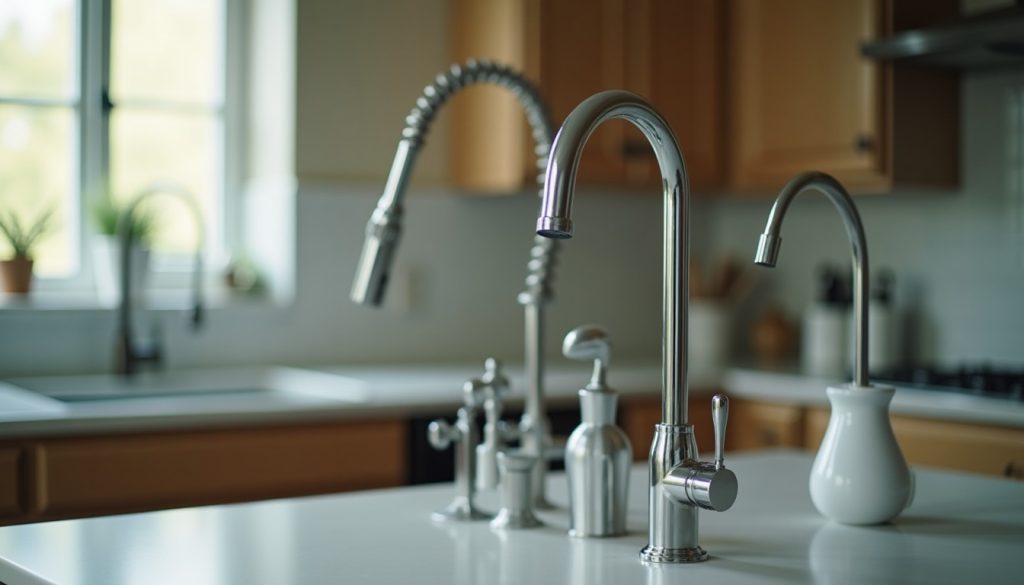
Faucets divide by how they mount, how many handles they carry, and the valve inside; kitchen and bathroom styles differ, and a WaterSense faucet flows 1.5 gpm versus the 2.2 gpm federal cap.
Key Takeaways
- Bathroom faucets mount three main ways: single-hole, centerset (a 4-inch fixed spread), and widespread (three pieces spaced 8 to 16 inches), plus wall-mounted for vessel and freestanding basins.
- The federal maximum flow for a bathroom sink faucet is 2.2 gallons per minute (gpm) at 60 psi, per the US Department of Energy.
- A WaterSense-labeled bathroom faucet flows at 1.5 gpm or less, using at least 30 percent less water than the federal maximum, per the EPA.
- California limits lavatory faucets to 1.2 gpm, stricter than the WaterSense 1.5 gpm threshold, and WaterSense sets a 0.8 gpm minimum at 20 psi so pressure stays usable.
- The four valve types are compression, ball, cartridge, and ceramic disc; ceramic disc is the most durable, while compression (rubber washer) is the oldest and most prone to dripping.
- Kitchen styles include pull-down, pull-out, single-handle, commercial pre-rinse, and touchless motion-sensor models, each suited to a different sink and workflow.
What are the main types of faucets?
Faucets are classified four ways at once: by mount and hole count, by handle count, by kitchen style, and by the valve inside. Any real faucet combines all four, for example a single-hole, single-handle kitchen pull-down with a ceramic disc valve. Choosing well means matching the mount to your sink’s drilled holes, the style to how you use the sink, and the valve and finish to how long you want it to last.
Bathroom and kitchen faucets share valve technology and finishes but split on mounting and spout style. Before you shop, count the holes in your sink or countertop and measure their spacing, because that dictates which mount will physically fit. Our guide to bathroom faucet plumbing covers those supply and mounting connections in detail.
How are faucets classified by mount and hole count?
Mount is set by how many holes your sink or counter has and how far apart they sit. The four bathroom mounts are single-hole (one hole), centerset (three holes on a fixed 4-inch spread), widespread (three separate holes spaced 8 to 16 inches), and wall-mounted (holes in the wall, not the deck). Kitchen faucets are usually single-hole or use a base plate to cover extra holes.
Single-hole
A single-hole faucet puts the spout and handle in one body through a single deck hole, so it installs fast and looks compact. It suits small vanities, modern designs, and vessel sinks. Many single-hole models ship with an optional escutcheon plate so they can also cover a 3-hole sink.
Centerset (4-inch)
A centerset faucet is a single unit that bridges a fixed 4-inch center-to-center hole spacing, with the spout and both handles joined on one base. It is the most common bathroom configuration and the most affordable, fitting standard 3-hole sinks drilled on 4-inch centers.
Widespread (8-inch)
A widespread faucet is three separate pieces, a spout and two handles, mounted in holes spaced 8 to 16 inches apart. The spread is adjustable, so it fits larger vanities and gives a higher-end, custom look. It costs more and takes longer to install than a centerset.
Wall-mounted
A wall-mounted faucet comes out of the wall above the basin rather than the deck, which frees counter space and pairs with vessel sinks and freestanding tubs. It needs a valve and supply lines roughed into the wall, so it is the most involved to install and best planned during a remodel.
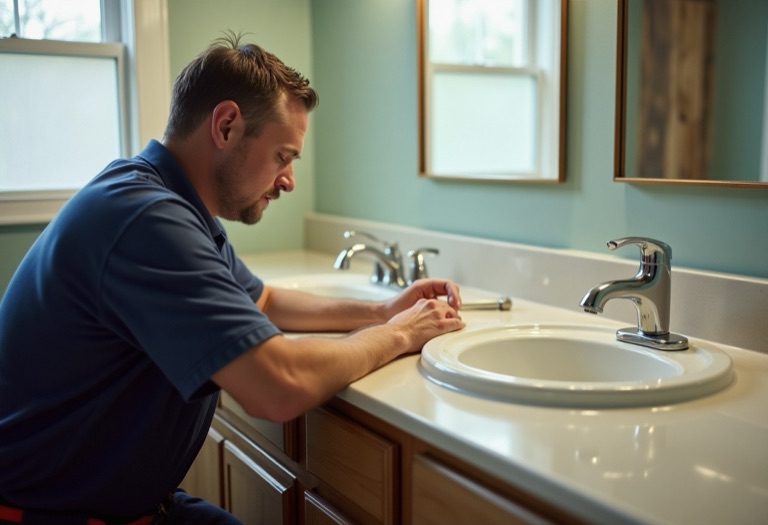
Which faucet style fits your kitchen or bath?
The right style depends on the sink and how you use it. The table below compares the common bathroom mounts and kitchen spout styles on where each is used, its main advantages, and what to watch for. Use it to shortlist before matching a valve and finish.
| Faucet type | Where used | Pros | Notes |
|---|---|---|---|
| Single-hole | Small vanities, vessel sinks, modern baths | Compact, fast install, one deck hole | Handle integrated; plate can cover a 3-hole sink |
| Centerset (4 in) | Standard bathroom sinks | Affordable, fits common 3-hole sinks | Spout and handles fixed on one 4-inch base |
| Widespread (8 in) | Larger vanities, upscale baths | Adjustable 8 to 16 in spread, premium look | Three separate pieces; more install time |
| Wall-mounted | Vessel sinks, freestanding basins | Frees counter, long reach over the basin | Needs in-wall valve and rough-in |
| Pull-down (kitchen) | Deep single-bowl kitchen sinks | Tall arc, spray head pulls down into bowl | Needs headroom; can splash in shallow sinks |
| Pull-out (kitchen) | Kitchens under windows or low cabinets | Low profile, wand pulls out toward you | Shorter spout, less clearance for tall pots |
| Commercial / pre-rinse | Busy or prep kitchens | High spring spout, powerful spray | Tall industrial look; check ceiling clearance |
| Touchless / motion | High-use, hygiene-focused kitchens and baths | Hands-free, cuts cross-contamination and waste | Needs battery or AC power; keeps manual backup |
Kitchen faucets take more abuse than bathroom faucets, so spout reach and spray control matter more there. Our kitchen sink plumbing guide shows how the faucet, drain, and disposal connect under the sink.
Single or double handle: which should you pick?
A single-handle faucet controls both water volume and temperature with one lever, so it is quicker to use one-handed and simpler to install because it has fewer supply connections that can leak. A double-handle faucet uses separate hot and cold controls, which allows finer temperature setting and pairs with traditional or widespread styling.
Single-handle is the practical default for kitchens, where one hand is often full. Double-handle suits formal bathrooms and widespread installations where the paired handles are part of the look. Handle count is independent of valve type: a single-handle faucet usually rides on a cartridge or ball valve, while double-handle faucets often use two cartridge or ceramic disc valves, one per side.
What kitchen faucet styles are there?
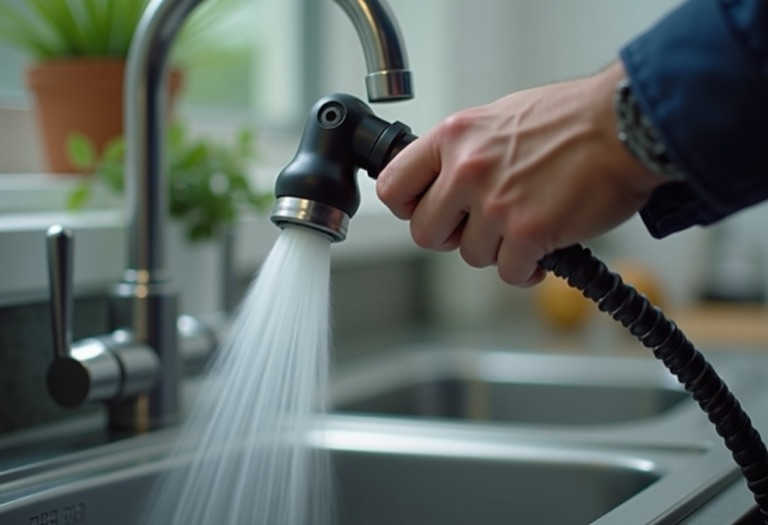
Kitchen faucets come in five common spout styles: pull-down, pull-out, standard single-handle, commercial pre-rinse, and touchless. They differ in spout height, how the sprayer moves, and how much clearance they need. Pull-down and pull-out models dominate today because the integrated sprayer replaces a separate side spray. Before choosing a spout style, check how sprayer mechanics compare to shower head styles and gpm ratings elsewhere in the home.
A pull-down faucet has a tall, high-arc spout with a spray head that pulls straight down into the basin, ideal for deep single-bowl sinks. A pull-out faucet has a lower spout and a wand that pulls out horizontally toward you, which fits under a window or a wall cabinet. A commercial or pre-rinse faucet uses a tall spring-mounted spout and a strong spray for heavy prep work. A touchless faucet adds a motion sensor that starts flow when your hand enters the field, useful when your hands are full or dirty. A standard single-handle faucet with a fixed spout remains the simplest and cheapest option.
Whichever style you choose, replacing an old unit follows the same core steps; see our guide to how to replace a faucet for removing the old faucet and connecting the new supply lines.
Which faucet valve lasts longest?
The valve is the part inside that starts, stops, and mixes the water, and it decides how long a faucet goes without dripping. The four types are compression, ball, cartridge, and ceramic disc. Ceramic disc is the most durable; compression is the oldest and drips soonest as its rubber washer wears. The table below compares them.
| Valve type | How it works | Durability | Notes |
|---|---|---|---|
| Compression | A rubber washer is screwed down onto a seat to stop flow | Lowest; washer wears and drips | Oldest design; two handles; washers are cheap to replace |
| Ball | A slotted ball rotates to align hot and cold ports | Moderate; many small parts and springs | Common in older single-handle kitchen faucets |
| Cartridge | A movable cartridge with O-rings controls flow and mix | Good; reliable, especially with a brass cartridge | Single or double handle; swap the whole cartridge to repair |
| Ceramic disc | Two polished ceramic discs slide to control flow | Highest; resists wear and mineral buildup | Washerless; most modern quality faucets use it |
Compression valves still show up in budget and utility faucets and are easy to service, but they drip once the washer hardens. Cartridge and ceramic disc valves are washerless and last far longer. When a modern faucet finally drips, the fix is usually a new cartridge rather than a washer; our guide to fix a leaky faucet walks through it by valve type.
How much water do faucets use?
Flow rate is capped by federal standard and cut further by WaterSense and state rules. The federal maximum for a bathroom sink faucet is 2.2 gallons per minute at 60 psi, per the US Department of Energy. A WaterSense-labeled faucet flows at 1.5 gpm or less, at least 30 percent below the federal cap, and California limits lavatory faucets to 1.2 gpm. WaterSense also sets a 0.8 gpm floor so low-flow faucets still feel usable.
Kitchen faucets carry their own limits: the federal cap is also 2.2 gpm, while California allows kitchen faucets up to 1.8 gpm. An aerator on the spout is what sets the actual flow, so swapping a worn aerator for a WaterSense-rated one is the cheapest way to cut a faucet’s water use.
What faucet finishes should you choose?
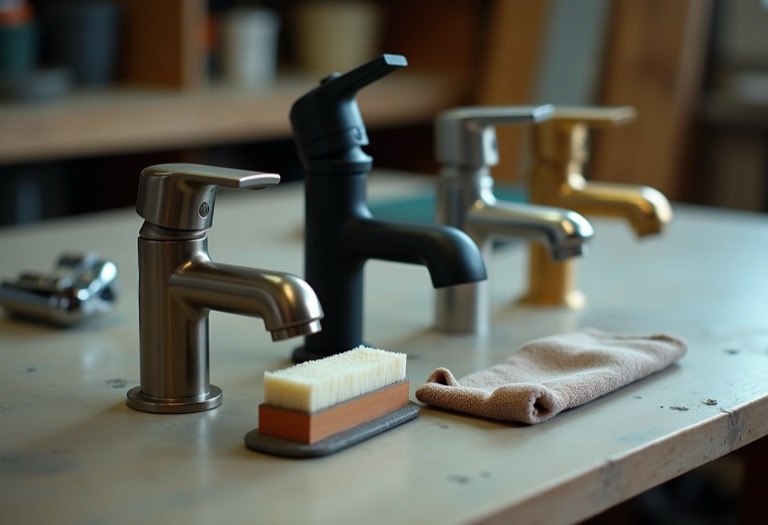
Finish is cosmetic but affects maintenance and durability. The common options are polished chrome, brushed or satin nickel, matte black, brushed gold or brass, and oil-rubbed bronze. Chrome is the cheapest and most common and wipes clean, but shows water spots. Brushed nickel and matte black hide fingerprints and spots best.
For durability, look for a physical vapor deposition (PVD) finish, which bonds the coating at a molecular level and resists scratching and tarnish far better than standard electroplating. Match the finish across the faucet, drain, and any shower trim in the same room so the metals read as intentional rather than mismatched.
Which faucet should you choose?
Start with the sink: count and measure the holes, because that decides your mount. For a standard 3-hole bathroom sink, a centerset is the safe, affordable pick; for a larger vanity, a widespread looks more custom; for a vessel or small sink, go single-hole or wall-mounted. In the kitchen, a single-handle pull-down suits most deep sinks, while a pull-out fits tight spots under a window.
Then choose for longevity: pick a faucet with a ceramic disc or quality cartridge valve, a WaterSense label if water savings matter, and a PVD finish that survives daily wiping. Confirm the valve is a widely stocked type so repair parts stay easy to find years from now.
How we sourced this
Flow-rate figures come from federal and state sources: the 2.2 gpm federal maximum for bathroom sink faucets is documented by the US Department of Energy (FEMP Best Management Practice #7); the 1.5 gpm WaterSense maximum, the at-least-30-percent savings versus the federal cap, and the 0.8 gpm minimum flow at 20 psi come from the EPA WaterSense faucet specification. The 1.2 gpm California lavatory limit and 1.8 gpm California kitchen limit reflect California Title 20 / CALGreen requirements. Mounting definitions (single-hole, 4-inch centerset, 8 to 16 inch widespread, wall-mounted), the four valve types (compression, ball, cartridge, ceramic disc) and their relative durability, kitchen spout styles, and finish characteristics are reported as standard product classifications from manufacturer and retailer buying guides read for context. Cost is discussed only in relative terms; specific prices vary by brand and region and are not stated as fixed figures.
Frequently asked questions
What are the main types of faucets?
Faucets are grouped four ways: by mount and hole count (single-hole, centerset, widespread, wall-mounted), by handle count (single or double), by kitchen style (pull-down, pull-out, single-handle, commercial pre-rinse, touchless), and by the valve inside (compression, ball, cartridge, ceramic disc). A single faucet is a combination of all four.
What is the difference between centerset and widespread faucets?
A centerset faucet is one body that spans a fixed 4-inch center-to-center hole spacing, with the spout and both handles joined on a single base. A widespread faucet is three separate pieces (spout plus two handles) that mount in holes spaced 8 to 16 inches apart, giving a more custom look and fitting larger vanities.
Which faucet valve lasts the longest?
Ceramic disc valves are the most durable and longest-lasting type. Two polished ceramic discs slide against each other to control flow, and they resist wear and mineral buildup better than rubber washers or O-rings. Compression valves, which rely on a rubber washer, are the oldest design and the most prone to dripping as the washer wears.
How much water does a faucet use?
The federal maximum for a bathroom sink faucet is 2.2 gallons per minute (gpm) at 60 psi, per the US Department of Energy. A WaterSense-labeled bathroom faucet flows at 1.5 gpm or less, at least 30 percent less water, per the EPA. California limits lavatory faucets to 1.2 gpm.
What is the difference between a pull-down and a pull-out kitchen faucet?
A pull-down faucet has a tall, high-arc spout and a spray head that pulls straight down into the sink, which suits deep single-bowl basins. A pull-out faucet has a lower spout and a spray wand that pulls out horizontally toward you, which works better under a window or a low cabinet and reaches across the counter.
Should I choose a single-handle or double-handle faucet?
A single-handle faucet controls both volume and temperature with one lever, so it is quicker to use one-handed and simpler to install. A double-handle faucet has separate hot and cold controls, which allows finer temperature setting and pairs with traditional or widespread styling. Single-handle models have fewer connections that can leak.
Are touchless faucets worth it?
Touchless (motion-sensor) faucets turn on when a hand or object enters the sensor field, which cuts cross-contamination and can reduce water waste from a faucet left running. The tradeoffs are a higher price and the need for battery or AC power, so a dead battery can disable the sensor. Most models keep a manual handle as a backup.
What faucet finish is easiest to maintain?
Brushed or satin nickel and matte black hide water spots and fingerprints best, so they show smudges less than polished chrome. Polished chrome is the most common and least expensive finish and wipes clean easily but shows spots. Look for a physical vapor deposition (PVD) finish, which resists scratching and tarnish far better than standard plated coatings.


