Heat Pump Water Heater Condensate Drain: How Much Water, Where It Goes, and the 3/4 Inch Rules in 3 Maker Manuals
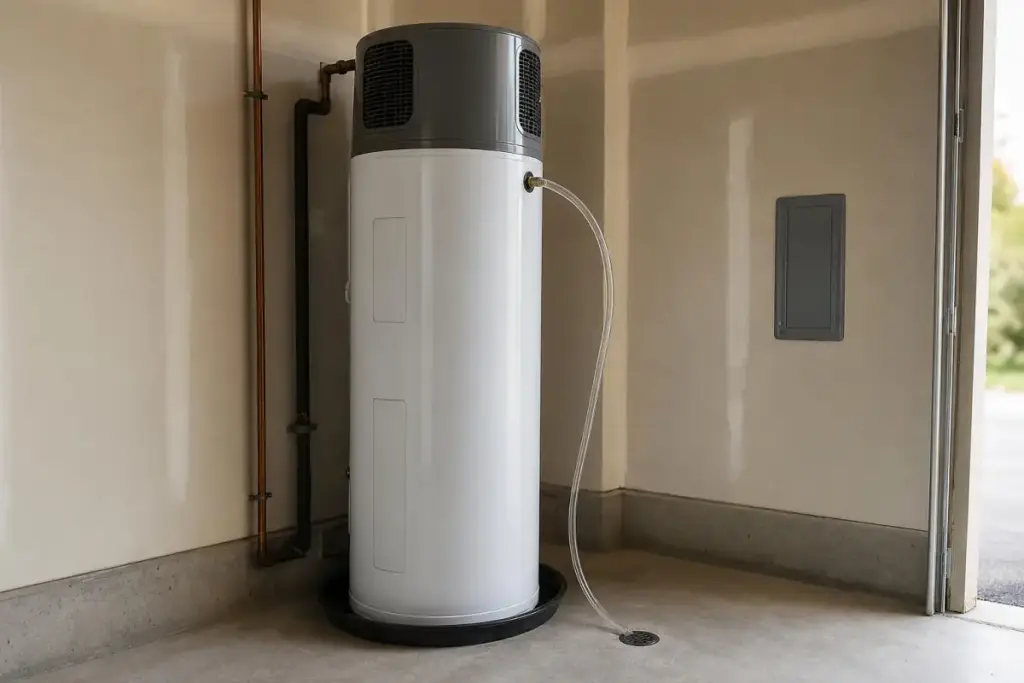
A heat pump water heater condensate drain carries roughly 0.2 to 3 pints of water a day in published measurements. Rheem, A. O. Smith and Bradford White all call for a 3/4 inch line sloped downhill to a floor drain or laundry standpipe, or a condensate pump rated at least 1 to 2 gallons a day.
How much water does a heat pump water heater condensate drain carry?
Less than most installers expect: published daily figures run from under 0.2 pints to about 2 quarts, depending on humidity and compressor run time. GE’s GeoSpring condensation support page puts its hybrid at approximately 1 to 2 quarts per day. In Fine Homebuilding’s 2024 dehumidification report, Jon Harrod cites William Murphy’s Kentucky data (under 0.2 pints a day in winter, about 0.9 in summer), a Florida Solar Energy Center garage test at 3.2 pints a day with a four-person draw, and his own unit at 1.3 pints a day once relative humidity passed 70 percent.
One utility handout overshoots. Peninsula Clean Energy’s 2023 HPWH condensate sheet says a heater can create 1 to 2 gallons a day, which is 8 to 16 pints and roughly 5 times the highest monitored figure above. None of the three maker manuals below states a daily volume.
Computed: condensate by household size on a Rheem ProTerra
No maker publishes condensate per run hour, so this table converts hot water use into compressor hours, then pints. Inputs: daily hot water from Table 2 of the RESNET 301 Addendum A background paper (PD-02) (125°F setpoint, 56.8°F average climate); 8.34 lb per gallon times a 68.2°F rise, or 569 Btu per gallon; the 4,200 Btu/h compressor rating in Rheem’s ProTerra spec sheet HP-375 Rev. 2; and Harrod’s humid week, 1.3 pints a day over 1.2 cycles of 68 minutes, or about 0.96 pints per run hour. The last column is a physical ceiling: 4,200 Btu/h divided by about 1,060 Btu per pound to condense water vapor (steam table value near 60°F) gives 0.48 gallons per hour even if every Btu came from moisture.
| Occupants (RESNET row) | Hot water, gal/day | Load, Btu/day | Compressor hours at 4,200 Btu/h | Humid-month estimate at 0.96 pt/h | Physical ceiling at 0.48 gal/h |
|---|---|---|---|---|---|
| 2.17 (2 bedrooms) | 39.2 | 22,300 | 5.3 | 5.1 pints (0.63 gal) | 2.5 gal |
| 4.33 (6 bedrooms) | 74.7 | 42,500 | 10.1 | 9.7 pints (1.21 gal) | 4.8 gal |
| 5.95 (9 bedrooms) | 99.9 | 56,800 | 13.5 | 12.9 pints (1.62 gal) | 6.4 gal |
Read the middle column as a muggy-August planning number, not a typical day: FSEC’s monitored four-person garage test produced 3.2 pints, about a third of the 9.7 pint estimate, because most of the heat an evaporator pulls from room air is sensible heat, not moisture. Rheem’s minimum pump capacity of 2 gallons a day covers the humid-month estimate for 6 occupants (1.62 gallons) with margin, and Bradford White’s 1 gallon a day minimum covers a 2 to 4 person house.
What the Rheem, A. O. Smith and Bradford White manuals require
All three use a 3/4 inch primary connection and forbid shrinking the line below it; they differ on pump size, the secondary port and the blocked-drain code.
| Maker and document | Stated condensate volume | Primary fitting | Secondary or overflow | Pump rule | Blocked-drain code |
|---|---|---|---|---|---|
| Rheem electric residential hybrid, Use and Care Manual AP23657 Rev 04 (2024) | None stated | 3/4 inch NPT female, MIP fittings, hand tight | Not described in the condensate section | Common pump of at least 2 gal/day where no drain exists | A108 Condensate Blocked, heating defaults to elements |
| A. O. Smith hybrid electric HPWH, guide 100277324 Rev A (50, 66, 80 gal) | None stated | 3/4 inch PVC via a 3/4 inch slip by 3/4 inch MNPT 90° elbow | Secondary port with 1/2 inch ID flexible tubing, plus an overflow slot in the drain access cover | Required if no floor drain or drain above the condensate line; wire pump float switch to shut off the heat pump | EoF, condensate management |
| Bradford White AeroTherm RE2H50S, 65T, 80T (-1NCWT), manual 238-52324-00B (08/18) | None stated | 3/4 inch FNPT fitting on the side primary port | Condensate drain overflow port shown beside the primary | Common pump of at least 1 gal (3.8 L)/day if no drain; gravity drain no higher than 36 inches | F20, heat pump stops and alarm sounds |
None of the three manuals names a factory condensate pump kit or part number; each says to buy a common pump, so price that part as a generic HVAC condensate pump with a safety switch. Only A. O. Smith spells out the shutoff wiring: two 22 AWG leads from a loop behind the drain access cover to the pump’s overflow switch. The heat pump water heater pros and cons page covers the cost, air volume and noise that come with this line.
Where can the condensate line go: floor drain, standpipe or pump?
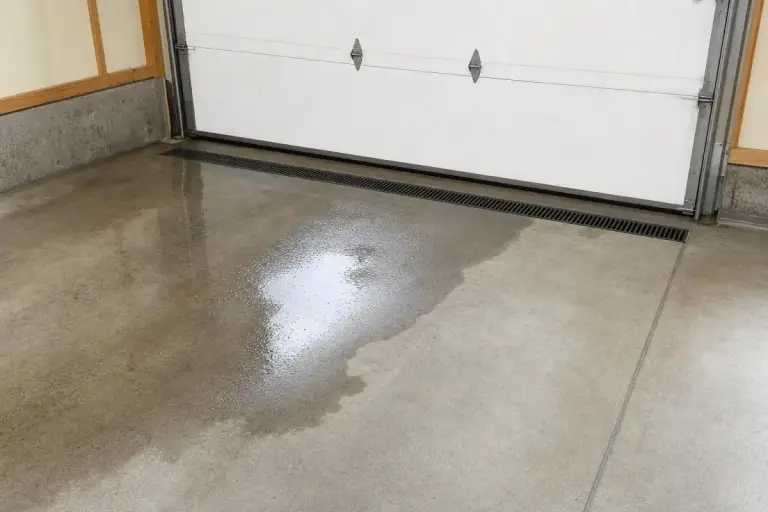
Three routes pass every manual read here: gravity to a floor drain, gravity into a laundry standpipe, or a condensate pump; two routes fail all of them.
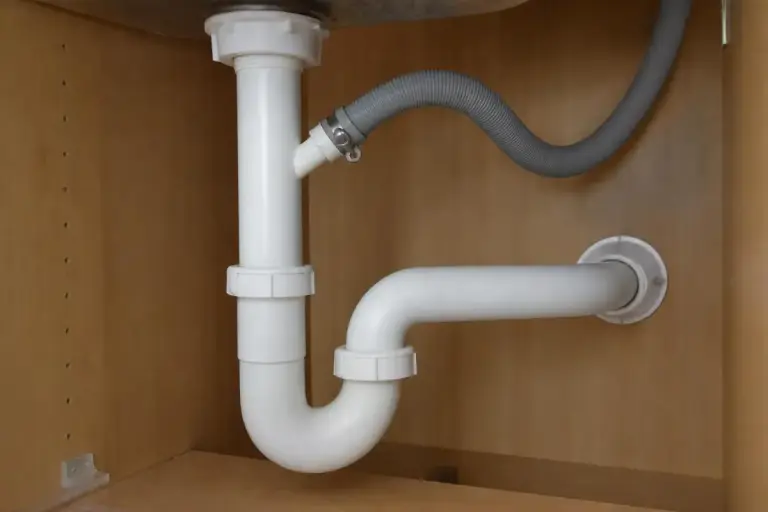
Rheem requires a P-trap when the line ties into a sewer pipe and a tee in the condensate line as a yearly inspection and cleaning opening. GE’s support page states that a laundry drain is acceptable, and The T&P rule is absolute in both Rheem and A. O. Smith text: Rheem says not to connect the relief valve plumbing to the condensate plumbing, and A. O. Smith says each line, condensate and relief discharge, runs independently to an adequate drain rather than into one common pipe.
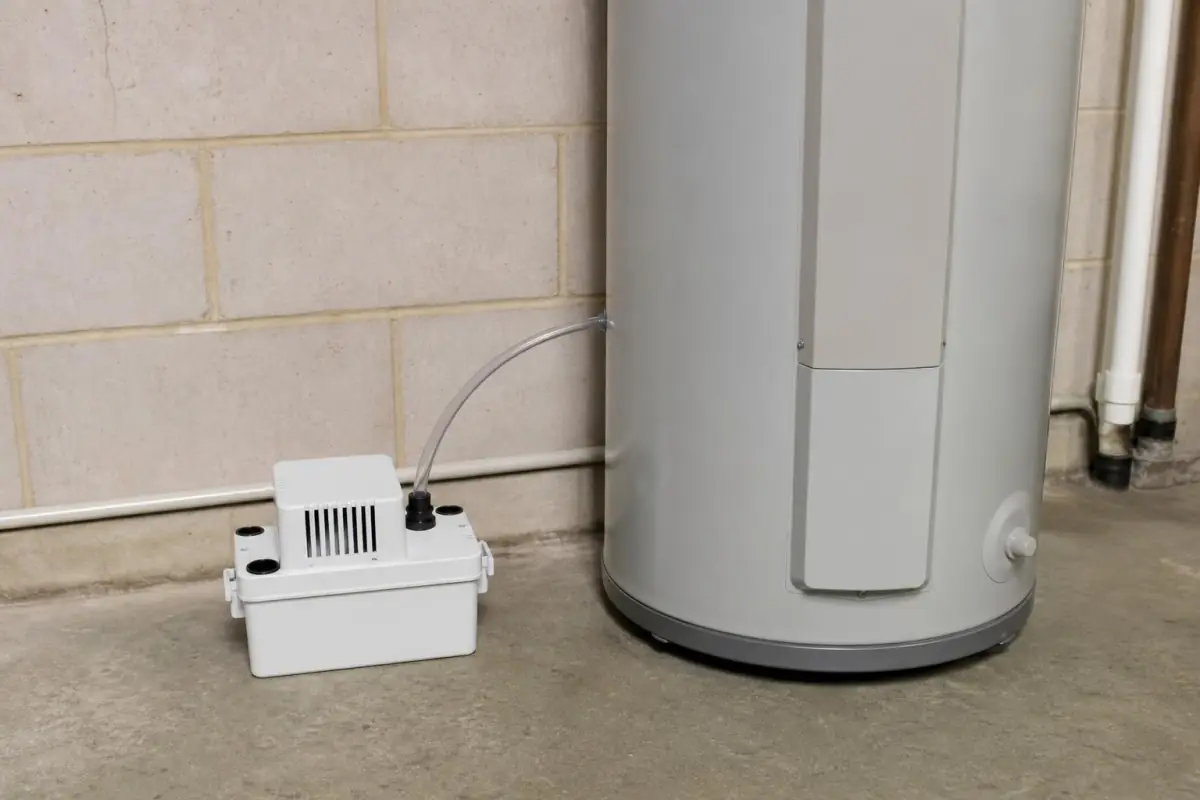
No floor drain: sizing and wiring the condensate pump
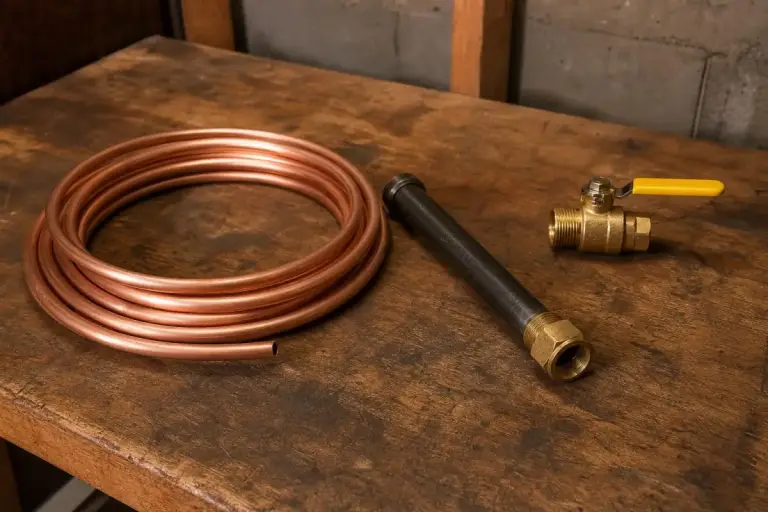
With no drain at or below 36 inches, every manual sends you to a pump, and A. O. Smith adds that the pump must shut the heat pump off if it fails or its float switch trips. ICC’s Code Essentials excerpt on condensate (page 145) describes the same interlock as mandatory for pumps in uninhabitable spaces such as attics, citing IFGC 307.6 and IRC G2404.11. In a basement, mount the pump below the 3/4 inch outlet so the line still falls 1/8 inch per foot into the pump inlet,. Rheem’s pump floor of 2 gallons a day and Bradford White’s 1 gallon a day are both above every monitored daily figure, so pick on safety switch and noise, not capacity. If the pump and line add enough cost to change the decision, the heat pump versus tankless comparison shows the install cost gap.
What code applies: IRC M1411.3, IMC 307 and the pan rules
The evaporator in a heat pump water heater makes condensate, so residential inspectors apply IRC M1411.3 (condensate disposal) and commercial ones IMC 307, with plumbing-side disposal in IPC Section 314; local amendments vary.
| Section | Topic | What it requires |
|---|---|---|
| IRC M1411.3 | Condensate disposal | Condensate from evaporators goes from the drain pan outlet to an approved place of disposal, not onto a street or alley as a nuisance |
| IRC M1411.3.1 | Auxiliary and secondary drain systems | Where overflow would damage building parts: an auxiliary pan at least 1-1/2 inches deep and 3 inches larger than the unit draining to a conspicuous spot, a secondary 3/4 inch drain, or a water-level switch that shuts the unit off (per ICC Code Essentials, page 145) |
| IRC M1411.3.2 | Drain pipe materials and sizes | At least 3/4 inch internal diameter, no reduction between pan connection and disposal point, uniform slope (Baltimore’s adopted text); Rheem sets that slope at 1/8 inch per foot |
| IRC M1411.3.3 | Drain line maintenance | Lines must be serviceable; Rheem’s required tee and yearly cup of bleach meet this |
| IRC P2801.6 | Water heater pan | Pan at least 1-1/2 inches deep with a drain of at least 3/4 inch where a leak would cause damage; covered in our water heater drain pan rules |
The tank pan and the condensate system are separate jobs. Rheem’s pan drawing calls for the heater diameter plus 4 inches; A. O. Smith wants at least 2 inches wider than the tank and water no deeper than 1-3/4 inches. Neither pan may receive the condensate line, because a pan that is always damp cannot announce a split tank.
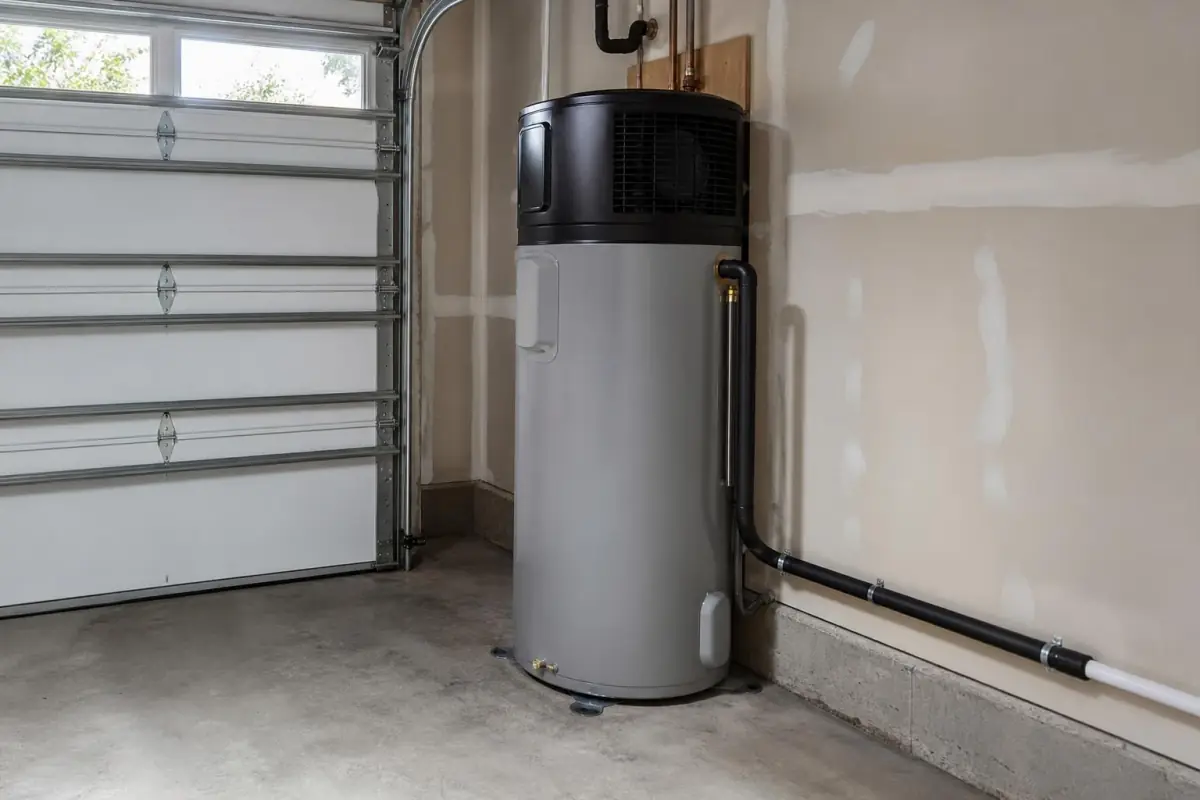
Garage installs: freezing, sweating lines and the low-temperature cutoffs
The compressor stops making condensate below its ambient floor: 37°F on the ProTerra spec sheet, 35°F in the Bradford White manual and 45°F in the 2016 A. O. Smith guide, after which the elements take over.A. O. Smith says condensate lines belong in conditioned areas and must be wrapped with a nationally recognized heat tape where freezing is possible. Rheem’s installation checklist asks for a location protected from temperatures below 32°F and says to insulate the drain line where needed to stop sweating, which in a humid garage can drip as much as the line itself carries.
Clogged condensate: A108, F20 and EoF
A blocked line trips a sensor on all three brands,, and each code means water is backing up in the evaporator pan. On Rheem hybrids, A108 Condensate Blocked switches heating to the elements; the manual says to remove the top cover, check the pan, clear the blockage and, if the pan is dry, replace the condensate sensor. Bradford White’s F20 stops the heat pump and sounds an alarm until the drain lines and port are cleared. A. O. Smith’s EoF check list starts with leveling the unit, then clearing primary and secondary lines, then checking the pump’s control wires and power. Water from A. O. Smith’s overflow slot means both lines may be blocked. Rheem’s annual cup of bleach in the access tee targets the algae and mold behind these clogs; the full list of Rheem hybrid alarm codes covers the sensor and compressor faults that look similar.
Heat pump water heater condensate questions
Can a heat pump water heater condensate line drain into the drain pan?
No. Rheem’s Use and Care Manual AP23657 says not to let condensate drain into the water heater drain pan, and A. O. Smith’s hybrid guide says not to discharge condensate lines into the metal pan. The pan is a leak alarm, so a constant trickle in it hides a real tank failure.
Do I need a condensate neutralizer for a heat pump water heater?
Not for a Rheem hybrid. Rheem’s manual states the condensate from the unit is not acidic and is not required to be neutralized. Neutralizer kits are sold for condensing gas water heaters, whose flue condensate is a different liquid from the plain water an evaporator coil collects.
Can the condensate line run outside?
Rheem’s typical installation drawing labels the primary line as going to an open drain or outdoors, and Peninsula Clean Energy shows landscaping as an option where local code allows. Outdoors in a freezing climate the line end can ice shut, so heat tape per A. O. Smith or an indoor drain is the safer choice.
Why is no water coming out of my heat pump water heater condensate line?
In dry or cool air there may be almost none. William Murphy’s monitored Kentucky units averaged under 0.2 pints a day in winter, and a heat pump water heater in a dehumidified basement made 0.17 pints a day. A dry line with an A108, F20 or EoF code is a blockage, not low output.
How high can the drain be above the floor?
Bradford White and GE both say a gravity drain must sit no higher than 36 inches above the floor, and GE adds that a laundry drain is acceptable. Above that height, or above the condensate outlet itself, A. O. Smith requires a condensate pump.
How we sourced this
Read: Rheem Use and Care Manual AP23657 Rev 04 and ProTerra spec sheet HP-375 Rev. 2; A. O. Smith hybrid guide 100277324 Rev A; Bradford White manual 238-52324-00B; GE’s GeoSpring support page; Peninsula Clean Energy’s condensate sheet; Fine Homebuilding’s 2024 report; the RESNET PD-02 background paper; ICC Code Essentials page 145; Baltimore’s adopted IRC 1411.3.2. Computed: hot water load, compressor hours, per-hour condensate rate and the physical ceiling, all inputs shown above. Left out: maker pump part numbers and prices (none published), a current Voltex-branded manual, Stiebel Eltron data and a pH figure for HPWH condensate.