Can You Have a Floor Drain in a Garage? Code, Oil Separators and Where It Can Drain
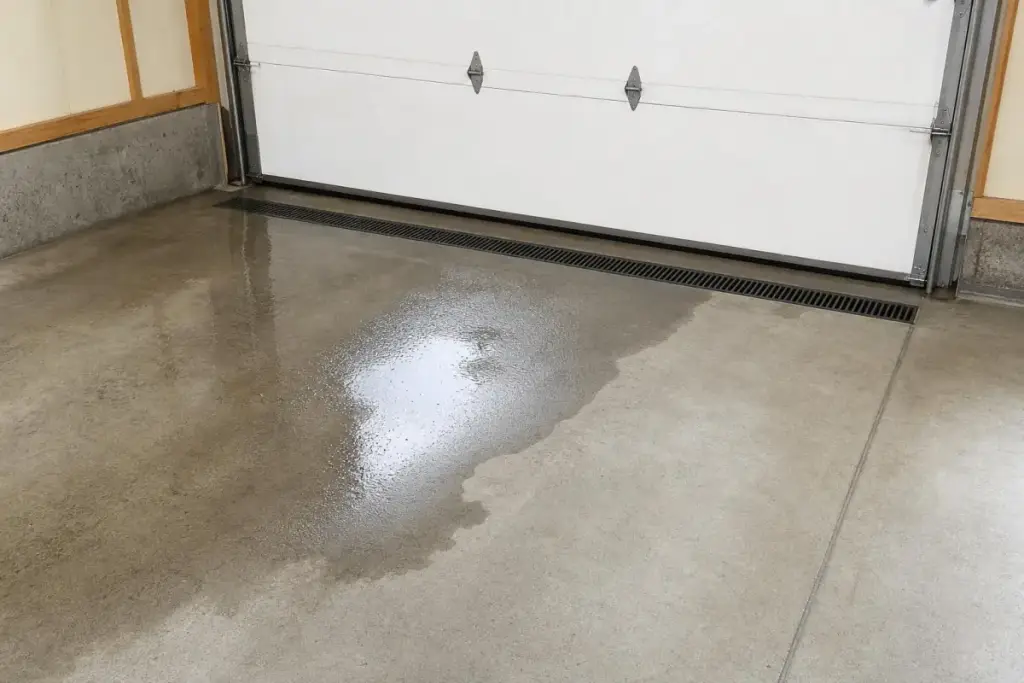
Yes, you can have a floor drain in a garage in most U.S. jurisdictions, but where it drains decides whether it is legal: sanitary sewer through a sediment basket or oil interceptor, daylight or a swale, or a sump. Some places, such as Sonoma County, California, ban private garage floor drains outright.
Which of the 3 discharge routes does your code allow?
The code question is never “drain or no drain” but which of 3 outlets the inspector will sign off, and each outlet has its own deciding rule. A garage drain collects snowmelt, road salt brine, antifreeze drips and motor oil, so every code that allows one controls where that mix ends up.
Route 1, sanitary sewer. Minnesota’s plumbing code, Minn. R. 4714.0418 subpart 2, sends floor drains in enclosed parking areas and in any vehicle maintenance or wash area to the sanitary sewer when a municipal sewer is available. The deciding rule is the separator: under IPC Section 1003.4 a repair garage with floor or trench drains needs an oil separator, while IPC 1003.4.2.2 says a parking garage with no servicing, repairing, washing or fuel dispensing does not.
Route 2, daylight or a treatment swale. The same Minnesota subpart lets floor drains in private garages serving 1 and 2 family dwellings discharge to daylight, but only if the administrative authority approves it. The deciding rule is the receiving ground: a pipe outlet on your own lot, never a neighbor’s, and in some cities a treatment area before any storm inlet.
Route 3, sump or dry well. A sump pit with a pump moves garage water to a lawful outlet, while a dry well puts it straight into the ground, which federal underground injection rules treat as a well once vehicle fluids enter it. The deciding rule is what the water carries, covered in the EPA section below.
Garage floor drain rules in 6 named codes
The table below lines up the rule text from 6 codes read for this page, and no 2 of them handle a home garage drain the same way.
| Jurisdiction and document | Allowed discharge | Interceptor rule | Approval |
|---|---|---|---|
| Minnesota, Minn. R. 4714.0418 subp. 2 and 4714.1017 | Enclosed parking to sanitary sewer if a municipal sewer is available; private garages of 1 and 2 family homes may go to daylight | Oil and flammable liquid interceptor at repair garages and parking garages over 1,000 sq ft, with an 18 in water seal on the outlet | Daylight only if the administrative authority approves |
| Wisconsin, SPS 382.34(4) | Into the drain system through a garage catch basin or sediment drain | 1 and 2 family garage floor drains need a removable solid bottom sediment basket; catch basins serving those garages need an 18 in minimum inside diameter (36 in for other garages) | State plumbing code, local inspector |
| Sonoma County, Calif., Permit Sonoma Technical Bulletin P-02 (4/1/2020) | None: floor drains “will not be allowed in private garages” | Not applicable | Cites 2019 California Plumbing Code 304.0, 306.1 and 1007 |
| Cherry Hills Village, Colo., Garage Floor Drain and Sump Pump Policy (adopted April 8, 2022) | Daylight only, through a grass swale, grass buffer or bioretention area before any storm sewer; never to sanitary sewer | Water quality treatment area in place of a mechanical interceptor | Design approved before installation under the city’s MS4 permit |
| Elkhart, Ind., City Code 156.007 | Prohibited in residential garages unless routed through interceptors | Grease and oil interceptor plus sand and gravel interceptor; combination units allowed | City plumbing permit under Chapter 156 |
| Model code, IPC 1003.4 and 1003.4.2.2 | Building drainage system after any required separator | Separator at repair garages with floor drains; none for parking only garages with no washing or fuel | Local adoption and amendments |
For a homeowner, the table means 2 calls settle the question: the building department for the plumbing permit and the sewer utility for what it accepts. If the answer is “sanitary only with an interceptor” as in Elkhart, budget for a combination oil and sand unit; if it is “daylight only” as in Cherry Hills Village, the drain needs a downhill outlet and a planted treatment strip before the street.
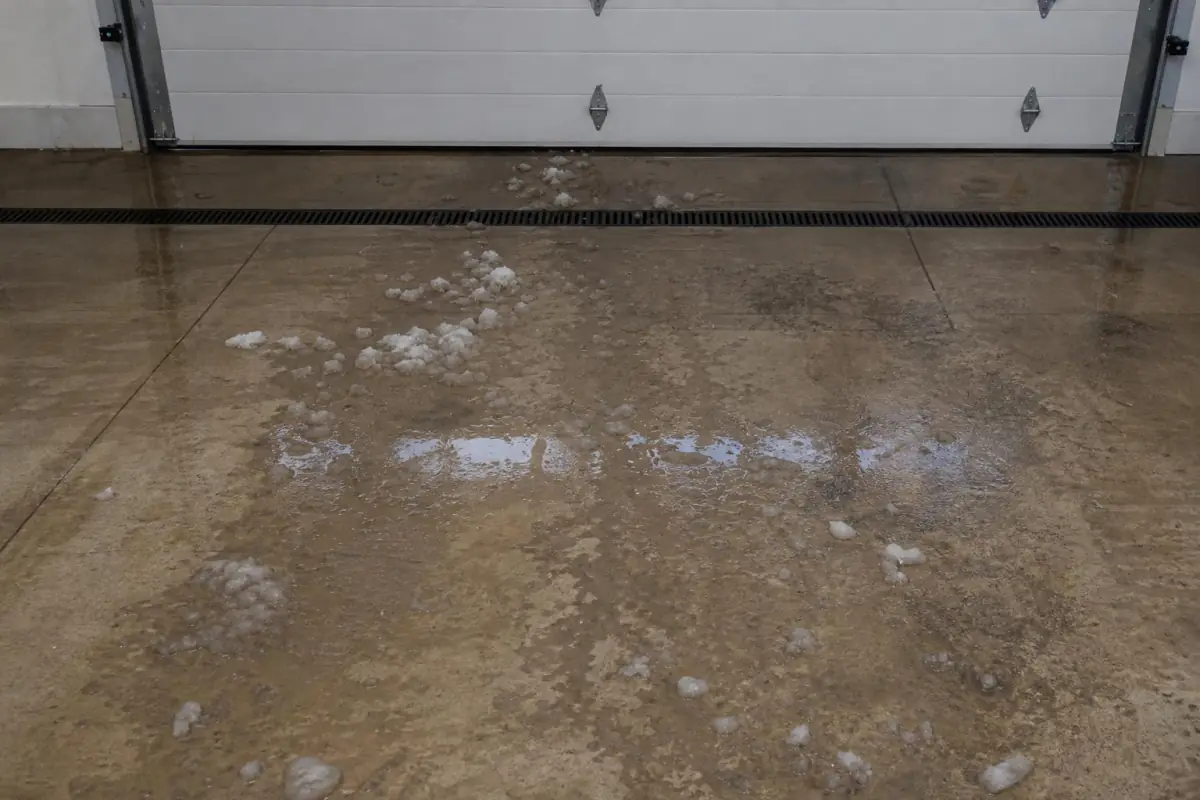
How much water does one snowy car bring in, and how much slope moves it?
One sedan carrying 2 in of wet snow on its upper surfaces sheds about 22 gallons of meltwater onto the stall, by the arithmetic below. Inputs: 90 sq ft of roof, hood and trunk holding snow (a 6 by 15 ft plan area), a 200 sq ft stall (10 by 20 ft), and snow to water ratios of 10 to 1 and 5 to 1, the typical and wet ends that UCAR’s National Weather Service measuring guidance describes. 1 cu ft holds 7.48 gallons.
| Snow on car | Snow to water ratio | Water (cu ft) | Water (gallons) | Depth if spread over 200 sq ft stall |
|---|---|---|---|---|
| 1 in | 10 to 1 | 0.75 | 5.6 | 0.045 in |
| 1 in | 5 to 1 (wet) | 1.5 | 11.2 | 0.09 in |
| 2 in | 10 to 1 | 1.5 | 11.2 | 0.09 in |
| 2 in | 5 to 1 (wet) | 3.0 | 22.4 | 0.18 in |
A level floor does not spread water evenly, so the real issue is the puddle that collects in low spots, and slope is what fixes it. The fall needed is plain multiplication of slope by run:
| Slope | Fall over 10 ft run | Fall over 20 ft run |
|---|---|---|
| 1/8 in per ft | 1.25 in | 2.5 in |
| 1/4 in per ft | 2.5 in | 5 in |
Read together, the tables give 3 decisions. A 20 ft deep garage pitched at 1/4 in per ft needs the back of the slab 5 in higher than the door line, which is why many builders settle on 1/8 in per ft and 2.5 in of fall. An 18 in diameter Wisconsin style catch basin holds 13.2 gallons per foot of water depth (pi x 0.75 ft x 0.75 ft x 7.48), so a single wet 2 in snow load of 22.4 gallons fills about 1.7 ft of it, and 2 cars double that. A containment mat with no drain has to hold the 22.4 gallon case per car or it overflows onto the floor.
Why EPA calls a garage dry well a Class V well
A dry well that receives fluids from vehicle repair or maintenance is a motor vehicle waste disposal well, a Class V injection well, and EPA bans any built after April 5, 2000. EPA classifies the well by what goes into it, not how it is built, and its list of users includes vehicle repair home businesses. Its page does not say that a parking only home garage counts, so the risk line is the activity: an oil change, coolant flush or brake job over a drain that feeds a dry well or septic tank moves the drain into the banned category. Minnesota’s pollution agency fact sheet on Class V wells goes further and treats floor drain wells serving any vehicle servicing, including home based repair, as prohibited.
Trap seals in heated and unheated garages
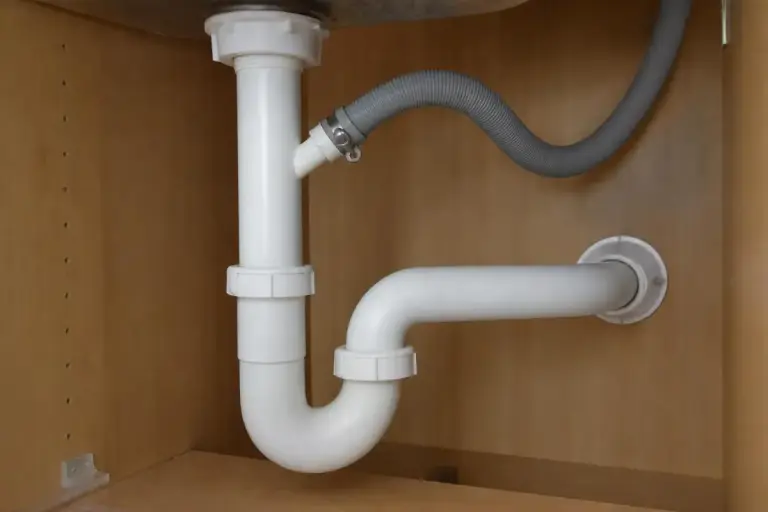
A garage drain that connects to a sanitary sewer needs a trap, and IPC Section 1002.4 sets that water seal at 2 to 4 in deep, which evaporates in a drain that only sees water a few winter days a year. The 2024 IRC, Section P3201.2.1, requires protection for traps subject to evaporation: a primer valve to ASSE 1018, a drainage type primer to ASSE 1044, or a barrier insert to ASSE 1072. The trap primer types and prices page covers those devices part by part, and the cheap fix in a dry season is 1 gallon of water poured down the grate each month.
An unheated garage adds the opposite failure: a frozen seal. Minnesota writes the principle into 4714.0418 subpart 1 for drains in freezing rooms, requiring traps “located where the seal will not freeze”, and the same physics applies under a cold garage slab. A drain that smells of sewer gas in summer has a dry seal, while one that backs up during a thaw may have an ice plug or a sewer problem, which the floor drain backup diagnosis sorts by symptom.
Retrofitting a drain into an existing garage slab
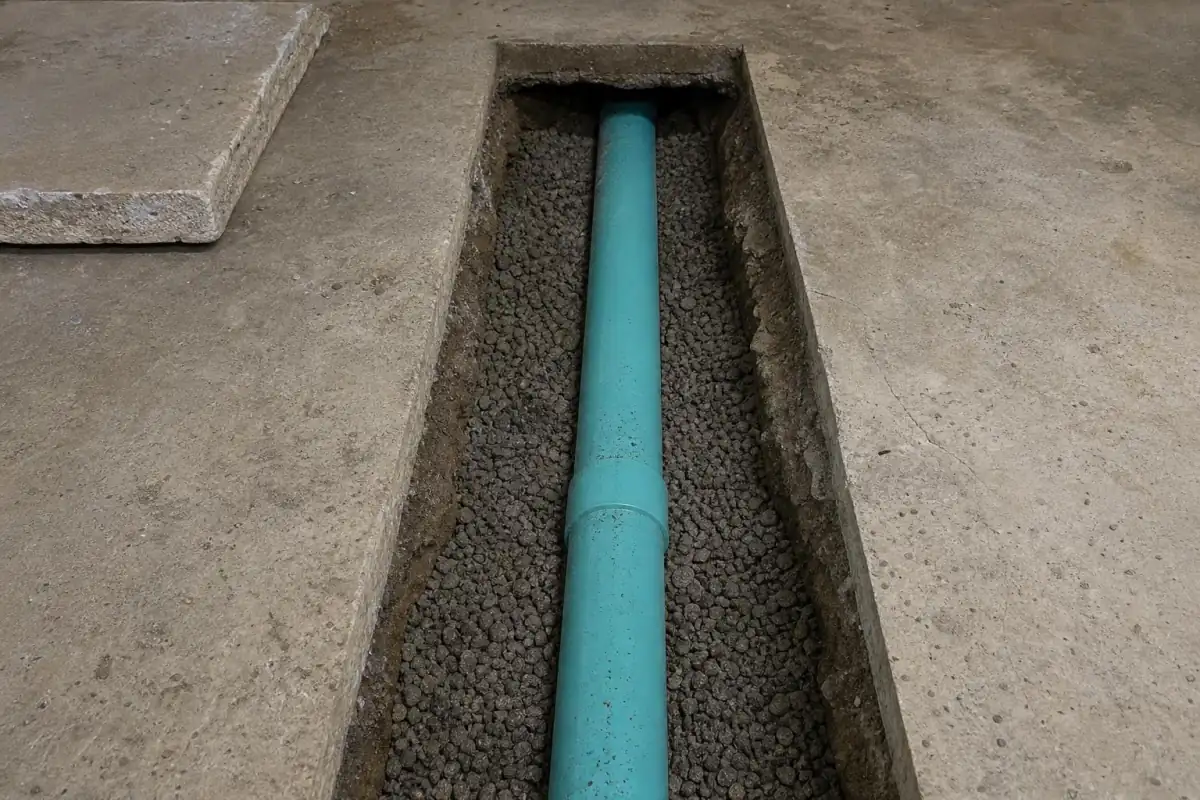
Adding a drain to a finished slab means saw cutting, trenching to an outlet and repouring, and a 2026 cost aggregator, LatestCost’s floor drain pricing page, puts a new drain through an existing slab at $900 to $3,500, with $1,200 to $2,500 as a starting budget when the waste line is accessible. Slot Drain’s retrofit installation guide for its 6000 and 7000 Series residential channels calls for a 24 in wide cut, at least 6 in of concrete around the channel, dowels drilled into both slab edges every 16 to 24 in, and a 2 stage pour so the channel does not float.
Before cutting, confirm the outlet: a trench at the door that daylights downhill needs no sewer tie in, while a sanitary connection needs a trap, a primer and possibly an interceptor. If the plan is to pipe it to the street, the storm drain and sanitary sewer comparison explains why most cities refuse oily water in the storm system. Where daylight is impossible, a pit and pump or a gravel trench is the fallback, and the sump pump versus French drain breakdown lists the outlets each one can use.
How we sourced this
Read: Minn. R. 4714.0418 and 4714.1017 on the Minnesota Revisor site; Wisconsin SPS 382.34(4) as quoted in the state code index; Permit Sonoma Technical Bulletin P-02 (version 4/1/2020); the Cherry Hills Village policy PDF adopted April 8, 2022; Elkhart City Code 156.007 as indexed by American Legal Publishing; IPC 1002.4, 1003.4 and 1003.4.2.2 and IRC P3201.2.1 on UpCodes; EPA’s motor vehicle waste disposal well page; UCAR’s snow measurement article; Slot Drain’s retrofit guide; LatestCost’s 2026 pricing page. Computed: meltwater volumes, stall depths, slope falls and catch basin capacity from the inputs stated. Left out: a Michigan rule and a measured trap evaporation rate, because no primary text for either was found.
Garage floor drain questions
Is a garage floor drain legal?
In most places yes, with conditions on the outlet. Minnesota allows daylight discharge for 1 and 2 family garages with approval, Elkhart requires oil and sand interceptors, Cherry Hills Village requires a treatment swale, and Sonoma County, California does not allow floor drains in private garages at all.
Can a garage floor drain go to the sewer?
Often, through a sanitary connection with a trap and, where required, a sediment basket or interceptor. Minnesota sends enclosed parking drains to sanitary sewer when one is available. Cherry Hills Village forbids any garage drain from reaching its sanitary sewer, so the sewer utility gets the final word.
Do I need an oil separator for a home garage drain?
Under the model IPC, no for a garage used only to park cars with no washing or fuel dispensing, and yes for repair garages with floor drains. Local codes add their own rule, such as the Elkhart grease and oil plus sand and gravel interceptor requirement for residential garages.
Can a garage drain empty into a dry well?
Only with care about what enters it. A dry well that receives vehicle repair or maintenance fluids is an EPA Class V motor vehicle waste disposal well, and new ones have been banned since April 5, 2000. Many state programs also restrict dry wells used by home repair work.
What if I do not want to cut the slab?
Slope and containment are the 2 options. A floor pitched 1/8 in per ft toward the door moves meltwater out over a 20 ft run with 2.5 in of fall, and a containment mat needs to hold about 22 gallons per car for 2 in of wet snow.