Can You Use Copper Pipe for Natural Gas? Code Rules, Sulfur Limits and Where It Is Banned
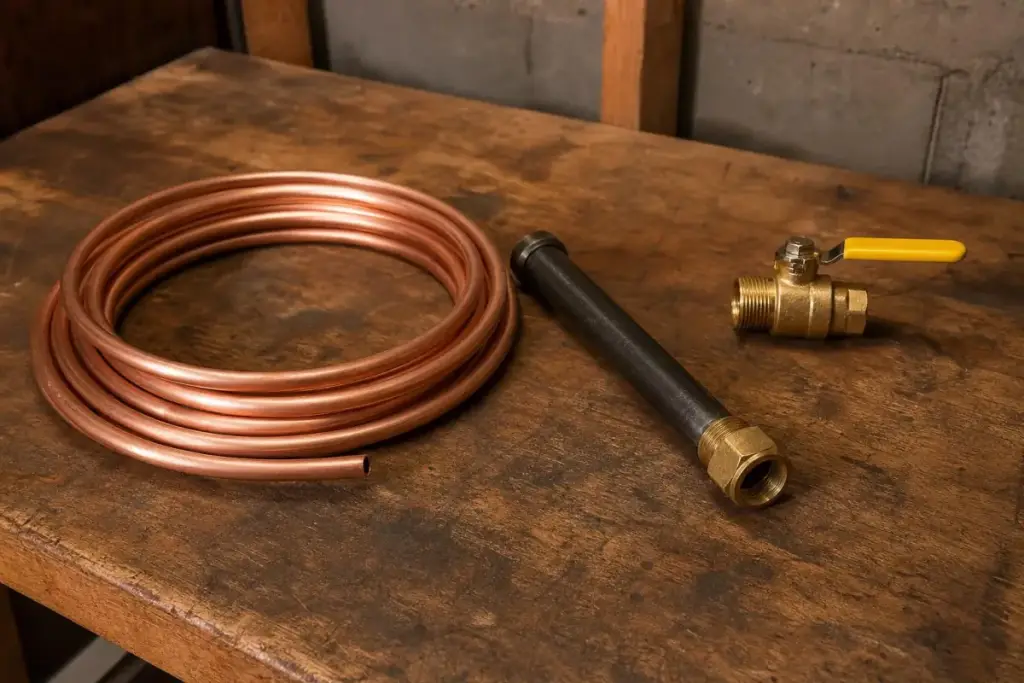
Yes, you can use copper pipe for natural gas under the model fuel gas code, but only Type K or L tubing (or ACR tube), only where the gas averages no more than 0.3 grains of hydrogen sulfide per 100 cubic feet, and only where your city and gas utility have not banned it. NYC and Salina, Kansas, ban it.
What does IFGC 403.4.3 actually allow for copper gas tubing?
Section 403.4.3 of the 2021 International Fuel Gas Code allows copper tubing made to Type K or L of ASTM B88, or to ASTM B280 (the ACR tube refrigeration contractors buy), and then bars it when the gas carries more than an average of 0.3 grains of hydrogen sulfide per 100 standard cubic feet (0.7 mg per 100 liters). The same text sits in the International Residential Code as IRC Section G2414.4.3, and Seattle printed it unchanged in its 2021 Seattle Fuel Gas Code, Chapter 4.
Type M water tube is not on that list. Parent Section 403.4 adds that tubing “shall not be used with gases corrosive to the tubing material,” so the 0.3-grain figure is a gas-supplier number, not one an installer can measure at the house.
Hydrogen sulfide attacks copper from the inside. Salina, Kansas, interpretation ADM-2.1209.5.3.2 (October 25, 2010) says the tubing “is eaten away on the inside with no visible clues of the damage on the outside” until appliance vibration can break it, which is why many local authorities refuse copper outright.
Which cities and utilities ban copper gas lines, and which allow it?
The model code permits copper with conditions, while local amendments run from a total ban to a 3 ft connector exception. Each row below comes from adopted code text or a written interpretation.
| Code or authority | Copper for natural gas | Materials named in the text | Section |
|---|---|---|---|
| 2021 IFGC and 2021 IRC (model codes) | Allowed if gas averages 0.3 grains H2S per 100 scf or less | Copper Type K or L (ASTM B88), ACR (ASTM B280), Schedule 40 steel, CSST to ANSI LC1/CSA 6.26, PE to ASTM D2513 | IFGC 403.4.3, 403.4.5, 403.5; IRC G2414.4.3 |
| Seattle Fuel Gas Code, 2021 | Allowed, same 0.3-grain limit | Same list as the IFGC; copper sizing tables kept | SFGC 403.4.3, 403.9.2 |
| 2022 NYC Fuel Gas Code | Banned: “Copper and brass pipe shall not be used” | Steel pipe to ASME B36.10M, ASTM A53 or A106; metallic tubing barred except listed stainless hose assemblies for seismic movement | NYC FGC 403.4.3, 403.5, 404.2.1.1 |
| Cookeville, Tennessee, 2018 IFGC amendments | Banned as piping; allowed only as a connector of 3 ft or less to a non-motorized appliance in the same room | CSST allowed, but not where exposed to weather or sunlight | Amended 403.4.3 |
| Salina, Kansas, with Kansas Gas Service | Banned, no grandfathering, corrected immediately when found | Interpretation of 2006 UPC 1209.5.3.2 | ADM-2.1209.5.3.2 |
NYC bars metallic tubing generally, so CSST is out there too, and its Section 403.1.1 requires welded piping above 1/2 psig. Salina’s ban runs through Kansas Gas Service, whose servicepeople treat copper found in a house line as a violation needing immediate correction.
To find your own answer, ask the building department 2 questions: which edition of the IFGC, UPC or NFPA 54 is adopted, and whether Section 403.4.3 (or its UPC or NFPA 54 equivalent) is amended. Then ask the gas utility whether its tariff or service rules accept copper downstream of the meter. If either says no, the job is black steel or CSST, and our CSST gas line bonding rules page covers the 6 AWG bond that yellow tubing needs.
How much gas do 1/2 and 3/4 inch copper carry compared with steel?
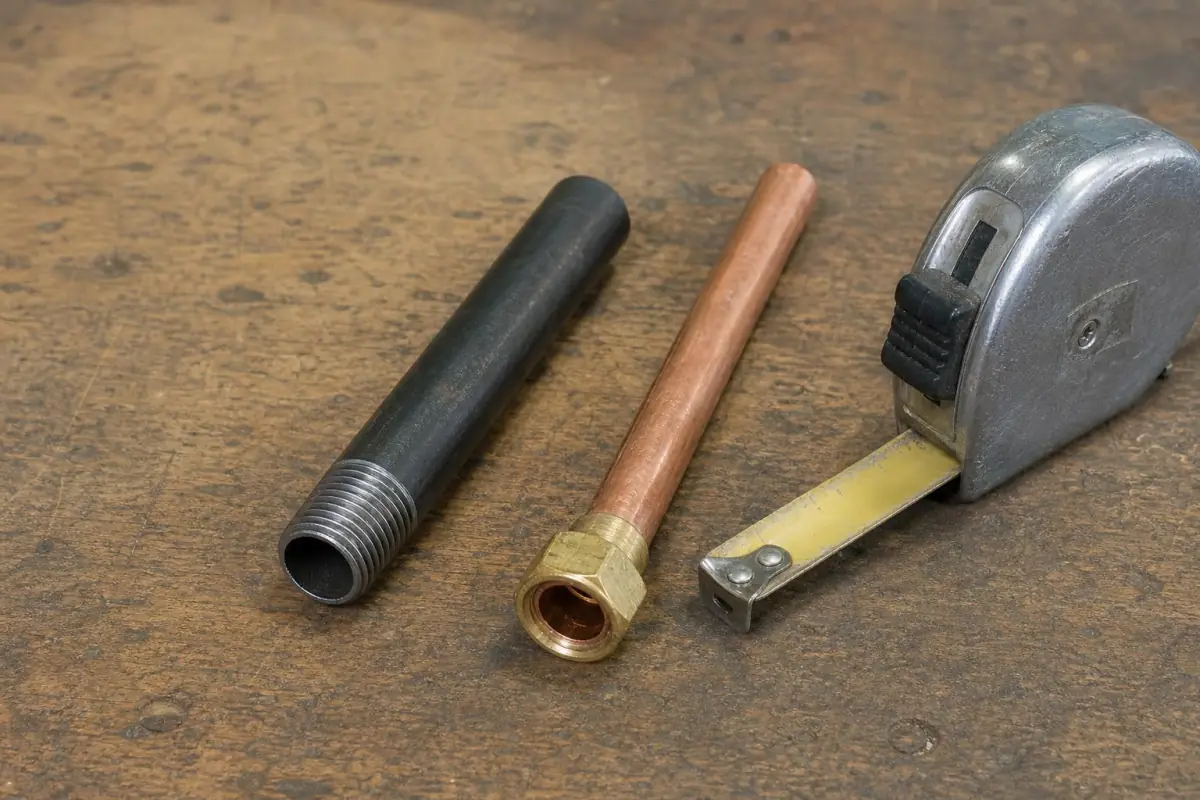
Copper of the same nominal size carries about 64 to 77 percent of what Schedule 40 steel carries, because the code tables are built on the smaller Type K bore. The figures below come from IFGC Table 402.4(2) for Schedule 40 metallic pipe and Table 402.4(9) for semirigid copper tubing (IRC Tables G2413.4(1) and G2413.4(3)), both at natural gas, under 2 psi inlet, 0.5 in. w.c. pressure drop and 0.60 specific gravity.
| Size (bore used by the table) | 10 ft | 25 ft (30 ft row) | 50 ft | Copper as % of steel |
|---|---|---|---|---|
| 1/2 in Schedule 40 steel (0.622 in ID) | 172 cfh | 95 cfh | 72 cfh | Baseline |
| 1/2 in K or L copper, 5/8 in OD (0.527 in ID) | 111 cfh | 61 cfh | 47 cfh | 64.5%, 64.2%, 65.3% |
| 5/8 in K or L copper, 3/4 in OD (0.652 in ID) | 195 cfh | 107 cfh | 82 cfh | 113%, 113%, 114% of 1/2 in steel |
| 3/4 in Schedule 40 steel (0.824 in ID) | 360 cfh | 199 cfh | 151 cfh | Baseline |
| 3/4 in K or L copper, 7/8 in OD (0.745 in ID) | 276 cfh | 152 cfh | 116 cfh | 76.7%, 76.4%, 76.8% |
| 1 in K or L copper, 1-1/8 in OD (0.995 in ID) | 590 cfh | 326 cfh | 247 cfh | 164%, 164%, 164% of 3/4 in steel |
Inputs: neither table prints a 25 ft row, so that column uses the 30 ft row, the next longer length under the IFGC 402.4.1 longest length method. Percentages are copper cfh divided by steel cfh on the same row. The copper table footnote says capacities assume the Type K bore, so Type L has slight extra margin.
The decision rule that falls out: to replace a steel branch with copper at the same 0.5 in. w.c. drop, go one nominal copper size up from 1/2 in steel (5/8 copper clears it by 13 to 14 percent) and two sizes up from 3/4 in steel, because 3/4 copper misses by about 23 percent and 1 in copper is the first size that clears. A 100,000 Btu/h furnace at an assumed 1,000 Btu per cubic foot draws 100 cfh; at 25 ft that rules out 1/2 in steel (95 cfh) and 1/2 in copper (61 cfh) and passes 5/8 in copper (107 cfh). The full steel chart, with fitting allowances, is on our gas pipe sizing chart page.
What joints does code accept on copper gas tubing, and why is solder out?
IFGC 403.9.2 lists 3 joint types for copper gas tubing: approved gas tubing fittings, brazing with a filler that melts above 1,000°F (538°C), or press-connect fittings listed to ANSI LC4/CSA 6.32. Brazing alloys may carry no more than 0.05 percent phosphorus, so the rod’s spec sheet has to show phosphorus at or below that figure before it goes on a gas line.
Soft solder is out because every tin-based solder melts below the 1,000°F floor that the IRC’s own definition of brazing sets. Julius Ballanco, P.E., put it plainly in Plumbing & Mechanical (May 1, 2004): soldering copper gas tubing “is illegal,” and the gas press fittings that later won listing use a high-temperature O-ring rated above 800°F so the joint holds in a fire. Flared joints are allowed by IFGC 403.9.4 only on nonferrous tubing where experience or tests show the joint suits the conditions and the design keeps it from pulling apart.
What marking, bonding and leak testing does a copper gas line need?
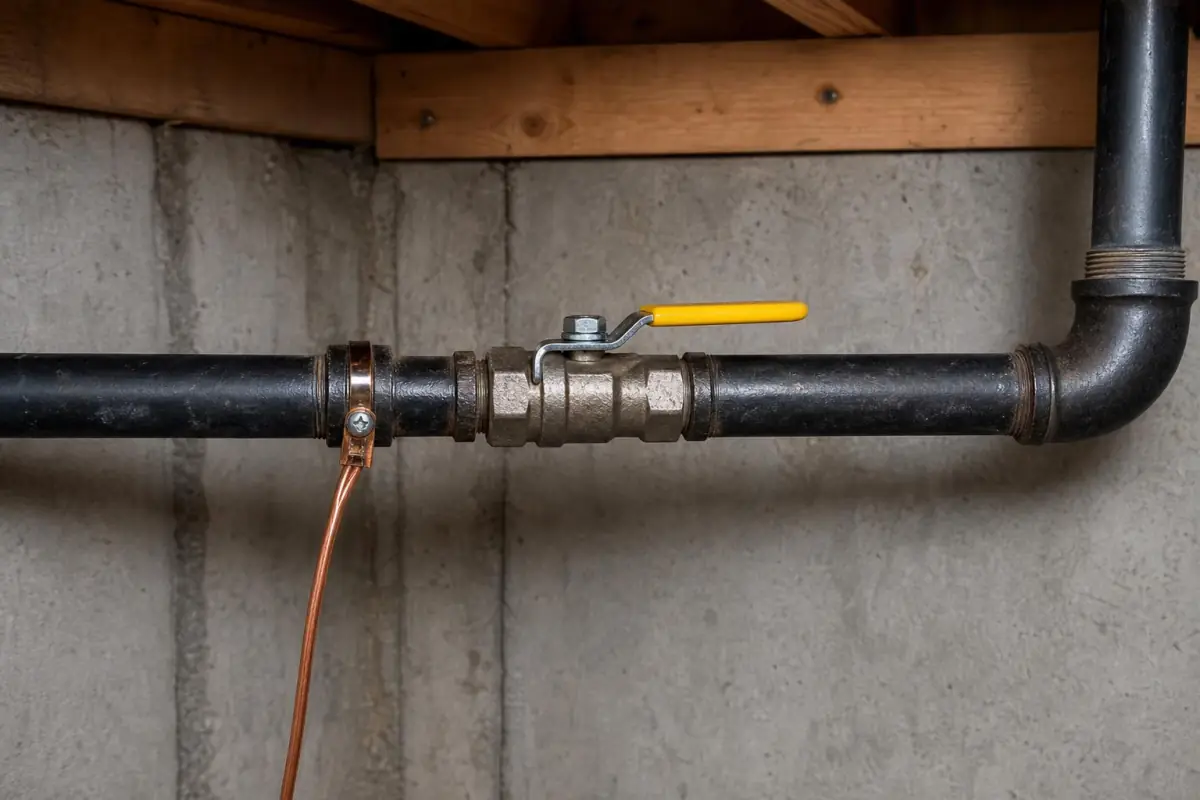
Exposed gas piping other than steel pipe and CSST gets a yellow label marked “Gas” in black letters at intervals of 5 ft or less under IFGC 401.5 (IRC G2412.5), with no label needed in the same room as the appliance served. Unlabeled, a copper gas line looks like a Type L water line, and a soldered tee cut into it is the joint 403.9.2 forbids.
Bonding: IFGC 310.1 requires above-ground gas piping other than CSST that is likely to become energized to be electrically continuous and bonded to an effective ground-fault current path, and it counts as bonded where it connects to an appliance on a grounded circuit. NEC 250.104(B), on bonding metal piping including gas, is the electrical side of the same check.
Leak testing under IFGC 406.4.1 runs at 1.5 times the maximum working pressure but never below 3 psig, held for at least 10 minutes (406.4.2), measured with a manometer or a gauge whose full scale is no more than 5 times the test pressure. The fitter runs that test for the inspector; for the household side, our gas leak detector placement guide explains where a natural gas unit goes.
Why is copper common on propane but contested on natural gas?
Copper tubing is one of the most popular LP gas piping materials, Ballanco wrote in 2004, and northern Virginia contractors run it on 2 psi natural gas systems to use smaller tubing. The IFGC limit in 403.4.3 applies to “the gas” whatever its type, so a propane system is held to the same 0.3-grain ceiling and the same joint rules.
Propane tanks and the piping up to the first-stage regulator fall under NFPA 58, and IFGC 403.5.2 sends plastic pipe in undiluted LP systems to NFPA 58 as well. Massachusetts amends NFPA 54 in 248 CMR 5.00 and requires dual-fuel buildings to label natural gas piping yellow and propane piping light green.
Underground, the IFGC lists polyethylene to ASTM D2513, marked “Gas” and “ASTM D2513,” buried at least 12 in below grade (404.12) and never run under a building unless sleeved in a listed conduit (404.14). The gas line plumbing overview covers permits for those outdoor runs.
Who can install copper gas tubing, and what stops the job?
A licensed gas fitter or plumber installs it under a permit, after the building department and the gas utility both confirm copper is accepted; the 0.3-grain limit, local bans and 403.9.2 joint rules make this a licensed-only job, so no installation steps appear here. In New York City, NYC FGC 404.21 limits gas work to people holding the qualifications in Article 28-423 of the Administrative Code.
Ask the fitter for 4 things: the local code section that permits copper, the joint method (brazed, LC4 press or listed tubing fittings), the permit test pressure and duration, and the bonding point. Stop and call the utility’s emergency line from outside if you smell the mercaptan odorant, if an inspector or utility tech flags existing copper as prohibited or if a joint on the gas line turns out to be soft-soldered.
How we sourced this
We read the 2021 IRC Chapter 24 text (G2411.1, G2412.5, G2414.4.3, G2414.9.2, G2414.9.4, G2417.4, Tables G2413.4(1) and (3)), the 2021 Seattle Fuel Gas Code Chapter 4 for matching IFGC numbers, the 2022 NYC Fuel Gas Code Chapter 4, the Cookeville, Tennessee, 2018 IFGC amendments, Salina, Kansas, interpretation ADM-2.1209.5.3.2, 248 CMR 5.00, and Julius Ballanco’s 2004 Plumbing & Mechanical column. The capacity comparison is our arithmetic on the two code tables. Current NFPA 54 and UPC copper sections, a claimed Massachusetts copper ban and Chicago’s Title 14G materials section could not be confirmed in text we could open, so they are left out.
Copper gas line questions people ask
Is ACR copper tubing allowed for natural gas?
Yes, where copper is allowed at all. ASTM B280 tube, sold for air conditioning and refrigeration, is the second standard named in IFGC 403.4.3. It is sized by outside diameter, so 5/8 in ACR equals 1/2 in nominal Type K or L in the code sizing tables.
How do I find out if my utility allows copper gas pipe?
Call the gas utility’s new service or customer engineering desk and ask whether its service rules accept copper downstream of the meter, and ask the building department whether Section 403.4.3 is amended. Get both answers in writing before a fitter quotes the job, since either one can override the model code.
Can copper tubing be used for a gas dryer or stove connector?
IFGC 411.1 connects appliances by rigid metallic pipe, CSST, or a listed connector to ANSI Z21.24, which can be no longer than 6 ft. Cookeville, Tennessee, allows a copper connector of 3 ft or less only to a non-motorized appliance in the same room, so a dryer needs the building official’s approval before work starts.
Should I replace old copper gas line in my house?
Have a licensed fitter and the utility inspect it. Salina, Kansas, and Kansas Gas Service order immediate correction with no grandfathering, because sulfur damage starts inside the tube. Where copper is legal, the fitter checks the type marking, joints and labels, and a pressure test at 3 psig or more confirms tightness.