CSST Gas Line: Bonding Rules, Lightning Risk, Cost and Code, With Five Makers’ Rules Side by Side
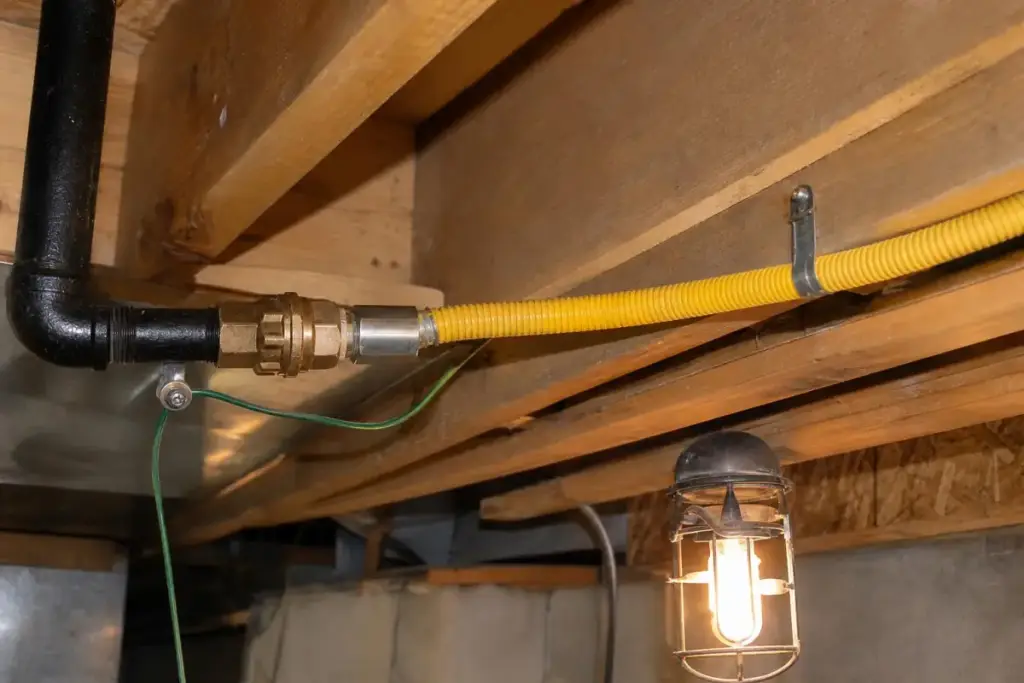
A CSST gas line is safe when it is installed to code: yellow CSST must be bonded to the electrical service with a 6 AWG copper wire no longer than 75 ft, while black arc-resistant CSST marked “AR” needs no extra bond under the 2018 and 2021 IFGC.
Why lightning burns holes in a CSST gas line
Lightning damages CSST because the stainless tube wall is about 0.010 in thick, so an electrical arc jumping between the gas line and a nearby metal pipe or wire can perforate it. The TracPipe Design Guide FGP-001US (July 2026) lists a wall of .01 in for 3/8 in through 1 in tubing, and the Pro-Flex Flak Jacket spec sheet gives .010 in for 1/2 in tube. That is 0.25 mm of steel, in tubing Pro-Flex rates for up to 25 psig, running behind drywall.
The strike does not have to hit the house. The Maryland Public Service Commission warns that lightning “on or near a structure” can travel through gas piping and cause a leak and, in some cases, a fire. WARDFlex Section 5.10 explains the mechanism: an unbonded voltage difference between two energized metal systems lets the charge arc from one to the other.
A 6 AWG bond removes that difference by tying the gas piping to the grounding electrode system shared by the water pipe, raceways and coax. Arc-resistant jackets take the other route: per the ICC CodeNotes on CSST bonding (2021 IFGC and IRC), a single thick black layer absorbs the arc energy, and a multi-layer black jacket conducts it to ground, in both cases to stop the tube wall from perforating.
Is CSST safe? Jacket color decides which rule applies
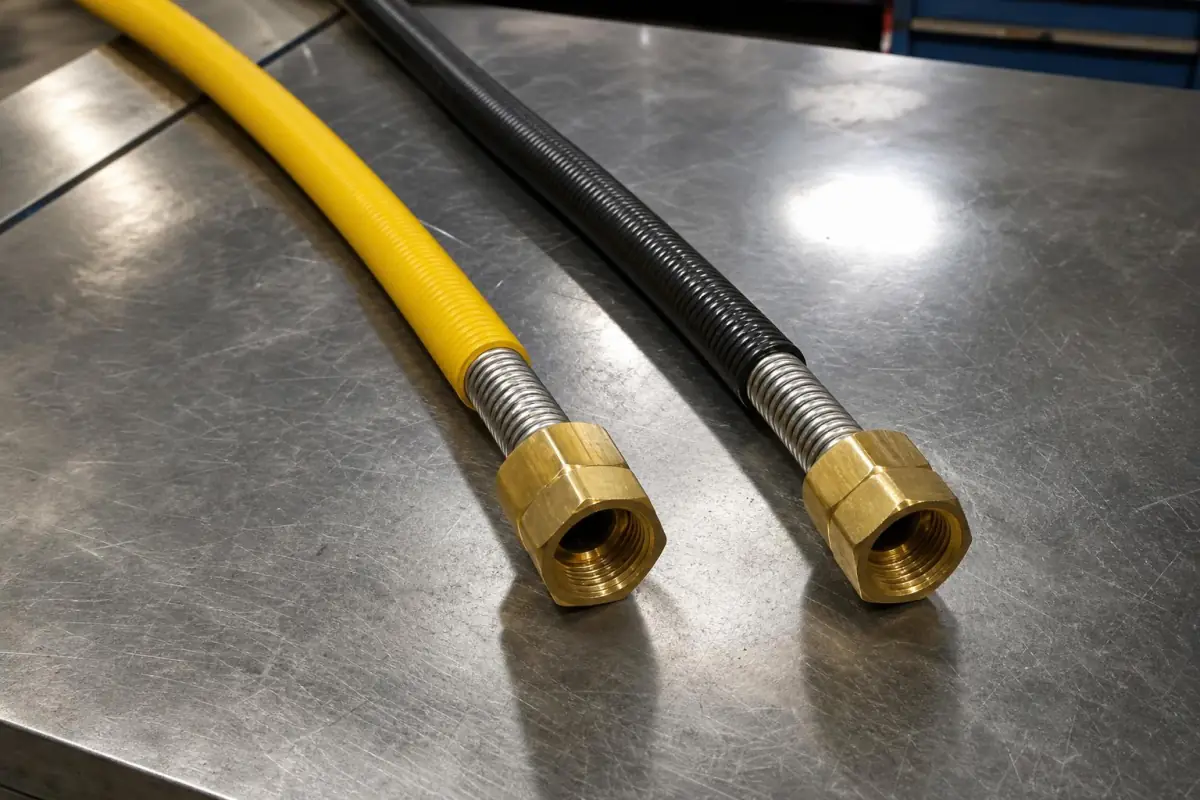
Yellow CSST is safe only when directly bonded; black CSST certified as arc-resistant is treated by the 2018 and 2021 IFGC as equal to or better than bonded yellow. The 2021 IFGC and IRC kept the 2018 rules “without any modifications”: IFGC 310.2 (IRC G2411.2) requires the extra bond for yellow tubing, and IFGC 310.3 (IRC G2411.3) accepts a listed arc-resistant jacket instead, identified by the letters “AR” printed on it.
Three conditions put black CSST back under the yellow rule: any yellow segment anywhere in the system; no appliance on the system with an equipment grounding conductor; or a jurisdiction still on the 2015 or earlier IFGC or IRC, unless the code official accepts the maker’s listing as an alternate approval.
Maryland went further. The Flynn and Laird Act of 2022 (House Bill 1052), in force since October 1, 2022, bans non-arc-resistant CSST in new construction, in renovations touching more than 50% of a property’s square footage, and on any job that adds a new gas line.
CSST bonding requirements: code sections and five makers’ rules
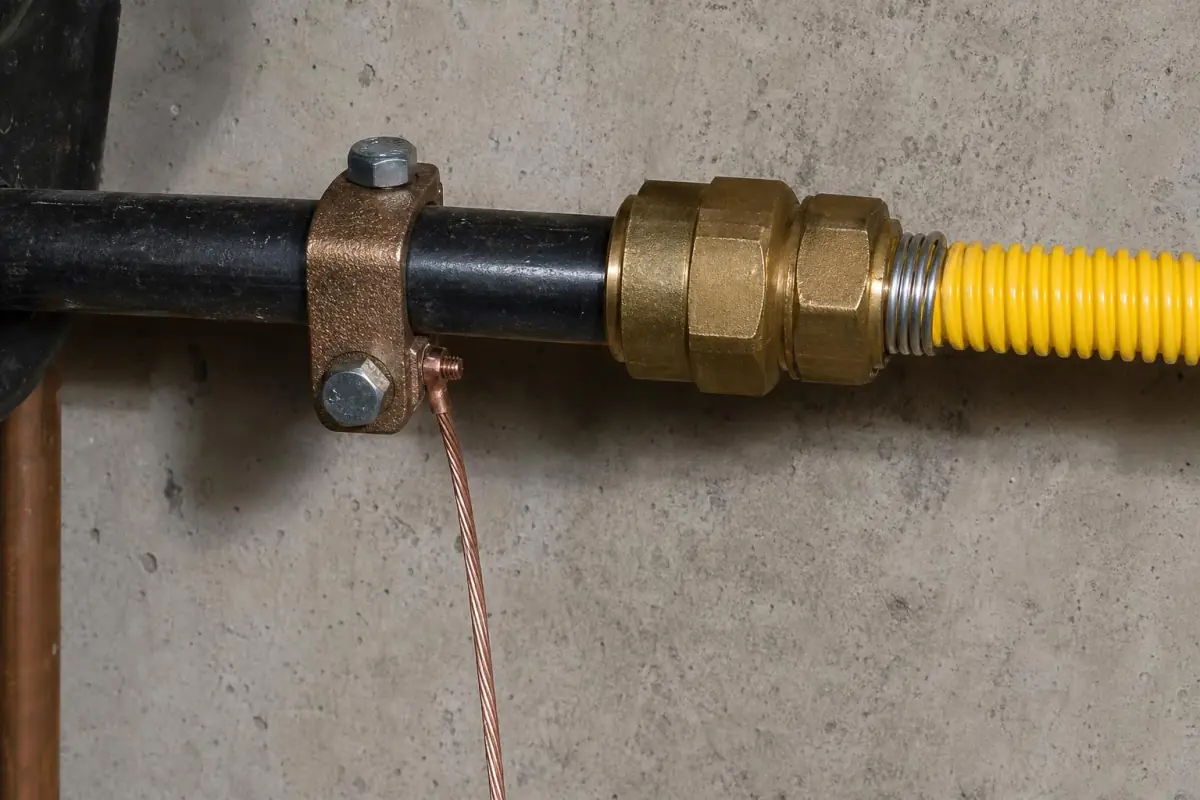
The bond for yellow CSST is one 6 AWG copper conductor, 75 ft or shorter, from a UL 467 clamp on the gas piping downstream of the meter to the electrical service grounding system. Table 1 is the code per the ICC summaries; Table 2 sets each maker’s current document beside it.
| Requirement | 2018 and 2021 IFGC / IRC |
|---|---|
| Extra bond for yellow CSST | IFGC 310.2, IRC G2411.2; in addition to the ground-fault bond in IFGC 310.1, IRC G2411.1 |
| Arc-resistant alternative | IFGC 310.3, IRC G2411.3; jacket listed to CSA/ANSI LC 1 and marked “AR” |
| Conductor size | Not smaller than 6 AWG copper, or equivalent aluminum; solid or stranded |
| Conductor length | 75 ft (22,860 mm) maximum |
| Clamp | Listed to UL 467, accessible, weather-listed if outdoors |
| Clamp location | Downstream of the gas meter or LP second-stage regulator, on rigid pipe, a malleable iron fitting, a manifold or a brass CSST fitting; never on the corrugated tube |
| Electrical end | A grounding electrode, the grounding electrode conductor, or the service enclosure, attached per NFPA 70 |
| Number of bonds | One, regardless of system length |
| Retrofit trigger | Adding any length of yellow CSST to an existing steel or copper system means bonding the whole system |
| Maker and document | Yellow CSST | Black arc-resistant CSST |
|---|---|---|
| TracPipe, OmegaFlex: FGP-001US 07/26, Section 4.10 | Bond per the 2009 or later UPC, IFGC or NFPA 54; clamp FGP-GC-1 fits 3/8 in and 1/2 in fittings | TracPipe AP (renamed CounterStrike): no extra maker bond; NEC 250.104(B) as for rigid pipe. Paint or non-metallic labels on the jacket void this |
| Gastite, Titeflex: Gastite installer certification module, slide 12 | Gastite direct bonding applies | FlashShield: direct bonding does not apply; NFPA 70 Article 250.104 as for rigid pipe |
| WARDFlex, ASC Engineered Solutions: D&I Guide Rev. 16, December 2025, Section 5.10 | Direct bond even with no powered appliance; #6 AWG minimum; 75 ft maximum | WARDFlexMAX: no extra maker bond; NEC 250.104 as for rigid pipe |
| HOME-FLEX, Valencia Pipe Company: CSST Electrical Bonding Guidelines | Direct bond per NFPA 54 Section 7.13; 6 AWG minimum; clamp on a HOME-FLEX brass fitting or rigid pipe before the first CSST fitting | Not addressed in the bonding sheet |
| Pro-Flex: Flak Jacket PFARCT spec sheet | Yellow PFCT sold for use “when electrical bonding is required”; clamp PFBC-AB fits 1/2 in to 1 in pipe | Flak Jacket: no extra Pro-Flex bond; any yellow CSST in the system means direct bonding |
The four makers with a black AR product drop the extra bond for it, yet each says a stricter local rule governs. Before buying black tubing to skip the wire, ask the building department which IFGC, IRC or NFPA 54 edition it enforces.
CSST vs black pipe cost for 25 ft and 50 ft runs (prices of 14 November 2026)
For a straight 1/2 in run, black iron material costs about one third of arc-resistant CSST: $43.15 vs $116.85 for 25 ft and $72.85 vs $220.35 for 50 ft. Inputs are PexUniverse list prices checked on 14 November 2026, one store so the comparison is like for like: Pro-Flex PFARCT-1225 25 ft coil $90.95; PFARCT-1275 75 ft coil $270.95; PFMF-1212 adapter $12.95; PFUF-1212 union $12.55; Everhot BL012-10FT 10 ft Schedule 40 pipe $13.45; Matco-Norca 911-08 coupling $1.40.
| Run | Arc-resistant CSST (Pro-Flex) | Black iron (Schedule 40) | CSST premium |
|---|---|---|---|
| Bare price per foot | $3.64 (25 ft coil), $3.61 (75 ft coil) | $1.35 (10 ft stick) | 2.7x |
| 25 ft straight run | 1 coil + 2 adapters = $116.85 ($4.67/ft); 2 fittings | 3 sticks + 2 couplings = $43.15 ($1.73/ft); 6 threaded joints, 1 field-cut thread | +$73.70 (2.7x) |
| 50 ft, two 25 ft coils | 2 coils + 1 union + 2 adapters = $220.35 ($4.41/ft); 3 fittings | 5 sticks + 4 couplings = $72.85 ($1.46/ft); 10 threaded joints | +$147.50 (3.0x) |
| 50 ft, one 75 ft coil | 1 coil + 2 adapters = $296.85; 25 ft left over | Same $72.85 | +$224.00 (4.1x) |
On material alone, CSST costs $74 to $224 more on these runs, and 50 ft is cheaper as two 25 ft coils plus a $12.55 union than as one 75 ft coil. What CSST buys is fewer joints: the 50 ft iron run has 10 threaded joints to make and leak-test against 3 CSST fittings. Yellow tubing would add a PFBC-AB clamp ($9.55, same store) plus 6 AWG wire and an electrician, not priced here. Elbows, tees, labor and permits are outside this table; see what a stove gas line costs installed for full-job numbers.
Size before you price: CSST capacity is published per brand by EHD (equivalent hydraulic diameter, 18 for 1/2 in Pro-Flex), so check the gas pipe sizing chart and the maker’s table before assuming 1/2 in tubing replaces 1/2 in pipe.
Who may install CSST, and what the inspector checks
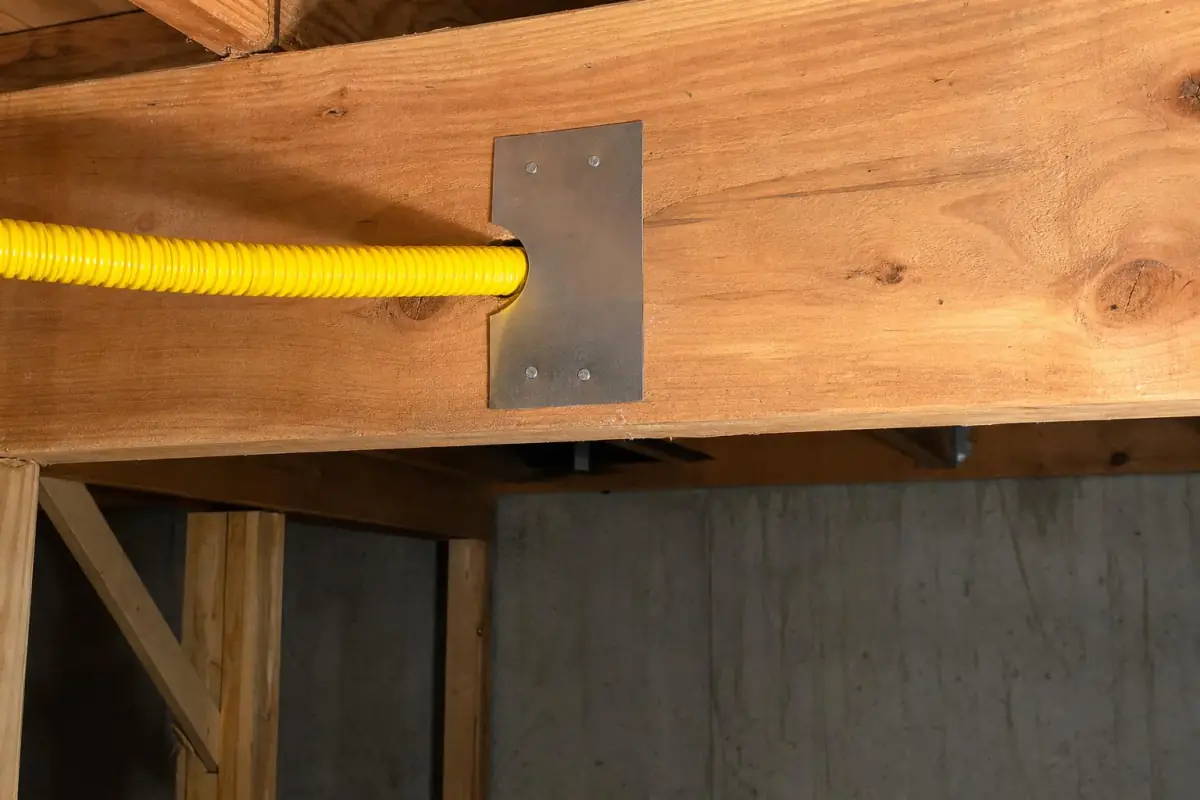
Only installers trained on that specific brand may install CSST, and fittings from different makers are not interchangeable. The WARDFlex guide opens with the rule that installation “must be performed by a trained installer who has successfully completed the WARDFlex training program” and also meets state and local licensing. TracPipe’s Section 5.1 inspection checklist starts with “Installer has TracPipe System Training Certification card,” then a rough-in pressure test, strike protection, support spacing and bonding. Pro-Flex qualifies installers through a training presentation and quiz on its site.
Every brand here is certified to the same standard, CSA/ANSI LC 1 / CSA 6.26, the standard for fuel gas piping systems using CSST; the WARDFlex guide is written to it, and it also lists ICC-ES LC-1024, the listing criteria for conductive jacketed CSST, for WARDFlexMAX only. For where CSST sits between the meter and the appliances, see how a house gas piping system is laid out.
Bonding yellow CSST in an older house, and the signs of damage
If a house has yellow CSST, have a licensed electrician confirm a 6 AWG bond exists; the Maryland PSC notes every maker has required direct bonding of yellow CSST in new installations since 2006, so older systems are the likeliest to lack one. The retrofit is the same single bond as new work: one UL 467 clamp on the black pipe or brass fitting nearest the panel, 75 ft of wire or less, landed at the service enclosure, grounding electrode conductor or electrode.
Check for a copper wire clamped to the iron pipe near where gas enters, a clamp sitting on the yellow jacket (wrong in every guide above), and paint under the clamp. TracPipe’s repair rules set the damage thresholds: a jacket that is ripped, torn, cut or “exposed to an electrical arc” must be wrapped with self-bonding silicone tape, while tubing punctured by a nail or arc, crushed, or kinked past its bend radius must be replaced or spliced with a listed coupling.
After a strike on or near the house, if you smell gas or hear a hiss near the CSST, leave and call the gas utility from outside; a gas leak detector is a cheap backstop. In high lightning flash density regions, TracPipe points owners to the risk assessment in Annex L of NFPA 780 to decide on a full lightning protection system.
What the 2006 CSST class settlement actually covered
The main CSST class action ended in a 2006 settlement, not a verdict, and the makers denied liability throughout. The National Class Action Stipulation and Settlement Agreement, filed as Exhibit 99.2 to an OmegaFlex Form 8-K, is captioned Lovelis, Wingfield, Bledsoe and Sealy v. Titeflex Corporation, Ward Manufacturing, OmegaFlex and Parker Hannifin, Case No. CIV-2004-211, Circuit Court of Clark County, Arkansas. OmegaFlex’s press release, which calls the case Berry v. Titeflex, dates the signing to September 5, 2006. Ward Manufacturing was a co-defendant, not a plaintiff.
The class was every US structure owner with CSST from those four makers installed as of preliminary approval. The remedy was payment vouchers toward bonding and grounding, or toward a lightning protection system built to NFPA 780 (2004) and UL 96A. Plaintiffs contended CSST walls were about .2 mm against 4 mm for black pipe. Class counsel’s fees were capped at $11,611,111 (Titeflex), $10,200,000 (OmegaFlex), $6,333,334 (Ward) and $1,055,555 (Parker Hannifin), $29.2 million combined.
How we sourced this
Read: ICC PMG CodeNotes on CSST bonding (2018 and 2021 IFGC/IRC); TracPipe FGP-001US 07/26; WARDFlex D&I Guide Rev. 16; HOME-FLEX bonding guidelines; Pro-Flex PFARCT spec sheet and product guide; Gastite FlashShield module; Maryland PSC; the 2006 settlement agreement and OmegaFlex release on SEC EDGAR. Computed: per-foot prices, run totals and joint counts from PexUniverse listings of 14 November 2026. Not confirmed, so left out: 2024 IFGC section numbers, the current NFPA 54 subsection, the settlement’s final approval date, later state cases, insurer positions, and a same-store yellow CSST price.
CSST gas line questions
Can a homeowner install CSST?
The makers say no. WARDFlex requires a trained installer who has completed the WARDFlex training program, the TracPipe inspection checklist asks for a TracPipe System Training Certification card, and Pro-Flex runs its own qualification quiz. Most jurisdictions also require a gas permit and a pressure test.
Does black CSST need to be bonded?
Under the 2018 and 2021 IFGC, listed arc-resistant CSST marked AR needs no extra direct bond. It still needs the normal bond that comes from an appliance circuit’s equipment grounding conductor, and it must be bonded like yellow CSST if any yellow tubing is in the system.
Can the bonding clamp go on the yellow tubing?
No. The ICC CodeNotes and every maker guide reviewed here forbid clamping the corrugated tubing. The UL 467 clamp goes on rigid pipe, a malleable iron fitting, a manifold or the brass CSST fitting, with paint removed for metal to metal contact.
Is yellow CSST banned in Maryland?
Maryland’s Flynn and Laird Act of 2022, House Bill 1052, took effect on October 1, 2022. It bars non-arc-resistant CSST in new construction, in renovations affecting more than 50 percent of the floor area, and where a new gas line is added. For existing yellow CSST the PSC recommends a licensed electrician check the bonding.