Gas Leak Detector: Types, Where to Mount It, and What the Alarm Means
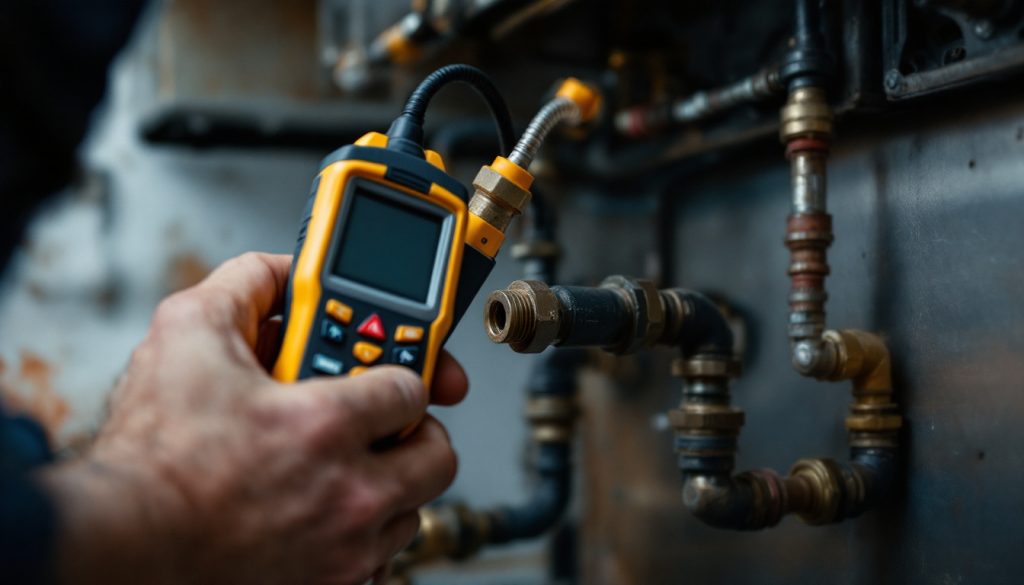
A gas leak detector is a plug-in or handheld sensor that alarms at or below 25 percent of the explosive limit for natural gas or propane, giving you time to get out before the air can ignite.
Key Takeaways
- UL 1484, the standard for residential gas detectors, sets the alarm point at no more than 25 percent of the lower explosive limit (LEL), per NFPA 715 committee documents.
- The NFPA 715 technical committee has said a 10 percent LEL alarm point would be safer, but UL 1484 has to change first.
- Federal rule 49 CFR 192.625 requires utility gas to smell at one-fifth of the LEL, roughly 1 percent gas in air.
- Natural gas rises, so its detector goes within about 12 inches of the ceiling; propane, at a specific gravity near 1.5 per supplier safety data sheets, sinks, so its detector goes within about 12 inches of the floor.
- Propane suppliers odorize with ethyl mercaptan; NFPA 58 references 1 pound per 10,000 gallons as an effective rate.
- A combination unit such as the Kidde KN-COEG-3 covers CO and explosive gas in one plug-in, with an 85-decibel horn and a 7-year rated life.
What does a gas leak detector actually detect?
A residential gas leak detector senses combustible fuel gas in the air, usually methane (the main component of natural gas) or propane, and sounds an alarm before the mix reaches the lower explosive limit. It does not sense carbon monoxide unless it is a combination unit. Its job is to warn you while the air is still too lean to burn. Before combustion becomes a risk, check gas line installation costs for a stove if you are planning a new kitchen hookup.
The lower explosive limit (LEL) is the smallest share of gas in air that can ignite. For methane it sits around 4.4 to 5 percent by volume; for propane it is about 2.1 to 2.2 percent, per supplier safety data sheets. Below the LEL, a spark does nothing. At or above it, a light switch can start a fire.
Most plug-in alarms use a metal oxide semiconductor sensor. Kidde’s spec sheet for the KN-COEG-3 describes exactly that: a metal oxide sensor for methane or propane paired with a fuel cell CO sensor. Handheld tools often use catalytic or semiconductor sensors tuned to sniff along a pipe run.
What types of gas leak detector can you buy?
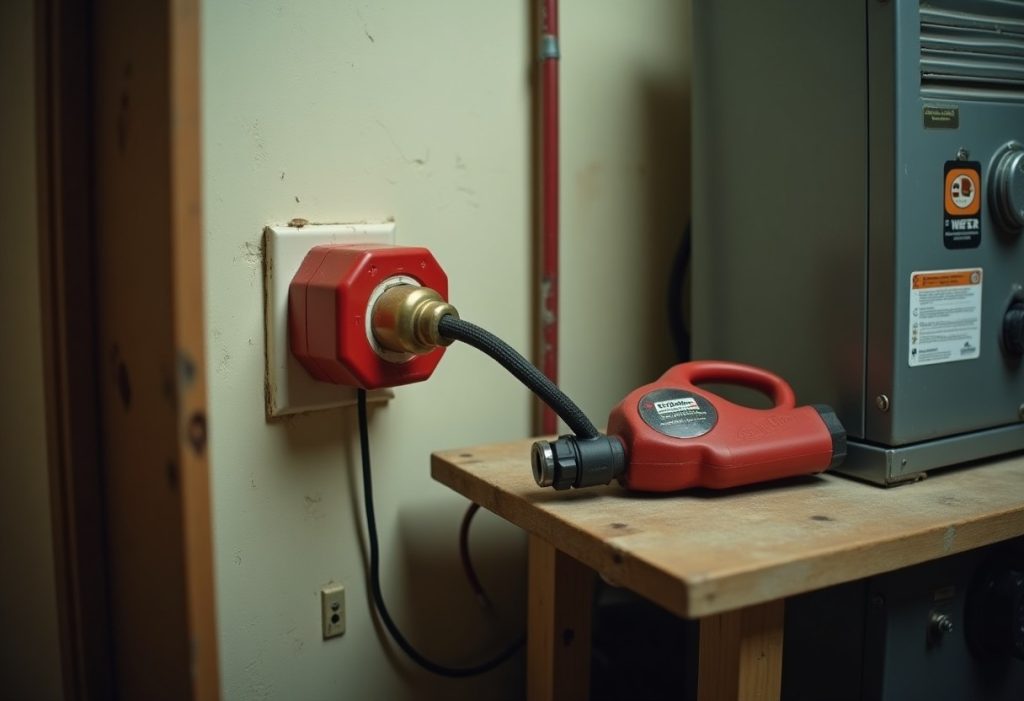
Homeowners and plumbers choose from four main types: plug-in explosive gas alarms, combination CO plus explosive gas alarms, handheld combustible gas detectors, and smart alarms that push alerts to a phone. Plug-in and combination units guard a room around the clock. Handheld units find the exact leaking fitting. Smart units add remote alerts, which matter most in vacation homes and rentals.
| Type | What it senses | Mounting | Best for |
|---|---|---|---|
| Plug-in explosive gas alarm | Methane and/or propane, listed to UL 1484 | Fixed: high for natural gas, low for propane | Rooms with a furnace, water heater, range, or dryer |
| Combination CO plus explosive gas (e.g. Kidde KN-COEG-3) | CO (UL 2034) plus methane or propane (UL 1484) | Fixed outlet; height set by the gas, not the CO | One device near fuel-burning appliances |
| Handheld combustible gas detector | Combustible gas at the probe tip | Portable, run along joints and valves | Pinpointing a leak after the smell or an alarm |
| Smart (Wi-Fi) gas alarm | Methane and/or propane, some add CO | Fixed; needs reliable Wi-Fi | Second homes, rentals, owners who travel |
| Hardwired interconnected alarm | Fuel gas, often tied into a fire panel | Fixed, installed by a pro | New builds and multifamily buildings |
A handheld detector does not replace a fixed alarm. It is a diagnostic tool. Plumbers run the probe along threaded joints and flex connectors, then confirm the spot with a soap solution, which is standard practice during gas line work.
A combination unit is the simplest choice for most houses with gas appliances. Check the box for both listings. A CO-only alarm will stay silent through a raw gas leak.
When does a gas leak detector go off?
A listed gas leak detector must alarm at or below 25 percent of the lower explosive limit under UL 1484. For methane, that works out to roughly 1.1 to 1.25 percent gas in air. For propane, it is roughly 0.53 to 0.55 percent. The margin exists so you hear the horn while the air is still about four times too lean to ignite.
Bars are drawn to the upper value of each range. The odor rule and the alarm rule land close together on purpose: your nose is meant to catch a leak near 1 percent methane, and the detector is meant to catch it by about 1.25 percent if nobody is home to smell it, or if nobody can.
The bar may move. In NFPA 715 public comment responses, the technical committee wrote that a 10 percent LEL sensitivity “provides a significantly higher level of safety for occupants” but held off because UL 1484 needed to change first. A UL 1484 revision bulletin hosted by Intertek (revised February 2022, effective June 2024) lists updates to the combustible gas detection threshold requirements, so check the listing date on any unit you buy.
Isn’t the rotten-egg smell enough warning?
The rotten-egg smell is the first line of defense, but it is not reliable on its own. Natural gas and propane are odorless, so suppliers add a sulfur compound called mercaptan. Federal rules require utility gas to be readily smelled at one-fifth of the LEL, but sleep, a weak sense of smell, and a problem called odor fade can all defeat it.
For pipeline gas, 49 CFR 192.625 requires operators to odorize gas so a person with a normal sense of smell can detect it at one-fifth of the LEL. Operators must also sample periodically with an instrument that measures the gas-in-air percentage at which the odor becomes noticeable.
Propane follows NFPA 58, which references 1 pound of ethyl mercaptan per 10,000 gallons as an effective odorant rate. LP Gas magazine reports ethyl mercaptan is the odorant of choice for about 95 percent of the propane industry.
Odor fade is the weak point. Rust and moisture inside a new or long-idle tank can oxidize mercaptan into compounds that smell much weaker, so a leak can be present with little or no odor. Propane users have the strongest reason to own a detector.
Where should you install a gas leak detector?
Install a natural gas leak detector high, within about 12 inches of the ceiling, because methane is lighter than air and rises. Install a propane detector low, within about 12 inches of the floor, because propane is about 1.5 times heavier than air and pools. Put either type in the room with the gas appliance, up to about 10 feet from it.
Some fixed-detector makers, such as GDS Corp, recommend about 6 inches below the ceiling and about 10 feet from the appliance for natural gas. Follow the manual for your exact model, since clearances differ.
| Factor | Natural gas (methane) | Propane (LP) |
|---|---|---|
| Weight vs air | Lighter than air | Heavier (specific gravity about 1.5) |
| Where a leak collects | Near the ceiling, upper floors | Floor level, basements, crawlspaces, pits |
| Mount height | Within about 12 inches of the ceiling | Within about 12 inches of the floor |
| Rooms to cover | Kitchen, utility room, basement, near the sleeping hallway | Same, plus any low space near the tank line entry |
| Plug-in outlet trap | A low wall outlet is too low; use a high outlet or extension mount | A standard low outlet often works |
- Good spots: near the furnace, water heater, range, and dryer; where the gas line enters the house; outside bedrooms so a sleeper hears it.
- Bad spots: beside windows, exterior doors, range hoods, bath fans, and supply registers, where moving air thins the gas; inside cabinets; directly above a range, where cooking vapors cause nuisance alarms.
Many houses have only one gas appliance in a closet or garage. If you are weighing fuel types for a replacement, our gas vs electric water heater comparison covers the venting and safety tradeoffs that come with keeping gas in the house.
What should you do if a gas leak detector goes off?
If a gas leak detector alarms, or you smell gas, leave the building right away with everyone inside, and call your gas utility or 911 only after you are outside and well away. Do not hunt for the leak, flip switches, or use a phone indoors. Gas utilities treat a leak call as an emergency and send a crew.
- Get everyone out, including pets. Leave the door open behind you if it is on your way.
- Do not touch light switches, appliances, thermostats, doorbells, or garage door openers. Each can spark.
- Do not light a match or lighter, and do not start a car in an attached garage.
- Walk well away from the building, then call the gas utility emergency line or 911.
- Shut the gas at the outdoor meter only if you know how and the utility tells you to.
- Stay out until the utility or fire department says the building is safe.
- Have a licensed plumber or gas fitter repair the leak and pressure-test the line before service is restored.
After the utility restores service, appliances with standing pilots need to be relit. Our guide to relighting a water heater pilot light walks through that step, and if a burner keeps going out, have it checked instead of relighting again and again.
A gas alarm belongs on the same short list as a burst pipe or a sewage backup. Our plumbing emergency checklist covers the shutoffs every household member should be able to find.
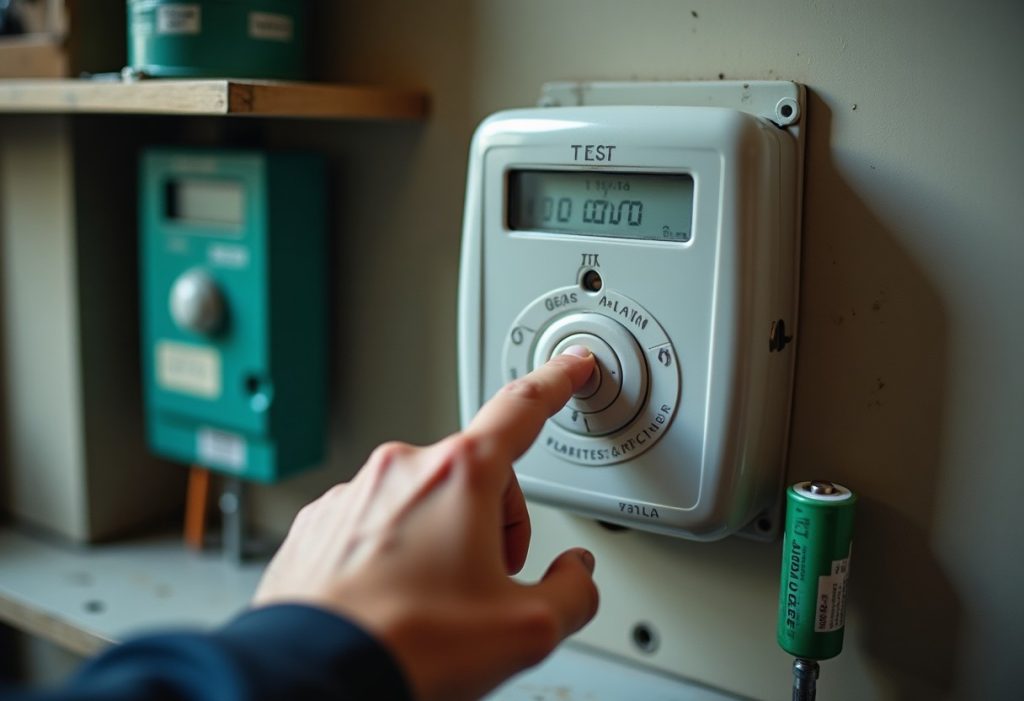
How long does a gas leak detector last, and how do you test it?
Every plug-in gas leak detector has a rated sensor life, and the whole unit should be replaced when it ends. Kidde lists a 7-year life for the KN-COEG-3, and other makers print an end-of-life date on the label. Press the test button monthly to check the horn and electronics, and replace the backup battery when the unit chirps or on the date in the manual.
The test button checks the horn, not the gas sensor. To confirm the sensor itself, some makers sell a test gas or describe a check in the manual. Do not test with a stove burner or an unlit lighter held to the unit, since that releases fuel indoors on purpose.
- Write the install date on the back of the unit.
- Vacuum the vents every few months; dust and grease dull the sensor.
- Keep the unit within its rated range. The KN-COEG-3 spec lists 40 to 100 degrees F and 5 to 95 percent relative humidity, which rules out many unheated garages in winter.
Do building codes require a gas leak detector?
Most US homes are not yet required to have a gas leak detector, unlike smoke and CO alarms, but that is changing. NFPA 715, the Standard for the Installation of Fuel Gas Detection and Warning Equipment, sets out where and how to install them, and some jurisdictions now require them. New York City’s Local Law 157 of 2016 is the best-known example.
NFPA 715 is a recent standard and works like NFPA 72 does for smoke alarms: it covers placement, power, and maintenance, and it relies on UL 1484 for the device itself. Whether it applies to your home depends on whether your state or city has adopted it.
NYC’s law requires natural gas detectors in many residential buildings with gas service, with compliance dates set by city rule. Check with your local building department before assuming you are exempt, and ask about requirements during any permitted gas appliance or gas piping job.
How we sourced this
We reviewed results from six searches in October 2026 and cited 8 sources: the eCFR text of 49 CFR 192.625 (PHMSA odorization rule), NFPA 715 committee public comment responses, NFPA 58 odorant guidance as reported by LP Gas magazine, a UL 1484 standard bulletin hosted by Intertek, the Kidde KN-COEG-3 product page and spec sheet, a propane supplier safety data sheet, GDS Corp installation guidance, and New York City Local Law 157 summaries. LEL figures are ranged because published values differ slightly by source and test method. We excluded retail product roundups and pages without a named primary source, and we did not publish retail prices because they vary by store and week.
Frequently asked questions
Do gas leak detectors really work?
Listed residential gas leak detectors work as a backup to your nose. UL 1484 requires them to alarm at or below 25 percent of the lower explosive limit, so a working unit sounds well before a room can ignite. They only cover the air near the sensor, though, so placement, the correct gas setting, and replacement at end of life decide whether one actually protects you.
Where should a gas detector be placed?
Mount a natural gas detector high, within about 12 inches of the ceiling, because methane is lighter than air. Mount a propane detector low, within about 12 inches of the floor, because propane is roughly 1.5 times heavier than air. Keep either type near gas appliances but away from windows, doors, vents, and fans that dilute the gas before it reaches the sensor.
Can a carbon monoxide detector detect a gas leak?
No. A standard carbon monoxide alarm listed to UL 2034 senses CO, a product of incomplete combustion, not raw natural gas or propane. A leaking gas line can fill a room with methane while a CO alarm stays silent. If you want one device for both hazards, buy a combination unit that carries both the UL 2034 and UL 1484 listings.
How do I know if I have a gas leak without a detector?
The main sign is the rotten-egg smell of mercaptan odorant. Other signs include a hissing or whistling sound near a gas line or appliance, dead or discolored plants above a buried line, bubbles in standing water outdoors, or a burner flame that burns yellow instead of blue. Any of these calls for leaving the building and calling your gas utility from outside.
Can I use my phone during a gas leak?
Do not use a phone inside a building where you smell gas or a detector is sounding. Phones, light switches, doorbells, and garage door openers can make a small spark. Gas utilities tell customers to walk outside and well away from the building first, then call the utility emergency line or 911 from a safe distance.
Why does my gas detector go off for no reason?
Many plug-in gas leak detectors use metal oxide or catalytic sensors that can also react to other vapors, such as aerosol sprays, cleaning solvents, alcohol, paint, and hair spray. A unit near a kitchen or bathroom may pick these up. Treat every alarm as real first: get out and call the utility. Once a technician clears the home, move the unit away from the source.
What is the difference between a natural gas detector and a propane detector?
The gases behave differently, so the detectors mount differently. Natural gas (mostly methane) is lighter than air and rises, so its detector goes near the ceiling. Propane is heavier than air and pools at floor level, so its detector goes near the floor. Many plug-in units sense both gases, but you still mount them at the height that matches the fuel you burn.
How long do gas leak detectors last?
Gas leak detectors carry a rated sensor life set by the maker, usually printed on the label or in the manual. Kidde, for example, lists a 7-year life for its KN-COEG-3 combination alarm. When a unit reaches end of life, it usually chirps or shows an end-of-life code. Write the install date on the back and replace the whole unit on schedule rather than swapping only the battery.
Is there a device that can detect gas leaks?
Yes. A gas leak detector is a plug-in or handheld sensor that alarms at or below 25 percent of the explosive limit for natural gas or propane, giving you time to get out before the air can ignite. Listed units follow UL 1484, and combination models like the Kidde KN-COEG-3 also cover carbon monoxide with an 85-decibel horn and a 7-year rated life.