Water Heater Drain Pan: When Code Requires One and How to Install It
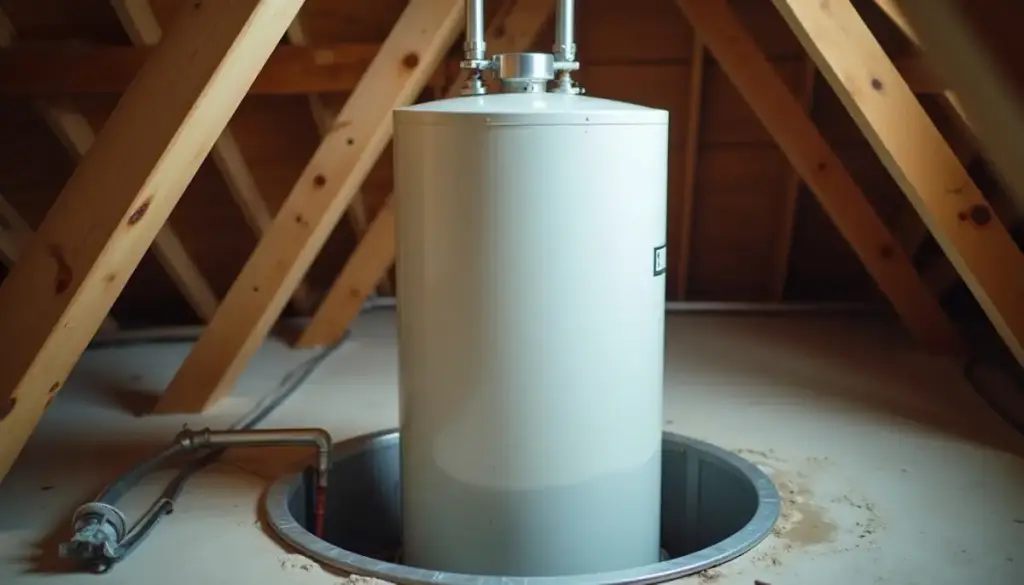
A water heater drain pan is required wherever a leaking tank would damage the building, such as attics, upper floors and finished rooms, and IRC P2801.6 sets a 1-1/2 inch minimum depth with a 3/4 inch drain.
Key Takeaways
- The IRC (P2801.6) and IPC (504.7) require a pan under any storage tank water heater installed where leakage from the tank will cause damage, per the code text published on UpCodes.
- Code minimums: galvanized steel or aluminum at least 0.0236 inch thick, plastic at least 0.036 inch thick, 1-1/2 inches deep, and a drain no smaller than 3/4 inch.
- A pan drain run outdoors must end 6 to 24 inches above the ground under IRC P2801.6.2, so the leak shows up where someone will see it.
- Lennox advises a pan at least 2 inches wider than the heater base. Rheem’s tall 40 gallon Performance Plus measures 18-1/4 inches, so it needs a 22 inch pan, not a 20.
- Oatey says gas water heaters need aluminum pans and its plastic pans are for electric units only, and ICC’s 2018 IPC guide says plastic pans shall not go under gas-fired heaters.
- A 2-1/2 inch deep pan holds only about 1.3 to 1.7 gallons around the tank, by our math from Oatey and Rheem dimensions.
When does code require a water heater drain pan?
Code requires a water heater drain pan when a storage tank heater sits where a leak would damage the building. The IRC P2801.6 text on UpCodes reads “Where a storage tank-type water heater or a hot water storage tank is installed in a location where water leakage from the tank will cause damage, the tank shall be installed in a pan.” IPC 504.7 uses the same trigger for commercial and multifamily work.
The trigger is location, not fuel or tank age. North Carolina’s Office of State Fire Marshal, interpreting its 2012 code section 504.7, listed suspended ceilings, attics, spaces above occupied rooms and unventilated crawl spaces, counting finished basements but not unfinished ones.
Section numbers shift between editions. The 2024 residential code as published on UpCodes for Texas (TWIA) numbers the same rule P2801.5, with pan size and drain at P2801.5.1, so an inspector citing either number means the same requirement. For the rest of the heater checklist, see our guide to water heater code requirements.
What does the code say about pan depth, material and drain size?
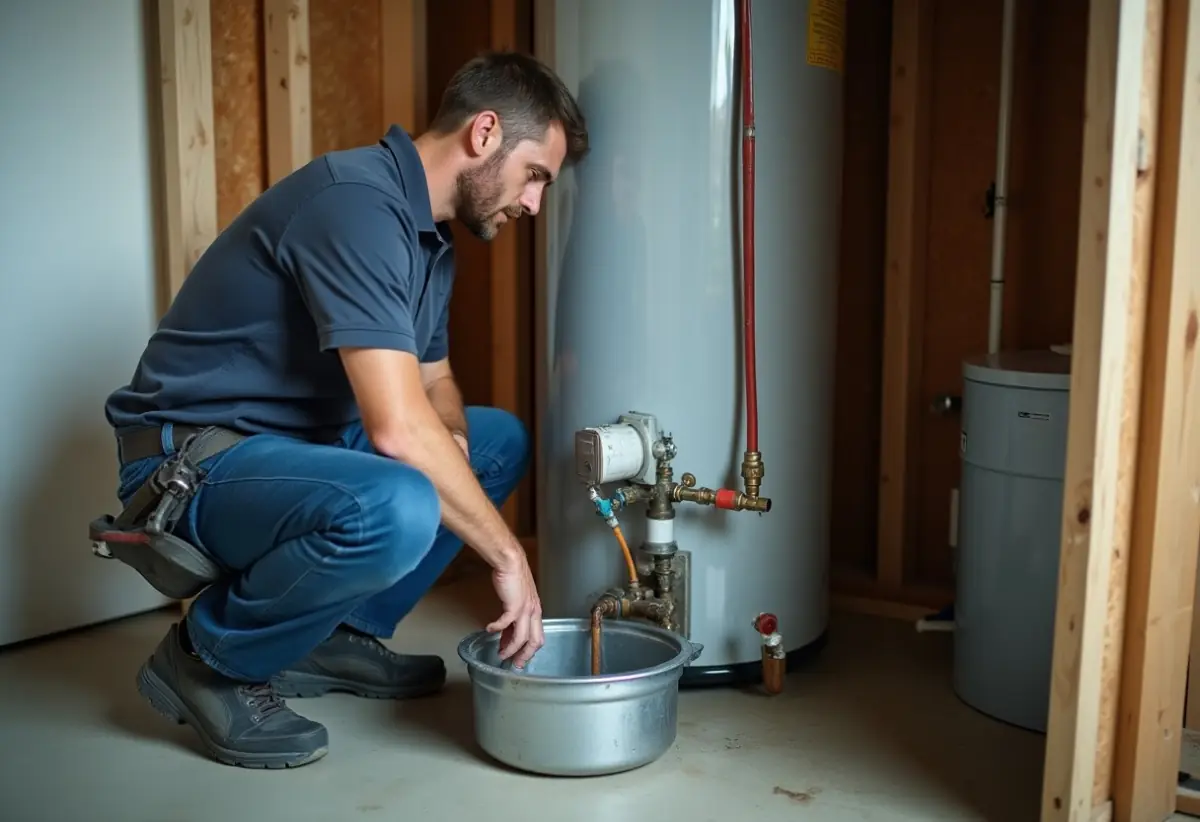
The IRC sets four numbers for a water heater drain pan: metal at least 0.0236 inch thick, plastic at least 0.036 inch thick, a depth of at least 1-1/2 inches, and an indirect waste drain of at least 3/4 inch. The pan must also be “of sufficient size and shape to receive dripping or condensate from the tank or water heater,” per P2801.6.1.
The material list in P2801.6 is galvanized steel or aluminum of not less than 0.0236 inch (0.6010 mm), plastic of not less than 0.036 inch (0.9 mm), or other approved materials. Drain piping has to be one of the materials in Table P2906.5.
One replacement rule trips people up. P2801.6.1 says “Where a pan drain was not previously installed, a pan drain shall not be required for a replacement water heater installation.” That waives the drain, not the pan. ICC’s own 2018 Plumbing Code Essentials phrases it more loosely, saying a drain pan is not required when replacing, so ask your local office which reading it enforces.
Where is a water heater pan required, and where can its drain end?
A pan is required in attics, upper floors, closets in living space, finished basements and any spot over finished ceilings. Its drain must run full size to an indirect waste receptor or outdoors, ending 6 to 24 inches above grade. Garages and bare concrete basements with a floor drain often pass without a pan, at the inspector’s discretion.
| Heater location | Pan required? | Drain termination | Basis |
|---|---|---|---|
| Attic or attic platform | Yes | Outdoors 6 to 24 in above grade, or an indirect waste receptor | NC OSFM 504.7; Hamilton County; IRC P2801.6.2 |
| Suspended ceiling or other remote spot | Yes | Indirect waste receptor or outdoors | NC OSFM 504.7 |
| Closet or laundry room on any floor of a home | Yes | Indirect waste receptor, or outdoors through a wall | NC OSFM; Hamilton County “any living areas” |
| Finished basement | Yes | Floor drain or other indirect receptor | NC OSFM; Hamilton County |
| Unventilated crawl space | Yes | Outdoors 6 to 24 in above grade | NC OSFM 504.7 (2012 code) |
| Unfinished basement, concrete floor and walls, floor drain in the room | Often no | Not required; leak flows to floor drain | Hamilton County Public Health |
| Garage with a floor drain, away from drywall and stored goods | Often no | Not required; code official decides if a sloped garage floor is acceptable | Hamilton County; ICC 2018 IPC Essentials |
| Replacement heater where no pan drain existed | Pan yes if location triggers it | Drain may be waived | IRC P2801.6.1 replacement clause |
Hamilton County’s handout puts it bluntly: “9 times out of 10 a pan is required,” and the installer has to prove why one is not.
What size water heater drain pan do I need?
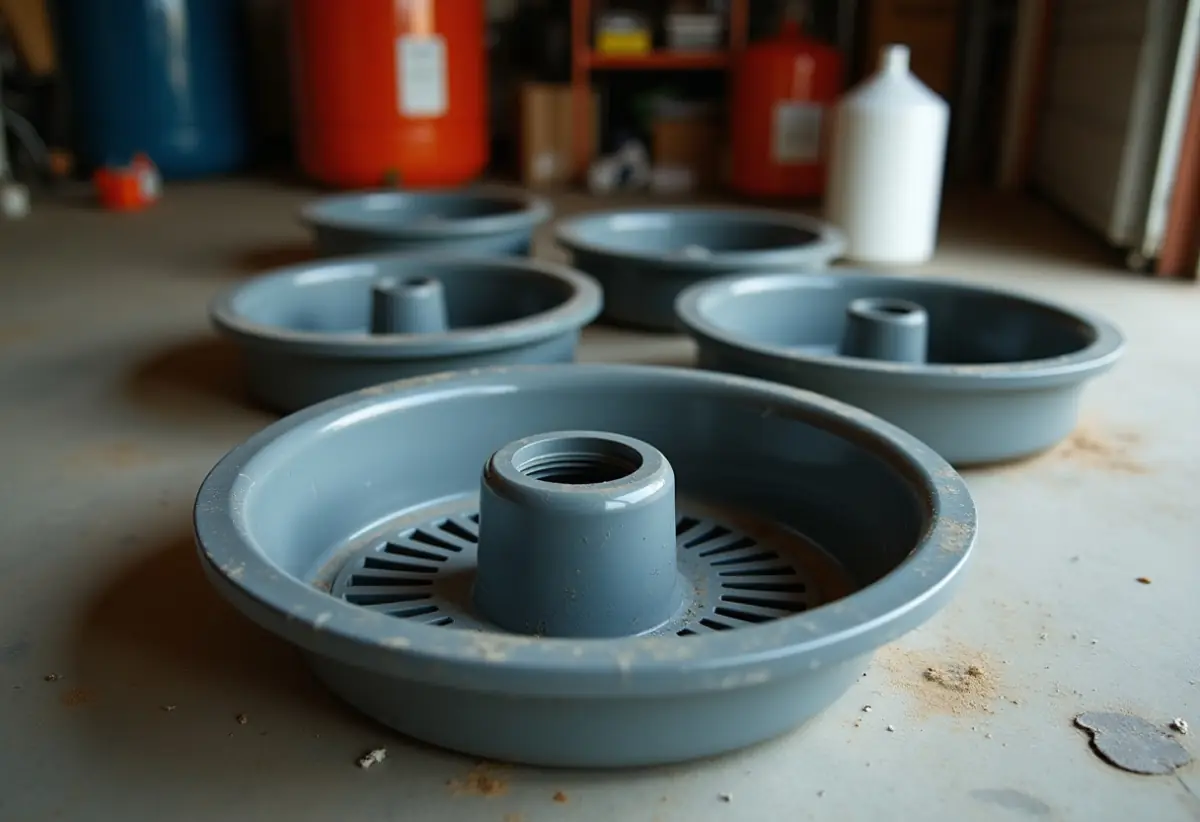
Buy a pan whose inside diameter is at least 2 inches larger than the heater’s base, the margin Lennox recommends, then round up to the next stock size. Measure the jacket, because Rheem’s 40 gallon models run 18-1/4 to 20-1/4 inches across.
Oatey’s aluminum pan spec sheet lists inside diameters from 18 to 32 inches in 2 inch steps, each with an outside diameter 1 inch larger. With the 1 inch PVC fitting, the part numbers are 34079 (18 in), 34151 (20 in), 34152 (22 in), 34153 (24 in), 34154 (26 in), 34156 (28 in), 34085 (30 in) and 34191 (32 in).
Chart sources: tank diameters from Rheem’s Performance Plus spec sheet (Form THD-P+EDR9, 12/23) and Performance Platinum hybrid sheet (Form THD-PPEH5-15, 02/24); pan sizes are the smallest Oatey inside diameter at least 2 inches larger.
Heat pump swaps catch people out. Rheem’s 40 gallon hybrid (XE40T10H22U0) is 20-1/4 inches across, 2 inches fatter than its 40 gallon tall electric (XE40T09CG45U0), so an old 22 inch pan will not fit the upgrade. The 65 and 80 gallon hybrids are 24-1/4 inches and need a 28 inch pan.
Should you buy a metal or plastic water heater pan?
Use aluminum or galvanized steel under any gas water heater and choose plastic only for electric units. Oatey states that gas installations must use aluminum, that its plastic pans are designed for electric heaters, and that metal is the pick for applications above 180 degrees Fahrenheit.
The code record is split on plastic under gas. ICC’s 2018 IPC guide says “a plastic drain pan shall not be installed beneath a gas-fired water heater.” The IRC text adopted in Texas in 2018 allows it only if the plastic tests at a flame spread index of 25 or less and a smoke-developed index of 450 or less under ASTM E84 or UL 723.
- Oatey aluminum: .032 prime aluminum on the 6/19 sheet (an older 10/2010 sheet says 28 gauge), minimum 2-1/2 inch depth, pre-cut side opening, gas or electric.
- Oatey plastic: electric only, standard 2-1/2 inch depth, with 3 inch deep versions in every size for jurisdictions that demand it, per Oatey’s pan guide.
- Adapters: Oatey 34088 (1 inch PVC, fits over 1 inch and inside 1-1/2 inch Schedule 40), 34086 (1-1/2 inch PVC) and 34089 (1 inch CPVC).
How do you install a drain pan under an existing water heater?
Installing a pan under an existing water heater means shutting it down, draining it, disconnecting it, lifting the empty tank into the pan and reconnecting everything. Plan for two people. Rheem lists its tall 50 gallon Performance Plus at 124 pounds shipping weight empty, while the 45 rated gallons inside add about 375 pounds of water, so never move a full tank.
- Turn the breaker off for an electric heater, or turn the gas control to OFF and close the gas shutoff for a gas unit. Close the cold water supply valve.
- Open a hot faucet upstairs, connect a hose to the drain valve and drain the tank completely.
- Disconnect the hot and cold connectors. On gas units, break the gas line at the union and lift off the vent connector.
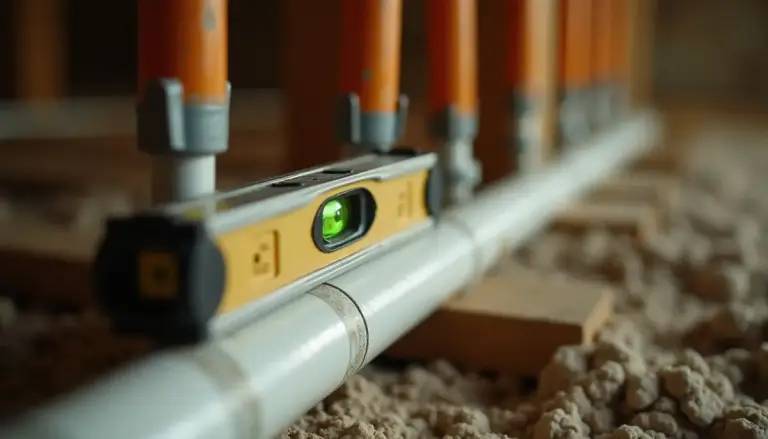
- Set the pan where the heater stood, with the pre-cut drain opening facing your drain route. Check it with a level and shim the floor, not the pan.
- Set the heater in the center of the pan, leaving roughly 1 inch of clearance all around with a pan 2 inches wider than the tank.
- Seat the adapter (for example Oatey 34088) and run at least 3/4 inch pipe, full size and sloping downhill all the way, to a floor drain or other indirect waste receptor, or outdoors 6 to 24 inches above grade.
- Reconnect water, gas and vent. Brush soapy water on every gas joint and watch for bubbles.
- Refill with a hot faucet open until water runs steady, then restore power or relight. Pour a gallon of water into the pan and confirm it exits the drain.
Are leak detectors and automatic shutoff valves worth adding to a pan?
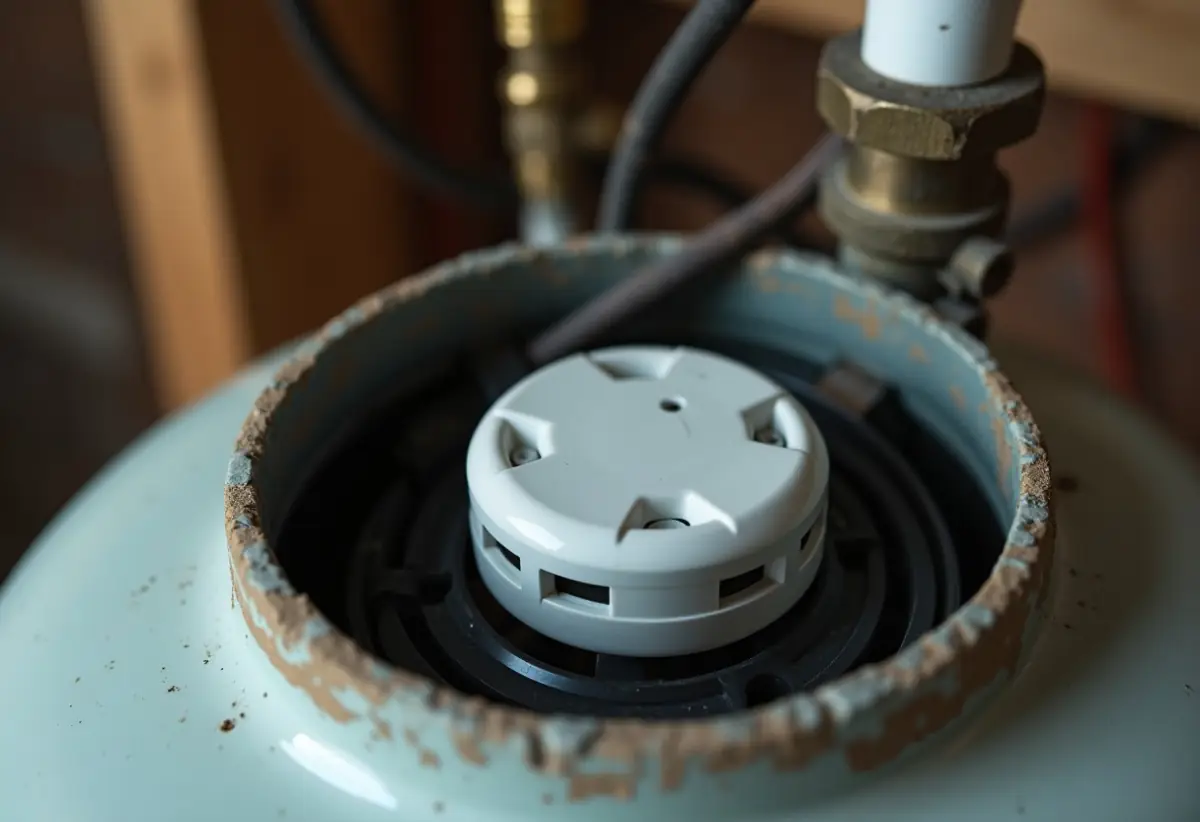
A leak detector with an automatic shutoff valve is worth adding wherever a pan’s small capacity would be overwhelmed, such as attics and closets over finished rooms. The Watts Series LFWDS FloodSafe detects as little as 1/16 inch of standing water on the floor or in the pan, closes the cold supply and cuts power or gas to the heater.
Key Watts LFWDS specs:
- Valve sizes 3/4 and 1 inch, lead free cast copper silicon alloy body, installed on the cold supply.
- Models LFWDS-SP-L and LFWDS-SP-R (standing pilot, left or right thread), LFWDS-E220 (220 VAC electric) and LFWDS-SI (spark ignition or oil fired).
- Maximum 150 psi and 210 degrees Fahrenheit. Runs from a low-voltage supply plugged into a 120 VAC outlet and handles electric heaters up to 30 amps.
Some heaters now ship with this built in. Rheem’s Performance Platinum ProTerra hybrid with LeakGuard includes a 360 degree leak detection cable and a boxed auto shutoff valve that Rheem says limits leaks to no more than 20 ounces, with replacement parts AP19134 (leak sensor) and AS50618A (shutoff valve).
What can a water heater drain pan not do?
A water heater drain pan cannot contain a tank rupture or a stuck relief valve. It is built to catch slow drips and condensate and send them to a visible spot. When a 40 or 50 gallon tank splits, water arrives far faster than a 3/4 inch gravity drain can carry it, and the pan overflows within moments.
A 2-1/2 inch deep, 24 inch pan around a 20-1/4 inch tank holds about 1.4 gallons outside the tank footprint by our calculation, against 45 rated gallons in Rheem’s tall 50 gallon model.
The pan also does not replace the relief valve discharge line. That pipe has its own termination rules, covered in our guide to the temperature and pressure relief valve. If you find water in the pan, treat it as an early warning and work through our leaking water heater checklist before the tank fails outright.
How we sourced this
We consulted 16 sources and cite 12. Code text came from UpCodes snippets of IRC P2801.6 (Texas 2018) and P2801.5.1 (Texas TWIA 2024) and ICC’s 2018 IPC Essentials. Local rulings came from North Carolina OSFM (2011) and Hamilton County, Ohio (2012). Product data came from Oatey, Rheem (12/23 to 11/24), Watts and Lennox documents. Pan capacities are our arithmetic. We excluded retailer listings, forums and AI code summaries, and could not view full UPC 507.5 text, so UPC rules are not quoted.
Frequently asked questions
Are water heater drain pans required?
Yes, wherever a leak from the tank would cause damage. The IRC (P2801.6) and IPC (504.7) apply that test to storage tank heaters, which in practice covers attics, upper floors, closets in living areas and finished basements. A garage or unfinished basement with a concrete floor and a floor drain often passes without one, but your local inspector makes the call.
What size drain pan do I need for a 50 gallon water heater?
Measure the tank, then buy a pan at least 2 inches wider, the margin Lennox recommends. Rheem lists its tall 50 gallon Performance Plus at 20-1/4 inches across, so it takes a 24 inch pan such as Oatey 34153. The medium 50 gallon model is 22-1/4 inches and needs a 26 inch pan.
Can you put a plastic drain pan under a gas water heater?
Usually not. ICC’s 2018 IPC guide says a plastic pan shall not go under a gas-fired heater, and Oatey says gas installs must use aluminum. Some IRC adoptions allow plastic under gas only if the material tests at a flame spread index of 25 or less and a smoke-developed index of 450 or less under ASTM E84 or UL 723.
How deep does a water heater pan need to be?
At least 1-1/2 inches deep under IRC P2801.6.1 and IPC 504.7.1, and it must be big enough to catch drips or condensate from the tank. Oatey builds its aluminum and plastic pans 2-1/2 inches deep and also sells 3 inch deep plastic pans for jurisdictions that ask for more depth.
Does a water heater drain pan need a drain line?
A required pan needs an indirect waste drain of at least 3/4 inch that runs full size to a waste receptor or outdoors, ending 6 to 24 inches above grade. The IRC waives the drain, not the pan, on a replacement heater where no pan drain existed before. A pan with no drain only buys time.
Do tankless water heaters need a drain pan?
The IRC and IPC pan sections name storage tank-type water heaters and hot water storage tanks, so a tankless unit without a storage tank falls outside that wording. Condensing tankless models still need a condensate route, so read the install manual and ask your local office about any amendments.
Can I put a drain pan under an existing water heater without removing it?
Not properly. The heater has to come out of the way so the pan sits flat under the whole base. That means shutting off power or gas and the cold supply, draining the tank, disconnecting the water lines, the gas line and vent, then lifting the empty tank into the pan. Two people and about 124 pounds of empty Rheem 50 gallon tank make that manageable.
Is it normal to have water in the drip pan of a water heater?
The article treats pan water as an early warning rather than something normal to ignore. The pan is built to catch slow drips and condensate and send them to a visible spot, so some moisture can appear. Still, the article says if you find water in the pan, treat it as an early warning and work through a leaking water heater checklist before the tank fails outright.