Sediment Filter for Well Water: Micron Ratings, Sizing and Setup
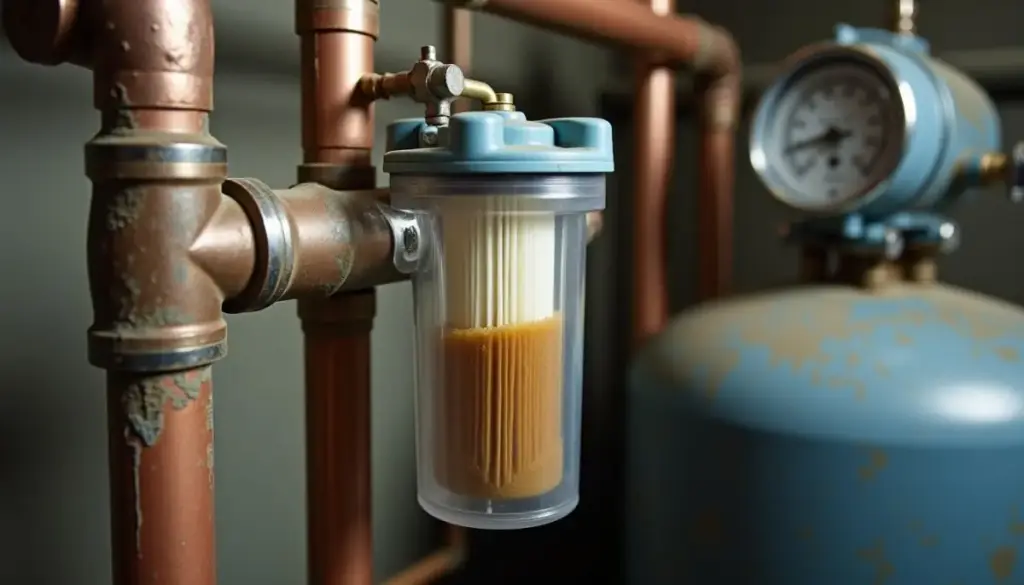
A sediment filter for well water is usually two stages: a 50 to 100 micron spin-down ahead of the pressure tank, then a 5 micron cartridge in a 1 inch Big Blue housing sized to your pump’s gpm.
Key Takeaways
- Nebraska Extension sizes the targets: sand 50 microns to 2 mm, silt 2 to 50 microns, clay 0.2 to 2 microns, which typical cartridges cannot stop.
- A nominal rating traps about 85 percent of particles at its size and an absolute rating about 99.9 percent, per Nebraska Extension.
- Rusco’s 60 mesh spin-down screen opens to 254 microns, roughly 50 times coarser than a 5 micron cartridge.
- Pentair rates the 20 inch DGD-5005-20 cartridge at under 1 psi initial drop at 20 gpm, double the 10 gpm rating of the 10 inch DGD-5005.
- Rusco says install the spin-down before the pressure tank and after the pressure switch, so tank water can backflush the screen.
- Pentair limits 20 inch Big Blue housings to 90 psi and 10 inch housings to 100 psi, both at 40 to 100°F.
What does a sediment filter for well water actually catch?
A sediment filter for well water strains out solid particles: sand, silt, loose scale, clay, rust flakes, and organic bits. The University of Nebraska NebGuide G1492 puts sand at 50 microns to 2 millimeters and silt at 2 to 50 microns. Clay at 0.2 to 2 microns, sometimes called flour sand, slips through typical cartridges and needs microfiltration.
The same guide says sediment filters do not remove nitrate, heavy metals, pesticides, or microbes. Treat the filter as equipment protection, then let well water testing tell you what else the water needs.

Is it sediment or iron that has to be oxidized first?
If water comes out clear and turns orange after sitting in a glass, that is dissolved iron, and a plain sediment cartridge will not catch it. Penn State Extension calls this the reduced, clear-water form. Nebraska Extension says sediment filters only trap iron once it is insoluble, which is why they often sit after aeration, ozonation, or chlorination that turn dissolved iron into particles.
If water is cloudy or orange at the tap, the iron is mostly particles a sediment filter can catch. Penn State Extension recommends no more than 0.3 mg/L of iron in household water. Above that, size a dedicated system for iron in well water and keep the sediment filter as its bodyguard.
- Run a cold tap into a clear glass and set it on the counter.
- Particles that settle within 30 minutes are sediment.
- Clear water that turns yellow or orange as it stands points to dissolved iron that needs oxidation first.
What micron sediment filter for well water should you choose?
Pick the largest micron rating that still stops your particles. Nebraska Extension says that rule gives the least maintenance, and warns that a 20 micron filter will pass some silt. For most wells that means a 5 micron final cartridge, with a 20 or 25 micron stage or a spin-down ahead of it when sand or heavy silt plugs the 5 micron too fast.
Check whether the rating is nominal or absolute. Pentair’s DGD series spec sheet lists the DGD-2501, DGD-5005, and DGD-7525 at nominal 1, 5, and 25 microns, certified to NSF/ANSI 42 for material requirements only. Nominal is fine for protecting a softener.
| Stage | Typical rating | What it is for | Source |
|---|---|---|---|
| Spin-down screen | 30 to 140 mesh (533 to 104 µm) or 50 to 100 micron | Sand and grit ahead of the pressure tank | Rusco; iSpring WSP series |
| Intermediate cartridge | 20 or 25 micron nominal (DGD-7525) | Heavy silt load, extends 5 micron life | Pentair DGD sheet; Nebraska Extension |
| Final cartridge | 5 micron nominal (DGD-5005, iSpring FP15B) | Fine silt before softener or UV | Pentair; iSpring |
| Surface-influenced well | 1 micron absolute, NSF approved housing | Required final stage before disinfection | Chautauqua County EHS |
Spin-down, cartridge or backwashing tank: which sediment filter fits your well?
Use a spin-down for sand, a cartridge for silt, and a backwashing media tank only when cartridges load up in weeks. Screens are flushable, cartridges filter finer but get thrown away, and a backwashing tank cleans itself on a timer but needs strong pump flow and a drain.
Spin-down screens and the mesh-to-micron catch
Rusco sells screens by mesh; iSpring sells them by micron. The Rusco mesh and micron table converts them, and the chart shows how coarse even a fine screen is next to a cartridge.
An iSpring 50 micron screen sits between Rusco’s 250 mesh (61 microns) and 500 mesh (30 microns).
Backwashing media tanks
Mid Atlantic Water sells a Fleck 2510SXT tank with Turbidex media for $1,895 and quotes the media maker at 3 to 5 microns. Turbidex backwashes at 15 to 20 gpm per square foot, so its 13 inch tank needs about 14 to 18 gpm, plus a 1/2 inch drain line, or 3/4 inch past 7 gpm or 20 feet.
| Filter type | Micron range | Flow | Maintenance | Cost |
|---|---|---|---|---|
| Rusco 1 inch spin-down | 24 to 1000 mesh (711 to 15 µm); 60 mesh standard screen | 1 to 25 gpm, 150 psi max | Open purge valve a few seconds under pressure | $145; 60 mesh screen $65 (Mid Atlantic Water) |
| iSpring WSP-SL spin-down | 50 to 1000 micron screens | 1 inch MNPT and 3/4 inch FNPT ends | Flush screen; replace Siliphos every 3 to 6 months | $79.99 (iSpring) |
| iSpring WSP50J jumbo spin-down | 50, 100, 200 or 500 micron | 25 gpm max, 1 gallon bowl | Flush screen | $321.99 (iSpring) |
| Big Blue 4.5 x 10, 1 inch (Pentek 150237) | 1, 5 or 25 µm nominal (DGD) | DGD-5005 under 1 psi at 10 gpm | Cartridge every 4 to 6 months | $165 kit, $45 cartridge (Mid Atlantic Water) |
| Big Blue 4.5 x 20, 1 inch (Pentek 150233) | 1, 5 or 25 µm nominal (DGD-20) | DGD-5005-20 under 1 psi at 20 gpm | Cartridge every 4 to 6 months | $195 kit, $55 cartridge (Mid Atlantic Water) |
| Backwashing tank, Fleck 2510SXT | 3 to 5 µm (Turbidex, per maker) | Needs about 14 to 18 gpm to backwash | Automatic backwash; drain line required | $1,895 (Mid Atlantic Water) |
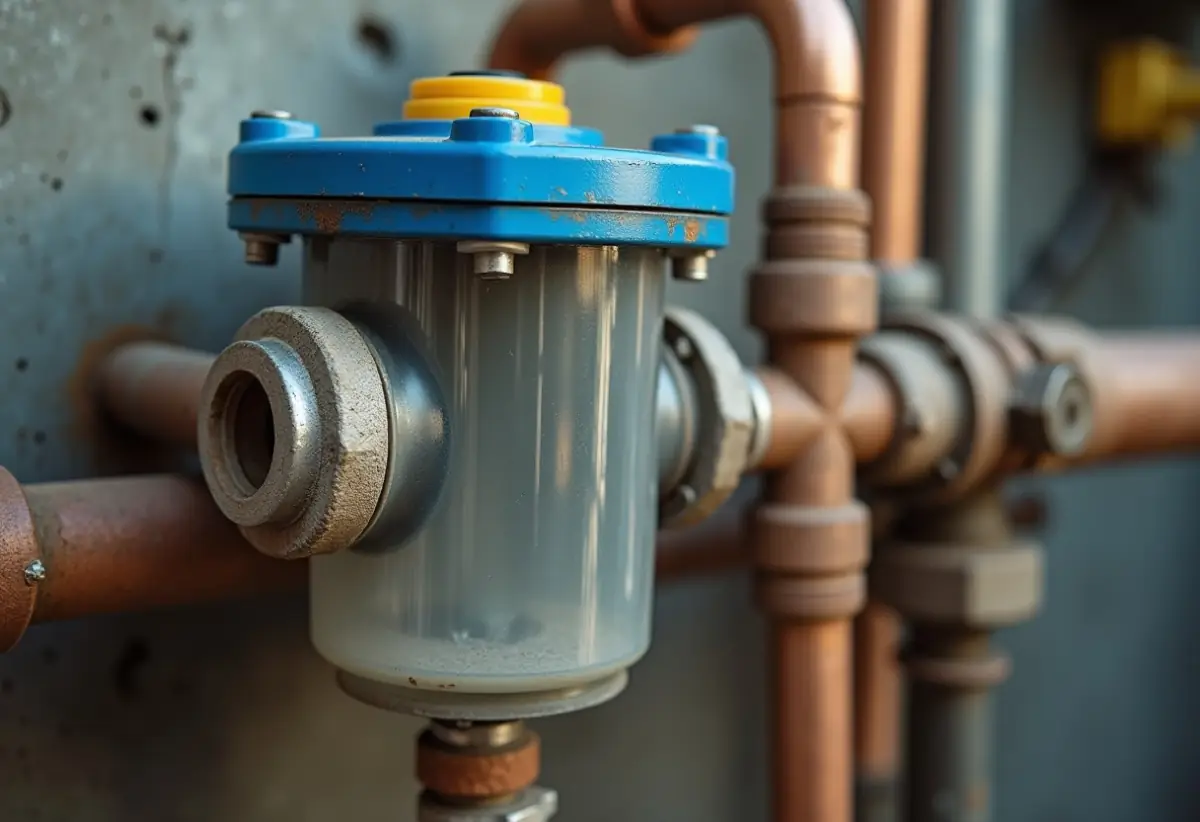
How do you size a sediment filter for well water by flow and pressure drop?
Size a sediment filter for well water to your pump’s maximum gpm, then pick the housing whose clean pressure drop at that flow stays near 1 psi. Chautauqua County notes that most 1/2 hp submersible pumps deliver 10 to 15 gpm and shallow-well jet pumps 5 to 10 gpm. Nebraska Extension adds that 30 psi is typical household pressure, so every lost psi shows at the shower.
Port size matters. Pentair’s Big Blue housing spec sheet lists the 3/4 inch housings at 2 psi at 15 gpm and the 1 inch housings at 1 psi at 15 gpm. On a 3/4 inch line, a 1 inch housing with reducing bushings still halves the housing loss.
Spin-downs have a floor as well as a ceiling. Rusco rates its 2 inch model at 18 to 100 gpm, and Mid Atlantic Water notes it needs 18 gpm to spin. A 10 gpm well belongs on the 1 inch or 3/4 inch body, rated 1 to 25 gpm.
4.5 x 10 or 4.5 x 20 Big Blue: which housing?
Choose the 4.5 x 20 for most whole-house well setups. Pentair rates the 20 inch DGD-5005-20 at under 1 psi at 20 gpm, versus 10 gpm for the 10 inch DGD-5005, and twice the media length means fewer changes. Pick the 4.5 x 10 when headroom is tight or the load is light. Pentair lists the 1 inch 10 inch housing at 13.30 inches tall and the 20 inch at 23.22.
The trade-off is pressure rating. Pentair caps the 20 inch housing at 90 psi and the 10 inch at 100 psi, both at 40 to 100°F, and warns to protect housings from freezing. If your pressure switch setting or surges can push past 90 psi, the 10 inch housing’s 100 psi rating gives more margin.
- Wrench: SW-3 (part 150296) for 10 inch housings, SW-4 (part 144368) for 20 inch.
- O-ring: Buna-N part 151122 fits Big Blue sumps.
- Pressure relief: Part numbers ending in “w/PR,” such as 150233 and 150237, carry a bleed button on the inlet side of the cap.
Where does the sediment filter go: before the pressure tank, softener and UV?
The spin-down goes first, after the pressure switch and before the pressure tank. Rusco’s installation sheet says that placement lets tank water purge the screen from the inside out. The cartridge goes after the tank and ahead of the softener, iron filter, and UV, which all foul when sediment reaches them.
- Well and pump, then the pressure switch.
- Spin-down filter (Rusco limits its cold-water model to 150 psi at 73°F and 100°F at 40 psi).
- Pressure tank.
- Raw water sampling tap, which Chautauqua County requires before filtration.
- Pressure gauge, Big Blue cartridge housing, pressure gauge.
- Iron filter or softener.
- UV unit as the last stage before the house.
Chautauqua County requires particle filtration ahead of UV on surface-influenced wells, and a UV water purifier for a well needs clear water because particles shade microbes from the lamp. For the rest of the treatment train, see our whole house water filter guide.
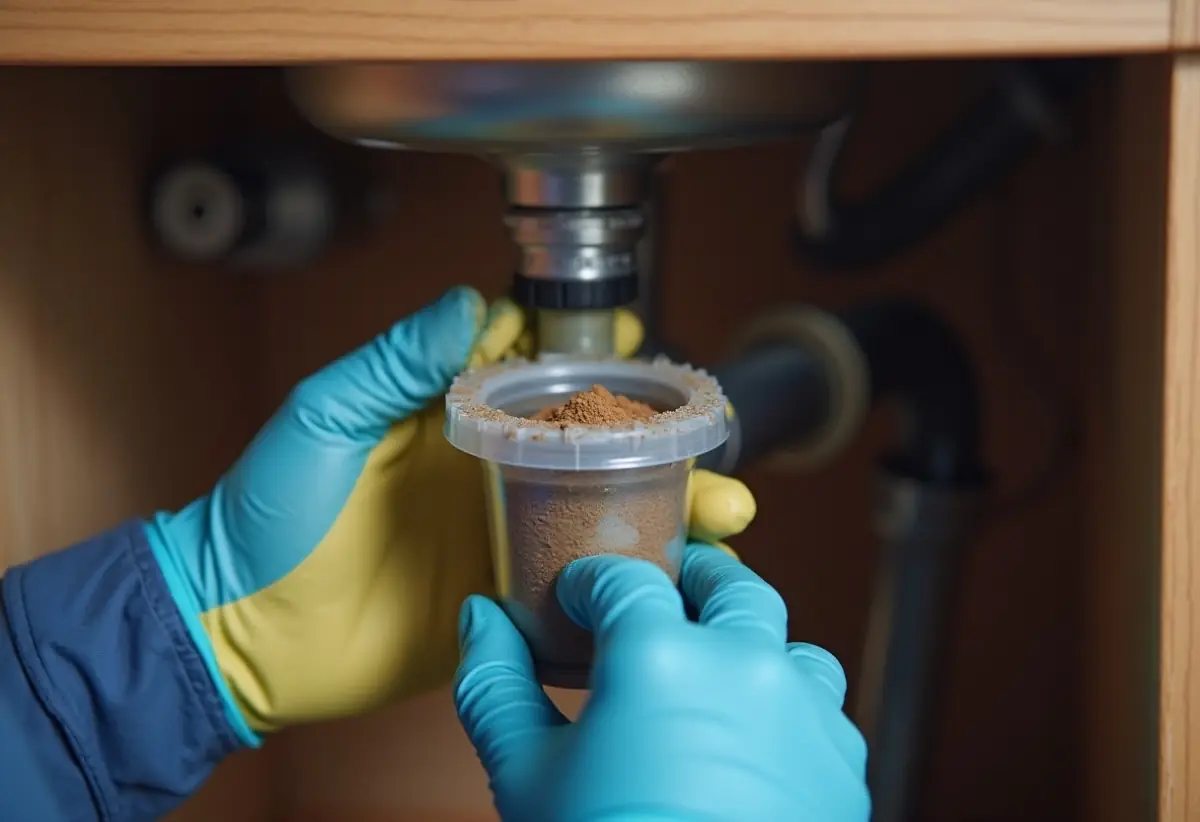
How often do you change a sediment filter, and what does the gauge tell you?
Change a well cartridge when the pressure drop across it grows, not on a calendar alone. Mid Atlantic Water’s rule of thumb is every 4 to 6 months, 12 on a clean well, every other month on a dirty one. iSpring says 3 to 6 months for its FP15B. Nebraska Extension says replace it when flow through the filter drops noticeably.
Chautauqua County recommends pressure gauges between filters for exactly this reason. Note the gap between the two gauges with a fresh cartridge and one tap running full. A new DGD-5005-20 should read under 1 psi at 20 gpm. When that gap keeps widening, the cartridge is loading up.
- Close the valves on both sides of the housing.
- Press the pressure relief button on the cap until water stops hissing.
- Unscrew the sump with the SW-3 or SW-4 wrench, keeping it upright.
- Dump the old cartridge, rinse the sump, and check the 151122 O-ring for flat spots or nicks.
- Seat the new cartridge, hand-tighten the sump, and open the inlet slowly while bleeding air at the button.
For a spin-down, Rusco says open the purge valve for a few seconds under pressure and close valves slowly.
What does a sediment filter for well water cost?
Retail hardware runs from about $80 to about $1,900. iSpring lists its WSP-SL spin-down at $79.99 and its WSP50J jumbo at $321.99. Mid Atlantic Water lists a 1 inch Rusco at $145, Big Blue kits at $165 and $195, and a Fleck 2510SXT backwashing tank at $1,895, before labor.
At Mid Atlantic Water’s $55 per 20 inch, 5 micron cartridge and two to three changes a year, a Big Blue costs about $110 to $165 a year by our math. A torn Rusco 60 mesh screen costs $65 to replace.
How we sourced this
We consulted 14 sources in October 2026 and cited 9: Nebraska NebGuide G1492 (2013), Penn State Extension (May 2025), Chautauqua County’s particle filtration standard, Pentair’s DGD and Big Blue spec sheets, Rusco’s install sheet and mesh table, iSpring listings, and Mid Atlantic Water’s October 2026 guides and prices. We excluded retailer psi thresholds for cartridge changes because no primary source publishes one. Prices change.
Frequently asked questions
What micron sediment filter is best for well water?
For most wells, a 5 micron cartridge is the working filter, with a coarser 50 to 100 micron spin-down ahead of it if the well pumps sand. The University of Nebraska says silt runs 2 to 50 microns and sand 50 microns to 2 millimeters, and that the largest rating that removes your problem particles needs the least maintenance.
Should a spin-down filter go before or after the pressure tank?
Before it. Rusco’s installation sheet says to install the spin-down before the pressure tank and after the pressure switch. That way, opening the purge valve lets stored tank water flush the screen from the inside out. Cartridge housings usually go after the tank, where the flow is steadier and the gauge readings are easier to compare.
Is a 5 micron or 20 micron filter better for well water?
A 5 micron cartridge catches most silt, which Nebraska Extension puts at 2 to 50 microns, so it gives clearer water. A 20 or 25 micron cartridge lets fine silt through but clogs more slowly. If a 5 micron cartridge plugs within weeks, add a 20 or 25 micron stage ahead of it instead of moving to a coarser final filter.
How often should you change a sediment filter on a well?
Mid Atlantic Water puts the rule of thumb at every 4 to 6 months for a Big Blue cartridge, stretching to 12 months on a clean well and every other month on a dirty one. iSpring says 3 to 6 months for its 5 micron FP15B. The better cue is a growing pressure drop across the housing, read on gauges before and after it.
Does a sediment filter remove iron from well water?
Only iron that is already a solid particle, such as rust flakes or orange silt. Nebraska Extension says sediment filters remove insoluble iron and are used after aeration, ozonation, or chlorination turn dissolved iron into particles. Clear water that turns orange after it sits holds dissolved iron, and that passes straight through a plain cartridge.
Does a sediment filter reduce water pressure?
A clean one barely does. Pentair rates the 20 inch DGD-5005-20 cartridge at under 1 psi of initial pressure drop at 20 gpm, and its 1 inch Big Blue housing at 1 psi at 15 gpm. The drop grows as the cartridge loads with dirt, so falling shower pressure is usually a full filter, not the filter itself.
Can a sediment filter remove bacteria from well water?
No. Nebraska Extension says cartridge sediment filters are not generally recommended for removing microbial contaminants, and Pentair’s DGD spec sheet warns against using them on unsafe or unknown water without disinfection. A positive coliform test calls for disinfection such as UV or continuous chlorination, with the sediment filter ahead of it.