Pool Plumbing Diagram: How Water Flows From Skimmer to Return Jets
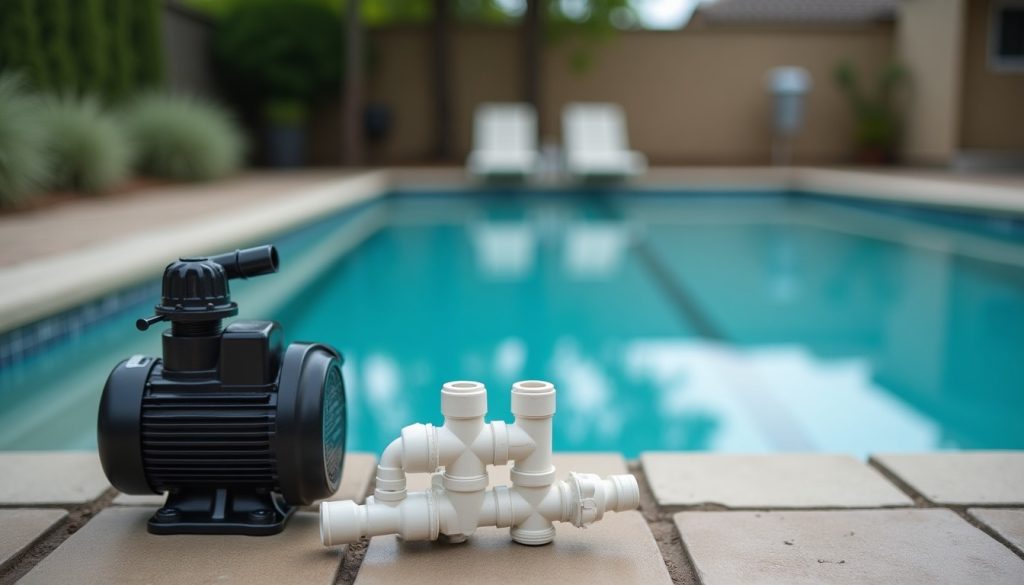
A pool plumbing diagram shows water leaving through the skimmers and main drains, then passing the pump, filter, heater, and chlorinator in that order before return jets push it back into the pool.
Key Takeaways
- Equipment order is fixed by function: pump, filter, heater, then chlorinator or salt cell last, a sequence InyoPools and equipment makers such as Hayward both describe.
- Hayward’s chlorinator instructions call for a check valve between the heater and the chlorinator so concentrated chlorine cannot back up into the heater.
- ANSI/APSP/ICC-15 caps residential filtration piping at 6 feet per second on the suction side and 8 feet per second on the return side, per the International Code Council.
- At 6 fps, the ICC table rates 1.5 inch Schedule 40 PVC at about 38 gpm and 2 inch at about 63 gpm, which is why 2 inch suction lines are now common.
- The filtration flow rate is the pool’s gallons divided by 360 minutes (a 6 hour turnover) or 36 gpm, whichever is greater, per the ICC’s CodeNotes on the 2021 ISPSC.
- CPSC Pool Safely guidance says dual main drains must sit at least 3 feet apart, and drain covers must meet ASME A112.19.8 or its successor, ANSI/APSP-16.
What does a pool plumbing diagram show?
A pool plumbing diagram shows the closed loop that keeps pool water clean: suction lines from the skimmers and main drains, the equipment pad where the pump, filter, heater, and sanitizer sit, and the return lines that carry treated water back through wall jets. The diagram below shows a typical in-ground layout with a heater and an inline chlorinator.
Read the diagram in two halves. Everything before the pump is the suction side, where the pump pulls water under vacuum. Everything after the pump is the pressure side, where it pushes water through equipment and back out the returns.
House plumbing works on a different logic, with pressurized supply lines and gravity drains, which we cover in our guide to residential plumbing diagrams. A pool is one loop, so every fitting moves water toward the pump or away from it.
What order does pool equipment go in?
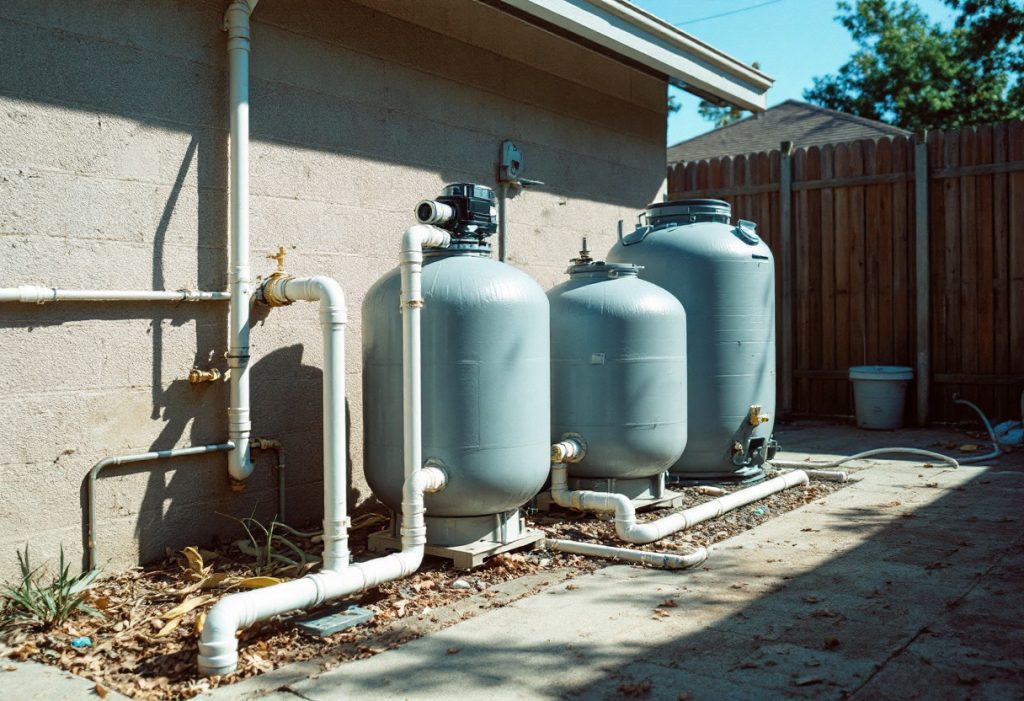
Pool equipment goes in this order: pump, filter, heater, then chlorinator or salt cell, with the return jets at the end. The pump comes first because it creates the flow. The filter comes next so debris never reaches the heater. The sanitizer goes last so freshly dosed water heads straight to the pool instead of sitting in a heat exchanger.
- Skimmers and main drains pull water out of the pool.
- Pump catches leaves and hair in its strainer basket, then pushes water forward.
- Filter traps fine debris in sand, cartridge pleats, or diatomaceous earth (DE).
- Heater (if installed) warms filtered water. Gas heaters, heat pumps, and solar loops all sit here.
- Check valve stops chlorinated water from drifting back into the heater.
- Chlorinator or salt cell adds sanitizer as the last treatment step.
- Return jets send water back into the pool, often aimed to circulate surface water toward the skimmer.
InyoPools and other equipment retailers describe the same sequence, and the reasoning holds for every brand. Accessories such as UV or ozone systems often mount after the filter, but follow the maker’s manual because flow and pressure ratings vary.
What does each component in a pool plumbing diagram do?
Each component in a pool plumbing diagram has one job: skimmers and drains collect water, the pump moves it, the filter cleans it, the heater warms it, the sanitizer treats it, and returns spread it back out. Valves sit between them to split or stop flow. The table below lists where each part usually sits on a residential system.
| Component | What it does | Typical location | Notes |
|---|---|---|---|
| Skimmer | Pulls surface water and floating debris into a basket | Pool wall at waterline, suction side | Many in-ground pools have 1 or 2. Above ground pools usually have 1. |
| Main drain(s) | Pulls water from the deep end floor | Pool floor, suction side | Dual drains at least 3 ft apart per CPSC guidance; covers must be certified. |
| 3-way diverter valve | Splits or blends flow between two lines | Ahead of pump (suction) or after equipment (returns) | Jandy and Pentair are common brands. Balances skimmer vs drain pull. |
| Pump | Creates flow; strainer pot catches large debris | First on the equipment pad | Suction pipe sized to keep velocity at or under 6 fps (APSP-15). |
| Filter | Removes fine particles | Directly after pump | Sand and DE use a multiport or push-pull valve to backwash. |
| Heater | Warms water | After filter | Optional. Some installers add a 3-valve bypass for service. |
| Check valve | Lets water flow one way only | Between heater and chlorinator | Required by Hayward chlorinator instructions to protect the heater. |
| Chlorinator or salt cell | Adds chlorine | Last before returns | Inline feeders and salt cells both go last. |
| Return jets | Push treated water back into the pool | Pool walls, pressure side | Eyeball fittings aim flow to circulate toward the skimmer. |
Where do valves go in pool plumbing?
Valves in pool plumbing go at three points: 3-way diverter valves on the suction side to balance skimmer and drain pull, a check valve between the heater and an inline chlorinator, and diverter or ball valves on the return side to split flow to a spa, cleaner, or water feature. Isolation valves on both sides of the pad make equipment swaps easier.
Pool valves are the same ball, check, and diverter families covered in our guide to plumbing valve types, built in PVC with larger handles.
- Suction-side 3-way valve. Takes the skimmer line and the main drain line and merges them into the pump. The handle shifts pull toward the skimmer or the drain.
- Check valve before the chlorinator. Hayward’s installation instructions call for one between the heater and the chlorinator. When the pump shuts off, concentrated chlorine can drift backward, and a copper heat exchanger may corrode.
- Check valve on a pump above water level. Helps the pump hold prime between cycles.
- Return-side diverter. On a pool and spa combo, two 3-way valves switch suction and returns between the two.
Never close every suction valve with the pump running. A dead-headed pump runs dry, overheats, and can melt its housing or warp the impeller in short order.
What size pipe is used in a pool plumbing diagram?
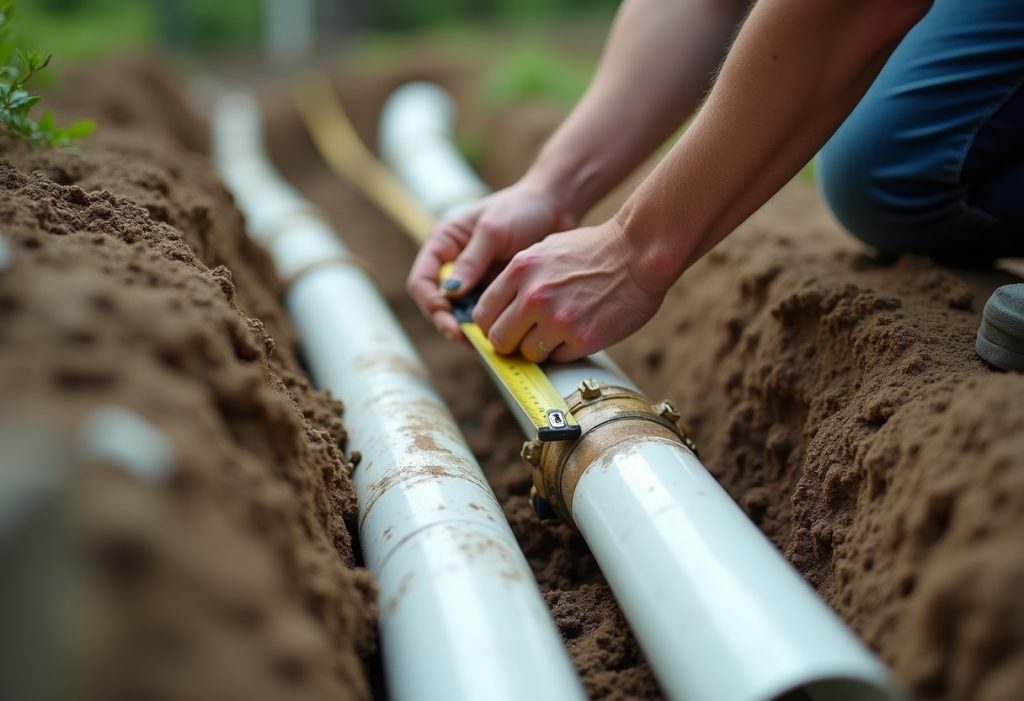
Most residential pool plumbing diagrams call for 1.5 inch or 2 inch Schedule 40 PVC, with 2 inch now common on suction lines. The right size depends on flow. The International Code Council rates 1.5 inch at about 38 gpm and 2 inch at about 63 gpm at the 6 feet per second suction limit set by ANSI/APSP/ICC-15.
The ICC’s CodeNotes on velocity limits in the 2021 ISPSC gives the sizing method. Divide pool gallons by 360 minutes to get the filtration flow rate, use 36 gpm if that number is lower, then pick pipe that keeps suction at or under 6 fps and returns at or under 8 fps.
A worked example shows why this matters. A 20,000 gallon pool divided by 360 minutes needs about 56 gpm. A single 1.5 inch suction line tops out near 38 gpm at 6 fps, so that pool needs a 2 inch suction line or two 1.5 inch lines feeding the pump.
Use pressure-rated Schedule 40 PVC pipe for rigid runs. The ICC notes that circulation pipe must be listed and labeled to NSF 14, so look for that mark on the print line. Suction fittings such as drain covers carry their own certified flow rating, and the system flow must stay under it.
How is an above ground pool plumbing diagram different from in-ground?
An above ground pool plumbing diagram is shorter and simpler than an in-ground one. Most above ground pools have one skimmer, one return, and no main drain, so water runs skimmer to pump, pump to filter, then through any heater or chlorinator and back through a single wall return. Flexible hose with clamps often replaces glued PVC, though hard plumbing is a common upgrade.
| Feature | Above ground pool | In-ground pool |
|---|---|---|
| Suction inlets | Usually 1 skimmer, no main drain | 1 or 2 skimmers, often dual main drains |
| Returns | Usually 1 wall return | Several returns, sometimes floor returns |
| Pipe type | Flexible hose and clamps, or hard PVC upgrade | Rigid Schedule 40 PVC, often 1.5 or 2 in, buried |
| Suction-side valves | Often none, or a simple shutoff | 3-way diverter to balance skimmer and drain |
| Equipment pad | Beside the pool wall, close to water level | Separate pad, sometimes well above or below water level |
| Anti-entrapment exposure | Low without a floor drain | Main drains need certified covers and dual-drain or backup layout |
The equipment order does not change. An above ground system still runs pump, filter, then salt cell, and a heat pump goes between the filter and the cell.
What do pool anti-entrapment rules require?
Pool anti-entrapment rules require certified drain covers on every suction outlet and a layout that keeps one blocked drain from trapping a swimmer. The Virginia Graeme Baker Pool and Spa Safety Act, signed in 2007, set the federal baseline. CPSC guidance calls for dual drains at least 3 feet apart, or a backup system on a single drain.
For plumbing layout, the rules work on three fronts.
- Drain covers. Covers must meet ASME A112.19.8, now carried forward as ANSI/APSP-16, according to CPSC’s Pool Safely FAQ on the Act. Each certified cover assembly has a lab-tested maximum flow rating, and the system flow must stay below it.
- Single drain layouts on public pools. A public pool on a single main drain that is not unblockable needs a second layer: a safety vacuum release system (SVRS), suction-limiting vent, gravity drainage system, automatic pump shutoff, or a disabled drain.
- Dual drains. Two or more drains at least 3 feet apart, teed together into one suction line, split the pull so a body cannot seal both.
Backyard pools are mostly governed by state and local codes, and many reference the International Swimming Pool and Spa Code and ANSI/APSP/ICC-7 for suction entrapment avoidance. The ICC notes that suction outlet safety standards apply to public and residential pools alike, so check with your local building department before you design the drain layout.
What are the most common pool plumbing mistakes?
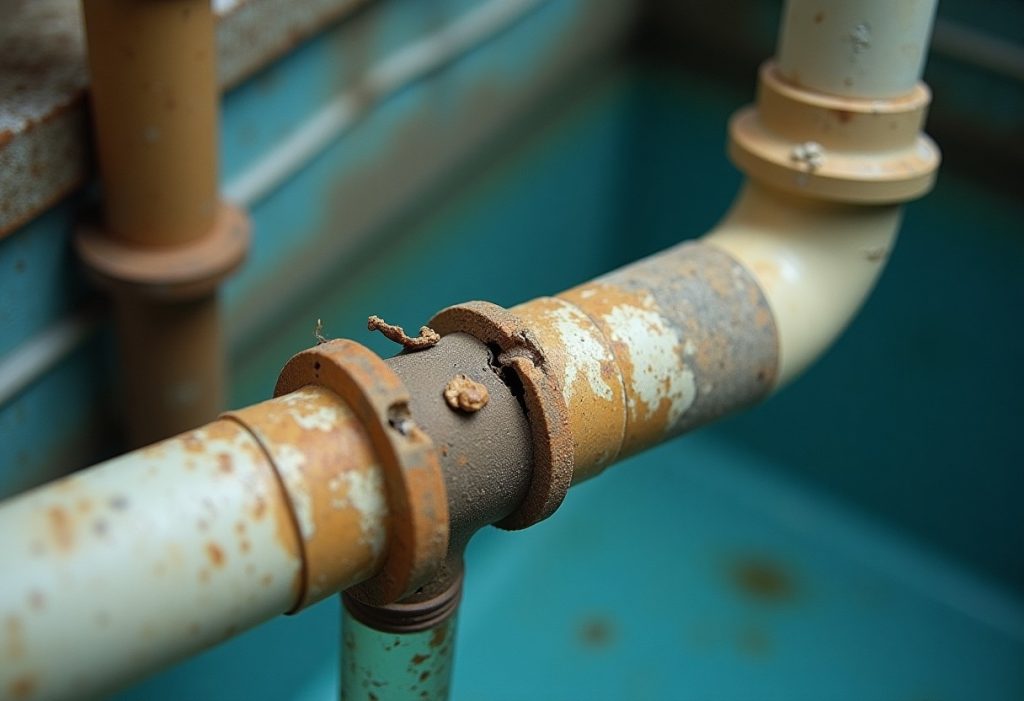
The most common pool plumbing mistakes are undersized suction pipe, putting the chlorinator ahead of the heater or leaving out its check valve, running one main drain with an old uncertified cover, weak solvent-weld joints, and too many sharp elbows. Each one raises pump strain, damages equipment, or creates a safety hazard, and most are cheap to avoid during a build.
- Undersizing the suction line. A large pump on a 1.5 inch suction line exceeds 6 fps fast, which adds noise, friction loss, and energy cost. Match pipe to flow using the ICC table.
- Chlorinator before the heater. Chlorine-rich water corrodes heat exchangers. Put the sanitizer last and fit a check valve between them, as Hayward’s instructions require.
- Weak glue joints. Skipping primer, missing the quarter turn, or turning on the pump before the cement cures causes slow leaks underground. Our guide on how to glue PVC pipe covers set and cure times by size.
- Expired or uncertified drain covers. Many certified covers list a service life from the manufacturer. Replace a cover when it reaches that date, cracks, or goes missing, and close the pool until it is fixed.
- Too many 90 degree elbows. Every sharp turn adds friction. Sweep elbows and pairs of 45s cut resistance on long runs.
- No unions at the pad. Without unions, a pump swap means cutting and re-gluing pipe.
- Undocumented buried lines. Photograph the trench before backfill so a leak crew can test one line at a time.
How do you draw a pool plumbing diagram for your own pool?
To draw a pool plumbing diagram for your own pool, start at the pool and trace every line to the pad. Mark each skimmer, drain, and return, label pipe sizes from the print on the pipe, then sketch the pad in flow order with every valve and its handle position. Photos of each valve, taken at normal operating settings, finish the record.
- Count the pipes coming out of the ground at the pad and match each to a skimmer, drain, return, or feature.
- Read the print line on each pipe for size and schedule.
- Draw the equipment left to right in flow order: pump, filter, heater, check valve, sanitizer.
- Mark every valve and write its normal setting on the drawing.
- Note each drain cover’s rated flow and any listed service life.
How we sourced this
Pipe velocity limits, the filtration flow formula, the 36 gpm minimum, and all flow figures in the chart come from the International Code Council’s CodeNotes on velocity limits in the 2021 ISPSC (Table 1, Schedule 40 PVC, published 2024), which cites ANSI/APSP/ICC-15 and ANSI/APSP/ICC-7. Drain cover, dual-drain spacing, and single-drain backup rules come from CPSC’s Pool Safely guidance on the Virginia Graeme Baker Act. The heater-to-chlorinator check valve comes from Hayward installation instructions. Top-ranking guides from PoolResearch, InyoPools, and TroubleFreePool were reviewed for coverage only; no forum figures are cited. Local codes vary. Reviewed October 2026.
Frequently asked questions
What order does pool equipment go in?
Water leaves the pool through the skimmers and main drains, enters the pump, then passes through the filter, the heater if you have one, and the chlorinator or salt cell last before the return jets. The pump goes first because it must pull water, and the sanitizer goes last so chlorine reaches the pool and not the heater.
Does the chlorinator go before or after the pool heater?
After. An inline chlorinator or salt cell should be the last piece of equipment before the returns. Hayward’s installation instructions call for the chlorinator downstream of the heater with a check valve between them, because concentrated chlorine that drifts back into a heater when the pump stops can corrode its heat exchanger and may void the warranty.
What size PVC pipe is used for pool plumbing?
Most residential in-ground pools use 1.5 or 2 inch Schedule 40 PVC, with 2 inch now common on suction lines. Size it from flow, not habit. Per the ICC table for Schedule 40 PVC, 1.5 inch carries about 38 gpm at the 6 fps suction limit and 2 inch about 63 gpm. Bigger pumps or long runs may need 2.5 inch.
Where does the check valve go in pool plumbing?
The most important check valve sits between the heater and an inline chlorinator or salt cell, so chlorinated water cannot flow back into the heater. Installers also add check valves on pumps set above water level to hold prime, and on solar lines so water does not drain back. Follow your equipment manual for exact placement.
Does a pool need two main drains?
Many codes and the federal anti-entrapment rules push pools toward two or more main drains, spaced at least 3 feet apart and plumbed together, so a body cannot block all suction at once. CPSC guidance treats a single main drain on a public pool as needing a backup such as a safety vacuum release system. Many modern pools skip main drains entirely.
How do you plumb an above ground pool?
Run a hose or pipe from the skimmer to the pump inlet, then pump to filter, filter to any heater or chlorinator, and the last unit to the return fitting in the wall. Most above ground pools have one skimmer and one return and no main drain, so the plumbing is short. Clamp every hose joint and keep the pump below water level.
What is a 3-way valve on a pool?
A 3-way diverter valve has one outlet and two inlets, or the reverse, and a handle that splits or blends flow between them. On the suction side it lets you balance pull between the skimmer and the main drains. On the return side it can split flow between pool returns and a spa, a cleaner line, or a water feature.
How does a pool plumbing system work?
A pool plumbing system works as one closed loop. Skimmers and main drains pull water out on the suction side under vacuum, feeding the pump, which pushes it through the filter, heater, and chlorinator or salt cell on the pressure side, in that fixed order, before return jets send treated water back into the pool, often aimed to circulate surface water toward the skimmer.


