Water Under Kitchen Sink: Find the Leak in 7 Checks
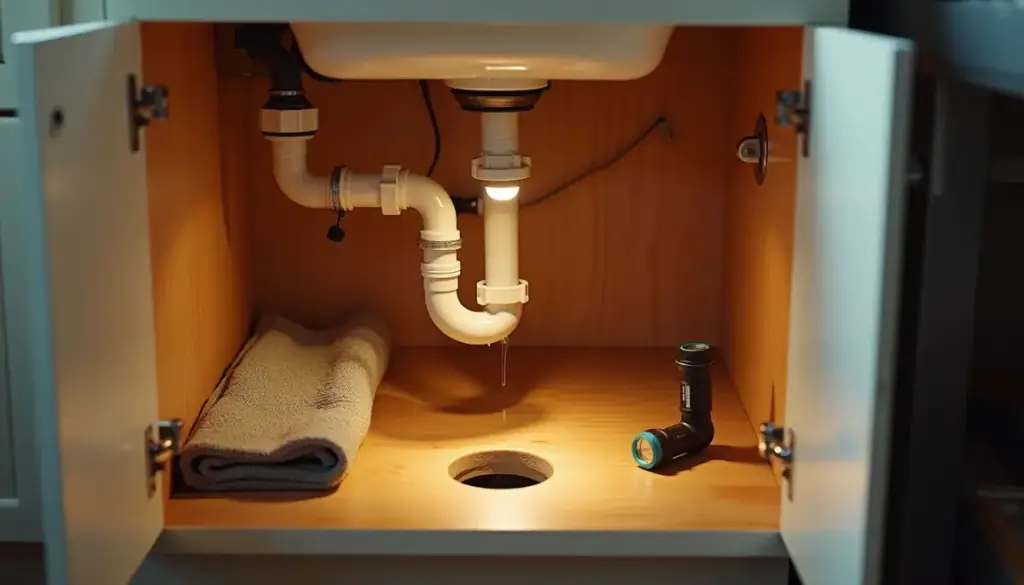
Water under kitchen sink cabinets almost always comes from one of seven spots, and filling the sink with the stopper in, then pulling it, tells you within minutes whether to chase the drain or the supply side.
Key Takeaways
- EPA WaterSense puts an average household’s leaks at more than 9,300 gallons a year.
- Water damage and freezing caused 22.6% of homeowners insurance losses in 2023, per ISO data from the Insurance Information Institute.
- The average water damage and freezing claim ran $15,400 from 2019 through 2023 (ISO).
- InSinkErator sorts disposal leaks into 7 locations and lists no home repair for a bottom leak.
- InSinkErator’s ES30 and ES50 manual seals the sink flange with a 1/2 inch putty rope and bans putty or pipe dope on other joints.
- BrassCraft calls for hand tight plus 1/4 turn on metal compression nuts, with no thread sealant.
- EPA says to dry a wet cabinet within 24 to 48 hours to prevent mold.
Why is there water under my kitchen sink?
Water under your kitchen sink comes from one of two systems. The supply side (angle stops, braided lines, faucet, sprayer hose, dishwasher feed and filter units) is under pressure and leaks whether or not you use the sink. The drain side (basket strainer, disposal, slip joints, trap and dishwasher drain hose) leaks only when water goes down. The seven checks below split the two fast.
New to that cabinet? See how the parts of kitchen sink plumbing fit together, then match what you see below.
| Where water appears | Likely source | Test | Fix |
|---|---|---|---|
| Under the basin, around the drain body | Basket strainer putty or locknut | Fill the basin, stopper in | Reseal the strainer with fresh putty |
| Top of the disposal | Loose mounting screws or dried flange putty | Tinted water, stopper in | Tighten 3 mounting screws or reseal with a 1/2 inch putty rope |
| Disposal bottom plate, everything above dry | Failed internal seal | Tinted water test | Replace the disposal |
| Tailpiece or trap, only while draining | Loose slip nut or flattened washer | Towel strips while a full sink drains | Reseat or replace the beveled washer |
| Wet only after a dishwasher cycle | Drain hose clamp or air gap | Short cycle, cabinet open | Tighten the clamp, clear the air gap |
| Wet only while the faucet runs | Faucet base seal or sprayer hose | Run water with the wand extended | Replace the hose or spout O-rings |
| Steady wet with the sink unused | Angle stop, compression nut or braided line | Dry towels, run nothing | Snug the metal nut 1/4 turn or replace the line |
| Puddle near a filter or RO unit | Housing O-ring, tubing or drain saddle | Towel under each housing overnight | Reseat the O-ring, recut tubing square |
How do you dry the cabinet and run the paper towel test?
Check 1 is drying everything and laying paper down, because you cannot trace a leak through standing water. Empty the cabinet, wipe every pipe, nut and hose dry, and lay dry paper towels flat on the cabinet floor. InSinkErator’s leak test uses newspaper taped to the cabinet floor, and a wet spot on the paper marks the drip line straight above it.
- Empty the cabinet and aim a flashlight up from the floor.
- Wipe the faucet base, supply lines, stops, strainer, disposal and trap dry.
- Tape dry paper towels across the cabinet floor.
- Wrap a strip of towel around each joint and nut, then wait.
Rule out sweat first. A cold supply line in a humid kitchen beads water along its whole length, while a leak drips from one joint. If nothing shows, InSinkErator advises leaving the paper down for a few days, then checking filters, the sprayer, the faucet and countertop seams.
Is the water under the kitchen sink coming from the drain or the supply?
Check 2 separates drain leaks from supply leaks by controlling when water moves. Stopper the sink, fill it with water tinted by 4 or 5 drops of food coloring, and leave it full with the faucet off. Then pull the stopper and watch. Colored water below means the drain side. Clear water that keeps appearing with the sink unused means the pressurized supply side.
- Stopper in, colored drip: the strainer or disposal flange, the only parts holding standing water.
- Stopper out, colored drip: tailpiece, disposal discharge, trap or trap arm.
- Clear drip, nothing running: stops, supply lines, faucet connections or a filter.
EPA WaterSense says to watch the water meter over two hours with no water use; if it moves, you probably have a leak. Close both angle stops first. If the meter then stops, the leak is in that cabinet.
Is the kitchen sink leaking underneath at the strainer or disposal?
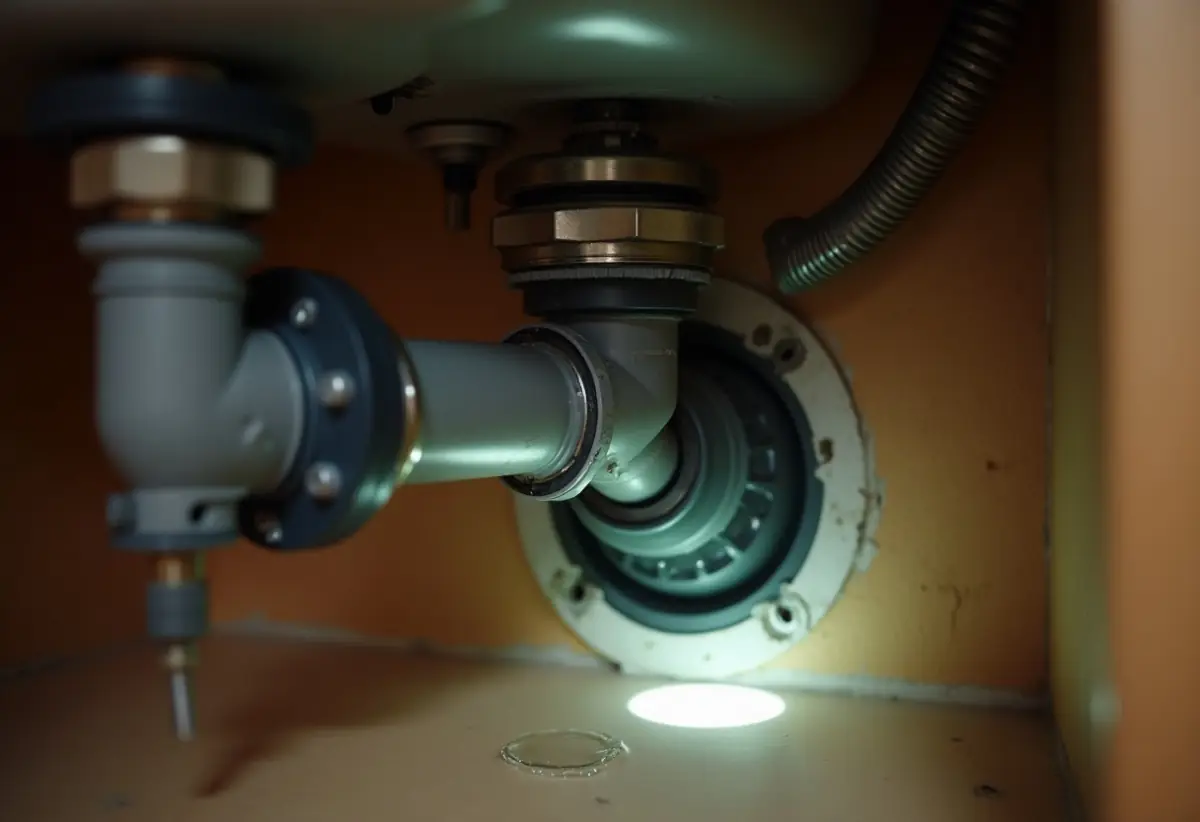
Check 3 covers the two parts that seal the basin to the drain, the basket strainer and the garbage disposal flange. A colored drip with the stopper in points here. Both seal with plumber’s putty under a flange, and both loosen over years of hot water and food scraps. The disposal adds side and bottom leak points that a plain strainer does not have.
Basket strainer. Putty seals the rim, and a rubber gasket, friction washer and large locknut clamp it from below. If snugging the locknut fails, disconnect the tailpiece, back off the locknut, scrape off the old putty and reset the strainer in a fresh rope.
Garbage disposal. InSinkErator’s leak page sorts leaks into 7 locations, from the mounting assembly and dishwasher inlet to the bottom and motor joint. Kill the breaker first.
- Top leak: tighten all 3 mounting screws evenly, or reseal the flange with a 1/2 inch putty rope, per the ES30 and ES50 manual.
- Bottom leak: water at the bottom plate with every joint above dry means an internal seal failed. InSinkErator publishes no home repair here, so plan on a new unit.
Are the slip-joint nuts on the tailpiece and trap leaking?
Check 4 targets the slip joints, the big plastic or chrome nuts on the tailpiece, trap and trap arm. Each seals with a beveled washer squeezed between nut and pipe, not on the threads. A colored drip only after you pull the stopper, wetting the towel strip at one nut, means that joint. Most kitchen drains in this spot are 1-1/2 inch pipe.
- Set a bucket under the trap and loosen the leaking nut by hand.
- Replace a flattened, cracked or missing washer.
- Seat the washer bevel into the fitting, align the pipes, and start the nut by hand.
- Hand tighten, then snug lightly with pliers. Cranking a plastic nut cracks it.
At the disposal outlet, InSinkErator’s discharge guide says to tighten the discharge nut or bolts and check the gasket for debris, cracks or rips. A drip at the wall stub-out or a soldered joint needs more than a nut turn; see how to fix a leaking pipe.
Could the dishwasher be putting water under the kitchen sink?
Check 5 is the dishwasher, and it fools people because it leaks only when the machine runs. Water that shows up after a load, with every other test dry, usually comes from the drain hose clamp at the disposal inlet, the countertop air gap, or the 3/8 inch hot water feed. Run a short cycle with the cabinet open and watch each connection.
- Drain hose: InSinkErator’s dishwasher inlet guide lists 4 checks: knockout plug removed, clamps tight, hose adapter intact, elbow and trap joint tight.
- Air gap: water spitting from the countertop cap means the hose below it is clogged.
- Supply: BrassCraft calls for hand tight plus 1/4 turn on metal nuts and no thread sealant on its connectors.
IBHS tells homeowners to replace dishwasher supply hoses every 5 years. Routing, the high loop and air gap rules are in our dishwasher plumbing guide.
Is the faucet base, sprayer hose or supply line the source?
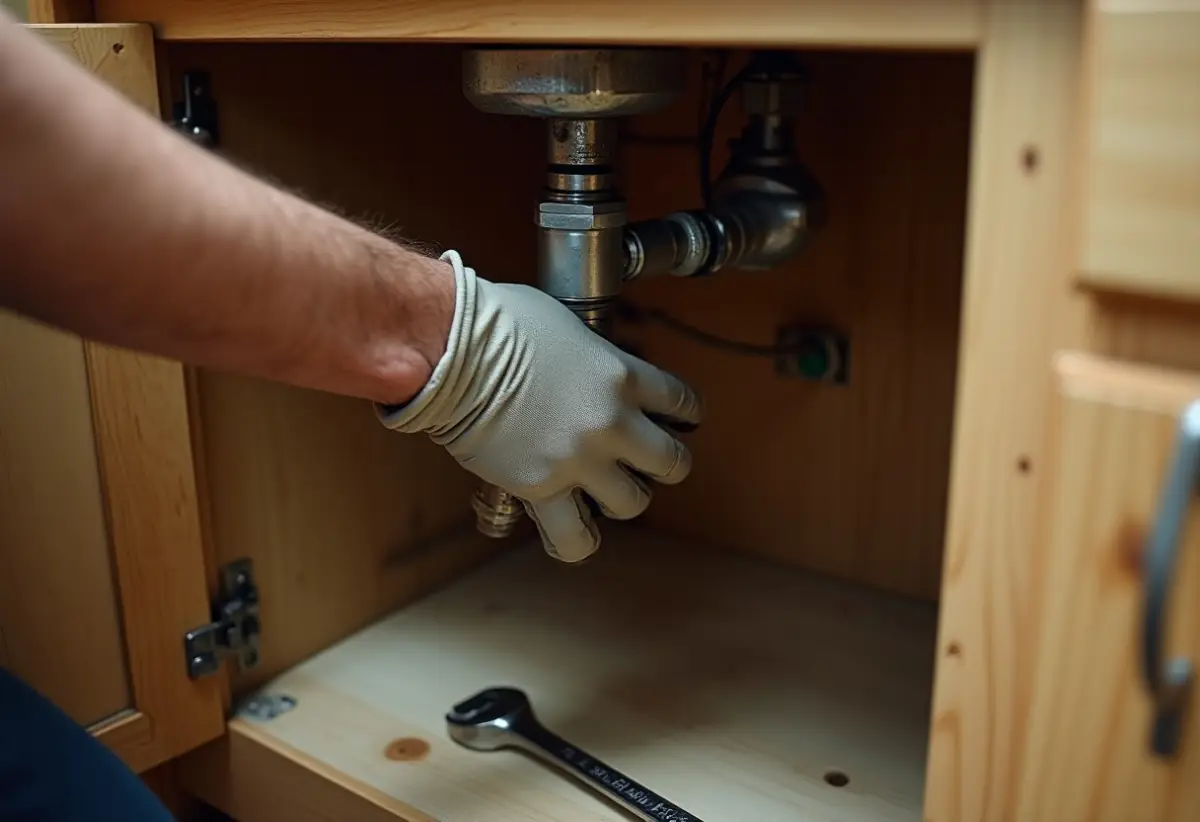
Checks 6 and 7 cover the faucet and everything feeding it. A puddle that grows only while the faucet runs points to the faucet base seal or a sprayer hose. A steady drip with the sink unused points to an angle stop, a supply nut or a braided line. Under-sink filters and reverse osmosis units add their own joints to the list.
Check 6, faucet and sprayer. Pull the wand out fully, run water and hold a dry towel on the hose under the sink. Pull-down hoses wear where they slide through the faucet, and a split may leak only when extended. Water around the spout base points to worn spout O-rings.
- Moen: the 150259 pull-down hose kit lists at $42.36 in chrome.
- Delta: wands are not designed to be taken apart, and the RP79659 Trinsic spray assembly uses a 1/2 inch threaded connection.
- Side sprayer: Ace lists a Danco 48 inch replacement hose at $7.99.
Check 7, supply and filters. A drip behind an angle stop handle when you turn it is the packing; snug the packing nut slightly or replace the stop. Frayed braid, rust or a bulge on a braided line means replace it, the same failures we cover for a toilet supply line leaking. On a filter or RO unit, check each housing O-ring, the tubing push fits and the drain saddle; a leak right after a filter change usually means a pinched O-ring.
How much damage can water leaking under a kitchen sink do?
A slow drip wastes water and a soaked cabinet costs real money. EPA WaterSense counts more than 9,300 gallons of leaks per average household each year. ISO data published by the Insurance Information Institute shows water damage and freezing claims averaged $15,400 from 2019 through 2023. Under-sink leaks sit inside that category, which also includes mold where a policy covers it.
Sources: Insurance Information Institute citing ISO (claims per 100 house-years, 2019 to 2023 average) and EPA WaterSense Fix a Leak Week.
Cabinet floor and mold. EPA’s mold guide says to dry water-damaged areas within 24 to 48 hours to prevent mold, and calls a moldy area under about 10 square feet a job most people can handle. Run a fan into the open cabinet overnight. Replace a swollen particleboard floor rather than painting over it.
Leak sensors. GoveeLife’s manual for its H5043 gateway and H5058 sensor kit lists an alarm adjustable up to 100 dB, AAA batteries and a LoRa range up to 1,968 feet, with phone alerts. Set the sensor at the cabinet’s lowest corner.
How we sourced this
We searched the primary keyword and a question variant in October 2026, then took figures only from primary sources: EPA WaterSense, the Insurance Information Institute (ISO data), EPA’s mold guide, InSinkErator support pages and manual, BrassCraft, Delta, Moen and Ace listings, and the GoveeLife manual. EPA’s current household leak figure is 9,300 gallons a year, lower than the 10,000 many sites still quote. We left out repair cost averages and RO part specs we could not confirm. Prices are October 2026 listings.
Frequently asked questions
Why is there water under my kitchen sink but no leak?
The leak is there but only shows under certain conditions. A cold supply line can sweat in humid weather, a pull-down hose may drip only when extended, and a dishwasher hose may leak only while draining. Water from the faucet base or countertop seams can also run down the back wall. Leave dry paper towels down for a few days to catch it.
Is water under the kitchen sink an emergency?
It is urgent if water is spraying or a supply line has burst, because supply leaks run nonstop under house pressure. Close both angle stops clockwise, or the main if a stop will not seal. A drip that appears only when the sink drains can wait a day, but fix it before the cabinet floor swells or mold starts.
Can a dishwasher cause water under the kitchen sink?
Yes. The drain hose clamps onto the disposal inlet or a sink tailpiece, and a loose clamp leaks every time the pump runs. The hot water feed is a 3/8 inch braided line that can weep at its compression nut. Run a short cycle with the cabinet open and watch both connections, plus the countertop air gap if you have one.
How do I find a slow leak under my kitchen sink?
Empty the cabinet, wipe every pipe dry, and tape dry paper towels on the cabinet floor. Wrap a towel strip around each joint. Fill the sink with tinted water, then drain it. Colored water below points to the drain side, while clear water with the sink unused points to the supply side. The first wet strip marks the leak.
Can you use plumber’s tape or silicone to stop a leak under the sink?
Usually not. BrassCraft says not to use thread sealant on its supply connectors because the seal forms at the washer and nut seat. InSinkErator’s manual calls for putty only at the sink flange and warns against putty or pipe dope on other disposal joints. Slip joints seal with a beveled washer, so tape on their threads does nothing.
How long can water sit under a sink before mold grows?
Not long. EPA mold guidance says to dry water-damaged areas within 24 to 48 hours to prevent mold growth. Particleboard cabinet floors also swell once they soak through. Pull everything out, run a fan into the open cabinet, and fix the source the same day. EPA says a moldy patch under about 10 square feet is usually a DIY job.
Does homeowners insurance cover water damage under a kitchen sink?
Many policies cover sudden and accidental damage, such as a burst supply line, but exclude a slow leak that ran for weeks. Wording varies by insurer and state, so read the water damage exclusions in your own policy. ISO data shows water damage and freezing claims averaged $15,400 from 2019 through 2023.