Water Heater Won’t Drain? Clogged Valve, Sediment and Vacuum Fixes in the Order to Try Them
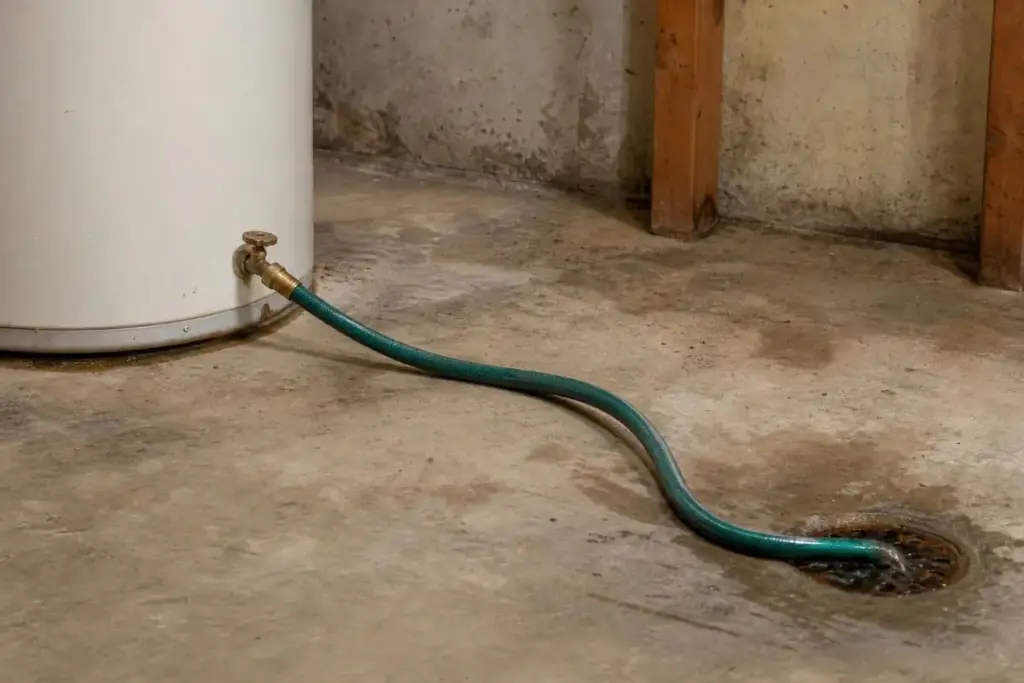
If your water heater won’t drain, let air in first: open a hot faucet or lift the T&P lever. Next make sure the hose runs downhill, then back-flush the valve with a garden hose. If grit still blocks it, replace the drain valve with a 3/4 inch brass or full port ball valve.
Shut off the heat before any check. Rheem’s gas manual (form AP23059, 30 to 60 gallon FVIR models) says to shut off gas at the gas control or manual shutoff before draining, and Bradford White’s power vent manual (form 238-51011-00G) makes gas off and electric power off steps 1 and 2.
Then let the tank cool. The scald table in that Bradford White installation and operation manual gives less than 5 seconds for a scald at 140°F, about 30 seconds at 130°F and more than 5 minutes at 120°F. A valve that suddenly unclogs releases that water at once, so aim the hose at a floor drain first.
Which of six causes is stopping your water heater from draining?
Match the symptom at the hose to one row; rows 1 to 5 cost nothing but a hose adapter, and row 6 needs a part.
| Cause | What you see | Confirming test | Fix and cost |
|---|---|---|---|
| 1. No air inlet (vacuum lock) | A gush for a few seconds, then nothing, with the valve fully open | Open a hot faucet: flow restarts at once | Leave one hot tap open, or lift the T&P lever as Rheem AP23059 directs. Free |
| 2. Hose kinked, or its end higher than the valve | Weak flow that stops while the tank is still part full | Pull the hose off: water runs from the bare valve | Straighten the hose and lay the end below the valve outlet. Free |
| 3. Bradford White ball valve not actually open | Stem turns endlessly, no flow | Read the stem slot: the manual says closed is perpendicular to the valve body | Turn the slot a quarter turn. Free |
| 4. Cold supply closed when you need pressure | Gravity flow is only a dribble of brown water | Crack the cold inlet open: flow jumps | Pressure-flush with the cold supply open. Free |
| 5. Sediment plug at the valve inlet | No flow at all, even with a hot tap open | Water comes out the T&P discharge pipe when the lever is lifted, but not the drain | Back-flush with a hose and a female-to-female hose adapter |
| 6. Plastic valve with a small bore, or a broken stem | Clogs again within minutes of each back-flush, or the handle spins on a cracked stem | Same symptom after 2 back-flushes | Replace with a 3/4 inch NPT brass valve or ball valve. Part numbers below |
Rows 1 and 5 look identical at the hose, so the 10 second hot faucet test comes first. The full step-by-step drain procedure covers hose routing, cooldown and refill.
How do you break the vacuum when a water heater drains and then stops?
Give the tank an air inlet above the water line, and the vacuum that stops the flow disappears. Rheem’s AP23059 manual says to turn off the cold water supply, then “open a hot water faucet or lift the handle on the relief valve to admit air to the tank.” Bradford White’s 238-51011-00G sequence puts “Open a hot water faucet to allow air to enter the system” as step 5, after the drain valve is open.
A faucet on the floor above is the safer inlet, because a lifted T&P lever can send hot water down the discharge pipe, which Rheem flags as a scald danger. If the lever will not reseat afterward, see testing and replacing the T&P valve covers the 3/4 inch valve swap.
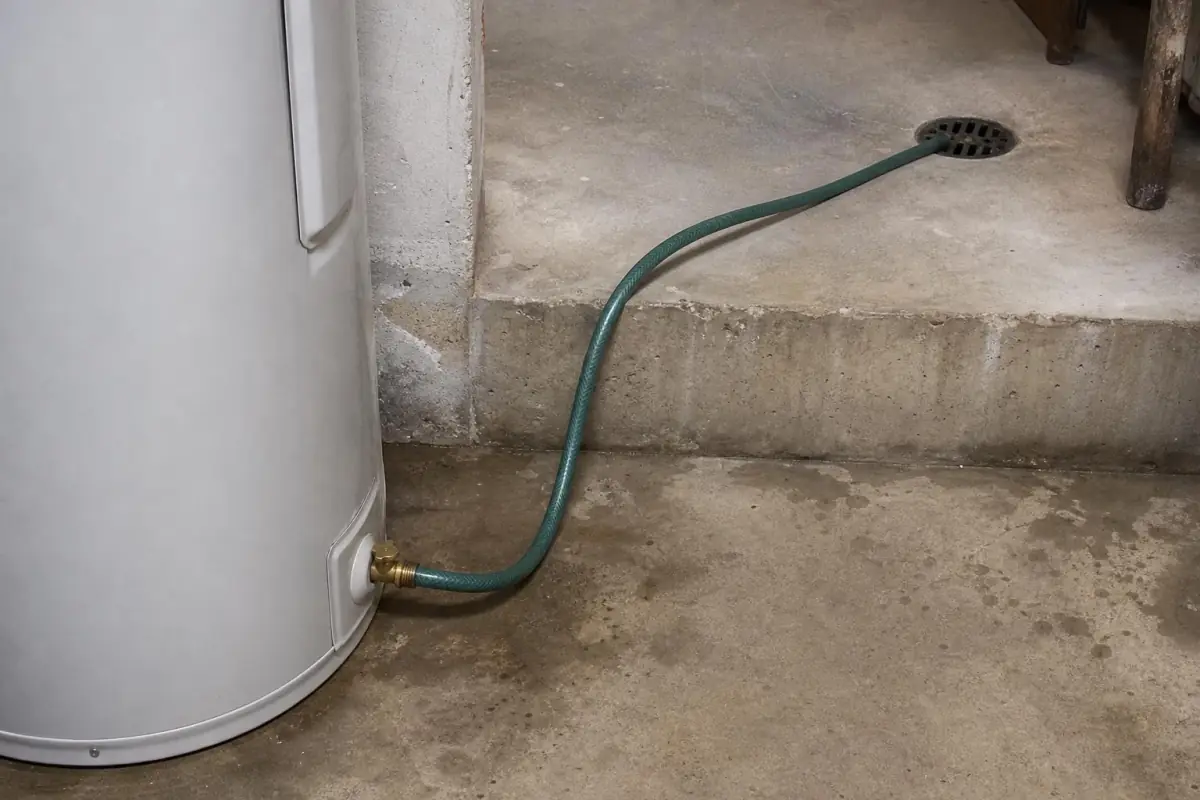
Why does hose height decide whether a water heater drains all the way?
Gravity drains the tank only down to the height of the hose end, so a hose that climbs 2 feet over a basement sill leaves the bottom 2 feet of water in the tank. Each foot of water column is worth 0.433 psi, the standard conversion for fresh water, and that is the entire driving pressure of a gravity drain.
Inputs below assume 4 feet of water above the valve in a full tank and 40 or 60 psi at the cold supply; a gauge on a hose bib gives your real figure.
| Push behind the water | Input | Pressure at the valve | Versus a full tank on gravity |
|---|---|---|---|
| Gravity, full tank | 4 ft × 0.433 psi/ft | 1.7 psi | 1 × |
| Gravity, half drained | 2 ft × 0.433 psi/ft | 0.9 psi | 0.5 × |
| Gravity, hose end raised 1 ft | (4 ft minus 1 ft) × 0.433 psi/ft | 1.3 psi | 0.75 × |
| Cold supply open, 40 psi house | 40 psi line pressure | about 40 psi | 23 × |
| Cold supply open, 60 psi house | 60 psi line pressure | about 60 psi | 35 × |
Line pressure pushes 23 to 35 times harder than a full tank’s gravity head, which is why cause 4 comes before any part swap. With the hose secured to a floor drain, open the drain valve, then the cold supply; A. O. Smith’s residential manuals describe flushing with system water pressure applied. The yearly flush routine uses the same line-pressure bursts to stir the tank floor.
How do you back-flush a clogged water heater drain valve?
Push water backward through the valve with a garden hose so line pressure lifts the plug off the valve inlet. Both the drain valve outlet and an outdoor hose bib carry male 3/4 inch garden hose threads, so the hose needs a female-to-female hose adapter on one end to join them.
- Shut off the gas or power, close the cold inlet on the heater and open one hot faucet so the tank can accept water.
- Connect the hose from a cold hose bib to the drain valve and open the drain valve fully.
- Turn the hose bib on in 2 or 3 short bursts; water entering the tank pushes grit up off the valve inlet and exits at the open hot faucet.
- Shut the hose bib, move the hose to drain position, route it below the valve and open the valve again.
Stop after 2 cycles; no flow after that means packed sediment or a broken valve. The page on what tank sediment is made of and how fast it builds explains why hard water areas reach this point sooner.
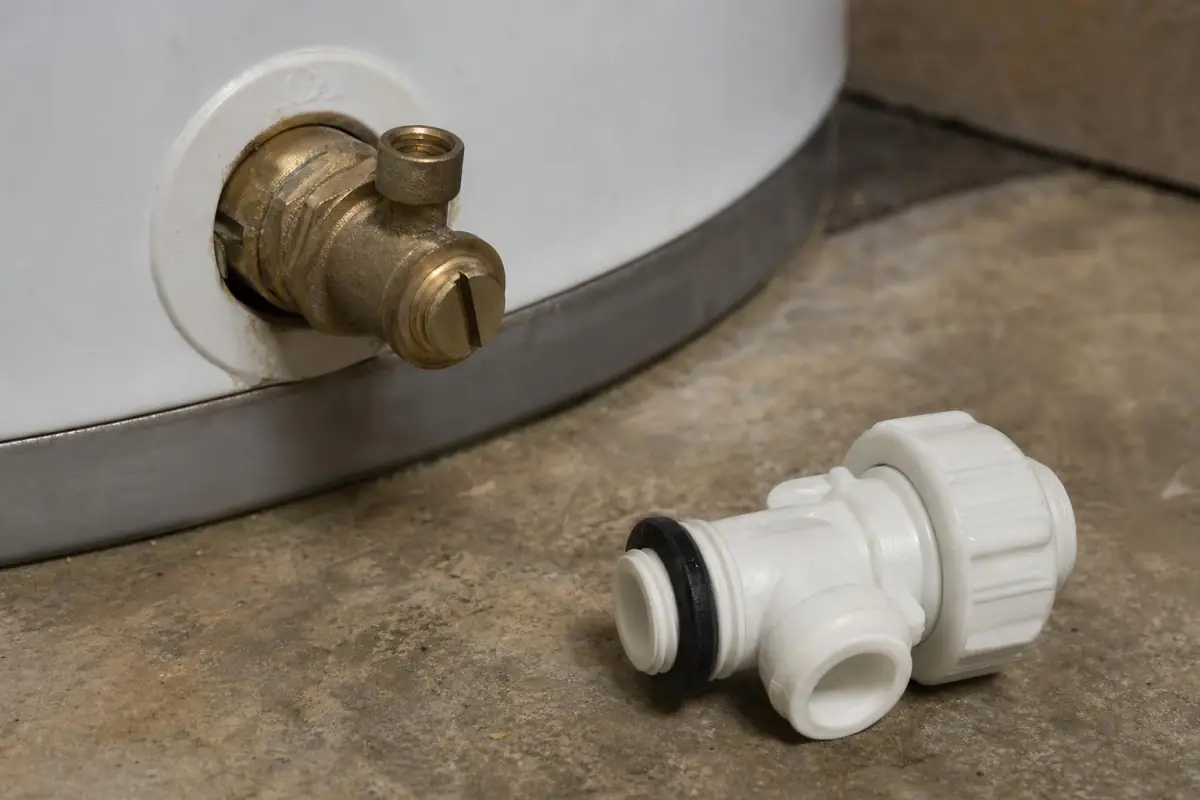
Which drain valve does your Rheem, A. O. Smith or Bradford White heater use?
The factory valve differs by brand and model, so read the rating plate before you order; the parts below are listed by distributors as the brand’s own replacement numbers.
| Brand | What the manual shows | Replacement part listed | Size and material |
|---|---|---|---|
| Rheem | AP23059 parts page shows a “Drain valve” marked “May differ as shown” for 30 to 60 gallon gas models | SP12159C plastic, sold as universal fit; SP12112G brass | SP12159C 3.75 inch long plastic; SP12112G 3/4 inch NPT brass |
| A. O. Smith | Drain valve at the tank base; drain steps call for the gas control OFF, cold inlet closed and a nearby hot faucet open | 100108605 nylon; 100109606 brass | 100108605 2-1/2 inch by 3/4 inch NPT nylon; 100109606 3/4 inch brass, 3 inch and 4-3/4 inch dimensions |
| Bradford White | 238-51011-00G says the drain is a ball valve whose stem “will spin indefinitely”; RG1PV literature lists a “Low Restrictive Brass Drain Valve” | 415-42351-02 (alternate number 265-42351-02) | 3/4 inch male thread, 2 inch shank, brass, 150 psi rating |
| Any brand, upgrade | Not a factory part on most tanks | 3/4 inch full port brass ball valve with a male hose thread adapter | Full bore passes more grit than a stem-type plastic valve |
Shank length matters as much as the 3/4 inch thread, because the valve must reach through the jacket and foam: measure the old valve against the 2 inch Bradford White shank or the 3 inch and 4-3/4 inch A. O. Smith dimensions before you buy.
Can you replace a water heater drain valve on a full tank?
Yes, but plan for the full tank behind it: a 40 gallon tank holds about 334 pounds of water and a 50 gallon tank about 417 pounds at 8.34 pounds per gallon. Closing the cold inlet and every hot tap keeps air out, which slows the outflow but does not stop it.
- Shut off gas or power, let the tank cool below 120°F, close the cold inlet and keep all hot taps and the T&P lever closed.
- Wrap the new valve’s threads with PTFE tape and have it within reach, along with a bucket and towels.
- Unscrew the old valve counterclockwise with a wrench on its hex, pull it, and thread in the new one immediately.
- Open the new valve with a hose attached and drain normally; the larger bore usually passes the sediment that blocked the old one.
A plastic valve that snaps off leaves its threads in the 3/4 inch tank fitting; that is a plumber’s job, so mention the broken shank when you book.
How long should a 40 or 50 gallon tank take to drain once flow returns?
At a steady 2 gallons per minute a 50 gallon tank empties in 25 minutes; none of the three manuals states a drain rate, so the flows are assumptions.
| Tank size | 1 gpm (assumed) | 2 gpm (assumed) | 4 gpm (assumed) |
|---|---|---|---|
| 40 gallons | 40 min | 20 min | 10 min |
| 50 gallons | 50 min | 25 min | 12.5 min |
Head falls from 1.7 psi at full to 0.9 psi at half, so the second half drains slower. A 50 gallon tank still running after 90 minutes, slower than 1 gpm, points to row 5 or 6.
When does sediment mean the tank needs replacing?
Sediment alone is a cleaning job in the manuals: Rheem’s troubleshooting chart pairs a rumbling noise with “scale and sediment in tank” and the remedy “clean tank,” and Bradford White lists “excessive sediment” as the first cause of its four-flash excessive tank temperature code on RG2PV models. Replacement becomes the answer when a new full port valve and two pressure flushes still bring out only grit, when the four-flash code returns after a flush, or when water weeps from the steel shell rather than a fitting.
Water heater drain questions
Why does my water heater drain for a minute and then stop?
A short burst followed by a dead hose is the vacuum signature. The water that leaves pulls a partial vacuum at the top of a sealed tank, and flow stops once nothing replaces it. Open one hot faucet or lift the T&P lever, as the Rheem manual AP23059 describes, and the flow should resume within seconds.
Can you drain a water heater through the T&P valve?
Use the T&P valve as an air inlet, not as the drain. Rheem tells owners to lift its handle to admit air while the bottom drain valve does the emptying. The valve sits near the top of the tank, so it cannot pass the water below it, and its discharge is hot enough to scald.
How often should I drain some water from the tank?
Bradford White tells owners of its RG2PV power vent models to drain off a gallon of water every month to remove silt and sediment. Rheem suggests a few quarts monthly in manual AP23059. Small monthly draws keep the valve inlet clear, which is the cheapest way to avoid a valve that will not drain later.
Is a brass drain valve better than a plastic one?
Brass resists cracking when a stuck stem is forced, and a full port ball valve gives sediment the widest path out. Plastic factory valves such as Rheem SP12159C work when the tank is flushed on schedule. If a plastic valve clogs twice, replace it with a 3/4 inch NPT brass valve or ball valve.
Does a tankless water heater drain the same way?
No. A tankless unit has no storage tank, so there is no 40 or 50 gallon gravity drain, no sediment bed on a tank floor and no vacuum lock to break. Scale inside a tankless heat exchanger is removed by a descaling flush through the service valves, following the model’s own manual.
How we sourced this
Drain steps, scald times, maintenance intervals and troubleshooting entries come from the Rheem residential gas FVIR Use & Care Manual (AP23059 Rev 01) and the Bradford White power vent Installation and Operation Manual (238-51011-00G, Rev 2/21), read in full. A. O. Smith’s drain sequence comes from its residential gas use and care manuals; its current residential manual PDF could not be downloaded for this review. Part numbers, sizes and ratings come from distributor listings for each brand’s replacement parts. The head pressures, ratios and drain times are our arithmetic, with the 4 foot water column, 40 and 60 psi supply and 1, 2 and 4 gpm flows stated as assumptions. No product was tested.