Reverse Osmosis Dripping From the Filter Housing? O-Rings, Overtightening and Cracked Housings
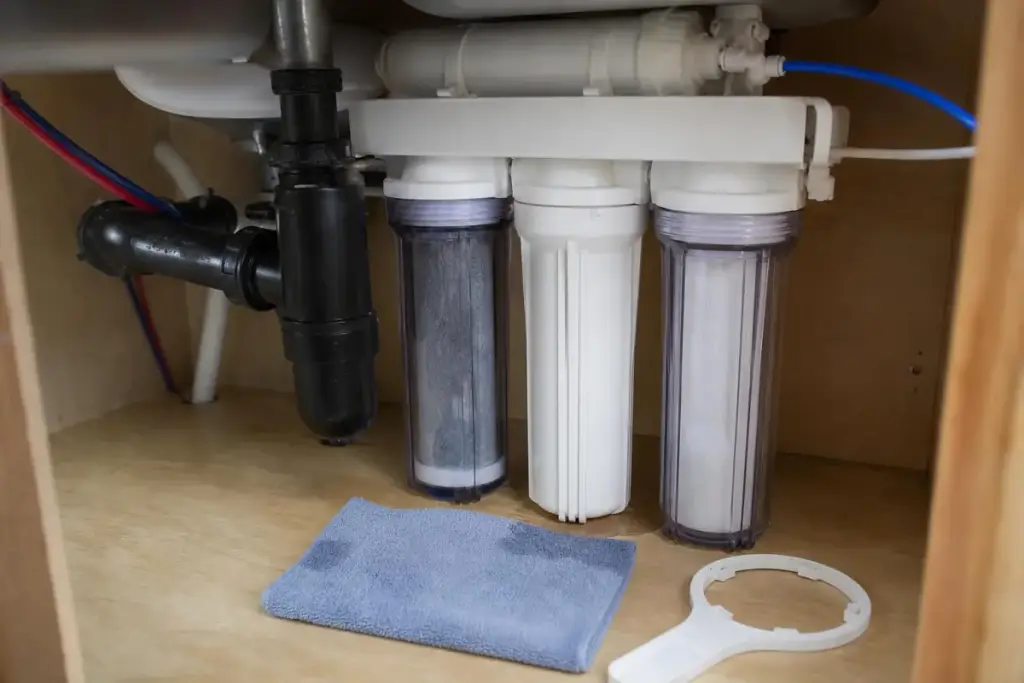
Reverse osmosis dripping from the filter housing almost always means the housing O-ring is twisted, dry, dirty or out of its groove, or the housing was cranked past the maker’s limit of hand tight plus a 1/4 to 1/2 turn with the wrench.
iSpring’s RO owner’s manual (Ver 02/2020) names 3 top leak causes: a tube not fully in its quick-connect, an O-ring out of place or kinked, and a housing not tightened properly or misaligned with its threads.
Why is my RO filter housing leaking right after a filter change?
A leak that starts right after a filter change points to something you disturbed: the O-ring, the sealing lip, the thread or a tube bumped while pulling the unit out. Stages 1 to 3 sit ahead of the membrane and its shut-off valve, so each pre-filter bowl holds house pressure 24 hours a day and a bad seal drips even when no one draws water.
| Where the drip appears | Likely cause | Fix | Part and price (Nov 2026) |
|---|---|---|---|
| Bead of water around the seam where the bowl meets the cap, all the way around | O-ring dry, flattened or reused after it stretched | Depressurize, replace the O-ring | APEC O-RING-SET, 3 rings for 10 inch Ultimate RO housings, $7.95 at apecwater.com; Express Water PRTHORING6, 6 pieces for standard 3.5 inch housings, $18.99 at Home Depot |
| Drip from one spot on the seam | O-ring twisted or rolled out of the groove, or a hair or sediment grain on the lip | Wipe groove and cap face, reseat flat | None; iSpring ORFX3 rings if nicked |
| Seam leak after you tightened hard | Overtightening flattened the ring or pushed it out of position | Reseat, hand tight plus 1/4 to 1/2 turn | Ring kit; housing if the lip is distorted |
| Housing turns more than it should, or the seam is uneven | Cross-threaded or undertightened | Unscrew, realign, rethread by hand | None unless threads are chewed |
| Wet line running down the side of the bowl below the seam | Hairline crack in the bowl | Replace the bowl | Express Water double O-ring housing PRTHSF10DB14 (parts list) |
| Water on top of the cap or running down from above | Tube not pushed past the fitting’s internal O-ring, or a failed elbow fitting | Push tube in fully or replace the elbow | Spare elbows ship in iSpring and Express Water kits |
The last row fools people: a quick-connect leak on the cap runs down the bowl and looks like a housing leak. iSpring says the tube must go a full 1/2 inch into the fitting, past its internal O-ring (its newer RCC7-series manual says 5/8 inch). Rule out the fitting before buying a housing.
How tight should an RO filter housing be?
iSpring says hand tight clockwise, then another 1/4 to 1/2 turn with the housing wrench, and warns that more causes leaks and a stuck bowl at the next change. The other makers phrase it differently.
| Maker and document | Tightening instruction | Lubricant on the O-ring | O-ring and housing replacement |
|---|---|---|---|
| iSpring RO manual, Ver 02/2020 and RCC7-series edition | Hand tight, then 1/4 to 1/2 turn with wrench AWR2 | “A light amount of food-grade silicone jelly may be used,” not required | Membrane housing O-ring every 3 years |
| APEC Essence RO manual, Ver 3.0 | Hand tight, then the filter housing wrench for “an additional quarter inch turn” | Troubleshooting step says to apply some lubricant around the O-ring | Housing O-ring every year or with each pre-filter change; stage 1 to 3 housings every 5 years |
| Express Water RO installation manual | Finish with the filter wrench, “DO NOT OVER TIGHTEN” | Food-grade lubricant comes pre-applied; the manual says not to wipe it off | Replace housing O-rings at least every 1 year; replace housings with proper parts as needed |
APEC’s filter-change steps on page 18 say to “fully tighten” each housing with the wrench, while its leak section on page 32 says hand tight plus a quarter turn; on a housing that already leaks, use the quarter turn. APEC opens bowls turning clockwise as seen from above and allows tapping the wrench handle with a hammer if one is stuck.
How do I reseat or replace the O-ring without making the leak worse?
Shut the water and bleed the pressure first, in 3 steps from both APEC and iSpring: cold feed to the RO off, tank valve off, then open the RO faucet briefly to relieve pressure, with a towel underneath.
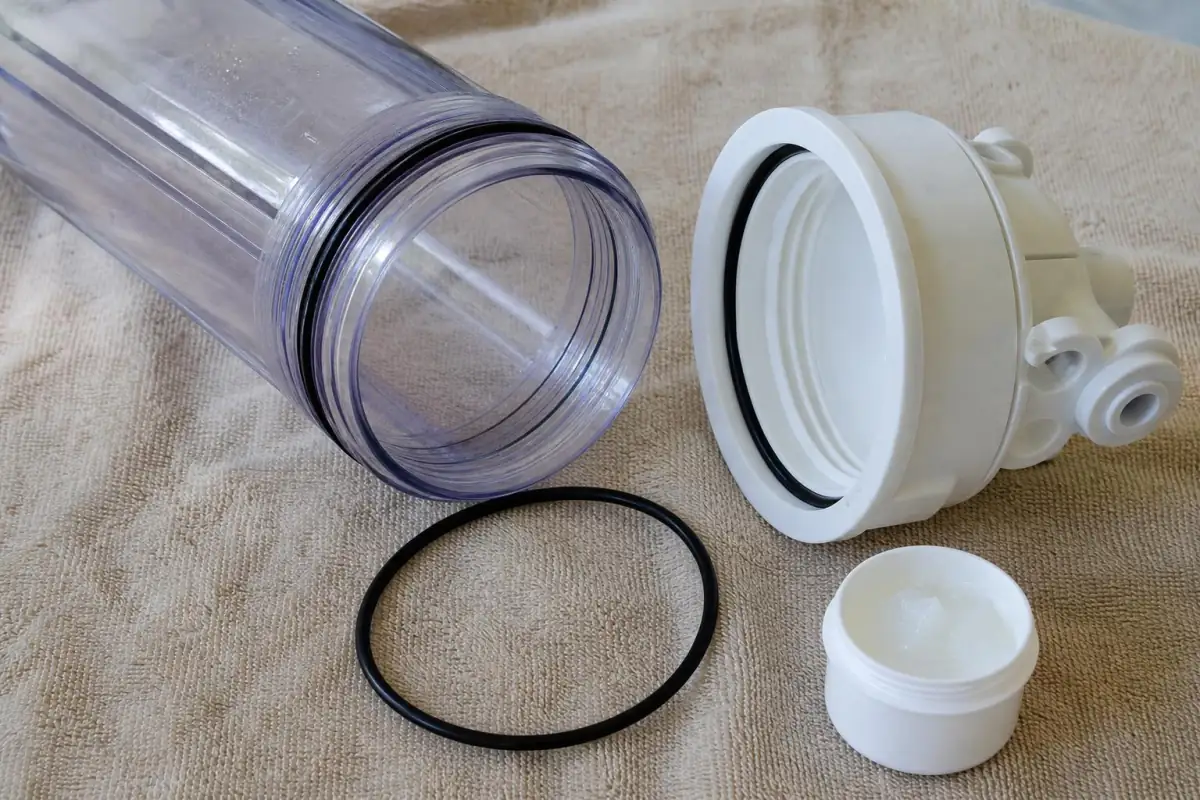
- Unscrew the leaking bowl with the housing wrench and lift the O-ring out with a fingertip.
- Express Water’s troubleshooting chart says to replace a ring with a twist, nicks or scratches.
- Wipe the groove and the sealing face inside the cap; APEC washes bowls with mild soap at each change.
- Lube only as your maker allows (see the table above); APEC sells a 6 gram food-grade O-ring lubricant.
- Press the ring flat into the groove all the way around, hand-thread the bowl, then no more than 1/2 turn with the wrench.
- Open the feed slowly, then the tank valve, and watch the seam for 10 minutes.
Buy rings by the housing, not the brand on the faucet. APEC’s O-RING-SET listing says it fits 10 inch Ultimate RO housings, iSpring’s whole-house O-ring page sends RO owners to the ORFX3 set for pre-filter bowls, and Express Water housings carry two O-rings each, one at the top and one in a lower groove, so a single-ring kit will not rebuild them.
How do I find which part is dripping with the dry paper test?
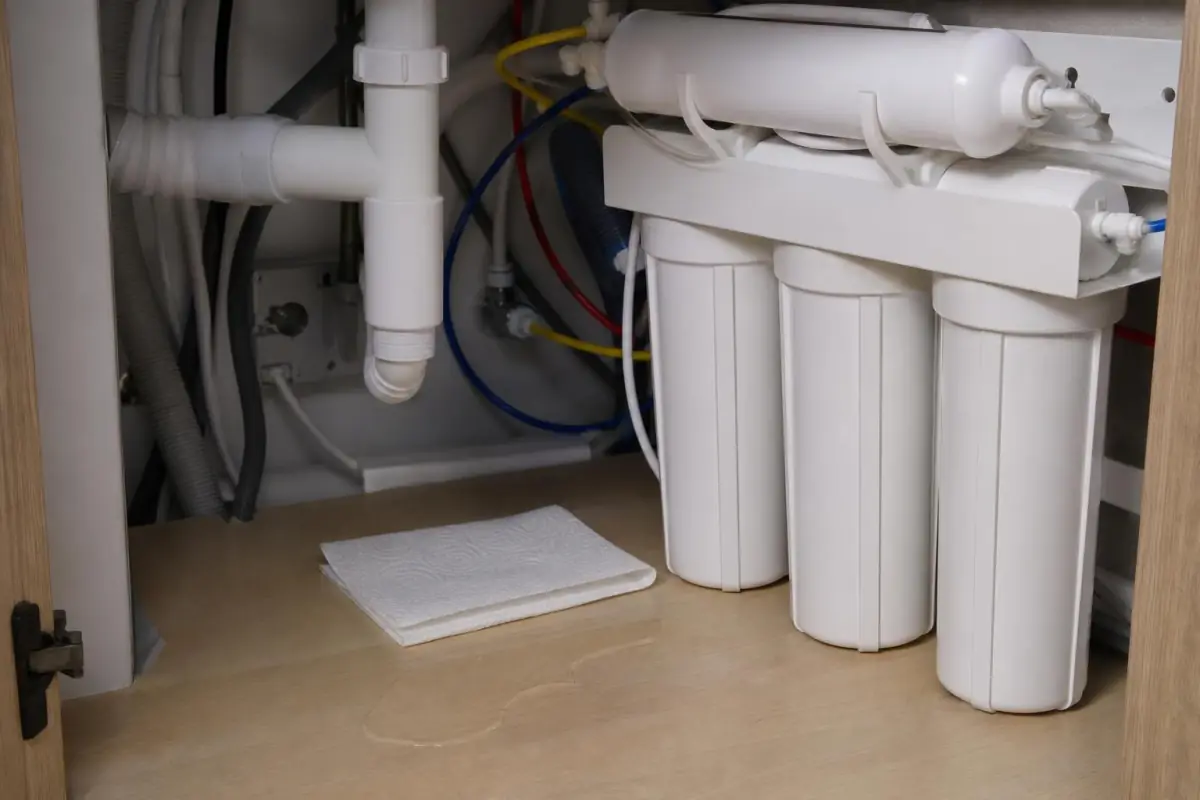
Dry every surface, wrap each suspect joint in its own strip of paper towel, restore pressure and check after 15 minutes; the strip that wets first marks the source, since water runs along tubing before it drops.
- Wrap a strip around the seam of each of the three pre-filter bowls, just below the cap skirt.
- Wrap a second strip around the middle of each bowl. If this strip wets while the seam strip stays dry, the bowl is cracked.
- Wrap each push-in fitting on the caps and on the membrane housing. A wet strip here means a tube or elbow, not a housing.
- Check the tank valve stem last; iSpring wants 8 to 10 wraps of tape there, APEC 6 to 8.
If the source turns out to be the membrane housing rather than a pre-filter bowl, iSpring says its O-ring must sit at the end of the housing before the threads begin, with no tension on it. To see where each housing sits in the flow path, read how the five stages of a reverse osmosis system are plumbed.
How much water does a dripping RO housing waste?
A housing dripping once every 10 seconds puts about 0.57 gallon, or 2.2 liters, on the cabinet floor every day. The inputs are the USGS drip calculator figures of 1/4 milliliter per drip and 15,140 drips per gallon, applied to 86,400 seconds in a day.
| Drip rate | Drips per day | Water per day | Water per 30 days | Time to pool 1 cup (237 mL) | Cabinet decision |
|---|---|---|---|---|---|
| 1 every 10 seconds | 8,640 | 2,160 mL (0.57 gal) | 17.1 gal | 2.6 hours | Shut the feed valve now; about 3 cups pool in an 8 hour night |
| 1 every 30 seconds | 2,880 | 720 mL (0.19 gal) | 5.7 gal | 7.9 hours | Fix the same day; set a tray under the unit |
| 1 every 60 seconds | 1,440 | 360 mL (0.10 gal) | 2.9 gal | 15.8 hours | Still a daily puddle; repair before you leave for a weekend |
Count drips for 60 seconds, then read the nearest row. The bill is not the reason to act: 2.2 liters a day goes into a closed sink base that nobody opens until the next filter change, 6 months away on iSpring’s schedule. The same cabinet often holds a standard 10 inch under-sink water filter, and its bowl uses the same thread-and-O-ring seal, so check it while the doors are open.
When is the housing itself cracked, and when should it be replaced?
A housing is cracked when the mid-bowl paper strip gets wet or a fresh, correctly seated O-ring still leaks; at that point APEC’s 4-step leak procedure ends with “contact APEC technician for replacement assistance.” Three things push bowls toward cracking.
- Feed pressure above the maker’s limit. APEC’s Essence manual sets 85 psi maximum, Express Water’s manual says incoming pressure should not exceed 80 psi and asks for a regulator above that, and iSpring’s manuals give 70 psi maximum with its APR70 regulator above it. A pressure gauge threaded onto an outdoor hose bib gives the reading.
- Weight on the threads. iSpring recommends supports under each of the bottom three housings on a wall-hung unit, so the water weight comes off the housing threads and thread strength does not decay over the years.
- Age. APEC recommends replacing the plastic stage 1 to 3 housings every 5 years, and Express Water’s annual maintenance list includes replacing connectors and housings with proper replacement parts.
NSF/ANSI 58 certification includes structural integrity tests (hydrostatic, burst and cycle, per the ANSI preview), but on new parts, not a bowl overtightened for 6 years.
Express Water’s Leak Stop Valve PRTLKS14Q sits on the cabinet floor and shuts the feed when its textile pad gets wet (pads are single use); iSpring’s ALS1 Leak Stopper cuts the supply when its sponge absorbs water. If the system will not refill after a repair, the detector may have tripped or a valve may still be closed, which is the first check for an RO tank that fills slowly or not at all. iSpring says air bubbles after a filter change clear on their own within weeks; a gurgling or sputtering RO faucet that lasts longer has other causes.
How we sourced this
We read the APEC Essence RO owner’s manual (Ver 3.0), two iSpring booster-pump RO manuals (Ver 02/2020 and the current RCC7-series edition), the Express Water RO installation manual with its parts list, the USGS Water Science School drip calculator and the ANSI preview of NSF/ANSI 58. Prices were taken from apecwater.com and a Home Depot listing in November 2026. The drip table is our arithmetic on the USGS factors. We left out an ORFX3 price and housing prices because no maker page we could open listed them, and torque values because no maker publishes one.
Frequently asked questions
Can I use plumber’s tape on an RO filter housing thread?
No. None of the APEC, iSpring or Express Water manuals call for tape on the housing thread, because the O-ring makes the seal, not the thread. Express Water calls for 8 to 11 wraps only on threaded fittings, and iSpring wants 8 to 10 wraps on the tank valve stem.
Why does my RO housing drip only some of the time?
Stages 1 to 3 hold line pressure all the time, so an on and off drip follows house pressure, not water use. Read feed pressure at a hose bib morning and night. APEC caps feed at 85 psi, Express Water at 80 and iSpring at 70, and a reading over the cap calls for a regulator.
Do I need to flush the system after fixing a housing leak?
Only if you installed new cartridges. iSpring flushes stages 1 to 3 into a bucket with the membrane tube disconnected until the water runs clear, and Express Water says to check for new leaks during the first 24 hours after restarting the system.
Will a leak detector stop a dripping housing?
It limits the damage, it does not fix the seal. The Express Water PRTLKS14Q and iSpring ALS1 both shut the feed when a pad or sponge under the unit gets wet, so the drip stops once water reaches the pad. The O-ring or housing still needs repair afterward.