Under Sink Water Filter: Types, Certifications, Costs
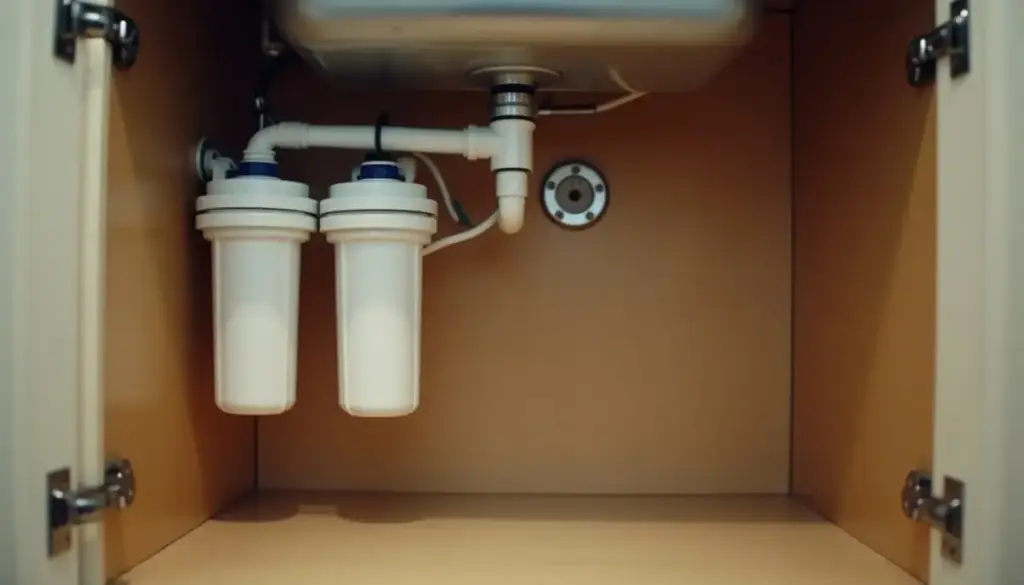
An under sink water filter is only as good as the certification on its exact model: NSF/ANSI 42 for chlorine taste, 53 for lead and PFOA/PFOS, 58 for reverse osmosis, and EPA’s lead bar is 5 ppb.
Key Takeaways
- EPA’s June 2024 consumer tool wants lead filters certified to NSF/ANSI 53 for lead plus NSF/ANSI 42 Class I particulate, cutting lead to 5 ppb or less.
- Per ANSI, NSF/ANSI 53 spans more than 50 health claims and 401 covers up to 15 emerging compounds. A 42-only filter is a taste filter.
- NSF/ANSI 58 certifies reverse osmosis and requires at least a 75% cut in total dissolved solids, per NSF.
- Aquasana sells four Claryum under-sink systems at $124.99 to $224.99 on sale (list $249.99 to $449.99), each claiming up to 99.99% reduction of 78 contaminants.
- The Claryum 3-Stage Max Flow (AQ-6300M-BN) filter is rated at 800 gallons, about 13 months at 2 gallons a day by our arithmetic.
- Waterdrop’s WD-10UA is rated at 0.75 gpm and 11,000 gallons over 12 months but is certified only to NSF/ANSI 42 and 372, so it makes no lead claim. 3M says its AP Easy Complete carries 42, 53 and 401.
- Angi’s 2026 data puts under-sink reverse osmosis at $150 to $1,300 installed plus $100 to $300 a year in upkeep.
What types of under sink water filter can you buy?
You can buy five types of under sink water filter: a single canister that feeds your existing faucet, a two-stage carbon system with its own spout, a three-stage system that adds a sediment pre-filter, a reverse osmosis unit with a membrane and storage tank, and a small inline cartridge that feeds a refrigerator or ice maker line.
The first three are carbon systems, and carbon block cartridges carry the health claims such as lead and PFOA/PFOS. Aquasana’s product listing shows one carbon platform sold three ways: Direct Connect (AQ-MF-1), 2-Stage (AQ-6200-BN) and 3-Stage (AQ-6300-BN).
Reverse osmosis is a different machine: a membrane sends rejected solids to a drain, and a tank stores the slow output. Inline fridge-style cartridges usually just fix chlorine taste on a 1/4 inch refrigerator line, where GE’s installation instructions call for 20 to 120 psi.
| Type (example) | What it targets | Cert to look for | Flow or output | Price (source) |
|---|---|---|---|---|
| Single canister on existing faucet (Claryum Direct Connect AQ-MF-1) | Chlorine taste; lead and PFOA/PFOS if certified | NSF/ANSI 42, plus 53 | Every cold draw at the main faucet | $124.99 sale, $249.99 list (Aquasana) |
| Single canister on existing faucet (Waterdrop WD-10UA) | Chlorine, odor, sediment; no lead claim | NSF/ANSI 42 and 372 (Waterdrop) | 0.75 gpm; 11,000 gal or 12 months; 10 to 125 psi feed | $58.99 list; cartridges $30.99 (Waterdrop, October 2026) |
| Dedicated faucet carbon (3M Aqua-Pure AP Easy Complete) | Health claims tested under 53 and 401 | NSF/ANSI 42, 53 and 401 (3M) | About 0.75 gpm; 750 gal | Cartridge at least every 6 months (3M) |
| Two-stage carbon, own spout (Claryum 2-Stage AQ-6200-BN) | Chlorine, PFAS, lead, microplastics, per Aquasana | NSF/ANSI 42 and 53; 401 for trace drugs and pesticides | Line pressure at a separate spout | $124.99 sale, $249.99 list (Aquasana) |
| Three-stage with sediment pre-filter (Claryum AQ-6300-BN; Max Flow AQ-6300M-BN) | Same carbon claims plus a sediment stage | NSF/ANSI 42 and 53 | Max Flow sold as 44% faster, 800 gallon filter | $174.99 and $224.99 sale (Aquasana) |
| Reverse osmosis, tank-fed | Dissolved solids, lead, arsenic, nitrate, PFAS | NSF/ANSI 58 | 10 to 75 gallons a day at 40 to 100 psi (Waterdrop) | $150 to $1,300 installed; $100 to $300 a year (Angi 2026) |
| Inline fridge-style cartridge | Chlorine taste at the ice maker | NSF/ANSI 42 | 1/4 inch line at 20 to 120 psi (GE) | Cartridge only, on the appliance schedule |
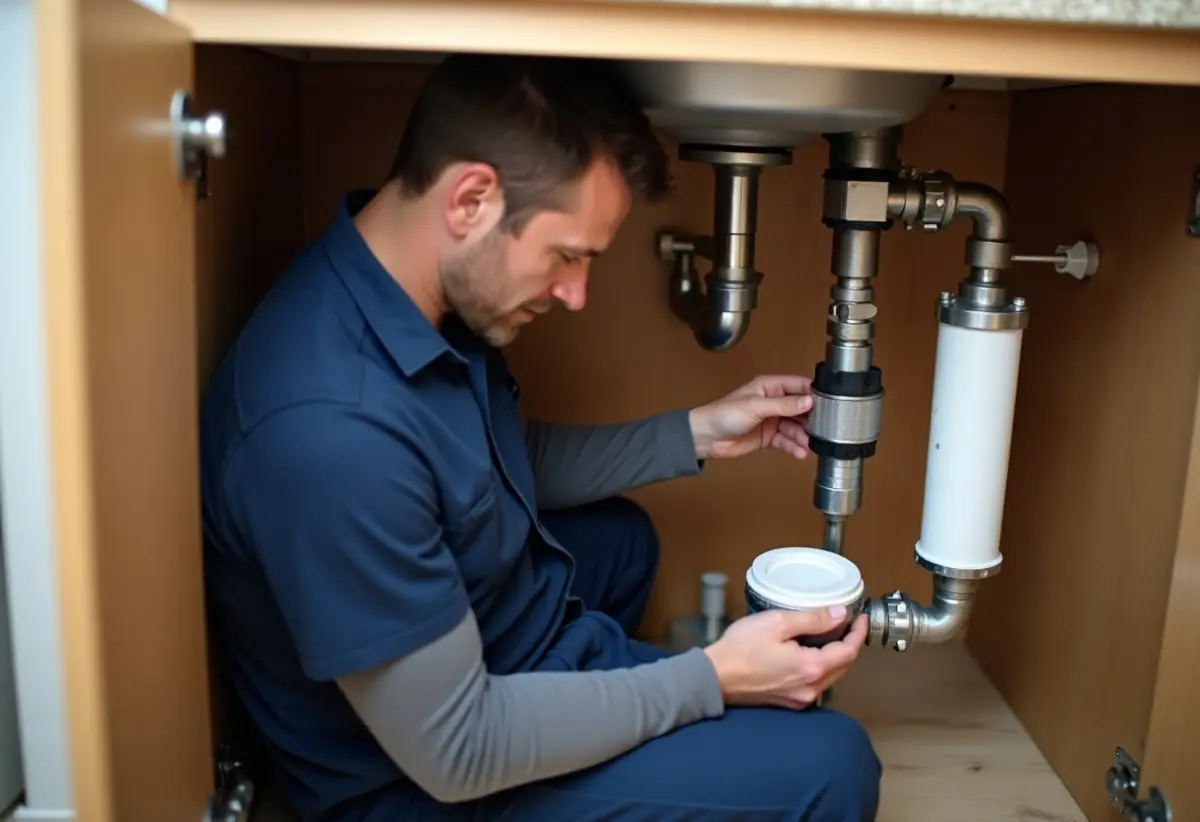
What do NSF/ANSI 42, 53, 401, 58 and P473 mean on the box?
Each number is a separate test. NSF/ANSI 42 covers aesthetic claims such as chlorine taste and odor, 53 covers health claims such as lead, VOCs and cysts, 401 covers trace emerging compounds, and 58 covers reverse osmosis systems. A filter listed only to 42 is a taste filter, not a health filter, whatever the marketing says.
The ANSI summary of the NSF/ANSI standards says 53 spans more than 50 health claims, including lead, Cryptosporidium, VOCs and chromium, and 401 covers up to 15 emerging compounds such as some pharmaceuticals and pesticides.
P473 is the older NSF protocol name for PFOA and PFOS claims. EPA now points buyers to a PFOA/PFOS claim under NSF/ANSI 53 or 58. Chloramine is its own claim: NSF tests it under 42 at about 3 mg/L, and a chlorine result proves nothing about chloramine, per NSF’s Rob Herman in WC&P.
How do you verify an under sink water filter’s certification?
Verify an under sink water filter by searching its exact model number in the certifier’s online listing, not by reading the box. EPA’s lead guidance requires evaluation by an accredited third-party certification body. The listing shows which standard, which contaminants and which replacement cartridge were tested, and all three must match what you bought.
“Tested to NSF standards” is not “certified.” The EPA consumer tool for lead filters counts only products an accredited certifier evaluated against NSF/ANSI 53 and 42.
- Copy the model number from the filter head and the cartridge. Aquasana’s AQ-6300-BN and AQ-6300M-BN are separate products.
- Search it in the NSF drinking water treatment unit listings or the Water Quality Association’s product search.
- Read each claim line. Lead, PFOA/PFOS, chloramine and VOCs are separate entries.
- Note the rated capacity in gallons and the rated flow. Past either, the claim no longer applies.
- Confirm the replacement cartridge is listed too. A look-alike cartridge carries none of the certification.
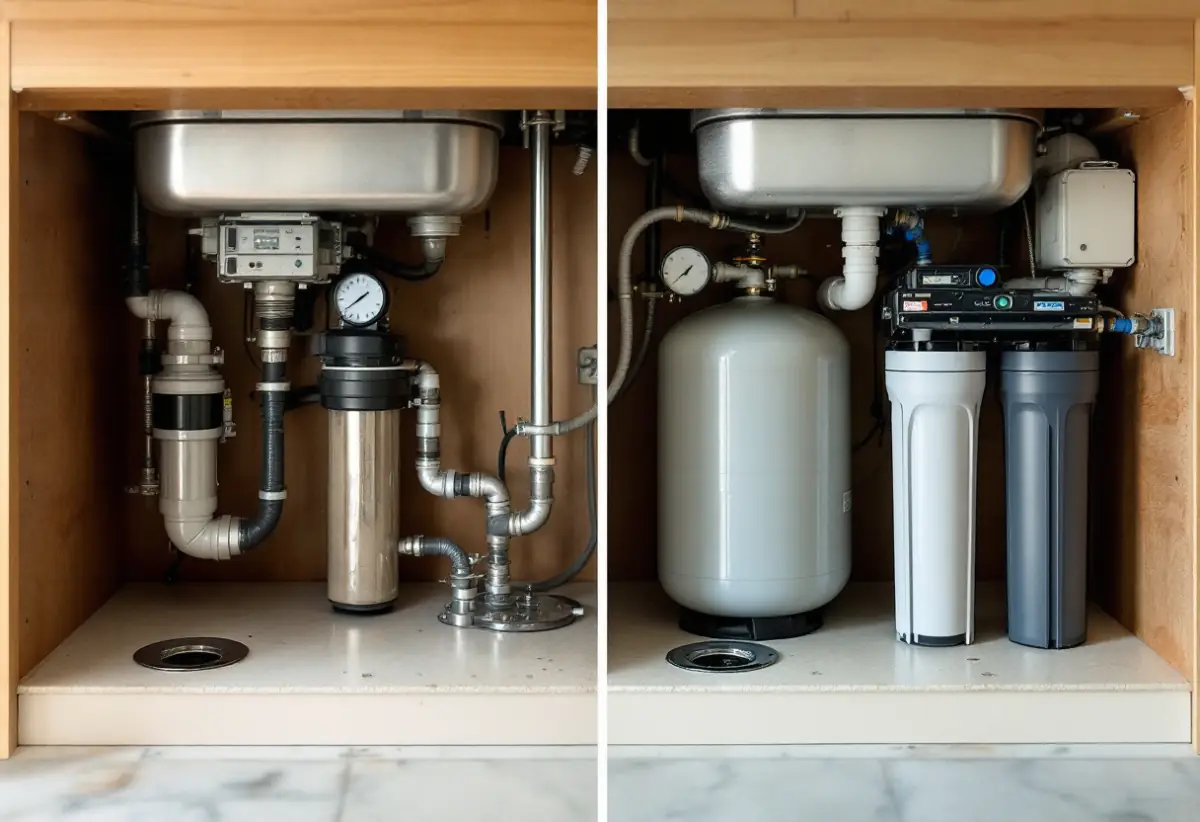
Is an under sink filter better than reverse osmosis?
An under sink carbon filter beats reverse osmosis when your problem is chlorine taste, chloramine or a certified lead or PFOA/PFOS claim, because it costs less, wastes no water and keeps the cabinet clear. Reverse osmosis wins when you need dissolved solids, nitrate, arsenic or fluoride out, which carbon cannot remove.
Angi’s 2026 data puts traditional reverse osmosis at 3 to 4 gallons to drain per filtered gallon, with efficient designs near 1 to 1, and Wirecutter reports the Cloud RO at 54% efficiency. Waterdrop says its RO filters operate at 40 to 100 psi and generate 10 to 75 gallons a day, which is why most need a storage tank.
Our reverse osmosis system guide covers membrane life, remineralization and the drain saddle.
Which under sink water filters publish verifiable specs?
Three makers published checkable numbers: Aquasana, Waterdrop and 3M. Rated capacity ranges from 750 gallons on 3M’s AP Easy Complete to 24,000 on Waterdrop’s WD-17UA, but the big numbers come with weaker certifications. Waterdrop lists NSF/ANSI 42 and 372 only, while 3M lists 42, 53 and 401, so compare capacity only between filters certified for the same claim.
NSF/ANSI 372 covers lead-free materials, not lead reduction. Waterdrop’s WD-10UA runs 0.75 gpm on a 10 to 125 psi feed and connects to the original faucet, and its 15UA and 17UA versions last 24 and 36 months. Aquasana’s four Claryum systems list at $449.99, $349.99, $249.99 and $249.99, sold at 50% off in October 2026. Aquasana lists lead reduction at pH 6.5 and 8.5 plus a PFOA/PFOS claim, and says every model needs a separate UV stage on well water because carbon does not disinfect.
Hydroviv says its existing-faucet unit installs in under 15 minutes. We left out Brita, Culligan, A.O. Smith and Filtrete specs we could not confirm on a maker page for this edition.
How do you install an under sink water filter?
You install an under sink water filter by teeing into the cold supply at the angle stop, mounting the filter head on the cabinet wall, running tubing to your existing faucet or a new drinking spout, then opening the stop slowly and flushing. A carbon system with a dedicated spout takes the 8 steps below. Reverse osmosis adds a drain saddle and a tank.
An existing-faucet unit like the Claryum Direct Connect needs no drilling, but dish rinsing uses up filter gallons. A dedicated spout needs a spare sink hole; InSinkErator, for comparison, specifies 1 3/8 inch for its dispenser spouts.
- Close the cold angle stop and open the faucet to drop pressure. Set a bucket under the stop.
- Disconnect the faucet’s cold supply from the stop. Most kitchen stops have a 3/8 inch compression outlet, the size kit tee adapters are made for.
- Thread the kit’s tee onto the stop, reconnect the faucet supply to one side and the filter tubing to the other. Tighten to your kit’s instructions, since overtightening distorts the ferrule.
- Screw the filter head to the cabinet wall with clearance below to drop the cartridge out.
- Mount the drinking spout, or skip this step on an existing-faucet unit.
- Cut tubing square and push it fully into each fitting.
- Open the stop slowly and watch every joint for drips for several minutes.
- Flush the cartridge for the time or volume the maker specifies before drinking.
Run only cold water through it. EPA tells households to use cold water for drinking, cooking and baby formula, and makers commonly rate under-sink units for cold only. Call a plumber when the stop will not close fully, the sink is stone that needs drilling, or an RO drain saddle must go on a drain you cannot reach.
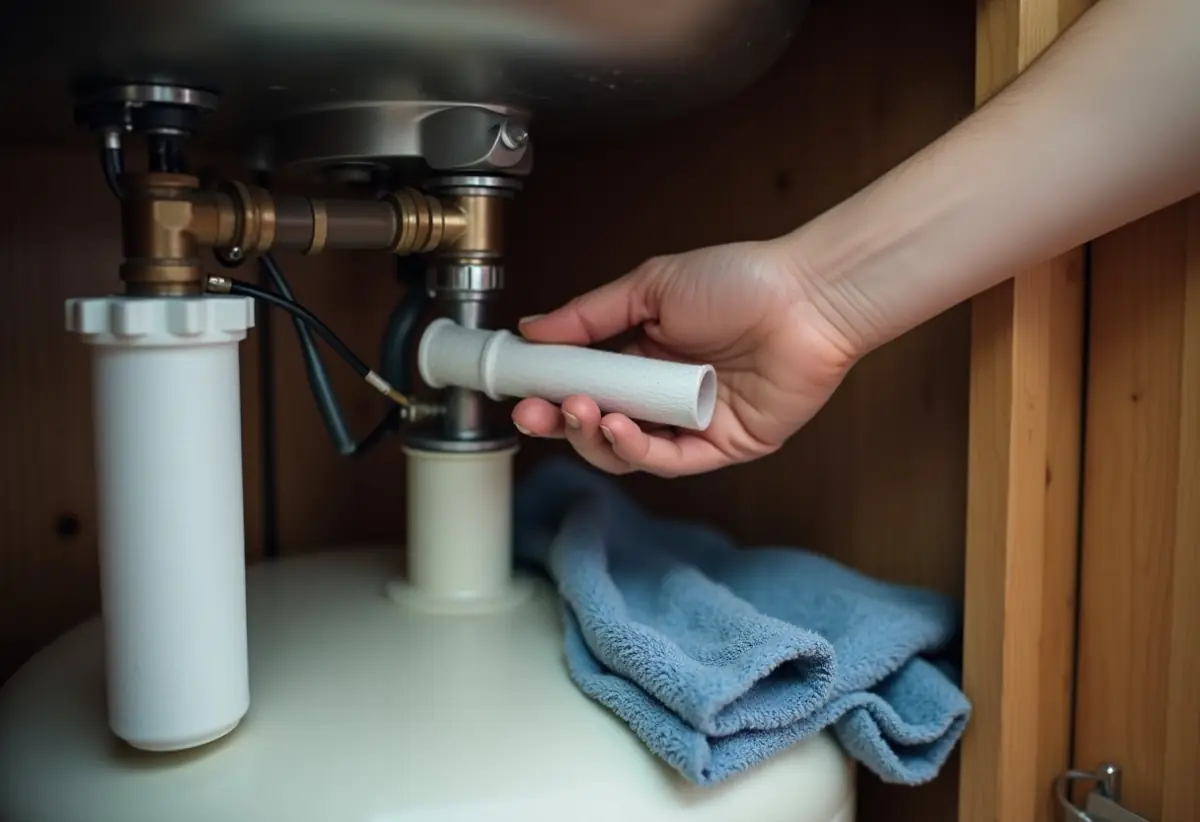
How often do you change the cartridge, and what does it cost a year?
Change an under sink water filter cartridge when it reaches its rated gallons or its rated months, whichever comes first. Aquasana rates the Claryum 3-Stage Max Flow cartridge at 800 gallons, InSinkErator tells owners of its filtered dispensers to change at least every 6 to 8 months, and reverse osmosis upkeep runs $100 to $300 a year, per Angi.
Waterdrop’s WD-10UA cartridge costs $30.99 for 12 months, so about $31 a year. 3M’s AP Easy Complete cartridge is rated for 750 gallons or 6 months, whichever comes first. At 2 gallons a day, 800 gallons lasts about 400 days, or 13 months. At 4 gallons a day it lasts 200 days, under 7 months. An existing-faucet unit also filters dish water, so it hits its limit sooner.
Lead and PFAS reduction can fail before flow at the spout drops. EPA’s PFAS home filter guidance warns an overdue filter can increase exposure and puts home filters at $20 to more than $1,000.
Do you need an under sink water filter for lead or PFAS?
You need an under sink water filter for lead or PFAS only if your water carries them, and only one certified for that contaminant will help. Start with your utility’s annual water quality report or a lab test, then buy to the result. For lead, EPA’s bar is NSF/ANSI 53 for lead plus NSF/ANSI 42 Class I particulate, reaching 5 ppb or less.
The USGS tap water study estimated in July 2023 that at least 45% of US tap water has one or more PFAS, and EPA set 4.0 ppt limits for PFOA and PFOS in April 2024. Our PFAS in drinking water explainer tracks that rule.
EPA names carbon, reverse osmosis and ion exchange for PFAS, but noted in April 2024 that certifications did not yet show removal down to 4.0 ppt. See our guide on whether tap water is safe to drink. For chlorine smell at every tap, a whole house water filter works at the main line.
How we sourced this
We consulted 22 sources and cite 15. Product figures come from Aquasana’s and Waterdrop’s product pages (checked October 2026), 3M’s AP Easy Complete page, Hydroviv, InSinkErator and GE documents. Standards come from ANSI, NSF and NSF’s Rob Herman in WC&P (2000). Guidance comes from EPA’s June 2024 lead filter tool, EPA’s April 2024 PFAS pages and USGS (July 2023). Costs come from Angi 2026 data and Wirecutter. Cartridge months are our arithmetic. We excluded affiliate rankings, retailer listings and any spec we could not confirm on a maker page.
Frequently asked questions
Do under-sink water filters actually work?
They work for the contaminants they are certified to reduce, and only within the cartridge’s rated gallons and months. A filter listed only to NSF/ANSI 42 improves chlorine taste but makes no health claim. For lead, EPA looks for NSF/ANSI 53 plus NSF/ANSI 42 Class I particulate reduction, cutting lead to 5 ppb or less.
What is the most effective under-sink water filter?
Reverse osmosis removes the widest range, including dissolved solids, nitrate, arsenic and PFAS, and NSF/ANSI 58 requires at least a 75% cut in dissolved solids. It costs $150 to $1,300 installed per Angi 2026 data and sends water to the drain. A certified carbon block is enough for chlorine, lead or PFOA and PFOS.
What is the best type of water filter for under the kitchen sink?
The one certified for what your water report or lab test found. Choose a carbon block certified to NSF/ANSI 42 and 53 for chlorine, lead or PFOA and PFOS. Choose reverse osmosis certified to NSF/ANSI 58 for nitrate, arsenic, fluoride or high dissolved solids. Add UV on a private well, as Aquasana advises.
What are the disadvantages of an under-sink water purifier?
It treats one tap, takes cabinet space and needs cartridges on schedule, since EPA warns an overdue filter can raise PFAS exposure. Existing-faucet units filter dish water too, so they use up rated gallons sooner. Traditional reverse osmosis also needs a tank and wastes about 3 to 4 gallons per filtered gallon, per Angi 2026 data.
Is an under sink filter better than reverse osmosis?
It is better for chlorine taste, chloramine and certified lead or PFOA and PFOS reduction, because it costs less, wastes no water and needs no drain connection. Reverse osmosis is better for dissolved solids, nitrate, arsenic and fluoride. Aquasana’s Claryum carbon systems sell for $124.99 to $224.99, while under-sink RO runs $150 to $1,300 installed.
How often should you change an under sink water filter?
At the rated gallons or rated months, whichever comes first. Aquasana rates its Claryum 3-Stage Max Flow at 800 gallons, about 13 months at 2 gallons a day and under 7 months at 4 gallons a day. InSinkErator tells owners of its filtered dispensers to change cartridges at least every 6 to 8 months.
Can you run hot water through an under sink water filter?
No, keep it on the cold line. Makers commonly rate under-sink units for cold water only, and hot water can damage the filter. EPA also tells households to use only cold water for drinking, cooking and baby formula, because hot water can carry more lead from pipes and fittings.