Why Is My Reverse Osmosis System Making Noise? Gurgling, Humming and Constant Drain Sounds
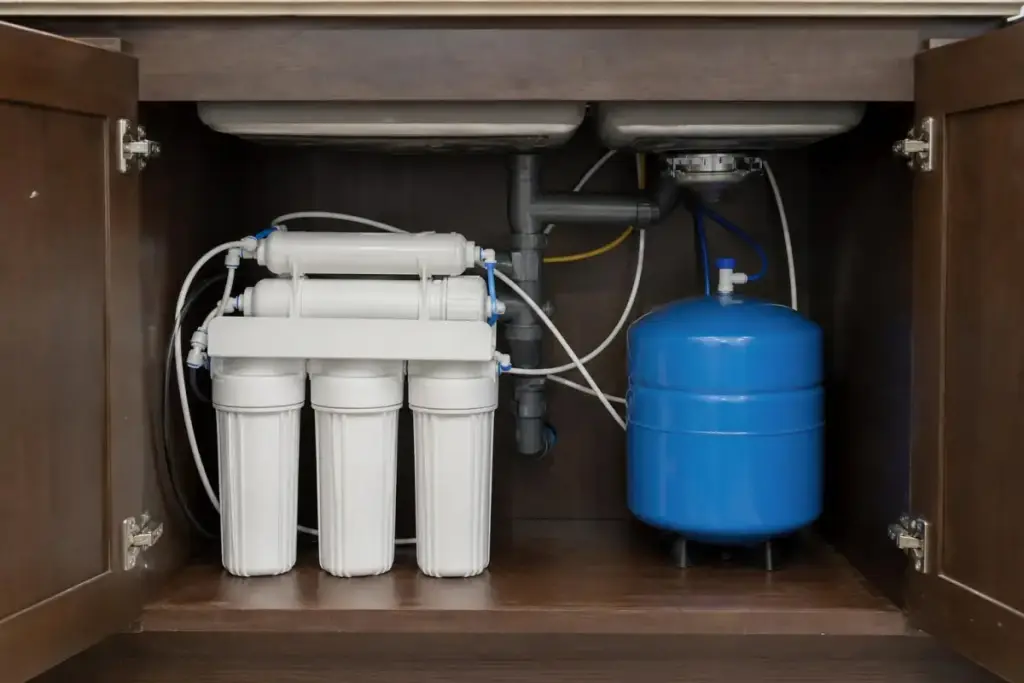
Your reverse osmosis filter is making noise for one of three reasons. A gurgle at the drain saddle while the tank refills is normal, water still running to the drain hours later means the shutoff valve, check valve or tank air has failed, and a hum is trapped air or a booster pump.
Close the blue ball valve on the tank a quarter turn to fake a full tank and listen at the drain. APEC’s Ultimate RO owner’s manual, Ver 3.1 (RO-QUICK90) says drain flow should stop within 10 minutes. If it keeps running, the shutoff has failed.
Which reverse osmosis sounds are normal, and which mean a part failed?
Five sounds cover nearly every complaint, and only two need a part. Causes come from the makers’ manuals; prices are list prices on each maker’s store, checked November 21, 2026.
| Sound | When you hear it | Cause | Test | Fix and part price (Nov 21, 2026) |
|---|---|---|---|---|
| Trickle or gurgle inside the sink drain pipe | 1 to 3 hours after you draw water (iSpring) | Normal: reject water dropping into the trap water | Sound stops once the tank is full | No part. Mount the saddle lower or on a horizontal pipe |
| Glug or gurgle from the air gap faucet or its 3/8 in. line | Same refill window | A dip in the gravity-fed 3/8 in. return line | Lift the low spot; the glug stops | No part. Shorten the line so it falls all the way |
| Steady hum or buzz from the RO head on a unit with no pump | After installation or a filter change | Air trapped in the check valve (APEC) | APEC purge, below | New check valve if it persists: APEC quick connect $10.99, iSpring ACV1K $17.99 |
| Motor hum that cycles on and off | Pumped units only, while the tank fills | Booster pump, normal: iSpring starts it below 20 psi tank pressure, stops it at 35 | Tank gauge reads 35 psi at stop | Runs 24/7: set tank air to 7 to 10 psi, then check the high pressure switch |
| Water running to the drain that never stops | Hours after anyone used the RO faucet | Feed under 30 psi, failed ASO, leaking check valve or flat tank | 10-minute tank valve test plus a bucket | ASO valve: APEC $8.99, iSpring AAS2 $13.99, Express Water $22.99, WECO ASV-14QWX $11.02 |
Judge by timing, not loudness. iSpring’s RO owner’s manual, Ver 02/2020 says a tank fills from empty in 1 to 3 hours with the drain trickling, and treats a drain running 4 or more hours as a fault. It rates its T32M tank at 3.2 gallons, the size used in the waste math below.
How do I run the reverse osmosis shutoff test, and what does each result mean?
The test takes 10 minutes and a bucket; APEC prints it as section 10 of its troubleshooting guide.
- Draw 3 to 4 glasses so the system starts refilling.
- Turn the tank ball valve 90 degrees clockwise to off, and shut any valve feeding an icemaker.
- Pull the black drain tube from the saddle into a bucket.
- Wait up to 10 minutes. Flow that stops means the shutoff works.
If flow continues, check line pressure before buying parts. APEC ties a drain that runs 6 to 7 hours then stops to feed under 40 psi, and one that never stops to feed under 30 psi, where it calls for a booster-pumped model. Express Water’s RO System Instruction Manual (2022) wants 45 to 80 psi and warns that tubing run more than 10 ft from the tank may not build enough back pressure to shut the system off.
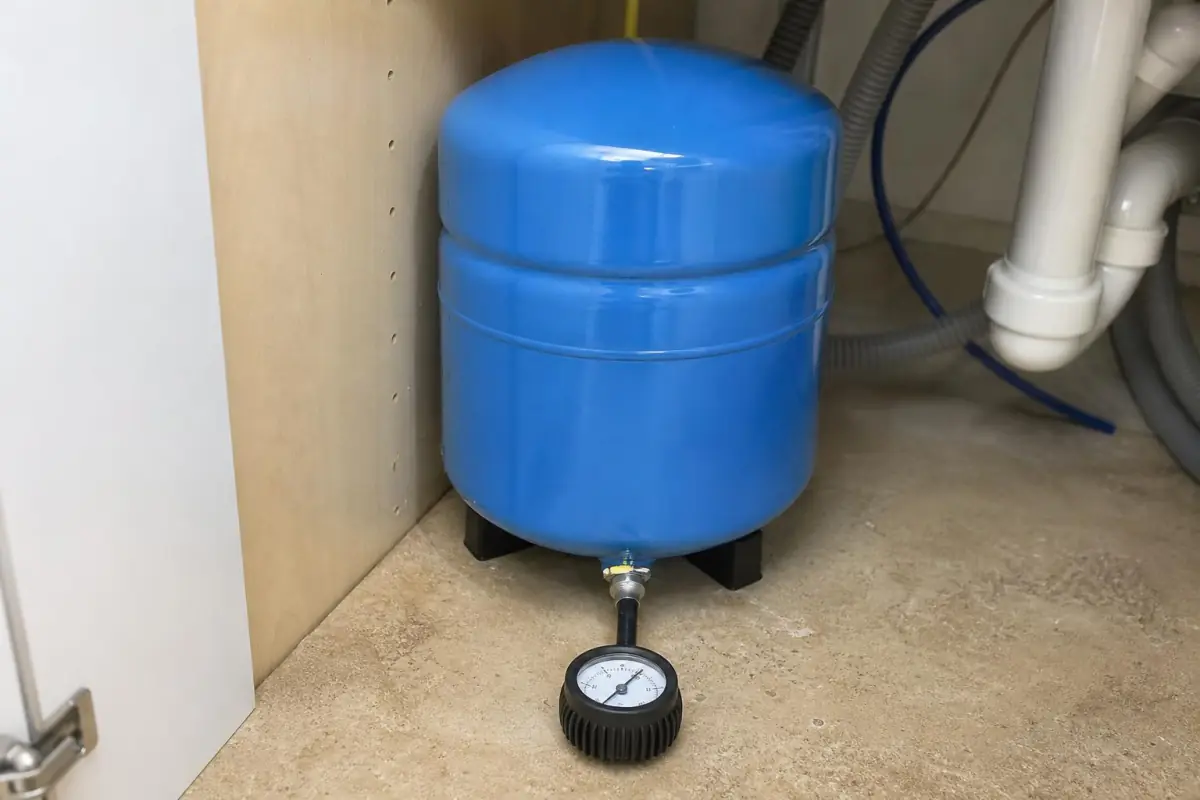
Next, test the tank. Shut the feed, empty the tank through the RO faucet and read the air valve with a tire gauge: APEC wants 5 to 7 psi, iSpring and Express Water 7 to 10 psi. Our guide to an RO tank that won’t fill lays out the gauge readings in order. A tank that won’t hold air has a failed bladder; iSpring lists the T32M at $48.99.
Only then replace valves. APEC puts the check valve at point E, on the membrane’s product port, where it stops tank water flowing back; Express Water’s part numbers are PRTFITCV1418Q for the check valve and PRTASV14Q for the ASO. A leaking check valve bleeds tank pressure back, so the ASO never sees enough pressure to close; replace both if the 10-minute test still fails after a new ASO.
How much water does a reverse osmosis system waste when the shutoff fails?
A failed shutoff sends 114 to 304 gallons a day down the drain, against 3.2 to 12.8 gallons for one normal refill. The restrictor fixes drain flow, so the math is its mL per minute rating x 1,440 minutes, divided by 3,785.41 mL per gallon.
| Scenario | Inputs | Drain water | Extra vs one normal refill at 1:4 |
|---|---|---|---|
| Refill a 3.2 gal tank at 1:1 | 3.2 gal pure x 1 | 3.2 gal | Baseline |
| Refill a 3.2 gal tank at 1:3 | 3.2 gal pure x 3 | 9.6 gal | Baseline |
| Refill a 3.2 gal tank at 1:4 | 3.2 gal pure x 4 | 12.8 gal | Baseline |
| Shutoff failed, 24 h, iSpring AFR300 | 300 mL/min x 1,440 min | 114.1 gal/day, 3,424 gal/30 days | 101.3 gal/day |
| Shutoff failed, 24 h, 420 mL/min restrictor | 420 mL/min x 1,440 min | 159.8 gal/day, 4,793 gal/30 days | 147.0 gal/day |
| Shutoff failed, 24 h, 800 mL/min restrictor | 800 mL/min x 1,440 min | 304.3 gal/day, 9,130 gal/30 days | 291.5 gal/day |
The ratings are real parts: iSpring sells the AFR300 (300 mL/min) and AFR420K (420 mL/min), and Pure Water Products’ restrictor chart pairs 800 mL/min with a 100 GPD membrane. Its rule of thumb, mL per minute x 0.38 = gallons per day, gives 114 for the AFR300. Ratios are pure to drain, as in our reverse osmosis waste water ratio figures; the extra column assumes one full tank drawn per day.
A constant drain sound wastes the water of 9 to 24 normal refills each day, so run the 10-minute test the evening you hear it.
Where should the drain saddle go so the reverse osmosis drain stops gurgling?
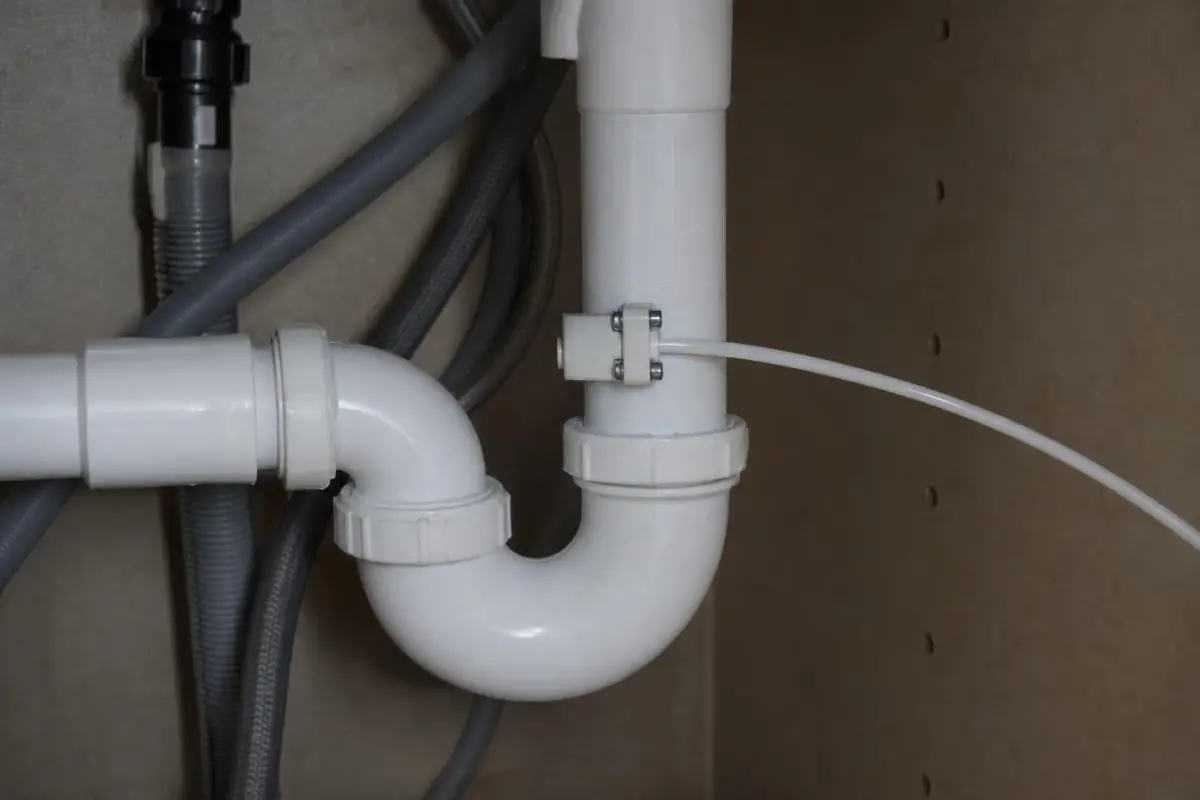
Put the saddle above the P-trap, low on the vertical tailpiece or on a horizontal run, and never downstream of a disposer. APEC says reject water is forced out under system pressure and that mounting the saddle as low as possible above the trap, or on the horizontal tailpiece, reduces drainage noise. iSpring recommends a horizontal pipe to minimize dripping sound, with a 1/4 in. hole.
Express Water’s saddle fits a 1-1/2 in. OD drain pipe on a straight section above the P-trap, and must not sit after the point where the drain meets a garbage disposal or dishwasher drain, because their debris clogs the drain line. On a double-bowl sink with a disposer, use the other bowl’s tailpiece, above where the bowls join.
An air gap faucet moves the noise rather than removing it. In APEC’s hookup, the 1/4 in. drain line runs up to the faucet’s red port and water falls back down a 3/8 in. black line to the saddle. That return leg drains by gravity, so a belly in it gurgles; cut it to slope down the whole way. Air gap rules vary with local code amendments, so ask your building department before removing one.
What makes a non-pump reverse osmosis system hum, and when is it the booster pump?
On a system with no pump, APEC says a hum is most likely air trapped in the check valve. Its purge: close the tank valve, tilt the RO to the right with something under the third housing, run the RO faucet about 1 minute, close it for 10 seconds, and repeat 3 to 4 times until flow stops sputtering, then reopen the tank valve. If the hum persists after a few days, APEC blames air in the source water or a check valve resonating with your pipes, and a new check valve fixes it.
A pumped system hums by design: iSpring’s pump raises feed to about 80 psi and stops at 35 psi tank pressure. APEC’s all-in-one tankless RO manual (v2) says a loud pump means low inlet pressure or flow, so check the feed adapter screen, and that noise during its 20-second flushes is normal. A yellow light with a 1-second beep every 4 seconds means the pump ran over 30 minutes, usually a faucet left open.
Do filter changes and membrane swaps make an RO system louder?
Yes: air enters with every change, and a mismatched restrictor raises drain flow. APEC sets pre-filter changes at 6 to 12 months and iSpring at 6 months; iSpring says the bubbles that cloud the water clear on their own in the weeks after.
Pure Water Products says the restrictor must match the membrane, listing 420 or 525 mL/min for 50 GPD and 525 or 800 for 75 GPD; Express Water stocks PRTFLO30014Q for 50 GPD and PRTFLO60014Q for 100 GPD. Swap the restrictor whenever you change membrane size. For how each stage fits together, see how a reverse osmosis system works; if hard water is clogging pre-filters early, compare a water softener vs a water filter upstream of the RO.
How we sourced this
We read APEC’s Ultimate RO owner’s manuals Ver 3.1 (RO-QUICK90) and Ver 4.0, APEC’s all-in-one tankless RO manual v2, iSpring’s RO owner’s manual Ver 02/2020, Express Water’s 2022 RO instruction manual, Pure Water Products’ flow restrictor chart and the WECO ASV-14QWX listing. Prices came from each maker’s store on November 21, 2026; the waste table is arithmetic from the restrictor ratings. Culligan’s owner’s guide could not be retrieved and no maker document we read describes tankless fan noise, so neither appears.
Reverse osmosis noise questions
Is it normal for a reverse osmosis system to make noise at night?
Yes, if someone drew water in the evening. The system refills the tank after use, and iSpring says filling from empty takes 1 to 3 hours with the drain trickling the whole time. A sound still running at 3 a.m. with no water drawn since dinner points to the shutoff, so run the 10-minute tank valve test.
Why does my RO air gap faucet gurgle?
Reject water rises to the faucet through a 1/4 inch line and falls back to the drain through a 3/8 inch line by gravity. A dip in that return line, or a drain saddle clogged with debris, backs water up in the faucet body and it gurgles. A steady downhill run to the saddle stops most of it.
Can a garbage disposal outlet stop an RO booster pump?
Yes. iSpring warns not to plug the booster pump into the same outlet as the garbage disposal, because that outlet usually has power only when the disposal switch is on. A pump that hums only while the disposal runs, then goes silent and leaves the tank empty, is wired to a switched outlet.
Will an RO system that never shuts off damage the membrane?
APEC says a system that keeps draining after the tank is full depletes the pre-filters and the membrane and may raise water bills. At a 300 mL per minute restrictor that is about 114 gallons a day, so fix the shutoff rather than living with the sound.