Septic Tank Not Breaking Down Solids? What Bacteria Can and Cannot Do
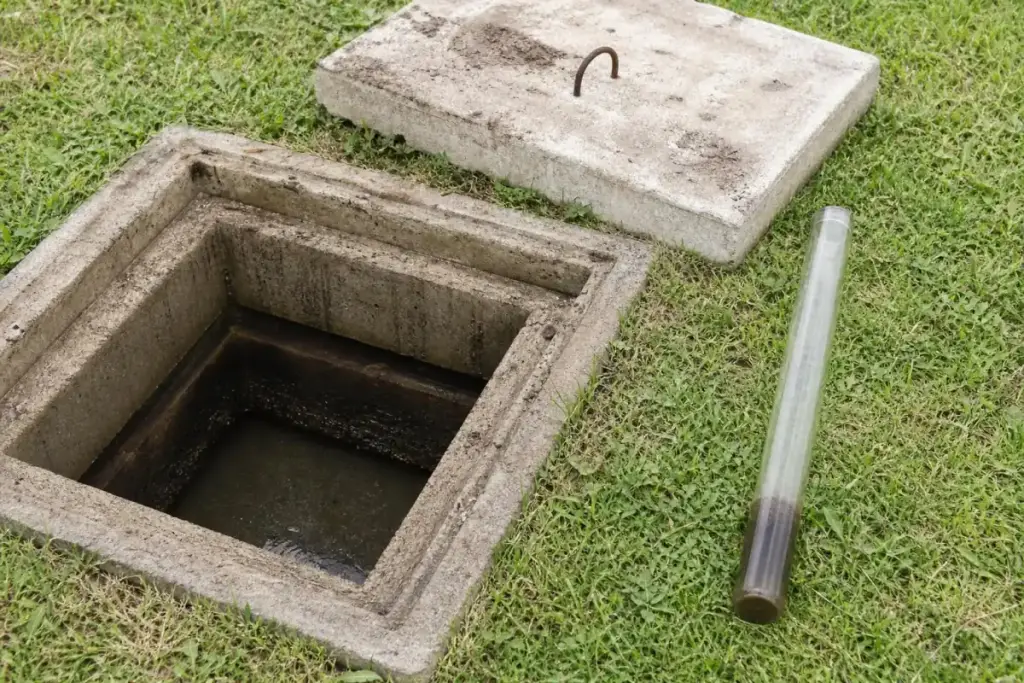
A septic tank not breaking down solids is usually doing its normal job: anaerobic bacteria digest up to about half of what settles, and the rest builds up as sludge and scum that only pumping removes. Pump when the two layers reach 25% of liquid depth, EPA’s trigger.
Why do solids pile up even when septic bacteria are working?
Solids pile up because a septic tank is a settling and storage box first and a digester second. Oregon State Extension publication EC 1343 says up to 50% of the solids retained in the tank decompose and the remainder accumulates, and Virginia Tech publication SPES-380 gives the same ceiling. Penn State Extension’s Septic Tank Pumping fact sheet is blunter: it calls the anaerobic decomposition “slow and largely ineffective” because the tank sits at the temperature of the surrounding soil.
The undigested share is not a malfunction. Penn State separates biodegradable solids such as feces from slowly biodegradable ones such as toilet paper, and notes that an effluent filter raises the volume stored in the tank. If you want the full path from house drain to soil, see how the tank, baffles and drainfield work together.
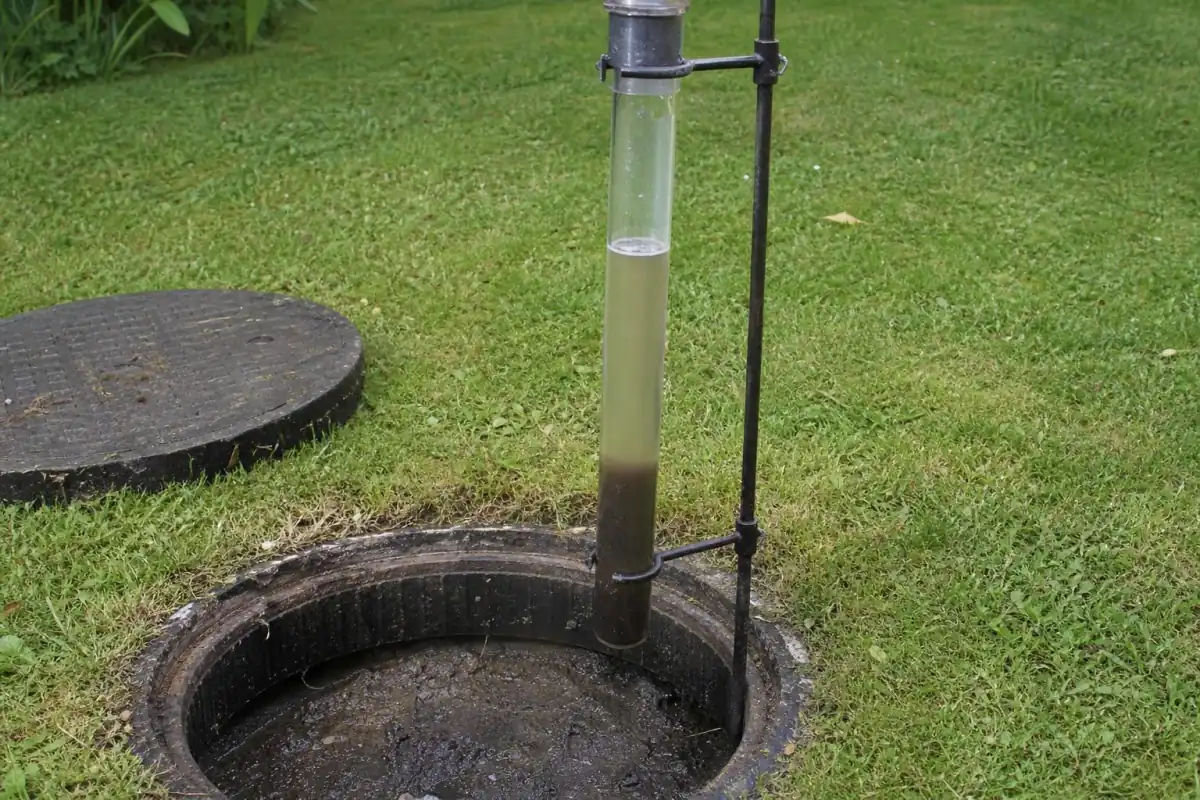
When is sludge plus scum depth a pump-now reading?
It is a pump-now reading once sludge plus scum take up 25% of the liquid depth, or once either layer closes the gap to the outlet. The EPA’s How to Care for Your Septic System page sets three triggers: scum bottom within 6 inches of the outlet bottom, sludge top within 12 inches of the outlet, or more than 25 percent of liquid depth in sludge and scum. Minnesota Rule 7080.2450, subpart 3 writes the same 12 inch and 25 percent limits into law but uses a 3 inch scum gap. Pennsylvania DEP, as quoted by Penn State, uses one-third (30%) full of solids, so the “one-third rule” is Pennsylvania’s figure, not EPA’s.
| Sludge + scum as share of liquid depth | What it means | Action |
|---|---|---|
| Under 15% | Normal storage; at least 10 points of room left before EPA’s 25% line | Record both depths; re-measure within 3 years (the Minnesota maximum interval in subpart 2) |
| 15% to 24% | Approaching the trigger; at full-time occupancy a 1,000 gallon tank can cross 25% inside a year | Book the pump-out; check the outlet gap readings, which can trip first |
| 25% to 30% | Over the EPA guideline and the Minnesota legal limit; under Pennsylvania’s 30% line | Pump now through the main manhole, not the baffle ports |
| Over 30% | Over every limit above; less retention time, more solids carried to the field (Penn State) | Pump now and ask for the outlet baffle and filter to be checked for solids carryover |
| Any %, sludge within 12 in of outlet | Solids can leave with effluent | Pump now, even if total depth reads low |
| Any %, scum within 6 in (EPA) or 3 in (MN) of outlet bottom | Floating solids can slip under the baffle | Pump now |
Worked example: a tank with 48 inches of liquid hits 25% at 12 inches of combined sludge and scum, and 30% at 14.4 inches. To turn one reading into a forecast, divide the remaining room by the growth since the last reading. A tank at 7 inches combined that gained 2.5 inches in 12 months has (12 minus 7) divided by 2.5, or 2 years, before the EPA line.
How fast should a 1,000 or 1,500 gallon tank reach the line?
At full-time occupancy, faster than most homeowners expect. Penn State states that each adult adds about 60 gallons of solids per year after bacterial reduction. Dividing the storage allowance by that rate gives the table below, computed for EPA’s 25% and Pennsylvania’s 30% lines and set beside Penn State’s own Table 2 (adapted from Mancl, 1984, at 50 gallons of water per person per day).
| Tank and occupants | Solids added per year (60 gal x people) | Years to 25% (EPA) | Years to 30% (PA DEP) | Penn State Table 2 (Mancl) |
|---|---|---|---|---|
| 1,000 gal, 2 people | 120 gal | 2.1 | 2.5 | 5.9 |
| 1,000 gal, 4 people | 240 gal | 1.0 | 1.25 | 2.6 |
| 1,000 gal, 6 people | 360 gal | 0.7 | 0.8 | 1.5 |
| 1,500 gal, 2 people | 120 gal | 3.1 | 3.75 | 9.1 |
| 1,500 gal, 4 people | 240 gal | 1.6 | 1.9 | 4.2 |
| 1,500 gal, 6 people | 360 gal | 1.0 | 1.25 | 2.6 |
Formula: years = (tank gallons x 0.25 or 0.30) divided by (60 x occupants), treating nominal gallons as liquid capacity. The per-adult column assumes every occupant is home all day, all year; Penn State itself shrinks it for work and school hours and lands on 2 to 3 years for a family. The Mancl column runs 2.2 to 2.9 times longer. A household that fills its tank on the left-hand schedule is not defective; it is home more than Mancl’s model assumes, which is why a measured rate beats a calendar.
What slows digestion, and how strong is the evidence?
Disinfectants slow digestion only at doses far above normal use, according to the one field study with numbers. The 1987 University of Arkansas technical report PUB-131 (Gross, project G-1212-07) dosed real household tanks; the University of Arizona Extension handout az1258 covers products the study did not.
| Input | Sourced effect on tank bacteria | Evidence strength |
|---|---|---|
| Liquid chlorine bleach | 1.85 mL per liter killed the population: 1.85 gallons in a 1,000 gallon tank; recovery in about 30 hours (PUB-131) | Field and lab study, one 1987 report |
| Lysol disinfectant | 5.0 mL per liter: 5.0 gallons per 1,000 gallons; recovery in about 60 hours (PUB-131) | Same study |
| Drano crystal drain cleaner | 3.0 mg per liter: 11.3 grams (0.4 ounce) per 1,000 gallons; recovery within 48 hours (PUB-131) | Same study; lowest kill dose of the four tested |
| Antibacterial soaps, sanitizing cleaners | Normal label use destroys some bacteria and the population quickly recovers; excessive, cumulative use can cause total loss (az1258) | Weak: az1258 says more research is needed to define excessive |
| Antibiotics and other medications | az1258 lists prescribed antibiotics among products that may affect the system | Weak: no dose or recovery time published in sources read |
| Cold tank temperature | Tank runs at soil temperature, and anaerobic bacteria need higher temperatures to decompose effectively (Penn State) | Mechanism stated by Penn State; no rate given |
| Water softener brine | 2013 Virginia Tech study (WQRF funded): efficient softeners at 3,000 to 4,000 grains per pound of salt helped settling; units under 1,000 grains hurt settling (WQA white paper, 2019) | Mixed; summary is by an industry group, and the 1978 NSF work tested aerobic units, not septic tanks |
Read the bleach row against real use: 1.85 gallons is about 237 fluid ounces poured at once into a 1,000 gallon tank. A cup in a laundry load is well under that line, and a 30 hour recovery cannot explain sludge that has built for months.
Which inputs add sludge that no bacteria can remove?
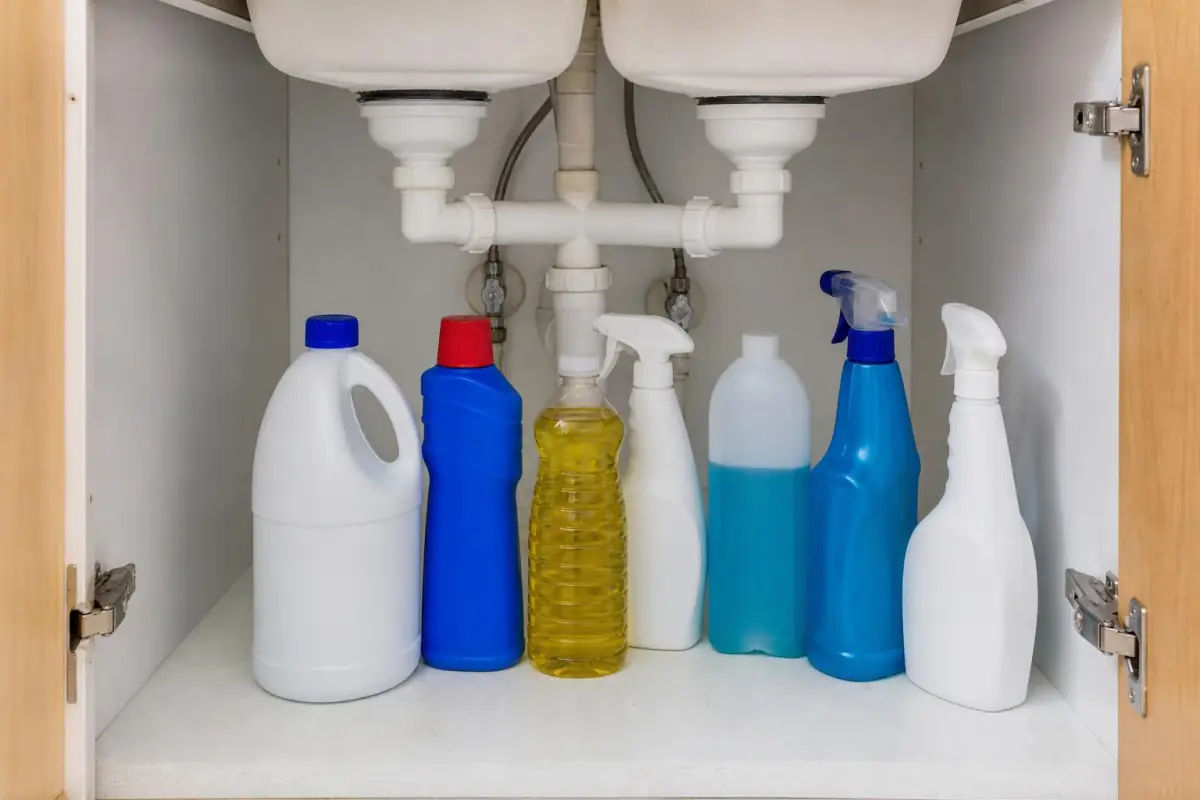
Non-digestible and slow-digesting inputs add sludge and scum that stay until the truck comes. The EPA never-flush list on its care page names non-flushable wipes such as baby wipes, feminine hygiene products, condoms, dental floss, diapers, cat litter, paper towels and coffee grounds. For paper, compare how fast different toilet papers break apart, since Penn State classes toilet paper as slowly biodegradable.
A garbage disposer is the largest optional source. EPA’s same page says food waste “usually is slowly digested” and builds scum and sludge, and that a tank served by a disposer “will need to be pumped more frequently.”
Additives cannot shorten any of this. Penn State says biological and chemical additives are not needed to aid decomposition, and that relying on them instead of pumping may result in failure of the entire system. Minnesota Rule 7080.2450, subpart 5, bars using an additive to reduce pumping frequency and bans additives containing hazardous materials. The longer evidence review is in our piece on what EPA and extension research say about septic additives.
What should the pumper measure and inspect at the pump-out?
The pumper should record sludge depth, scum thickness and the condition of both baffles, because EPA tells owners to write down the sludge and scum levels for tracking. Ask for these 5 items on the service report:
- Sludge depth, scum thickness and total liquid depth in inches, taken before pumping.
- Pumping through the main manhole, per Penn State, EC 1343 and Minnesota subpart 3, item B; baffle-port pumping can damage baffles and is not compliant in Minnesota.
- Both compartments pumped on a two-chamber tank. Pennsylvania DEP requires two-chamber tanks on new and upgraded systems, per Penn State.
- Baffle condition. Oregon State EC 1343 says to check the baffles before closing the tank and to replace any that are missing or deteriorated.
- Effluent filter cleaned, if one is fitted.
Pumping removes sludge, scum and liquid together as septage. For pricing by tank size, see what a pump-out costs by tank size. A stop point: if the readings were at 25% within a year of the last pump-out on a household of 4 or fewer with a 1,000 gallon tank, the table above says that is faster than full-time occupancy explains, so ask the inspector to check for a missing outlet baffle, a clogged or missing effluent filter, or a tank smaller than its records say.
Questions about septic solids and bacteria
How do I break down solids in a septic tank naturally?
You cannot make the tank digest everything. Oregon State Extension says up to 50 percent of retained solids decompose and the rest accumulate. The natural levers are input control, so no wipes, less disposer food, no grease and normal rather than heavy bleach use. The remaining sludge leaves only by pumping through the main manhole.
Does yeast or an additive fix a septic tank that is not breaking down solids?
No extension source we read recommends yeast. Penn State Extension says biological and chemical additives are not needed and that relying on them instead of pumping may cause failure of the entire system. Minnesota rule 7080.2450 subpart 5 says an additive does not satisfy the solids removal requirement.
How long do septic bacteria take to recover after bleach?
In the 1987 University of Arkansas study, the bacterial population recovered to its original level about 30 hours after a killing dose of liquid bleach, about 48 hours after Drano and about 60 hours after Lysol. The killing bleach dose was 1.85 gallons in a 1,000 gallon tank, far above laundry use.
Why is my septic sludge building up so fast after pumping?
Compare people to tank size first. At Penn State’s rate of 60 gallons of solids per adult per year, six full-time occupants fill the 250 gallon EPA allowance of a 1,000 gallon tank in about 8 months. Wipes, a garbage disposer and a failed outlet filter or baffle shorten that further.
Can a septic tank have too much bacteria or too little?
Too little is rare in a used tank, because University of Arizona Extension notes households add more than enough of the right bacteria every day. Too little happens only after heavy disinfectant use, and the Arkansas data show recovery within 30 to 60 hours. No source describes harm from too much native bacteria.
How we sourced this
Documents read: Penn State Extension, Septic Tank Pumping (updated November 3, 2026) with Table 2 from Mancl (1984); EPA, How to Care for Your Septic System; Minnesota Rule 7080.2450; Oregon State EC 1343; Virginia Tech SPES-380; Arkansas PUB-131 (Gross, 1987); Arizona az1258 (2018); WQA softener brine white paper (2019). Computed: years to the 25% and 30% lines from Penn State’s stated 60 gallons per adult per year, treating nominal tank gallons as liquid capacity; the measurement-table bands under 25% are our arithmetic, not a published standard. Penn State’s own text derives the 60 gallon figure from 90 gallons reduced by about 60%, which would compute to 36 gallons; we used the 60 gallon figure as published, which makes the table conservative. Left out: any dose or recovery time for medications or antibacterial soap, because no source read published one; the WQRF report itself was not read, only WQA’s summary of it.