Water Heater Sediment: Signs, What It Costs You and How to Remove It (Battelle Scale Math by Hardness)
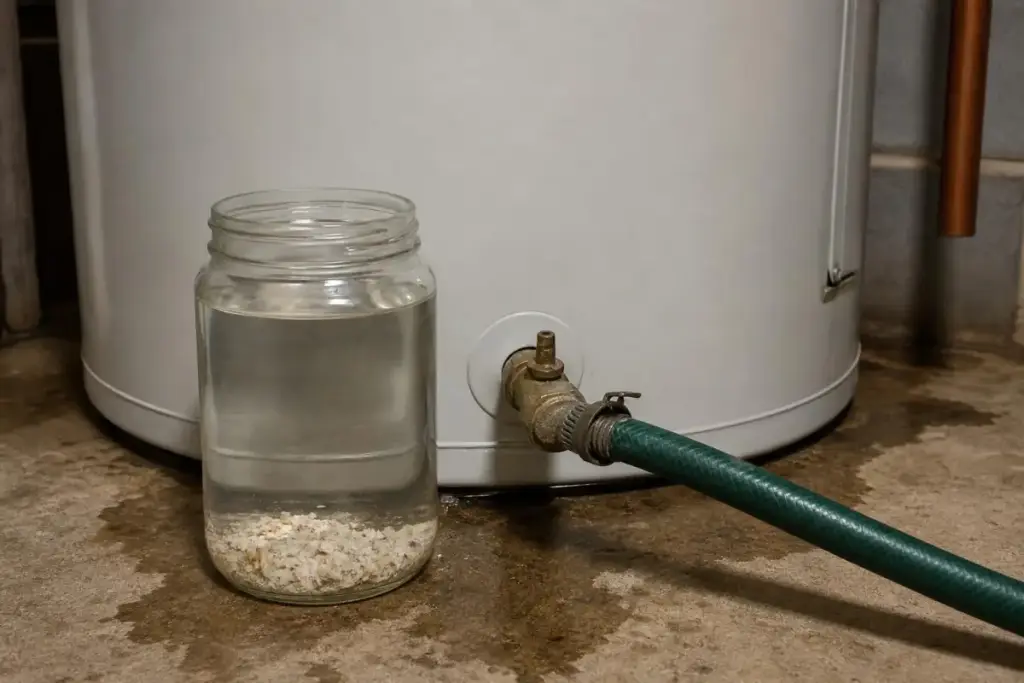
Water heater sediment is mostly calcium carbonate scale settling on the tank floor. It causes popping and rumbling, buries gas control sensors and lower elements, and in Battelle’s 2009 lab tests gas tanks on 26 gpg water lost 3 efficiency points in two equivalent years. Identify the particles first, then flush on your manual’s schedule.
What are the white particles in my hot water?
White particles in hot water are usually one of four things, and a glass of white vinegar sorts most of them in minutes. When Culligan analyzed scale from the heaters in the Battelle final report for the Water Quality Association, the overwhelming majority was calcium carbonate, the same chalky mineral that fizzes in acid. Collect debris from an aerator or the first quart out of the drain valve.
| What you see | Most likely source | Test | Fix |
|---|---|---|---|
| White, tan or red-brown hard flakes, curved like eggshell | Calcium carbonate scale that formed on the hot tank floor and broke loose | Fizzes and softens in white vinegar | Flush the tank; on water above 10 gpg, consider softening |
| White or gray bits that bend, float and stay hard | Plastic from a disintegrating dip tube | No fizz in vinegar; floats; squashes or flexes under a fingernail instead of crumbling | Replace the dip tube with the part listed for your model number |
| Gray to black specks or grit | Worn anode rod debris, or iron and manganese from the supply | Little or no fizz; check whether the cold tap shows the same specks | Pull the anode with a 1-1/16 in socket; A.O. Smith says replace it once most of its diameter is under 3/8 in |
| Sand or silt that sinks fast and feels gritty | Well pump or supply line pulling in sand | No fizz at all; shows up in cold water too | Fix it upstream with a sediment filter or well service; flushing only treats the symptom |
The plastic row is the one to rule out first on a 1990s heater. Perfection Corporation supplied defective dip tubes to water heater makers from August 1993 to October 1996, and our page on the failed dip tube and the 1993 to 1996 defect window covers the replacement in detail. A tube from that run is now 30 years old, so plastic flakes in a newer heater point to an ordinary tube failure rather than the defect batch.
Red-brown flakes are still scale, tinted by iron: Battelle’s test well carried 0.99 mg/L of iron, and its photos show rust-colored scale throughout. The cold-tap check separates supply problems (sand, iron, manganese) from debris made inside the heater.
Why does sediment make a gas water heater pop and rumble?
Sediment makes a gas tank pop because small pockets of water trapped under the layer flash to steam over the burner and burst through it. Rheem’s Use and Care Manual AP16412-1 for its Low NOx gas tanks lists “Rumbling noise” with the cause “Scale and sediment in tank” and the fix “Drain the water heater.”
Rheem’s AP16412-1 also says accumulated solids can cover the gas control sensors so that water at the fixture runs hotter than the thermostat setting. Bradford White’s power-vent manual 238-51011-00G lists “Excessive sediment” as the first cause of its four-flash, three-second-pause code for excessive tank temperature.
Not every pop is sediment. A.O. Smith’s March 2021 gas manual 100341461 says condensation can cause sizzling and popping in the burner area while a cold tank heats, and that it should fade after about 1 to 2 hours. If the noise only follows a big draw of cold refill water, wait before draining. Ticking, screeching and humming have different causes, which our sound-by-sound guide to water heater noises separates.
How much efficiency does water heater sediment cost at your hardness?
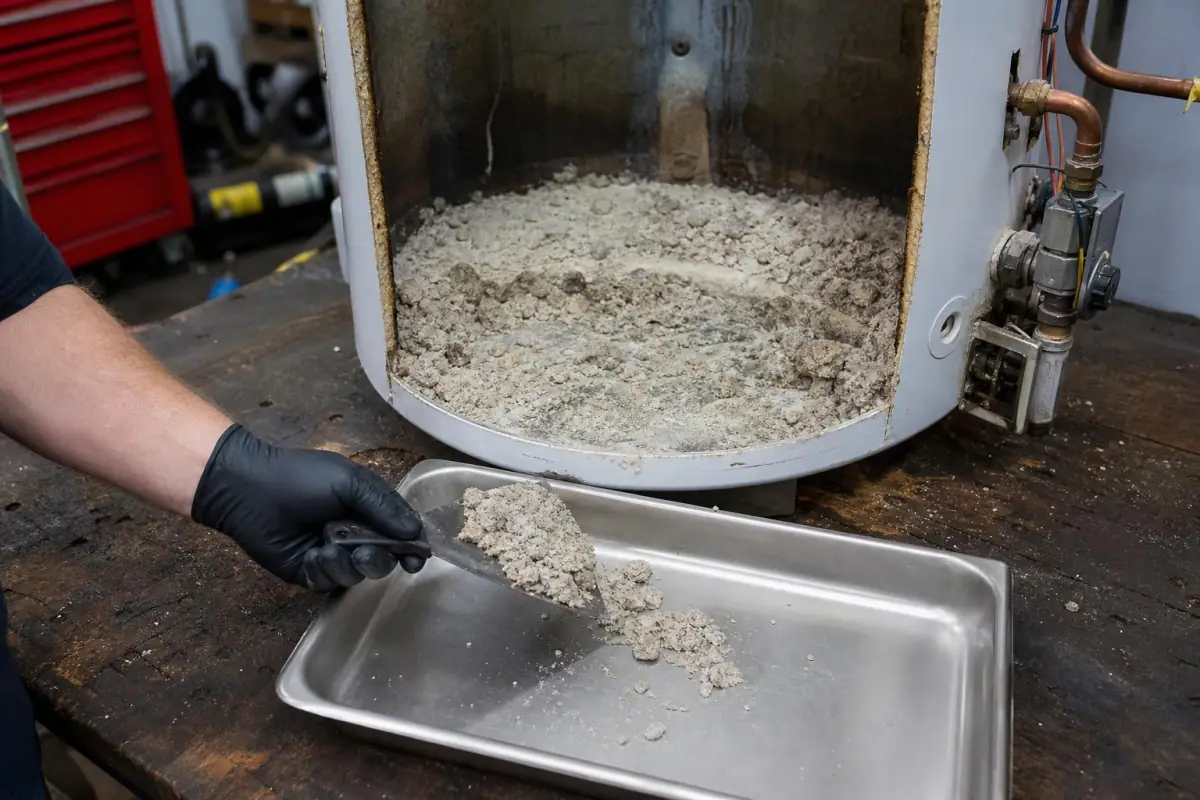
At household hardness levels, Battelle’s own equations put the loss on a gas tank at about 2.8 efficiency points per decade for every 5 gpg of hardness at 50 gallons a day. The team ran five 40 gallon, 38,000 Btu/h gas tanks on 26.2 gpg well water and five on softened water. The hard-water tanks fell from 70.4% to 67.4% efficiency over two equivalent years and collected 528 grams (1.16 lb) of scale per year; the softened tanks held 70.4% and collected 7 grams a year.
The table scales those measured rates linearly by hardness, which is the same proportional assumption Battelle built into its test design. Efficiency and lifetime gas cost come straight from the report’s Tables 5-3 and 5-4, which assume 50 gallons of hot water per day, a 15 year life and natural gas at $10 per MMBtu.
| Hardness | Example state median | Gas tank scale, lb/yr | Electric tank scale, lb/yr | Gas efficiency after 10 yr | Added gas cost over 15 yr |
|---|---|---|---|---|---|
| 0 gpg (softened) | None | 0.01 measured | 0.03 measured | 70.4% | $0 |
| 5 gpg (86 mg/L) | Tennessee, 4.9 | 0.22 | 0.38 | 67.6% | $92 |
| 10 gpg (171 mg/L) | Idaho, 10.0 | 0.44 | 0.76 | 64.7% | $192 |
| 15 gpg (257 mg/L) | Texas, 14.3 | 0.66 | 1.15 | 61.9% | $301 |
| 20 gpg (342 mg/L) | Iowa, 19.9 | 0.89 | 1.53 | 59.1% | $422 |
| 30 gpg (513 mg/L) | Above every state median | 1.33 | 2.29 | 53.4% | $705 |
Find your row with our median groundwater hardness for every state or a utility report. A Texas household near 14 gpg would collect about 6.6 lb of scale in a gas tank over 10 years under Battelle’s conditions and spend about $301 more on gas over 15 years than on softened water. At 30 gpg the gas bill for water heating runs 24% higher across the tank’s life ($3,620 versus $2,915), which is where the industry’s “24% less efficient” headline comes from.
Battelle ran its gas tanks near 161.8°F and electric tanks near 150°F, and the report’s rule of thumb says scale roughly doubles for every 20°F rise, so a tank set at 120°F should scale more slowly than the table shows.
Electric tanks: why the lower element fails instead of the bill rising
An electric tank does not lose measurable efficiency to scale, because its elements sit inside the water and every watt still ends up as heat. Battelle’s hard-water electric units read 99.5% at the start and 99.5% at the end, yet built scale at 907 grams (2.00 lb) per year, 1.7 times the gas rate. The report says element life is expected to shorten as scale raises the element’s operating temperature.
The practical sign is a dead lower element on a tank whose bill never moved. The lower element sits closest to the floor where loose scale collects, and Water Heater Rescue describes sediment burying it until it burns out, while the upper element keeps delivering a reduced supply of hot water. A.O. Smith’s manual adds the one rule that matters during any flush: do not turn power back on until the tank is full and a hot faucet runs without sputtering air, since an element powered in air burns out.
How often A.O. Smith, Rheem and Bradford White say to drain the tank
The three big tank makers give three different schedules, from a gallon a month to a full flush every 6 months. Follow the manual for your model number.
| Maker and document | Routine drain | Full flush | Anode check |
|---|---|---|---|
| A.O. Smith 100341461, March 2021, power-vent gas | A pail of water once a year | Drain and flush every 6 months | By year 3, then yearly; yearly on softened water |
| Rheem AP16412-1 (03/17), Low NOx gas | A few quarts every month | Drain when rumbling starts | Yearly; replace past 6 in of exposed core wire |
| Bradford White 238-51011-00G (REV 2/21), power-vent gas | A gallon every month | Not scheduled in this manual | Every 2 years; more often on softened water |
No drain removes scale already bonded to the tank floor, which is why A.O. Smith’s insufficient hot water chart pairs “Sediment or lime in tank” with “Drain/flush, provide water treatment if needed.”
Curved or jetted “self-cleaning” dip tubes do not replace those drains. State, an A.O. Smith brand, sells its DynaClean diffuser dip tube as an “automatic cleaning system,” and Bradford White’s Hydrojet swirls inlet water across the floor, yet no independent test of either turned up and both makers still print drain intervals.
How to get sediment out of a water heater without breaking the drain valve
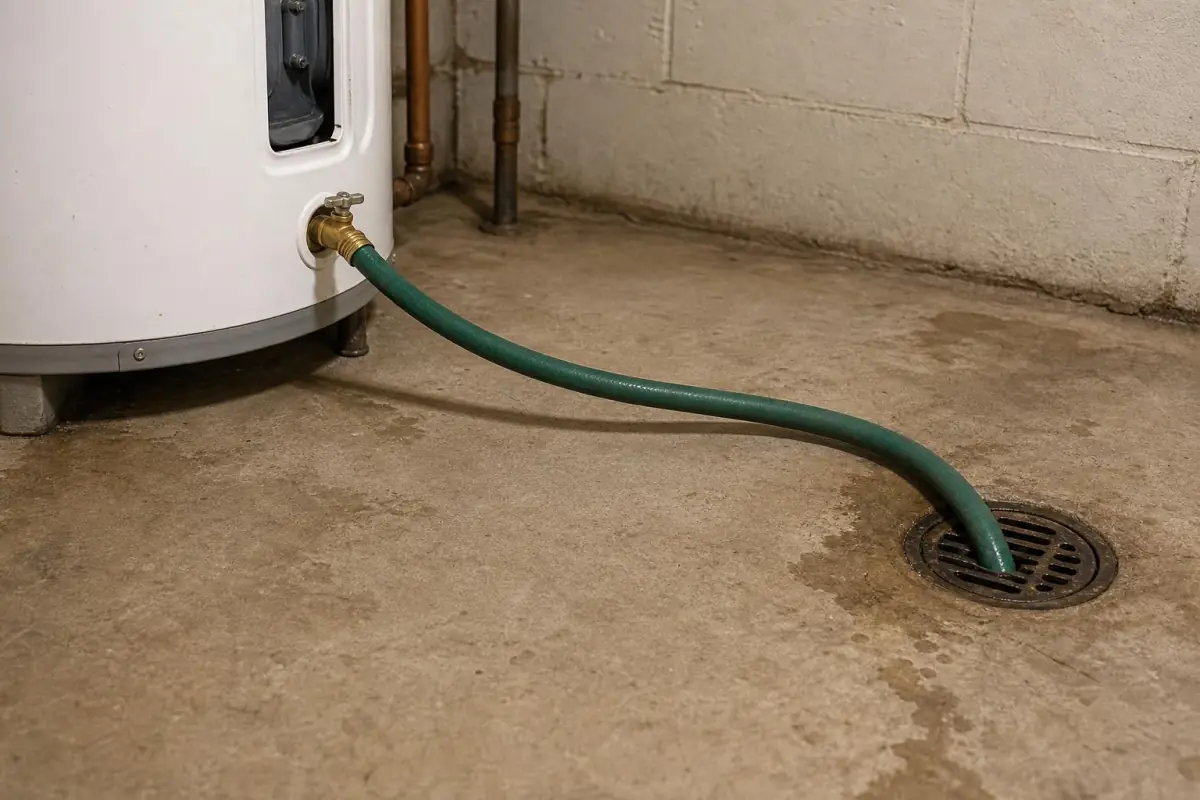
To get sediment out, drain through the bottom valve with the cold supply cycled open in short bursts, and stop when the hose runs clear. Our full step-by-step flush for gas and electric tanks lists the 10 steps, including relighting. Bradford White’s manual notes the drain valve takes a standard garden hose coupling. When grit plugs that valve for good, our guide to clogged water heater drain valves lists replacement part numbers for Rheem, A. O. Smith and Bradford White tanks.
A tank that has gone 8 to 10 years unflushed needs three precautions:
- Buy a 3/4 in garden hose cap before you start, so a valve that will not reseat can be capped instead of dripping.
- Open the valve slowly. A single large flake can plug the small plastic drain fitted to most residential tanks; reopen and close it 2 or 3 times with the cold supply on to blast it clear.
- Check the valve for cracks after refilling. A cracked plastic valve means draining again for a new one; ask a plumber for “drain valve replacement with a full-port brass valve.”
Stop and replace the heater rather than flush it if water seeps from the bottom seam or rust shows under the burner door. Stop and leave the house if you smell gas while relighting. A Bradford White four-flash lockout that returns after a flush and reset needs a gas-qualified technician, since the other listed causes include a faulty gas valve.
Tankless descaling: why vinegar replaces the drain hose
Tankless heaters have no floor for sediment to settle on, so scale coats the heat exchanger and has to be dissolved instead of drained. Battelle’s tankless units on 26.2 gpg water had to be delimed at 1.6 equivalent years after efficiency fell from 80% to 72%, and after deliming they recovered only to 77%.
Rinnai’s flushing procedure circulates 4 gallons (15.1 liters) of undiluted white vinegar through the service valves, using a pump where the model’s manual calls for one, says the process can take up to 45 minutes, and rules out chemical cleaners because the water is used for drinking and bathing.
Frequently asked questions about water heater sediment
Is water heater sediment dangerous?
On a gas tank it is mostly an efficiency and tank-life problem, but Rheem warns that buried sensors can let fixture water run hotter than the dial setting, and Bradford White lists excessive sediment as a cause of its four-flash high-temperature lockout. Treat a scalding tap or that blink code as a reason to drain the tank now.
Can sediment in a water heater make you sick?
Calcium carbonate scale itself is the same mineral found in hard tap water and is not a known health hazard. A rotten egg smell is a separate issue, which A.O. Smith ties to sulfate, low oxygen, sulfate-reducing bacteria and the anode rod all being present at once, and its fix is a replacement anode plus tank chlorination rather than a flush.
Will vinegar dissolve sediment inside a tank water heater?
Vinegar dissolves calcium carbonate, which is why it works on tankless heat exchangers and in the particle fizz test. Tank makers instead point owners to draining and flushing, and A.O. Smith lists a recommended delimer through its authorized servicers. Pouring household vinegar into a 40 or 50 gallon tank dilutes it too far to do much.
Why does my water heater still pop after flushing?
Hard scale bonded to the tank floor does not leave through a drain valve, so some popping can remain. On a gas unit that has just refilled with cold water, A.O. Smith also describes condensate dripping on the burner as normal sizzling and popping that fades after about 1 to 2 hours of heating.
How we sourced this
Scale and efficiency figures come from the Battelle Memorial Institute final report “Study on Benefits of Removal of Water Hardness (Calcium and Magnesium Ions) From a Water Supply” (D. D. Paul and others, prepared for the Water Quality Association, testing in 2009), Tables ES-1, 3-1, 5-3, 5-4, 5-5 and 5-7. Per-hardness scale rates scale the measured 1.16 lb/yr (gas) and 2.00 lb/yr (electric) at 26.2 gpg linearly; the study was industry-funded. Maintenance intervals, noise causes and blink codes come from A.O. Smith 100341461, Rheem AP16412-1 and Bradford White 238-51011-00G manuals and Rinnai’s published flush procedure. A widely repeated claim that sediment causes 85% of water heater failures had no traceable source and was left out, as was a DOE maintenance page that could not be loaded.