Water Heater Dip Tube: Signs It Failed and How to Replace It
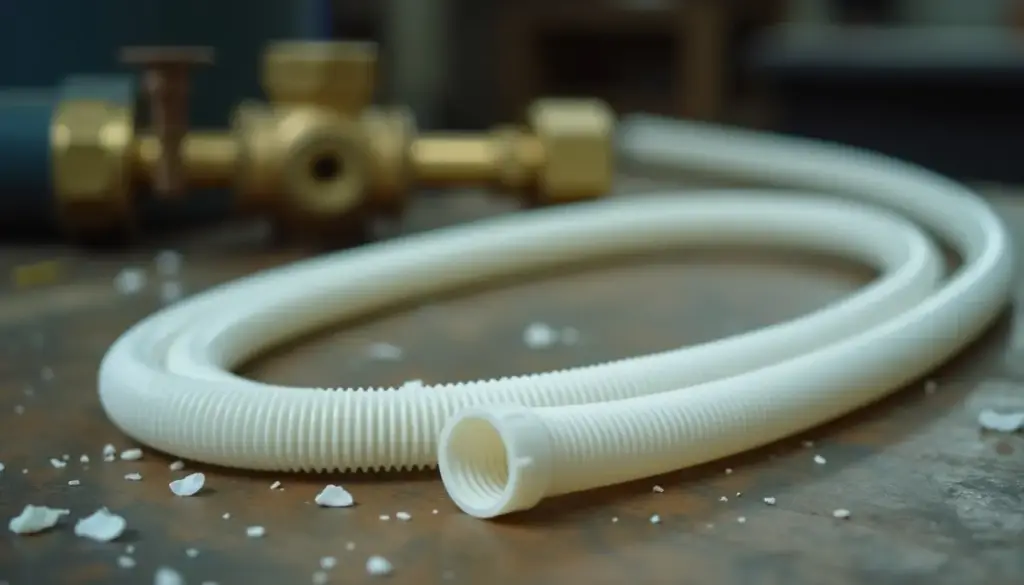
A water heater dip tube carries cold inlet water to the bottom of the tank, and when it cracks or crumbles your hot water turns lukewarm fast and white plastic flakes clog the faucet aerators.
Key Takeaways
- Perfection Corporation of Madison, Ohio, supplied defective dip tubes to water heater makers from August 1993 to October 1996, per A.O. Smith’s July 2004 SEC filing.
- Michigan’s Attorney General alleged Perfection made more than 23 million polypropylene dip tubes in 1993 to 1996, per PM Magazine.
- The national settlement paid $175 toward a qualifying dip tube replacement, and new claims closed December 31, 2000, per Supply House Times.
- A working tube stops about 8 inches above the tank bottom, according to Mr. Rooter, so a tube that ends higher has broken off.
- Rheem’s replacement dip tubes span 24 inches (SP11625C) to 53 inches (AP12933), per Malachy Parts Plus listings, so buy by model number.
- HomeServe, citing HomeGuide, puts the part at $10 to $20 and a plumber’s job at $100 to $300, with a DIY swap taking 1 to 4 hours.
What does a water heater dip tube do?
A water heater dip tube is a plastic pipe that hangs from the cold inlet at the top of a tank and carries incoming cold water down to the bottom, next to the burner or lower element. That keeps cold water from mixing with the hot layer at the top, which is where the hot outlet draws from. No tube, or a broken one, means cold water short-circuits straight into your hot supply.
Mr. Rooter describes the tube as stopping about 8 inches above the bottom of the tank. Hot water rises and cold water sinks, and the tube relies on that layering.
Many tubes also carry a small hole near the top. An A.O. Smith patent application published February 15, 2024 states that regulations in many jurisdictions require an anti-siphon orifice near the top of the tank, so a pressure loss on the supply side cannot siphon the tank empty through the tube. That hole is deliberate. Do not mistake it for a crack or plug it.
What are the signs of a bad water heater dip tube?
The classic signs are a full tank of hot water that turns lukewarm within minutes, a heater that never seems to get the water as hot as it used to, and white or gray plastic bits in faucet aerators, shower heads, and the inlet screens on a washing machine. The aerator debris is the most specific clue, since few other water heater faults leave plastic behind. Sorting out whether those particles are scale, resin, or dip tube debris starts with a simple white flakes test.
- Lukewarm water fast. A crack or a snapped-off tube dumps cold water near the top outlet. You get a burst of hot water, then a long run of warm.
- Plastic in aerators. Ron Hazelton’s HouseCalls lists small plastic pieces in faucet aerators, shower nozzles, and the washing machine supply tube as the main symptom of a disintegrating tube.
- Falling pressure at fixtures. Fragments pile up behind aerator screens and inside cartridges, so flow drops at one fixture after another.
Check before you blame the tube. Unscrew a few aerators, collect the debris on a paper towel, and drop it in a glass of white vinegar. Scale fizzes and softens. Dip tube plastic floats and stays hard.
Is it the dip tube or something else?
Lukewarm water and debris both have several possible causes, so match the exact symptom before you drain anything. Plastic that floats in vinegar points at the dip tube. Hard white grit that fizzes is scale. Black specks, no hot water at all, and short hot runs on an electric tank usually trace to other parts, and each has a faster test than pulling the tube.
| Symptom | Dip tube? | More likely cause and quick test |
|---|---|---|
| Hot water turns warm within minutes | Likely | Electric tank with a dead upper element also does this. Test both elements with a multimeter before draining. |
| White or gray flakes that float, stay hard in vinegar | Very likely | Few other sources. Pull the tube and look for a short or crumbling end. |
| White grit that sinks and fizzes in vinegar | No | Calcium carbonate scale from hard water and sediment. Flush the tank. |
| Black specks in water | No | Degrading rubber washers or hoses, a spent carbon filter, or manganese. |
| No hot water at all | No | Tripped high-limit, failed element, or a gas pilot that will not stay lit. |
| Hot water runs out fast but stays hot until it does | Unlikely | Tank too small for demand, thermostat set low, or heavy sediment. |
| Rumbling or popping while heating | No | Sediment boiling under the burner or around the lower element. |
If the main complaint is volume rather than temperature, read our breakdown of why hot water runs out fast, which covers tank sizing and first-hour ratings. On electric units, testing the water heater element with a multimeter rules out the other big cause of lukewarm water. Dark debris belongs to a separate diagnosis covered in our guide to black specks in water.
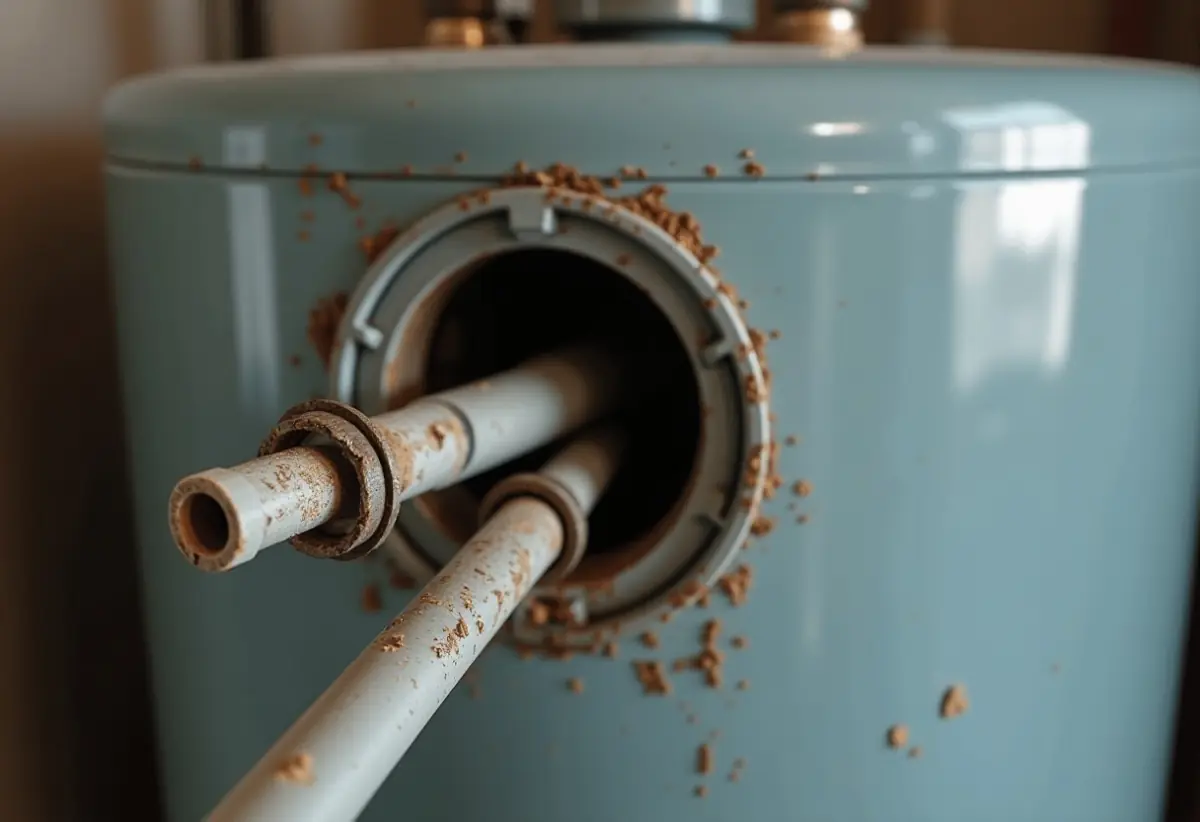
Which water heaters had the 1993 to 1997 defective dip tubes?
Tanks built with tubes from Perfection Corporation of Madison, Ohio, during the August 1993 to October 1996 supply window had a polypropylene dip tube that could crumble. The brands in the national settlement were Rheem, A.O. Smith, Bradford White, American Water Heater, Lochinvar, and State Industries. A 2000 manufacturer notice reported by PM Magazine cites tubes made between 1993 and 1997.
The source dates differ slightly. A.O. Smith’s July 13, 2004 Form 8-K gives the supply window as August 1993 to October 1996. A Michigan suit described by PM Magazine in June 2000 said Perfection produced more than 23 million dip tubes in 1993 to 1996 that were subject to breakdown, deterioration, and dissolution. Supply House Times reported final settlement approval on April 21, 2000.
To check a tank, read the serial number on the label. Ron Hazelton’s HouseCalls says the first four digits usually give month and year, and flags tanks with 93, 94, 95, 96, or 97 in the third and fourth digits. Serial formats differ by brand, so confirm with the maker’s decoder. Any tank from that window is now roughly 30 years old.
What material and length should a replacement dip tube be?
Buy a cross-linked polyethylene (PEX) dip tube that matches your tank’s model number, not a generic one from the shelf. Mr. Rooter and Ron Hazelton’s HouseCalls both specify PEX because it does not break down in hot tank water the way the 1990s polypropylene tubes did. Length varies with tank height, so the model number decides the part.
Rheem alone lists tubes from 24 to 53 inches. Parts retailer Malachy Parts Plus shows the SP11625C helix dip tube at 24 inches, the SP13763F at 3/4 inch by 28 inches, and the AP12933 at 3/4 inch by 53 inches. The helix version uses a spiral to swirl incoming water and keep sediment from settling.
Cut-to-fit universal tubes exist, but cutting one too short recreates the failure. If the old tube is broken, measure from the inlet fitting down to about 8 inches above the tank floor and order the matching OEM length.
How do you replace a water heater dip tube, step by step?
Shut off power or gas, close the cold supply, drain the tank, unscrew the cold inlet nipple, pull the old tube straight up, drop in the new PEX tube, seal the threads, and refill with a hot faucet open before restoring heat. HomeServe puts a DIY job at 1 to 4 hours, with draining and refilling taking most of that time.
- Kill the heat. Electric tank, switch off the breaker. Gas tank, turn the gas control knob to OFF.
- Close the cold supply valve on the inlet line above the tank.
- Open a hot faucet somewhere in the house to break the vacuum and relieve pressure.
- Drain the tank. Run a garden hose from the drain valve to a floor drain or outside. Follow our full water heater drain walkthrough if the valve is clogged with sediment.
- Disconnect the cold supply line at the top of the tank, usually a flex connector or union.
- Unscrew the cold inlet nipple with a pipe wrench. On some tanks the dip tube is attached to the nipple and comes out with it.
- Pull the old tube straight up. If it sticks, press a flat screwdriver against the inside wall of the tube and lift. Note which way any curved or notched bottom end faced.
- Check the new tube. Confirm length and the anti-siphon hole near the top.
- Insert the new tube so its flange seats in the inlet port. With a curved or helix tip, match the old tube’s orientation or the direction printed on the package sheet.
- Wrap the nipple threads clockwise with PTFE tape, thread the nipple back in snug, and reconnect the supply line.
- Close the drain valve and refill with the hot faucet still open. Shut it once water runs steady with no sputtering air.
- Check every joint for leaks, then restore the breaker or relight the pilot.
- Test. After a full recovery, time how long the shower stays hot against your pre-repair number.
Never restore power to an electric tank before it is full. An element that fires without water around it can burn out, and then you are replacing an element too.
How do you flush dip tube plastic out of the tank and pipes?
Flush the tank until the drain water runs clear of flakes, then clean every aerator, shower head, and appliance inlet screen downstream. Ron Hazelton’s HouseCalls advises catching the drain water on a screen and warns you may need to fill and flush the tank several times. Plastic left in the tank keeps drifting into the hot lines for weeks.
- With the new tube installed but power off, briefly open the cold supply with the drain valve open to stir the bottom, then close it.
- Catch the outflow on a window screen or kitchen strainer. Repeat until a full cycle shows no flakes.
- Remove and soak every faucet aerator and shower head. Clean the inlet screens on the washing machine and dishwasher, which trap fragments first.
How much does dip tube replacement cost?
A dip tube replacement is one of the cheapest water heater repairs. HomeServe, citing HomeGuide, puts the part at $10 to $20 and a plumber’s full job at $100 to $300 including parts and labor. That compares with $150 to $700 for most tank water heater repairs in the same HomeGuide data.
OEM tubes run higher than generic ones. Malachy Parts Plus lists Rheem’s SP11625C at $17.46, the SP13763F at $22.44, and the 53-inch AP12933 at $54.05. HomeServe notes that DIY work may void a tank still under warranty, so call the maker first if the tank is young.
How we sourced this
We reviewed 14 sources and cited 9. Primary sources are A.O. Smith’s July 13, 2004 SEC Form 8-K, A.O. Smith patent application US 2024/0053058 A1, and PM Magazine and Supply House Times coverage from April to June 2000. Part numbers, lengths, and prices come from Rheem listings at Malachy Parts Plus, checked October 2026. Costs come from HomeServe’s July 2025 guide, which cites HomeGuide. Step details draw on Mr. Rooter (March 2026) and Ron Hazelton’s HouseCalls. We left out tank-size-to-length charts because the sources we found disagreed and none came from a manufacturer.
Frequently asked questions
How do I know if my water heater dip tube is bad?
The two tells are hot water that turns lukewarm within a few minutes of a full tank and small white or gray plastic flakes in faucet aerators, shower heads, or washing machine inlet screens. Plastic flakes float and do not fizz in vinegar, which separates them from mineral scale. The final proof is pulling the tube and finding it cracked, short, or crumbling.
Can you replace a dip tube without draining the water heater?
You can swap the tube after draining only part of the tank, since the water level just has to sit below the cold inlet fitting. Plumbing guides such as Mr. Rooter and Ron Hazelton’s HouseCalls still drain the whole tank, because a failed tube leaves plastic pieces sitting on the bottom that will keep clogging aerators unless you flush them out.
Do all tank water heaters have a dip tube?
No. HomeServe notes that tanks with the cold inlet low on the side or bottom do not need one, because the water already enters near the burner or lower element. Tankless units have no dip tube at all since they store no water. Most standard top-inlet gas and electric tanks sold in the US do use one.
Is my water heater part of the dip tube settlement?
Probably not anymore. The national settlement covered tanks from Rheem, A.O. Smith, Bradford White, American Water Heater, Lochinvar, and State Industries built with tubes Perfection Corporation supplied from August 1993 to October 1996. Supply House Times reported the claim deadline for new claims was December 31, 2000. Any tank from that window is now about 30 years old and due for replacement anyway.
What are the white flakes in my faucet aerator?
They are either dip tube plastic or mineral scale. Drop a few into a glass of white vinegar. Scale is mostly calcium carbonate, so it fizzes and softens. Polypropylene dip tube plastic floats, stays hard, and does not react. Black specks are a different problem, usually rubber from a degrading washer or supply hose, or manganese in the water.
How much does it cost to replace a dip tube?
HomeServe, citing HomeGuide, puts the part at $10 to $20 and a plumber’s full job at $100 to $300 including the part and labor. Rheem’s own replacement tubes list from $17.46 to $54.05 at parts retailer Malachy Parts Plus depending on length. A DIY swap typically takes 1 to 4 hours, most of it draining and refilling the tank.
What material should a replacement dip tube be?
Cross-linked polyethylene, sold as PEX. Mr. Rooter and Ron Hazelton’s HouseCalls both recommend PEX because it does not break down in hot tank water. The failed tubes from the 1990s were polypropylene, which a Michigan Attorney General complaint said was subject to breakdown, deterioration, and dissolution. Match the original length and diameter to your model.