Water Heater Element: How to Test and Replace One
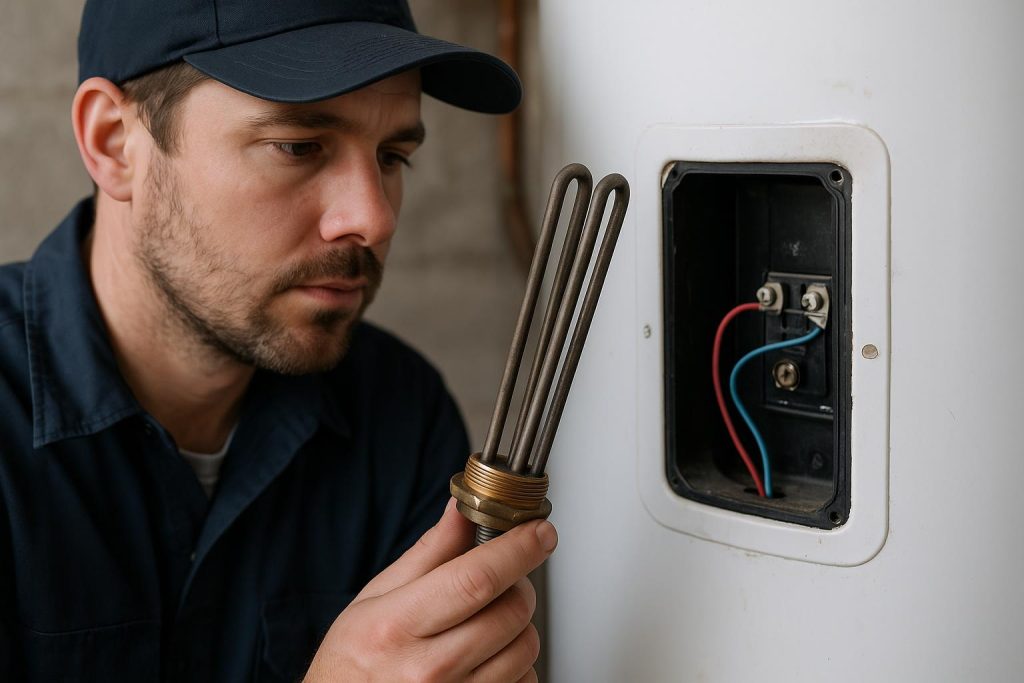
A water heater element is the screw-in or bolt-in coil that heats the water, and a burned-out one is the most common reason an electric tank quits, costing about $8 to $20 to replace yourself.
Key Takeaways
- An electric tank usually has two elements that run non-simultaneously: the upper heats the top of the tank first, then the lower heats the rest, so the draw stays near 4500W, not 9000W.
- No hot water at all usually means the upper element failed; hot water that runs out fast or stays lukewarm usually means the lower element failed.
- Test an element with a multimeter on the ohms setting: a good 240V element reads about 10 to 16 ohms, while a dead one reads open or infinite, per appliance-repair guidance.
- By Ohm’s law at 240V, a 5500W element reads about 10.5 ohms, a 4500W element about 12.8 ohms, and a 3500W element about 16.4 ohms.
- 4500W at 240V is the most common residential element; low-watt-density (foldback) elements resist scale in hard water, per Camco specs.
- The part costs about $8 to $20; a pro replacement runs about $150 to $350 including labor, per 2026 Angi data. Cut the 240V power at the breaker and drain the tank before you touch an element.
What is a water heater element and how does it work?
A water heater element is a metal heating coil that threads or bolts into the side of an electric tank and turns 240V electricity into heat directly in the water. Current flows through the coil, the coil resists that flow, and the resistance produces heat. Most residential tanks use two elements, one near the top and one near the bottom. Knowing how the upper and lower elements interact with the tank’s safety switch helps when troubleshooting the high-limit reset switch.
Each element pairs with its own thermostat bolted to the tank wall behind the access panel. The thermostat senses tank temperature and switches its element on or off. Gas tanks work completely differently with a burner and pilot, so if you want the full picture, read how a water heater works before you start testing parts.
Why do upper and lower elements not run at the same time?
A dual-element electric tank runs non-simultaneously, which means only one element is ever energized at a time. The upper thermostat holds priority. On a cold tank it sends power to the upper element to heat the top third fast, then once that zone is hot it hands control down to the lower element, which heats the rest of the tank.
This design is about the circuit, not speed. Running both 4500W elements together would draw about 9000W, far past what a standard 30-amp, 240V water heater circuit can carry. By firing one at a time, the tank stays near 4500W and the wiring stays safe. It also explains the two classic failure symptoms covered next.
What are the symptoms of a burned-out element?
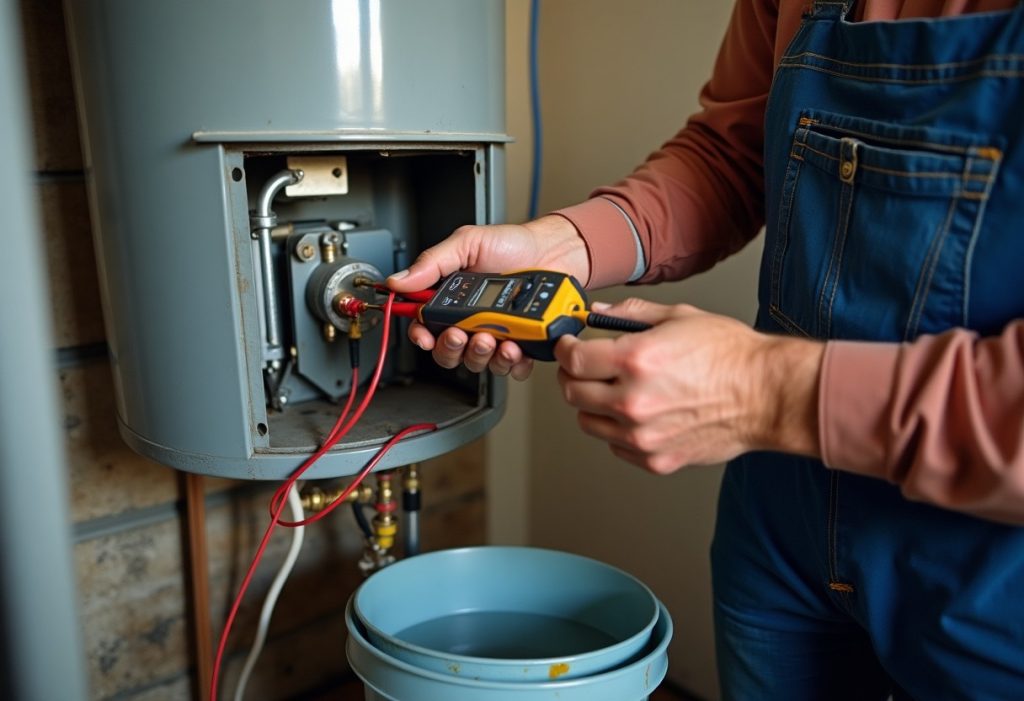
The symptom tells you which element died. No hot water at all points to the upper element, because the upper element heats first and the lower one never gets its turn. Hot water that runs out fast, or that is only lukewarm, points to the lower element, since the top of the tank still heats but the bulk of the water does not.
Other tells include a breaker that trips (often an element shorted to ground), water that heats much slower than it used to, or rusty water from a scaled element. Sediment noise is a separate issue, so if you hear rumbling or popping, check why a water heater makes noise. For a full symptom-by-symptom walkthrough of a dead electric tank, see how to troubleshoot no hot water.
| Symptom | Likely element | Why | Next step |
|---|---|---|---|
| No hot water at all | Upper element | Upper heats first; if it fails, lower never engages | Test upper element and upper thermostat |
| Hot water runs out fast | Lower element | Top heats, but the bulk of the tank does not | Test lower element and lower thermostat |
| Water only lukewarm | Lower element | Partial heating, lower coil weak or failing | Test lower element resistance |
| Breaker keeps tripping | Either element | Element shorted to ground | Test each terminal to the tank body |
How do you test a water heater element with a multimeter?
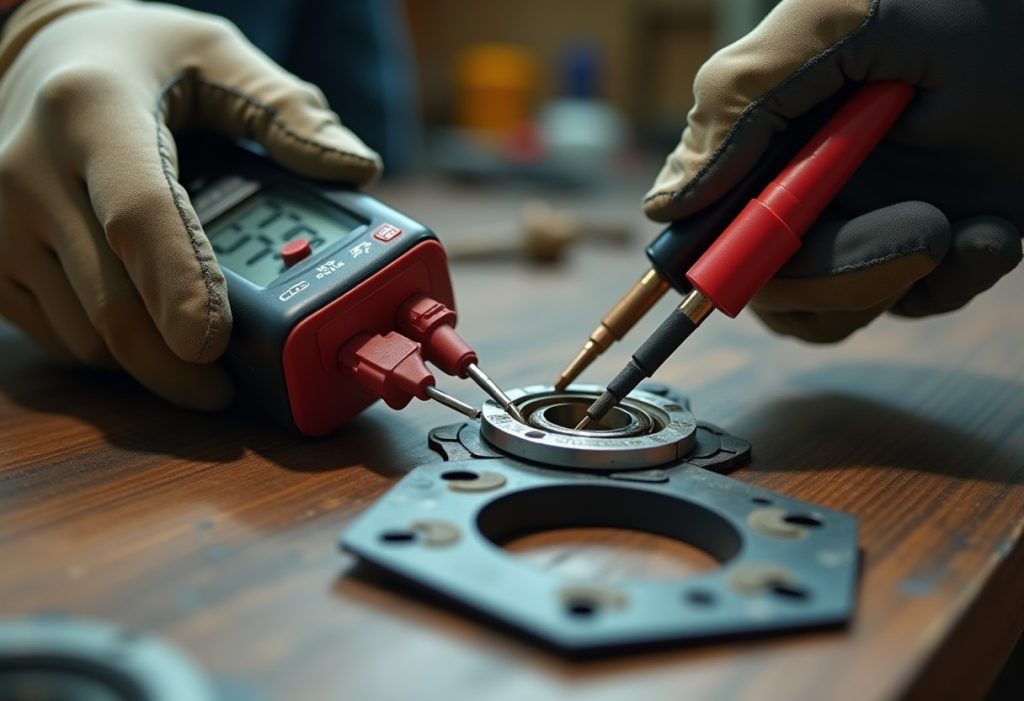
You test an element two ways: a resistance check for a broken coil and a ground check for a short. First, and this is not optional, shut the water heater breaker OFF at the panel and confirm the power is dead with a voltage tester. A water heater element runs on 240V, which can injure or kill you. Then remove the access panel, fold back the insulation, and pop off the plastic terminal cover.
- Set a multimeter to the lowest ohms (resistance) range.
- Touch one probe to each of the two screw terminals on the element. A good element reads about 10 to 16 ohms.
- Read the result: an open or infinite reading means the coil is broken and the element is dead. A reading near zero means a dead short.
- Move one probe to a bare metal spot on the tank and leave the other on a terminal. Any continuity here means the element shorted to ground and must be replaced.
- Disconnecting one wire before testing avoids a false reading through the circuit.
Do both elements while the panels are off. If the numbers are in range and nothing reads to ground, the element is fine and the fault is likely the thermostat or wiring, which is where a broader common water heater repairs checklist helps.
What resistance should an element read, and how does wattage set it?
Resistance is fixed by wattage and voltage through Ohm’s law: resistance equals voltage squared divided by watts. At 240V that puts a healthy element in the 10 to 16 ohm band. Higher wattage means a lower resistance reading. So the number you expect depends on the element printed on the label, not on guesswork.
For a 240V element, 5500W works out to about 10.5 ohms, 4500W to about 12.8 ohms, and 3500W to about 16.4 ohms. If your meter reads inside a couple of ohms of the expected value, the coil is intact. An open reading is the single clearest sign the element has burned through.
What types of water heater elements are there?
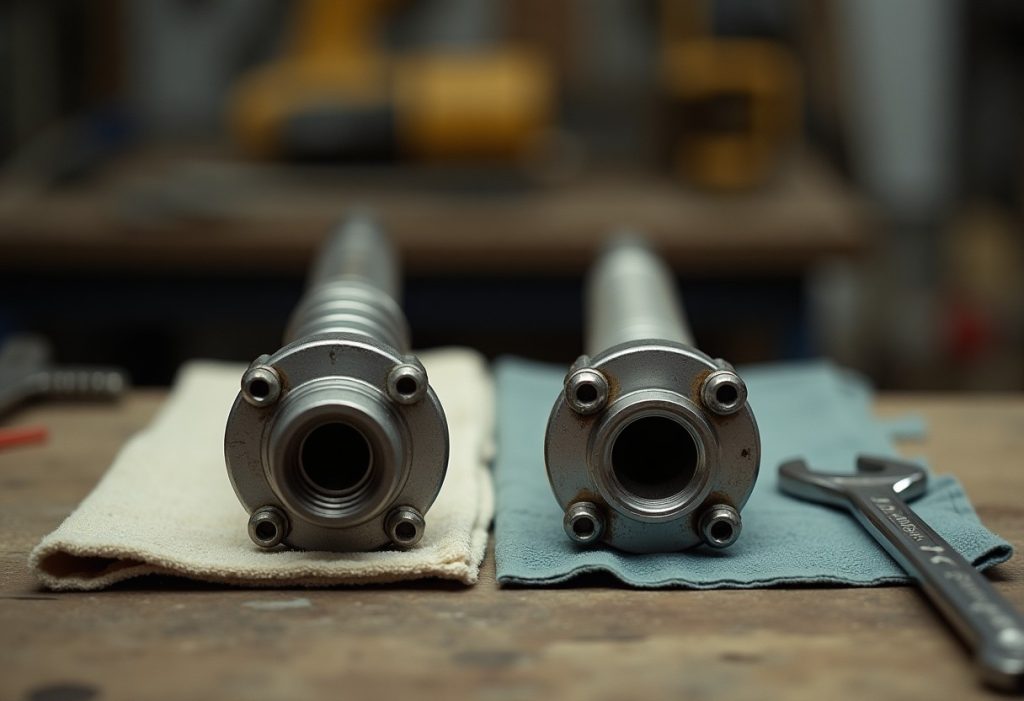
Elements split two ways: how they mount and how they spread their heat. Mounting is either screw-in (a 1-inch threaded base, the most common home type) or bolt-in (a four-bolt flange, used on some older and commercial tanks). Heat spread is measured as watt density, high or low, which decides how fast scale bakes onto the element in hard water.
High-watt-density elements are the cheap default and run hotter, so minerals cook onto them and burn them out faster in hard water. Low-watt-density and ultra-low-watt-density elements use a longer or foldback coil to spread the same wattage over more surface, run cooler, and shrug off lime. Match the new element to the old one on mount, voltage, and wattage.
| Element type | How it mounts | Best water type | Scale resistance |
|---|---|---|---|
| Screw-in | 1-inch threaded base, socket to install | Most residential tanks | Depends on watt density |
| Bolt-in (flange) | Four-bolt flange with gasket | Older and some commercial tanks | Depends on watt density |
| High-watt-density | Short coil, screw-in or bolt-in | Soft water, lowest cost | Low, scales fast in hard water |
| Low-watt-density (foldback) | Longer or folded coil, more surface | Hard water areas | High, runs cooler, resists lime |
How do you replace a water heater element safely?
Replacing an element is a drain-and-swap job, and the danger is the 240V power, so the first and last word is confirm it is off. Work through it in order and do not rush the power-off and draining steps.
- Turn the water heater breaker OFF and confirm zero voltage at the thermostat with a tester. This is a 240V circuit.
- Shut the cold water supply valve on top of the tank.
- Open a hot tap in the house to break the vacuum, then connect a hose to the drain valve and drain the tank below the element you are changing (the full tank for a lower element).
- Remove the access panel, insulation, and plastic cover, then disconnect the two wires from the element.
- Unscrew the element with an element socket (or unbolt a flange element) and pull it out with its gasket.
- Install the matching new element with a fresh gasket, snug it down, reconnect the wires, and close the drain valve.
- Reopen the cold supply and the hot tap, and let the tank fill completely. Running an element dry burns it out in seconds.
- Only after water runs steady from the hot tap, restore power at the breaker.
How we sourced this
We built the element specs, test procedure, and 2026 US costs from manufacturer and repair sources: Camco element listings (4500W and 5500W, 240V, screw-in vs bolt-in flange, high and low watt density), appliance and plumbing repair guidance from AppliancePartsPros, Mr. Rooter, and Corro-Protec on multimeter testing and the open-circuit failure reading, and 2026 cost data from Angi and HomeGuide for the part and professional labor. Resistance figures come from Ohm’s law (resistance equals voltage squared over watts) at a nominal 240V, so real readings vary slightly with supply voltage and element tolerance. We cite ranges, not single numbers, and we excluded 120V and commercial multi-element configurations, which differ.
Frequently asked questions
How do you test a water heater element with a multimeter?
Shut off the breaker first, confirm power is off, then remove the access panel, insulation, and plastic cover. Set a multimeter to the lowest ohms range and touch one probe to each element screw terminal. A good 240V element reads about 10 to 16 ohms. An open or infinite reading means the element is burned out and needs replacing.
What are the symptoms of a bad water heater element?
No hot water at all usually points to a failed upper element, since the upper element heats first. Hot water that runs out fast or stays lukewarm usually points to a failed lower element. A tripped breaker, water that heats slowly, or discolored water can also signal an element shorted to ground or caked in sediment.
What resistance should a water heater element read?
A working 240V element reads roughly 10 to 16 ohms, depending on wattage. By Ohm’s law a 5500W element reads about 10.5 ohms, a 4500W element about 12.8 ohms, and a 3500W element about 16.4 ohms. A reading of zero means a short, and infinite or open means the element coil has broken and the element is dead.
Why do upper and lower water heater elements not run at the same time?
A dual-element electric tank runs non-simultaneously, meaning only one element heats at a time. The upper thermostat has priority: it heats the top of the tank first, then hands control to the lower element to heat the rest. This keeps the draw near 4500W instead of 9000W, so a standard 30-amp, 240V circuit can supply it.
Can I replace just one water heater element?
Yes. If only one element tests bad you can replace that single element, though many plumbers swap both at once since labor is the same once the tank is drained. Match the voltage and wattage to the old element, usually 4500W at 240V, and pick screw-in or bolt-in to fit your tank. Always cut power at the breaker and drain the tank below the element first.
How much does it cost to replace a water heater element?
The element part costs about $8 to $20 for a standard screw-in, with premium low-watt-density and bolt-in types a bit more. A professional replacement typically runs $150 to $350, including the part and about one to three hours of labor, per 2026 Angi data. DIY is cheap if you are comfortable confirming the 240V power is off.
What is the difference between high and low watt density elements?
Watt density is how much heat the element puts out per square inch of surface. High-watt-density elements are cheaper and run hotter, so scale and sediment bake onto them faster in hard water. Low-watt-density and ultra-low-watt-density elements spread the same wattage over more surface (often a foldback shape), run cooler, and resist lime buildup, which is why they suit hard water.


