Washing Machine Hoses: Rubber vs Braided, 1,000 to 1,700 psi Burst Ratings and When to Replace
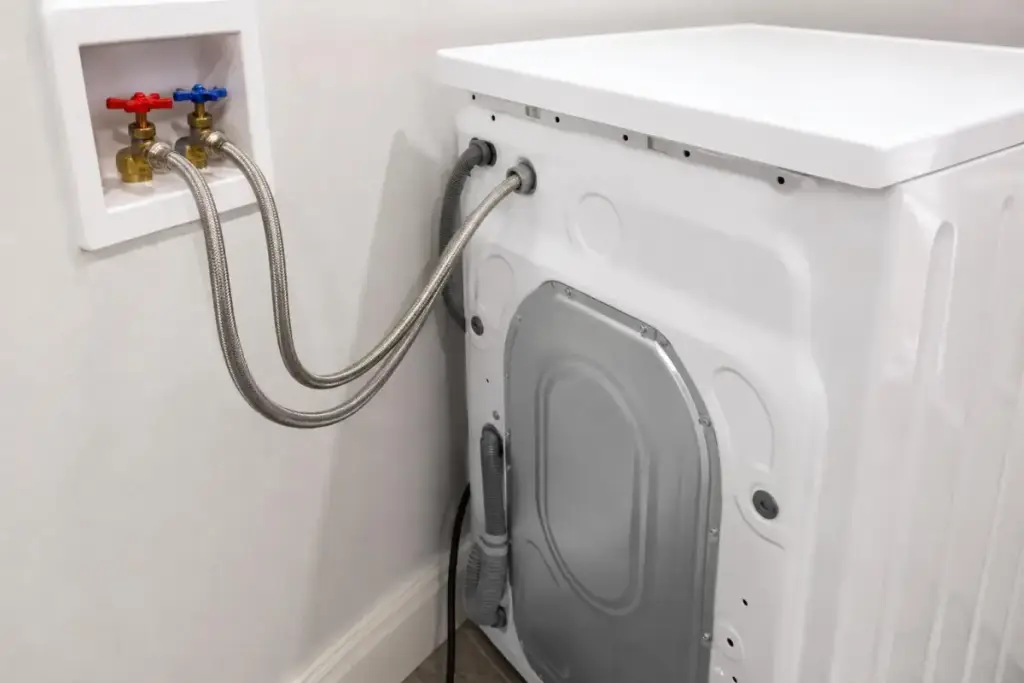
Washing machine hoses come in plain rubber, nylon braided rubber and stainless braided versions with burst ratings from about 1,000 to 1,700 psi, but every type gets the same replacement date: every 5 years per Whirlpool, or every 3 to 5 years per IBHS. Age, not rating, is what bursts them.
A washer fill hose sits under house pressure around the clock unless someone closes the valves. State Farm puts that load at about 70 pounds, and says each time the washer’s solenoid snaps shut the hose balloons and pulls back, weakening a little with every fill. That repeated flexing, not a single spike, is what the loss numbers below are measuring.
How often do washing machine hoses burst, and what does one burst cost?
A burst hose is the single biggest cause of washing machine water damage: an Institute for Business and Home Safety (IBHS) closed claims study found a burst supply line behind half of all washer water damage incidents, at more than $6,000 per incident. Insurer data since then puts the average higher.
| Source | What it measured | Figure |
|---|---|---|
| IBHS study, published in the Connecticut Insurance Department water damage pamphlet | Share of washing machine water damage incidents caused by a burst supply line | Half |
| Same pamphlet | Damage per burst supply line incident | More than $6,000 |
| State Farm newsroom, 2020 claims | Paid on homeowner claims from washing machine hose failure | Nearly $30 million |
| State Farm, 2020 | Average washer hose claim | $10,200 |
| Computed from the two State Farm figures | Implied number of paid hose claims ($30 million / $10,200) | Roughly 2,900, one insurer, one year |
| State Farm | Water released by a failed hose | 650 gallons on average; nearly 31,000 over a weekend away |
| Watts IntelliFlow brochure | Discharge from a burst washer hose | 500 gallons in one hour |
| IBHS interior water white paper, December 2024 | Average lifespan of a washing machine | 12.6 years |
The IBHS dollar figure is the oldest and the lowest; State Farm’s 2020 average of $10,200 is 70% higher, and both sit below the $15,400 average water and freezing claim across all causes in ISO’s 2019 to 2023 data. The 12.6 year washer lifespan matters for one reason: a machine kept that long goes through at least two sets of hoses on a 5 year schedule, and many owners never change the set that came in the box.
Rubber vs braided washing machine hoses: what the burst ratings say
Braided hoses carry higher burst ratings, 1,500 to 1,700 psi on Whirlpool’s pages against 1,000 to 1,050 psi for plain rubber, but a stainless sleeve does not change the tube inside it. Ratings below are from the makers’ own pages.
| Hose type | Example part | Burst rating (maker) | What the maker says about it |
|---|---|---|---|
| Plain EPDM rubber | Whirlpool 8212545RP, 5 ft pair | 1,000 psi | Built-in O-rings; replace every 5 years |
| Plain rubber, long | Whirlpool 8212656RP, 10 ft pair | 1,050 psi | Universal fit; replace every 5 years |
| Nylon braided EPDM (reinforced rubber) | Whirlpool 8212487RP, 5 ft pair | 1,500 psi | Hydro-Blue Steel anti-corrosive couplings; replace every 5 years |
| Nylon braided, 90 degree elbow | Whirlpool 8212638RP, 6 ft pair | 1,700 psi | Larger bore for flow, pre-installed EPDM washers; replace every 5 years |
| Stainless braided over a plastic core | Certified Appliance Accessories stainless line | No figure on the maker’s buying guide | PVC inner core under the steel braid; look for UPC, NSF 61, ASME and CSA marks; replace every 5 years |
| Automatic shutoff valve (protects any hose) | Watts IntelliFlow A2C-M1 (surface) or A2C-WB-M1 (recessed box) | Not a hose | Opens only while the washer draws current; leak sensor closes both valves |
Against the roughly 70 pounds of pressure State Farm cites, a 1,000 psi rubber hose has about 14 times that margin when new and a 1,700 psi braided hose about 24 times. Neither describes a 6 year old hose hardened at the crimp. One small flag on the Whirlpool pages: part 8212641RP is titled “rated 1050 PSI” while its description says 1,000 psi burst strength, so the lower figure is the safer one to use.
Where braid pays off is abuse, not age. Certified Appliance Accessories, which sells both kinds, describes the stainless braid as armor against punctures, crimping and kinking, and the IBHS white paper lists damage while moving an appliance as one of 5 causes of hose failure, alongside wear, excess pressure, heat and poor water quality. A washer that gets pulled out often justifies braid; one that never moves is well served by an EPDM pair changed on schedule.
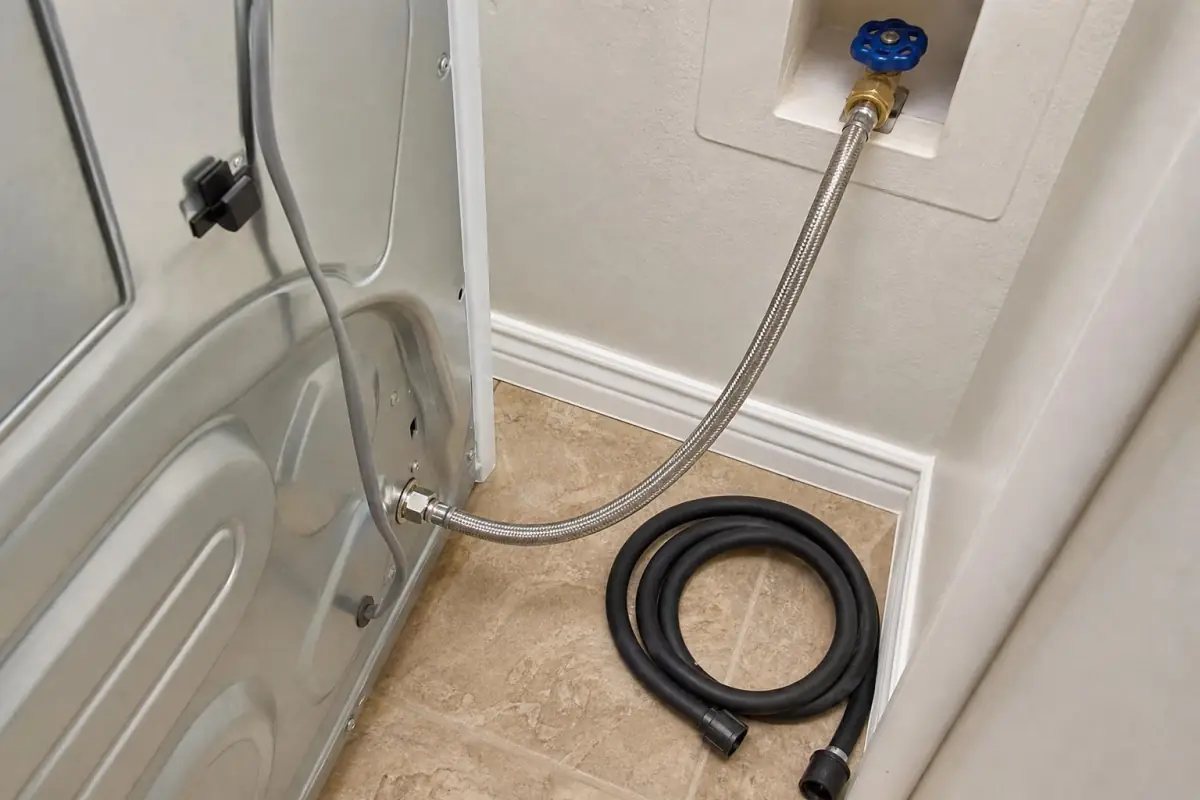
Why a 1,700 psi hose still gets a 5 year replacement date
Every source that publishes an interval gives the same 5 year ceiling regardless of construction, because the inner tube and the coupling washers age whether or not a braid covers them. Whirlpool prints the identical “every 5 years” tip on its 1,000 psi rubber page and its 1,700 psi braided page.
| Source | Replace hoses | Inspect | Other instruction |
|---|---|---|---|
| Whirlpool hose pages (8212545RP, 8212487RP, 8212638RP) | Every 5 years | Not stated | Unplug the washer and close hot and cold supplies before swapping |
| Connecticut Insurance Department, IBHS study facts | Every 5 years (washer makers’ figure) | Every 6 months | Consider reinforced braided stainless steel |
| IBHS prevention guide | Every 3 to 5 years | Regularly | Upgrade to braided stainless steel; leave 4 inches behind the washer |
| State Farm | Every 3 to 5 years | Monthly | Close the valves when away for several days |
| Certified Appliance Accessories | Every 5 years, any type | Not stated | Tag the hose with its change date |
The practical rule: write the install date on a strip of tape around the cold hose, change both hoses together at 5 years at the latest, and move that to 3 years if the hot side runs very hot or the water is hard. Replace sooner on sight of a blister, a crack near the coupling or a kink, which the Connecticut pamphlet says show up most often at the connection end.
Which washing machine hoses fit: thread, length, elbows and the 4 inch gap
Nearly every US washer hose has a 3/4 inch female garden hose (FGH) nut on both ends, the same thread as an outdoor spigot, so one pair fits almost any valve and machine. Some buying guides list these ends as NPT pipe thread; the maker describes them as garden hose ends, and they seal on the flat rubber washer inside the nut, not on the threads.
Length comes from the setup, not the box. IBHS says to leave 4 inches between the washer and the wall, and the Connecticut pamphlet gives 3 to 4 inches so the hose does not kink near the valve. Measure the old hoses at that spacing; Whirlpool’s sets come in 5, 6 and 10 foot lengths, and Certified Appliance Accessories warns that surplus hose coiled behind the washer adds stress at the end fittings.
A 90 degree elbow end, as on the 6 foot Whirlpool 8212638RP, keeps the hose from folding where it leaves a valve that points straight out. The elbow normally goes on the wall valve. If a recessed plastic outlet box is too shallow for it, Certified Appliance Accessories says to flip the hose and put the elbow on the washer. While the machine is out, check the drain hose and standpipe setup while the machine is pulled out; a drain hose pushed too far down or sealed into the standpipe causes its own floods. Our washing machine outlet box guide compares valve styles and arrestor options if the box itself needs replacing.
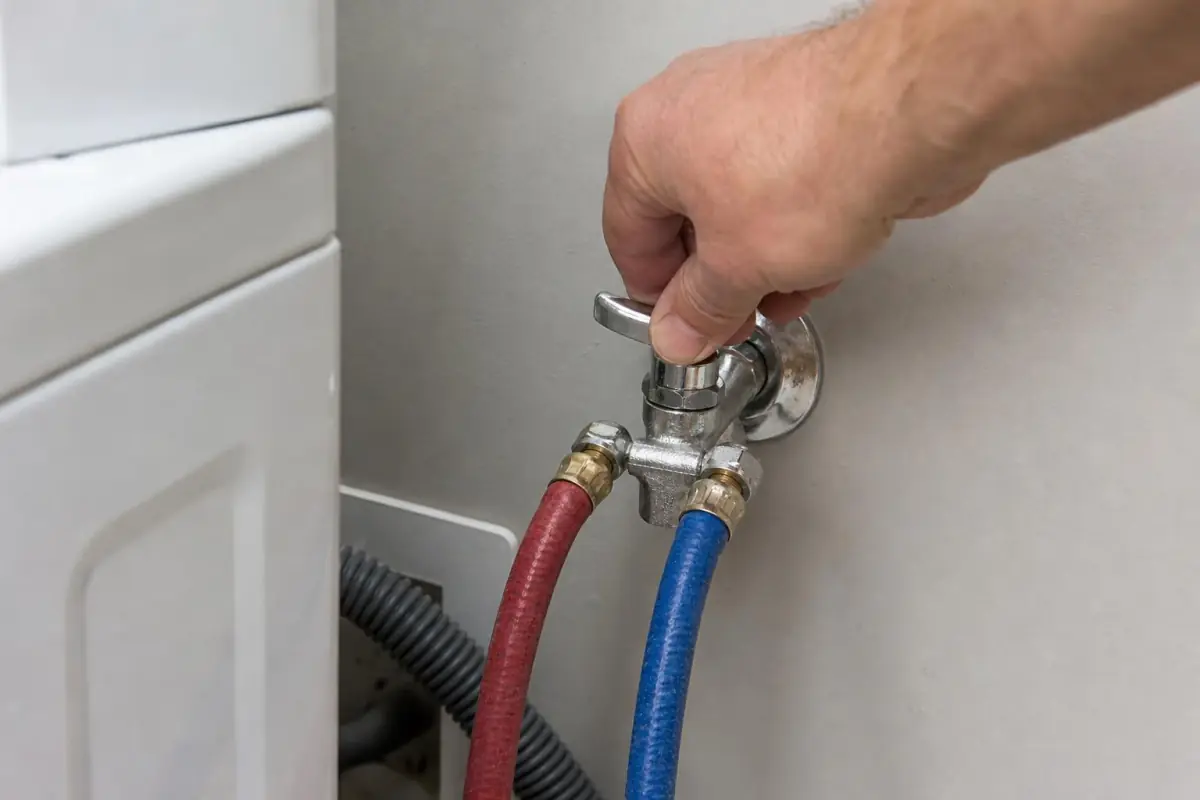
Valves, leak sensors and automatic shutoff: the backstops behind any hose
The cheapest protection is a closed valve: State Farm notes that most washer manuals carry the warning “TURN FAUCETS OFF WHEN WASHER IS NOT IN USE”, and the Connecticut pamphlet says to close the supply valves when the washer is idle and never to run it with nobody home.
A single lever outlet valve closes hot and cold with one 90 degree flip, which makes closing them after every wash a realistic habit. If the existing valves are stiff, drip at the stem or no longer stop flow fully, sort out a weeping or seized washer valve before trusting it to stop a burst.
Automatic options go further. The Watts IntelliFlow senses the washer drawing current, opens its valves only during a cycle and closes them after; its included leak sensor shuts both valves on contact with water, regardless of the wash cycle. Per the Watts brochure it ships with 1/2 inch sweat adapters, uses connections on 2 3/8 inch centers, plugs into a 115 volt GFI outlet, and needs the A2-IntelliTimer accessory for a 220 volt washer or washer dryer combo. IBHS also lists battery leak sensors at appliances, some of which close a valve automatically.
If a hose lets go with no automatic valve, close the washer valves if you can reach them without standing in water near the outlet, and otherwise go straight to closing the main shutoff for the whole house.
How we sourced this
Loss figures come from the Connecticut Insurance Department pamphlet that republishes IBHS study facts, the State Farm newsroom release on 2020 washer hose claims, the Watts IntelliFlow brochure (PF-IntelliFlow) and the IBHS December 2024 interior water white paper. Burst ratings and the 5 year interval are from Whirlpool’s own replacement part pages; construction notes from the Certified Appliance Accessories guide. The roughly 2,900 claim count and the pressure margins are our division of published numbers. FloodChek and FloodStop specifications and warranties could not be read from the makers and are left out, as is an often repeated 8.7 year average age of failed hoses we could not trace to an IBHS document.
Washing machine hose questions
Are stainless steel washing machine hoses burst proof?
No. A braided stainless hose is a plastic or rubber tube inside a metal sleeve, and the inner tube still ages. Certified Appliance Accessories says its stainless hoses use a PVC core, and Whirlpool tells buyers of its 1,700 psi braided hose to replace it every 5 years like any other.
Should I buy washing machine hoses with a 90 degree elbow?
Buy one if the washer sits close to the wall or the valves face straight out. The elbow turns the hose 90 degrees at the fitting so it does not fold. Certified Appliance Accessories says the elbow usually goes on the wall valve, but swap ends if a recessed box is too shallow for it.
How long should washing machine hoses be?
Long enough to reach with the washer pulled out 4 inches from the wall, and no longer. Whirlpool sells 5, 6 and 10 foot sets. Measure the old pair first, since Certified Appliance Accessories warns that extra length crowds the space behind the machine and loads the end fittings.
Can I use thread tape on washing machine hose fittings?
It is not needed. Washer hoses have female garden hose ends that seal on the flat rubber washer inside the coupling, not on the threads. Seat a new washer, run the nut on by hand, then snug it with pliers, about 2/3 of a turn per the Connecticut Insurance Department pamphlet.
Does homeowners insurance cover a burst washing machine hose?
A sudden burst is the kind of loss State Farm counts in its washer hose figures, which averaged $10,200 per claim in 2020. Damage from a slow leak over weeks is often treated differently, so read the water damage section of your own policy before you need it.