Can You Use CPVC Cement on PVC? What Oatey and ASTM Say
Can you use CPVC glue on PVC? Not to code. PVC cement is made to ASTM D2564 and CPVC cement to ASTM F493, and Oatey says any cement used on a pipe it is not specified for violates plumbing codes and the joint should be cut out. Weld-On says CPVC cement technically bonds PVC but still tells you to use PVC cement.
What do ASTM D2564 and ASTM F493 each cover?
Each standard covers one plastic. ASTM D2564 is titled “Solvent Cements for Poly(Vinyl Chloride) (PVC) Plastic Piping Systems” and applies to PVC piping made from compounds defined in ASTM D1784. ASTM F493 is titled “Solvent Cements for Chlorinated Poly(Vinyl Chloride) (CPVC) Plastic Pipe and Fittings” and requires a CPVC resin content of at least 10% in the cement.
That resin detail is the argument in one line: an F493 can carries dissolved CPVC, a D2564 can carries dissolved PVC, and the standard number is printed on every label we checked. A third standard, ASTM D3138, covers the green ABS to PVC transition cement; we found no ASTM cement standard written for a PVC to CPVC transition joint.
Oatey says no, Weld-On says “technically yes”: the two answers side by side
The two largest cement makers give different answers to the CPVC on PVC question, and only one of them is about code. The wording below is copied from each maker’s own FAQ or product page.
| Question | Oatey answer | IPS Weld-On answer |
|---|---|---|
| CPVC cement on PVC pipe | “We cannot support these applications although a semblance of a bond may exist.” Joints “should be cut out and the approved transition fittings used.” | “CPVC solvent cement technically will work on PVC piping,” but use “the correct Weld-On primer and PVC solvent cement.” |
| PVC cement on CPVC pipe | “Too aggressive and will cause probable failure”; cut the joints out and replace them. | “Because of temperature limitations, is not recommended for CPVC piping.” |
| Code status of the wrong cement | “A violation of all plumbing codes to use cements not specified for use with materials it is being applied to.” | No code statement in the FAQ. |
| Multi-purpose cement as a PVC to CPVC transition | All Purpose 30818: “Always check local codes for acceptability of this product.” | Weld-On 790 Multi-Purpose must not be used “as a transition cement between dissimilar materials (e.g. PVC and CPVC or ABS and PVC).” |
Sources: the Oatey solvent cement FAQ, the Weld-On technical FAQ and the Weld-On 790 product page. The decision rule that follows: on a permitted job, a CPVC cement on a PVC socket fails inspection for the label alone, even though Weld-On says the joint may hold.
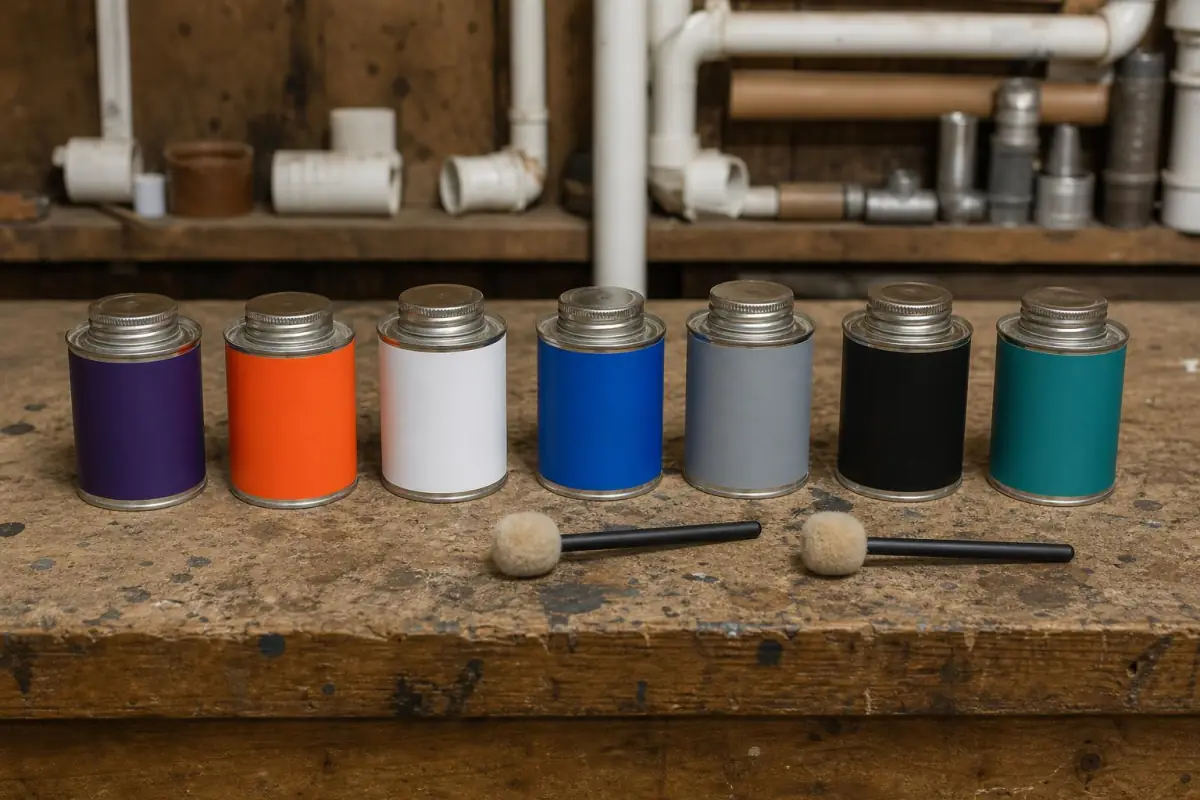
Eight real cements: standard, pipe, size limit and colour
Every cell below comes from the maker’s catalog, product page or data sheet; no maker publishes all eight in one place. Sizes are maximum diameters with an interference fit, the dry fit Oatey defines as the pipe stopping 1/3 to 1/2 of the way into the socket.
| Cement (part no.) | Standard on label | Pipe listed | Max size | Colour, body, set |
|---|---|---|---|---|
| Oatey PVC Regular Clear (31012 to 31016) | ASTM D2564 | PVC, all schedules | 4 in Sch 40, 2 in Sch 80 | Clear, regular body; apply at 40 to 110°F |
| Oatey PVC Heavy Duty Clear (30850, 31008) | ASTM D2564 | PVC, all schedules | 12 in pressure, 18 in non-pressure | Clear, heavy body; 40 to 110°F |
| Oatey FlowGuard Gold 1-Step (31910 to 31914) | ASTM F493, NSF/ANSI 61 | CTS CPVC hot and cold potable | 2 in | Yellow, medium body; 0 to 110°F; no primer where code permits |
| Oatey All Purpose (30818, 30847) | Performance requirements of D2564, D2235, F493 | ABS, PVC, CPVC | 6 in | Milky clear, medium body; check local code |
| Weld-On 705 | ASTM D2564, NSF/ANSI 14 and 61 | Rigid and flexible PVC | 6 in; 4 in Sch 80 | Clear, medium body, fast set |
| Weld-On 714 CPVC | ASTM F493 and D2846, NSF/ANSI 14 and 61 | Rigid CPVC | 12 in | Orange or gray, heavy body, medium set; to 180°F |
| Weld-On 724 CPVC | ASTM F493, NSF/ANSI 14 and 61 | Rigid CPVC and rigid PVC | 12 in | Orange or gray, heavy body, medium set; “always” with P-70 primer |
| Christy’s Red Hot Blue Glue, Low VOC | ASTM D2564, NSF/ANSI 14 and 61 | PVC, all schedules | 6 in; 4 in Sch 80 | Blue, medium body, very fast set |
Two of the eight name both PVC and CPVC, and they are not the same kind of product. Weld-On describes 724 as “specifically formulated for joining CPVC and PVC industrial piping systems carrying corrosive chemicals”, a process-piping cement sold with P-70 primer. Oatey All Purpose meets the performance requirements of three standards at once, and Oatey prints “check local codes” on it in its 2023 catalog, page 14. The other six are single-material cements: a 705 or Red Hot Blue Glue can on CPVC is PVC cement on CPVC.
The product list in this batch named an “Oatey Lo-V Universal”. No product under that name appears in Oatey’s 2023 catalog; Lo-V is Oatey’s low-VOC label, and the multi-material cement it sells is All Purpose, so that is the row shown.
Why PVC cement is the riskier mistake on CPVC
PVC cement on a CPVC line is the direction both makers reject, because CPVC carries the hot side of the house. FlowGuard Gold CPVC, made to ASTM D2846, is rated for 100 psi continuous at 180°F and 400 psi at 73°F, per the Wavin FlowGuard Gold installation guide, which also says to apply “only CPVC cement conforming to CSA B137.6 and ASTM F493.”
A joint made with D2564 cement holds dissolved PVC resin inside a CPVC socket, and Weld-On cites “temperature limitations” as its reason for ruling that out. The makers also disagree slightly on the ceiling for the same cement: Oatey’s FlowGuard Gold page says hot water “up to 200°F / 93°C”, while Weld-On’s FlowGuard Gold bulletin (FGG-04-2009) says 180°F maximum. Design to the 180°F pipe rating, the lower of the two.
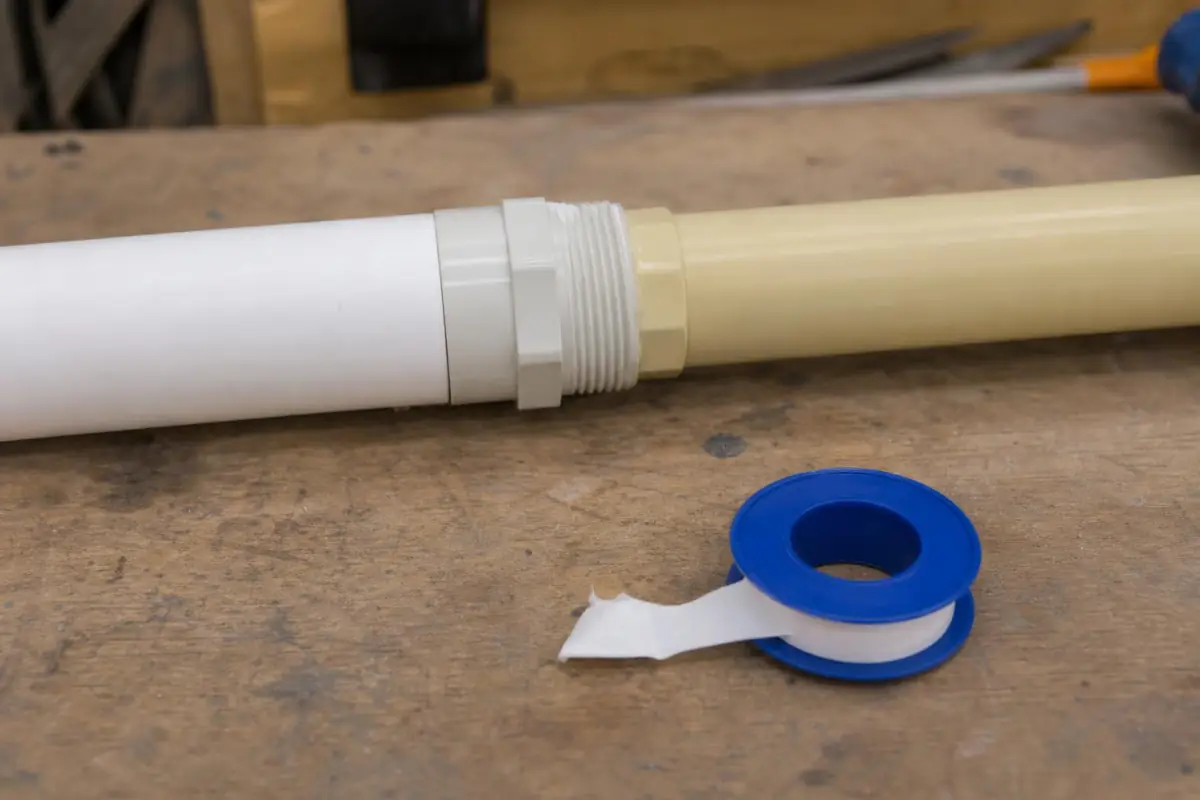
How to join PVC to CPVC without failing inspection
Join PVC to CPVC with a threaded or listed mechanical transition, and cement each side with its own standard. Oatey’s FAQ names this fix for any joint already made with the wrong cement: cut it out and use approved transition fittings.
The threaded rule comes from the same Wavin guide: male CPVC threaded adapters “may be used” on cold water connections and are “not recommended for hot water use as wide temperature fluctuations can result in a drip leak.” Because PVC is not a hot water pipe, a PVC to CPVC transition belongs on a cold branch, and the guide warns that some paste sealants “contain solvents that may be damaging to CPVC”, so tape is the default thread seal.
Do not reach for the green can. Oatey ABS to PVC Transition Green Cement (30900, 30925, 30926) meets ASTM D3138 and is listed “for use in joining ABS to PVC in non-pressure transition joints up to 6″ diameter”; CPVC is not on that label, and a supply line is a pressure line. The drain-side use of that cement is laid out in our comparison of PVC vs ABS drain pipe. If you are replumbing the CPVC run rather than tying into it, our CPVC vs PEX comparison covers the crimp and expansion fittings that need no cement at all.
Purple primer, one-step yellow cement and what the code allows
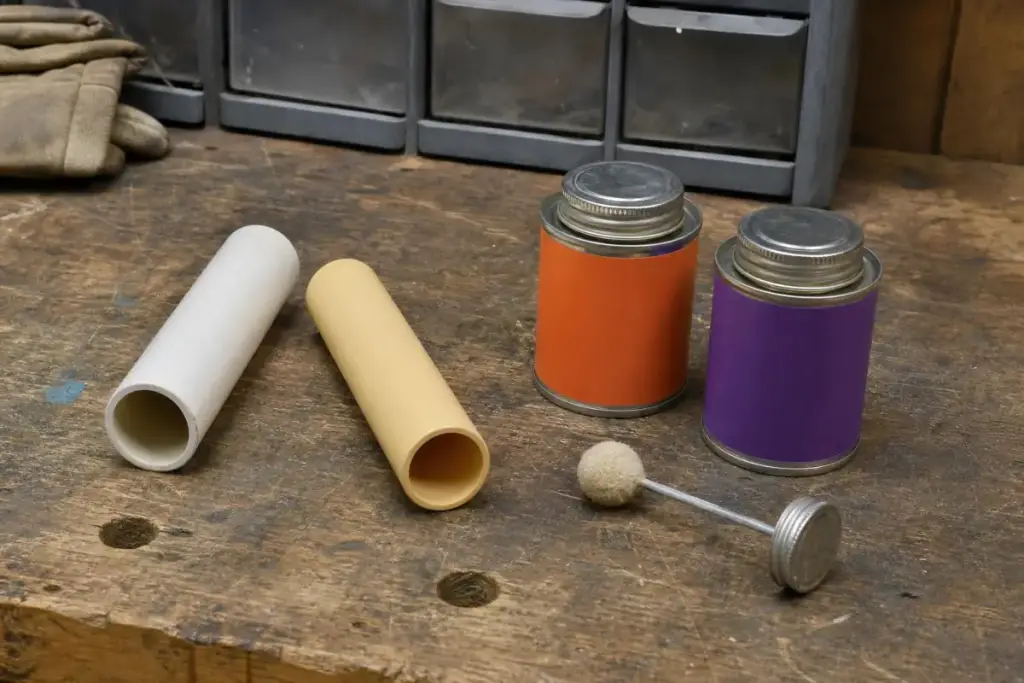
Primer rules differ by pipe and by job, and the PVC exception is narrow. The 2015 IPC Section 705.11.2 (IRC P3003.9.2) drops primer on PVC only when the cement is third-party certified to ASTM D2564 and the joint is DWV, non-pressure, 4 in or smaller. Connecticut’s State Building Inspector told officials in an August 6, 2018 memorandum that the exception does not cover “pressurized, direct venting, or any other applications.”
That memo gives inspectors three checks: what the pipe maker’s instructions say, whether the cement is third-party certified to D2564, and whether the system is non-pressure DWV at 4 in or less. “If the answer to any of these is no, or, I don’t know, then primer is required.” A PVC water line therefore gets purple ASTM F656 primer, the step shown in our guide to how to glue PVC pipe.
On CPVC, yellow one-step cement is the exception. Weld-On’s FlowGuard Gold bulletin says its IAPMO listing covers one-step use on listed CPVC “from ½ inch (20 mm) through 2 inch (63 mm), otherwise a Listed primer is required,” and Oatey’s 31910 series reads “no primer needed where local codes permit.” Weld-On’s FAQ still recommends primer for “large diameters, PVC Schedule 80, CPVC piping and cold weather installations.” Schedule 80 matters for cement choice too: Oatey Regular Clear stops at 2 in Sch 80, a limit explained alongside wall thickness in our Schedule 40 vs Schedule 80 PVC comparison.
How long to wait before pressure testing a mixed PVC and CPVC run
A run that mixes the two plastics waits for the CPVC number, which in Oatey’s chart is 4 to 6 times the PVC wait on small pipe. The figures below come from the “Average Joint Cure Times for PVC/CPVC Solvent Cements” chart on page 49 of the Oatey 2023 product catalog, which assumes 60% relative humidity or less and adds 50% “in damp or humid weather.”
| 1/2 to 1-1/4 in pipe | 60 to 100°F | 40 to 60°F | 20 to 40°F | Humid, 40 to 60°F (x1.5) |
|---|---|---|---|---|
| PVC, up to 180 psi | 15 min | 20 min | 30 min | 30 min |
| CPVC, up to 180 psi | 1 hr | 2 hr | Ask Oatey | 3 hr |
| PVC, over 180 psi | 4 hr | 8 hr | 36 hr | 12 hr |
| CPVC, over 180 psi | 6 hr | 12 hr | Ask Oatey | 18 hr |
| CPVC wait divided by PVC wait, up to 180 psi | 4.0 | 6.0 | n/a | 6.0 |
Inputs: Oatey’s chart values for the 1/2 to 1-1/4 in row, multiplied by 1.5 for the humid column and divided CPVC by PVC for the ratio row. Oatey prints no CPVC value below 40°F and says to call its technical service, and the chart is for new installations only, “not recommended for repair or cut-ins on hot and cold water distribution systems.” Test with water: Oatey and Weld-On both say never to test PVC or CPVC with compressed air or gas, and the Wavin guide suggests a 150 psi hydrostatic test for 1 hour.
How we sourced this
We read the Oatey solvent cement FAQ, Oatey’s 2023 product catalog (product pages 13 to 15 and the cure chart on page 49), the Oatey FlowGuard Gold product page, the Weld-On FAQ, Weld-On product pages for 705, 714, 724 and 790, Weld-On’s 2025 CPVC cements guide, the Weld-On FlowGuard Gold bulletin FGG-04-2009, the Christy’s Red Hot Blue Glue Low VOC page, the Wavin FlowGuard Gold installation guide, ASTM scope listings for D2564 and F493, and the Connecticut State Building Inspector memo of August 6, 2018. We computed the humid-weather column and the CPVC to PVC ratio from Oatey’s chart. We could not open the full ASTM texts or the current IPC Chapter 6 text on CPVC joints, so no CPVC code section number is quoted, and a chlorine-content figure for CPVC was left out because no primary page we could open stated it.
Questions about CPVC and PVC cement
Is CPVC cement safe on drinking water lines?
Yes when the can carries an NSF/ANSI 61 listing. Oatey FlowGuard Gold 1-Step and Weld-On 714 both list NSF/ANSI 61, and Oatey says all of its PVC and CPVC cements are tested to NSF standards. If a new CPVC line tastes of solvent, Oatey says to drain it and let the pipes air dry overnight.
What colour is CPVC cement supposed to be?
ASTM F656 names orange as the recommended colour for F493 CPVC cement, and Weld-On sells 714 and 724 in orange or gray. One-step CPVC cements for copper tube size pipe, such as Oatey 31910 and Weld-On FlowGuard Gold, are yellow. Read the ASTM F493 marking on the label, because colour alone does not prove which standard a can meets.
What do I do if I already glued PVC with CPVC cement?
Oatey’s answer is to cut the joints out and finish the run with approved transition fittings, since it treats any mismatched cement as a code violation. Weld-On says the bond may hold, but an inspector who reads F493 on the can at a PVC joint can still fail it, so redo it before the inspection.
Does the green ABS to PVC cement work for CPVC?
No. Oatey 30900 green cement meets ASTM D3138 and is listed only for ABS to PVC in non-pressure joints up to 6 in. CPVC is not on its label, and CPVC water lines are pressure lines, so it fails on both counts.
Can one can of cement cover PVC and CPVC jobs?
Some cans list both. Oatey All Purpose covers ABS, PVC and CPVC up to 6 in, and Weld-On 790 covers rigid PVC and CPVC to 6 in. Weld-On bars 790 from PVC to CPVC transition joints, and Oatey tells buyers to confirm All Purpose with local code first.