How to Flush a Tankless Water Heater (Step by Step)
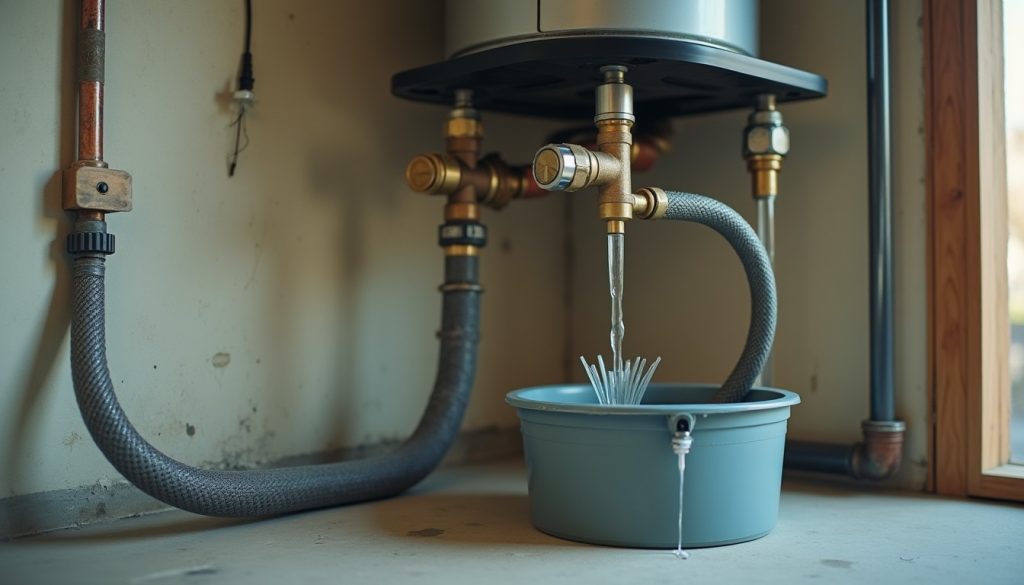
Flush tankless water heater units at least once a year: kill power and gas, close the isolation valves, and pump 4 gallons of undiluted white vinegar through the heat exchanger for 45 to 60 minutes.
Key Takeaways
- Rinnai and Navien both recommend descaling a tankless unit at least once a year, and more often where minerals, temperature, or usage are high (Navien).
- Rinnai’s procedure uses 4 gallons (15.1 liters) of undiluted white vinegar, and its US guide says never to use other chemical solutions (Rinnai).
- Circulation time runs from at least 45 minutes (Navien) to at least 1 hour at 3 to 4 gallons per minute (Rinnai Technical Bulletin 188 for Sensei models).
- The USGS classifies water above 180 mg/L as calcium carbonate as very hard, and those homes scale a heat exchanger fastest.
- A professional tankless flush costs $150 to $300, per HomeAdvisor’s 2026 cost data.
- Rinnai New Zealand states that damage caused by lime buildup is not covered by warranty, which makes skipped flushes an expensive gamble.
Why does a tankless water heater need flushing?
A tankless water heater needs flushing because hard water leaves calcium carbonate scale on the heat exchanger every time it heats. The USGS says that scale can shorten equipment life and raise water heating costs. In a tankless unit, the water passes through narrow passages at high heat, so even a thin crust cuts heat transfer and restricts flow. Reduced flow and heat transfer from that buildup often explain why a tankless unit stops working, making routine flushing worth the effort.
A tank heater collects loose sediment at the bottom. A tankless unit has no bottom to settle into, so minerals bond to the hot copper or stainless surfaces of the exchanger itself, which is the most expensive part of the heater.
So you do not drain a tankless unit to wash out grit. You circulate a mild acid through it to dissolve scale stuck to the metal.
The USGS Water Science School notes that hard water is most common in the east-central and western United States, where carbonate aquifers feed many water systems. If you live there, plan for more frequent flushing than the annual minimum.
How often should you flush a tankless water heater?
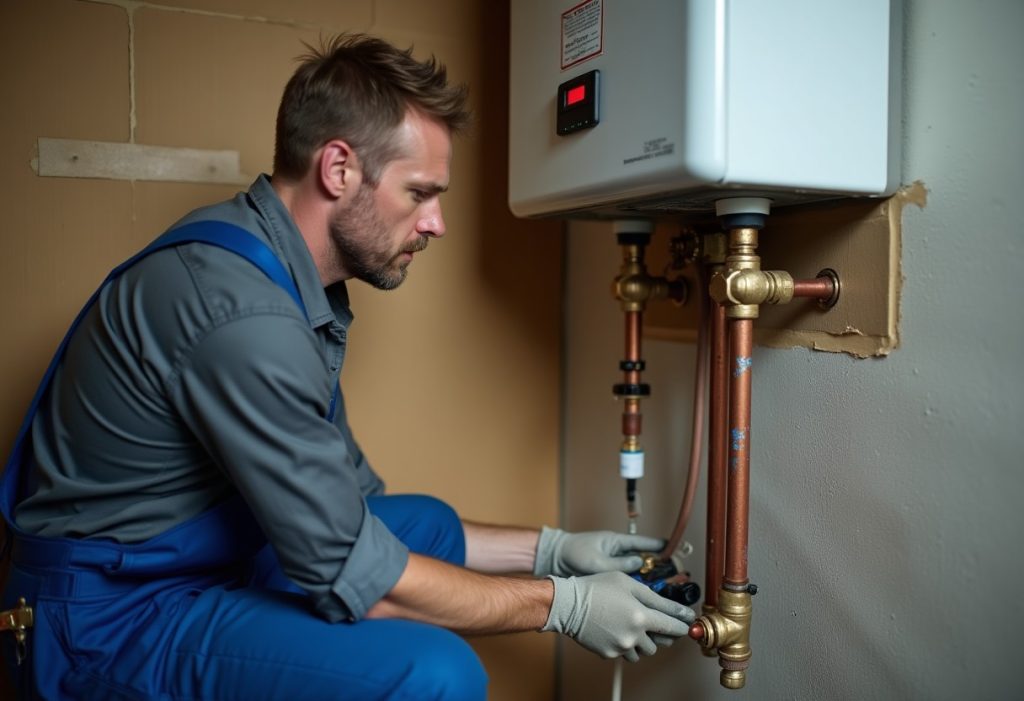
Flush a tankless water heater at least once a year, which is the baseline both Rinnai and Navien publish. Navien adds that the right frequency depends on mineral content, water temperature, and how much hot water the home uses. In practice, harder water and higher temperature settings mean shorter intervals, sometimes every 3 to 6 months.
Start by finding your hardness number. Your utility’s annual water quality report lists it, or a test strip from a hardware store gives a reading in a few minutes. Our hard water explainer covers reading the result and treatment options.
The table maps the USGS hardness classes to grains per gallon (at 17.1 mg/L per grain) and to a working flush interval. The annual floor comes from the manufacturers. The shorter intervals are our editorial scaling of that guidance, because the Rinnai and Navien documents we reviewed do not publish a hardness-indexed schedule.
| USGS hardness class | mg/L as calcium carbonate | Grains per gallon (approx.) | Working flush interval |
|---|---|---|---|
| Soft | 0 to 60 | 0 to 3.5 | Every 12 months (Rinnai and Navien minimum) |
| Moderately hard | 61 to 120 | 3.6 to 7.0 | Every 12 months; check the inlet filter at 6 months |
| Hard | 121 to 180 | 7.1 to 10.5 | Every 6 to 12 months |
| Very hard | Over 180 | Over 10.5 | Every 3 to 6 months, or add water treatment |
Navien lists water temperature as a factor, so if you raise the setpoint to 140 degrees from Rinnai’s 120 degree default, move one row down the table.
What do you need to flush a tankless water heater?
To flush a tankless water heater you need service valves with purge ports on the hot and cold lines, a small circulating or submersible pump, two or three washing machine style hoses, a 5 gallon bucket, and 4 gallons of undiluted white vinegar. Rinnai’s Sensei bulletin recommends a pump that moves about 4 gallons per minute.
- Service valves (isolation valves). These are the red and blue valve bodies under the heater with small T-shaped purge handles. Without them, you cannot isolate the unit from the house plumbing.
- Pump. A submersible pump sits in the bucket. Rinnai notes that if you use one, you can drop the separate pump inlet hose.
- Hoses. One feeds the pump outlet to the cold side purge port. One returns from the hot side purge port to the bucket.
- Descaler. Rinnai specifies food grade white vinegar. Navien also accepts an approved tankless descaling solution.
- Small brush and towel. You will clean the in-line inlet filter after the flush.
How do you flush a tankless water heater step by step?
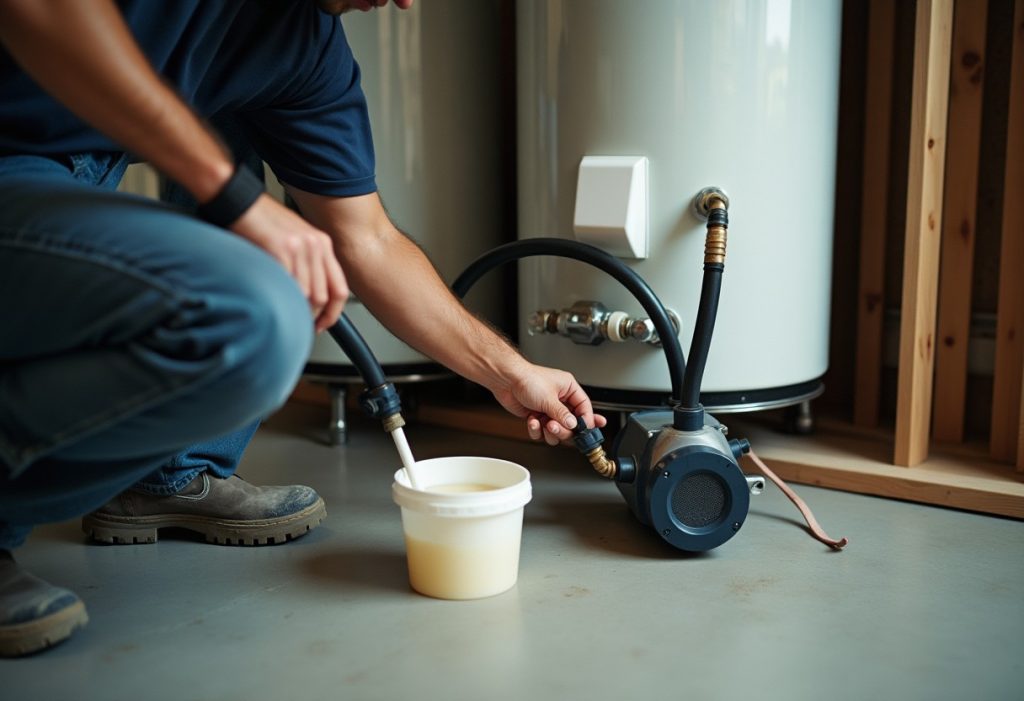
To flush a tankless water heater, shut off power and gas, close the hot and cold shutoffs, connect a pump and hoses to the purge ports, circulate vinegar for 45 to 60 minutes, rinse with fresh water for 5 to 10 minutes, clean the inlet filter, then restore water, gas, and power. The full procedure below follows Rinnai Technical Bulletin 188.
Safety first: power and gas go off before any valve moves. A burner or element that fires while the exchanger holds vinegar, or while it is empty, can damage the unit.
- Turn off the power. Unplug the unit or switch off its breaker. Rinnai notes the ON/OFF button on the controller is not a substitute.
- Shut off the gas at the appliance gas valve on a gas unit. On an electric unit, confirm every breaker serving the heater is off.
- Close the hot and cold shutoff valves so no house water enters or leaves the heater.
- Remove the purge port caps slowly. Rinnai warns there may be pressure behind them. Keep the rubber sealing discs in the caps.
- Connect the pump outlet hose to the cold water purge port, and connect the drain hose to the hot water purge port.
- Pour 4 gallons of undiluted white vinegar into the bucket, then place the pump (or the pump inlet hose) and the free end of the drain hose in it.
- Open both purge valves by turning the T handles perpendicular to the valve body.
- Run the pump. Circulate for at least 45 minutes (Navien) or at least 1 hour at 3 to 4 gallons per minute (Rinnai Sensei). If flow drops sharply, Rinnai says to pause, clean the filter, and resume.
- Rinse. Turn off the pump, move the drain hose to a sink or outdoors, and run fresh cold water through the unit. Rinnai calls for 5 minutes; Navien calls for at least 10.
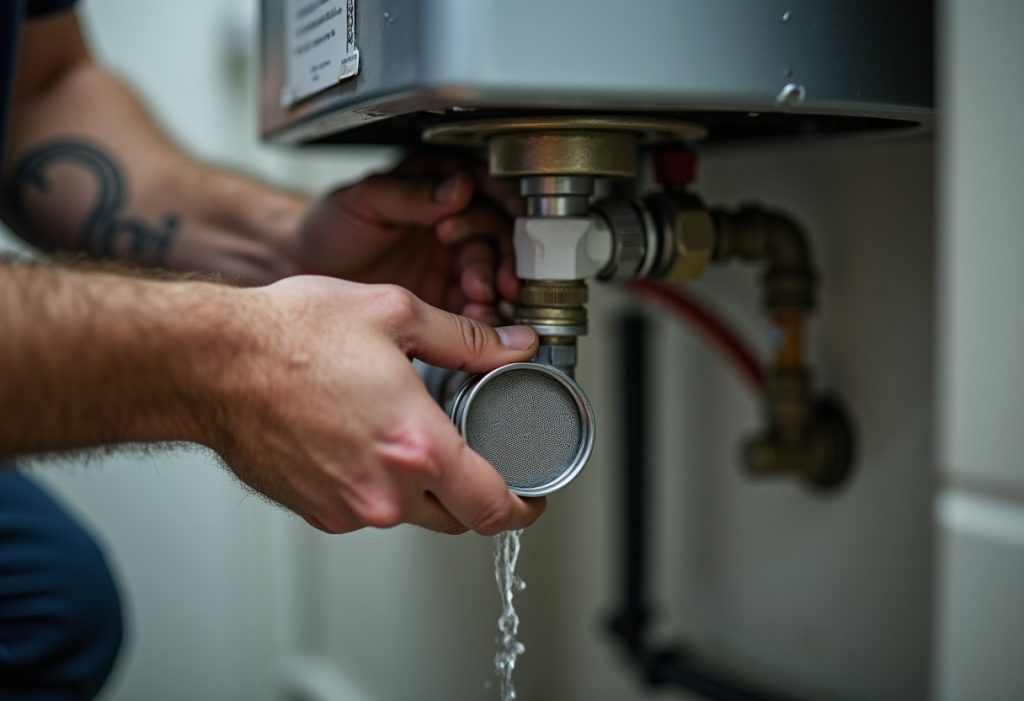
- Clean the in-line inlet filter at the cold water connection and reinstall it.
- Close the purge valves, remove the hoses, and replace the caps snugly without crushing the seals.
- Open the hot and cold shutoffs, then restore gas and power.
- Purge the air. Open a hot tap slowly and let it run until it stops sputtering, which Rinnai says may take 2 or 3 minutes.
Throw out the used vinegar. Rinnai’s bulletin is explicit that it should not be reused for the next flush. On multi-unit systems, the bulletin also says to disconnect the cascade or linking cable from the board on the unit being flushed.
Some Rinnai Sensei models need one extra step at the start. The bulletin says to unplug the unit until the display goes dark, plug it in for 20 seconds, then unplug it again so the internal valves sit in the right position for flushing.
How long does a tankless water heater flush take?
A tankless water heater flush takes roughly 90 minutes in total. The vinegar cycle alone runs 45 minutes to 1 hour depending on the manufacturer, and the fresh water rinse adds 5 to 10 minutes. Setup, filter cleaning, and purging air from the lines take the rest.
The manufacturers do not agree on the exact circulation time, and the chart shows how far apart they are.
| Manufacturer document | Descaler | Circulation | Rinse |
|---|---|---|---|
| Rinnai TB-188 (Sensei, 2023) | 4 gal undiluted food grade white vinegar | At least 1 hour at 3 to 4 GPM | 5 minutes, then clean inlet filter |
| Rinnai US 13-step guide | 4 gal undiluted white vinegar; no other chemicals | Up to 45 minutes | Per model manual |
| Navien descaling guide | White vinegar or approved descaling solution | At least 45 minutes | At least 10 minutes |
| Rinnai INFINITY (New Zealand) | About 15 L food grade vinegar or citric acid | At least 30 to 45 minutes | 5 minutes, then clean inlet filter |
Are gas and electric tankless units flushed the same way?
Gas and electric tankless units are flushed the same basic way: isolate the unit, circulate vinegar from the cold side to the hot side, then rinse. The differences are in the shutdown and the hardware. A gas unit needs its gas valve closed as well as its power cut, while an electric unit may sit on more than one breaker.
- Gas units. Scale forms on the primary heat exchanger above the burner. Condensing models, such as Rinnai’s Sensei line, add a secondary exchanger, and Rinnai issues model-specific bulletins for them. Close the appliance gas valve and cut power before touching water valves.
- Electric whole-house units. Scale coats the heating elements and their chambers instead of a finned exchanger. Large electric units often draw from two or more breakers, so verify each one is off. Follow the manual on whether the maker allows vinegar circulation or prefers element cleaning.
- Point-of-use electric units. Small under-sink heaters often ship without purge ports. Their manuals may call for removing and soaking parts rather than pump circulation.
Fuel choice also changes how much a scaled exchanger costs you. The USGS notes that scale lowers the efficiency of electric water heaters in particular. For a broader look at fuel type and system choice, see our tankless vs tank water heater comparison.
What are the signs a tankless water heater needs descaling?
The signs a tankless water heater needs descaling are hot water that swings between warm and cold, lower hot water flow at the tap, a longer wait for hot water, new rumbling or ticking from the unit, and a scale or maintenance error code on the display. Any one of these, in a hard water home, points to scale on the heat exchanger.
- Temperature swings. Scale insulates the exchanger, so the unit struggles to hold its setpoint.
- Reduced flow. Crust narrows the waterways, and a clogged inlet filter makes it worse.
- Unit shutdowns. An overheating exchanger can trip safety limits mid-shower.
- Error codes. Rinnai units can display an LC code, and Rinnai New Zealand says regular vinegar or citric acid flushing reduces the likelihood of an LC or 00 error. Other brands use their own scale or maintenance codes, so look yours up in the manual.
- Higher bills. The USGS notes that scale raises the cost of heating water.
A code that clears after a flush confirms the diagnosis. A code that returns within weeks suggests very hard water, an undersized flush, or a different fault worth a service call.
Should you flush a tankless water heater yourself or hire a pro?
Flush a tankless water heater yourself if the unit has service valves, you can reach them, and you are comfortable shutting off gas. Hire a pro if valves are missing, the unit is mounted high or in a tight space, or it is under warranty terms you are unsure of. HomeAdvisor puts a professional flush at $150 to $300 in 2026.
DIY costs are mostly one time. You buy a pump and hoses once, then pay only for 4 gallons of vinegar each flush. If your unit has no isolation valves, a plumber can install a valve kit, and every later flush becomes a 90 minute DIY job.
Rinnai’s own FAQ recommends having an experienced plumber or professional installer do the flush. A pro also checks gas pressure, venting, and the condensate line, which a vinegar flush does not touch.
Compare that $150 to $300 to repair costs. HomeAdvisor lists tankless repairs from $75 to $1,300, with an average near $600. Replacing a scaled-out unit costs far more, and our breakdown of what a tankless water heater costs to install shows why. The U.S. Department of Energy puts tankless life expectancy at more than 20 years, but that figure assumes maintenance.
If you also own a storage tank, the routine is different. Flushing a standard tank water heater means draining sediment out of the bottom rather than circulating acid through an exchanger.
How we sourced this
We cited eight named sources: Rinnai’s US 13-step flushing guide, Rinnai Technical Bulletin 188 (May 2023), the Rinnai New Zealand INFINITY vinegar flush procedure (January 2015), Navien’s descaling guide, the USGS Water Science School page on water hardness, HomeAdvisor’s 2026 tankless repair cost data, and the U.S. Department of Energy’s tankless water heater page, plus a Rinnai maintenance FAQ distributed by a Rinnai dealer, used only for the professional-service recommendation. We also read the top-ranking flush guides from retailers and contractors but did not cite them. Hardness classes come from the USGS; grains per gallon are converted at 17.1 mg/L per grain. The annual flush floor is manufacturer guidance; the shorter intervals in the hardness table are our editorial scaling, because no manufacturer document we reviewed publishes a hardness-indexed schedule. We excluded unattributed blog charts and cost figures without a named data source. Always follow the manual for your specific model.
Frequently asked questions
How often should a tankless water heater be flushed?
At least once a year. Rinnai and Navien both set annual flushing as the baseline for their tankless units. Homes on hard water often need it sooner because scale builds faster. Above 180 mg/L of hardness, which the USGS calls very hard, a 3 to 6 month interval or a water treatment system is a sensible plan.
Can I use vinegar to flush my tankless water heater?
Yes. Rinnai calls for 4 gallons of undiluted, food grade white vinegar, and Navien accepts household white vinegar or an approved tankless descaling solution. Rinnai’s US consumer guide says never to use other chemical solutions, so check your own manual before you swap in a commercial descaler. Discard the used vinegar after each flush.
What happens if you don’t flush a tankless water heater?
Scale keeps coating the heat exchanger. The USGS notes that heated hard water deposits calcium carbonate that can shorten equipment life and raise water heating costs. In a tankless unit that shows up as lower flow, swinging temperatures, and scale error codes. Rinnai New Zealand states that damage caused by lime buildup is not covered by warranty.
How long does it take to flush a tankless water heater?
Plan on about 90 minutes from shutoff to restart. Navien calls for at least 45 minutes of descaler circulation plus a 10 minute fresh water flush. Rinnai’s Sensei bulletin calls for at least 1 hour of circulation at 3 to 4 gallons per minute, followed by a 5 minute rinse. Setup, filter cleaning, and air purging add the rest.
How much does it cost to have a tankless water heater flushed?
HomeAdvisor’s 2026 cost data puts a professional tankless flush at $150 to $300. The price rises with hard to reach installs, very hard water, and units that lack service valves. Doing it yourself costs a few gallons of vinegar and a one time pump and hose kit, which you keep for every future flush.
Can I flush a tankless water heater without isolation valves?
Not in the standard way. The flush depends on service valves with purge ports on the hot and cold lines, so the pump can push vinegar through the heat exchanger without draining the house plumbing. If your unit has none, a plumber can add an isolation valve kit, and that one time upgrade makes every later flush simpler.
Do I need to turn off the gas to flush a tankless water heater?
Yes. Rinnai’s flushing procedure starts by turning off the power, then shutting off the main gas for gas units or the circuit breaker for electric ones. That keeps the burner or elements from firing while the heat exchanger is full of vinegar. Restore gas and power only after the rinse is done and the valves are reset.


