Sewer Lift Station: How Residential and Municipal Lift Stations Work
A sewer lift station is a pump station that pushes sewage uphill through a pressure pipe, from a home grinder basin with about 24 hours of reserve to city stations moving over 100,000 gallons per minute.
Key Takeaways
- EPA fact sheet 832-F-00-073 puts lift station capacity at 20 to more than 100,000 gpm; prefabricated stations generally top out near 10,000 gpm.
- Stations with peak inflow under 700 gpm customarily get two pumps, each able to carry the full peak alone, per EPA.
- E/One says its home grinder stations hold about 24 hours of emergency storage, depending on water use.
- EPA’s 1999 cost table runs from $134,467 for a 0.5 MGD station to $5.47 million for 20 MGD in Springfield, Oregon.
- St. Johns County, Florida, and Central San in California both put a private residential pump station on the homeowner.
What is a sewer lift station?
A sewer lift station is a pumping facility that collects wastewater at a low point and pumps it to a higher pipe so gravity can take over again. Every station has the same core parts: a receiving tank called a wet well, pumps, a level control, a pressurized discharge line called a force main, and an alarm. Sizes run from a backyard basin to a multi-million-dollar plant.
Utilities build them to save money. The EPA Collection Systems Technology Fact Sheet on lift stations says gravity sewer cost rises sharply once trenches pass 10 feet deep, because of heavier excavation and shoring. Pumping moves the same flow in a smaller, shallower pipe.
The tradeoff is reliability. EPA rates lift stations less reliable than gravity flow because they need power and many auxiliary systems. To see where a station sits between your house lateral and the treatment plant, read our explainer on how a municipal sewer system works.
How does a municipal sewer lift station work?
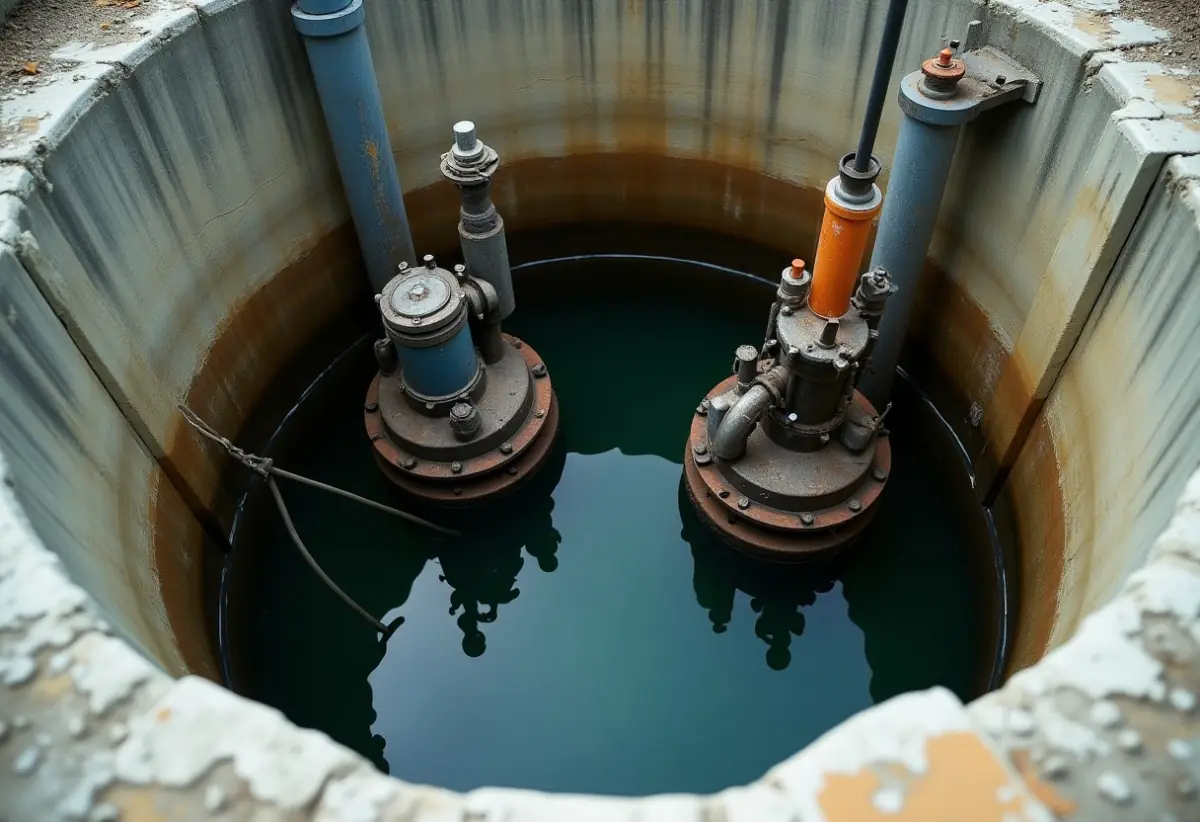
A municipal sewer lift station runs a fill and pump cycle. Gravity sewers drain into the wet well, a level sensor tracks the rise, and at a set point the lead pump pushes flow into the force main. At the off point it stops. A second pump stands by, and an alarm trips if the level keeps climbing.
- Sewage enters the wet well, often past a bar screen or grinder that EPA says cuts pump clogging.
- A level control tracks depth. EPA names a bubbler (trapped air column) as the common method, with electrodes and floats as alternatives.
- At the start level the lead pump discharges into the force main.
- If inflow outruns it, the second pump joins. Under 700 gpm, EPA says each of the two pumps should meet peak inflow alone.
- At the stop level the pumps shut off; EPA notes they may alternate to equalize wear.
- Past the high-water point, the alarm system calls the operator.
EPA sizes the wet well to stop rapid cycling without letting sewage sit: 20 to 30 minutes maximum detention with constant-speed pumps, or 5 to 15 minutes with variable frequency drives. It also calls for a 2:1 minimum bottom slope so solids self-clean, and 12 continuous air changes per hour of wet-well ventilation.
Dry-well stations keep pumps in a walk-in room; submersible stations hoist sealed pumps out on guide rails. EPA reports the trend is replacing dry-well stations under about 6,350 gpm with cheaper, smaller submersibles.
How does a residential lift station or grinder pump station work?
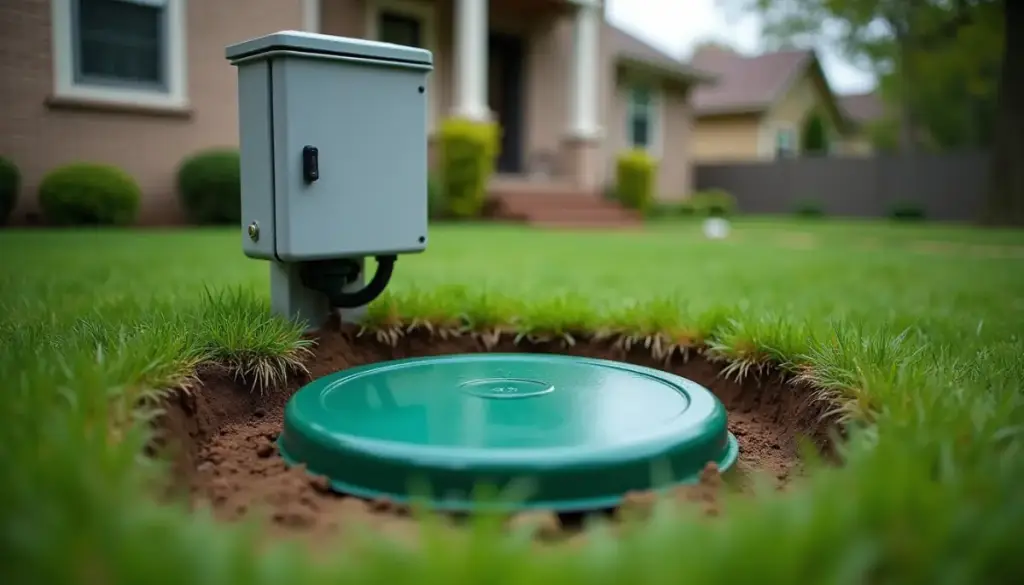
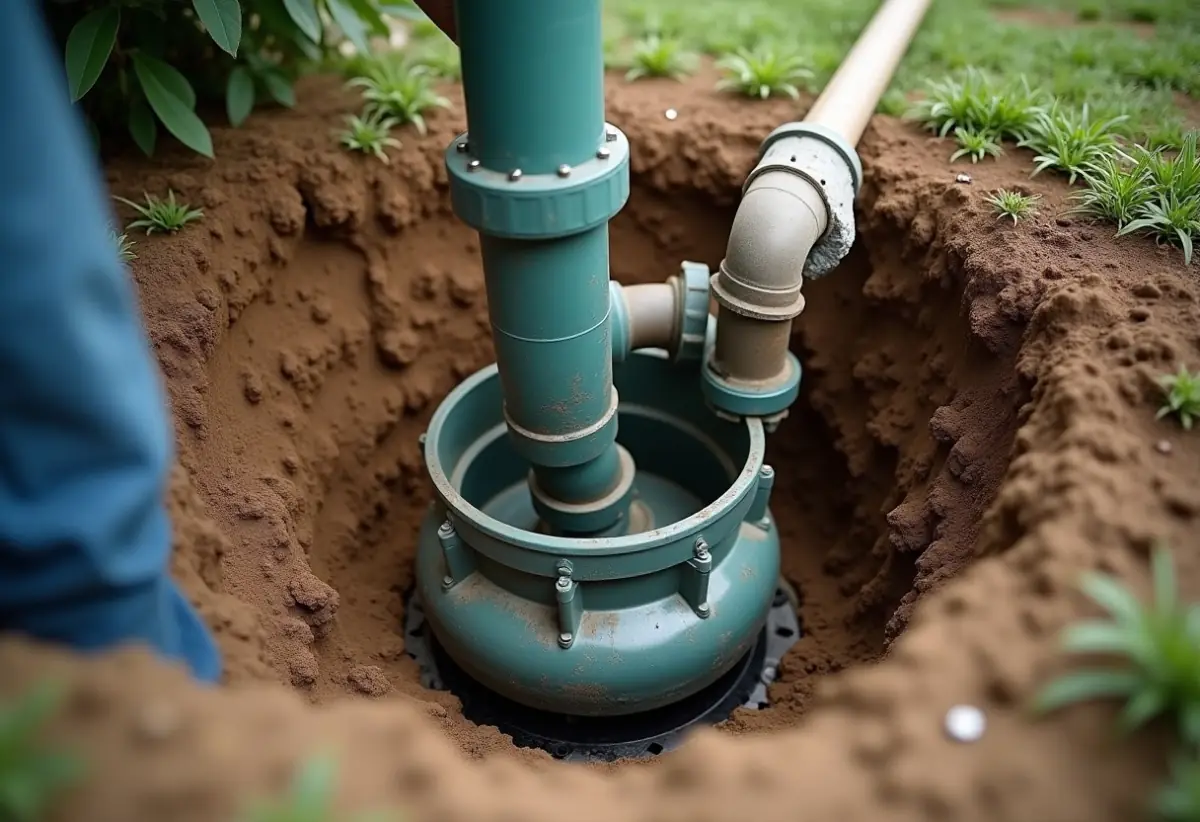
A residential lift station is a buried basin holding a pump, a float or level switch, a check valve on the discharge, and an alarm panel on the house or a post. When the basin fills, the pump sends sewage up to the gravity sewer or into a shared low-pressure main. Homes need one when fixtures sit below the sewer or the main is uphill.
In a pressure sewer district, each house gets a grinder station like those made by Environment One (E/One). The E/One Owners Guide describes a pumping unit on your property feeding a network of pipes shared with neighbors’ units, carrying wastewater to the municipal sewer or treatment plant. The grinder shreds solids so they fit those narrow lines.
The other setup is a packaged basin from makers such as Zoeller and Liberty Pumps, used for a basement bath or a house below the gravity sewer. A basin serving only a basement bath works like the sewage ejector pump we cover separately, and our breakdown of the difference between a sump pump and a sewage ejector explains why groundwater and sewage need separate pits. Choose a grinder over an ejector when the force main is long, narrow or ties into a pressure sewer.
What are the types of sewer lift station, and who owns each?
Sewer lift stations fall into four practical types: a single-home grinder station, a home ejector basin, a small city submersible station, and a large custom station. They differ in pump, capacity, ownership and price by orders of magnitude. EPA costs below are in 1999 dollars, not adjusted for inflation.
| Type | Where | Pump | Capacity | Usual owner | Cost (source) |
|---|---|---|---|---|---|
| Home grinder station (E/One) | Each lot in a low-pressure sewer district | Grinder pump in a buried tank | About 24 hr emergency storage (E/One) | Homeowner in St. Johns County, FL and Central San, CA; varies elsewhere | $16,100 to $25,970 per connection (Chatham, MA) |
| Home ejector or grinder basin (Zoeller, Liberty) | Basement bath or a house below the sewer | Ejector or grinder | Sized to the fixtures served | Homeowner | Quoted per job |
| Small municipal submersible | Low points in a gravity network | Two pumps, each meeting peak inflow | Under 700 gpm peak (EPA) | City or sewer utility | $134,467 at 0.5 MGD (EPA) |
| Prefabricated municipal station | Subdivisions and trunk sewers | Centrifugal, often submersible | Up to about 10,000 gpm (EPA) | Utility; developer first in some towns | $246,524 at 1 MGD (EPA) |
| Large custom dry-well station | Major trunk lines | Duty pumps plus a standby | Over 100,000 gpm possible (EPA) | City or regional authority | $128.8 million at 750 MGD, Detroit (EPA) |
For scale, 1 MGD (million gallons per day) averages about 694 gallons per minute.
Who maintains a lift station, the homeowner or the city?
The city or sewer utility almost always owns and maintains public lift stations, while the homeowner usually owns a station that serves only their property. Rules differ by utility, so the deciding document is your local sewer ordinance, a recorded easement, or a pump station affidavit signed at permit time.
The St. Johns County, Florida pump station affidavit makes operation and maintenance the sole responsibility of the homeowner. Central San in California says owners of homes below the public sewer must install and maintain a residential sewage pump. Rigby, Idaho’s code makes the developer responsible for a subdivision lift station for up to one year after the final house is completed.
Service follows ownership. E/One tells owners not to repair the unit themselves, to call an authorized service provider, and expects no service for several years under normal use. City crews inspect weekly, per EPA, checking pumps for noise, vibration, heat and leaks, plus valves, panel switches and discharge rates, and keep critical spare parts on hand.
How much does a sewer lift station cost?
A municipal sewer lift station cost $134,467 at 0.5 MGD and $5.47 million at 20 MGD in EPA’s 1999 dollar table, and today’s prices run higher. A home grinder connection in Chatham, Massachusetts was estimated at $16,100 to $25,970. Capacity, pump horsepower, rock, dewatering and backup power drive the gap.
EPA spells out the economics. Doubling capacity raises construction cost only 50 to 55 percent, and two identical stations cost 25 to 30 percent more than one of the same combined capacity. Stations with two or more complicating factors, such as rock excavation, cofferdam dewatering, piling, on-site generators or heads above 200 feet, cost two to three times more.
At home, the Cape Cod Chronicle reported a Chatham estimate of about $1,500 for pump electrical work plus $2,000 to $3,000 in added installation, against $5,800 to $11,870 for a gravity connection. Your quote turns on lateral length, rock, panel distance and whether the utility supplies the pump.
Why do sewer lift stations fail?
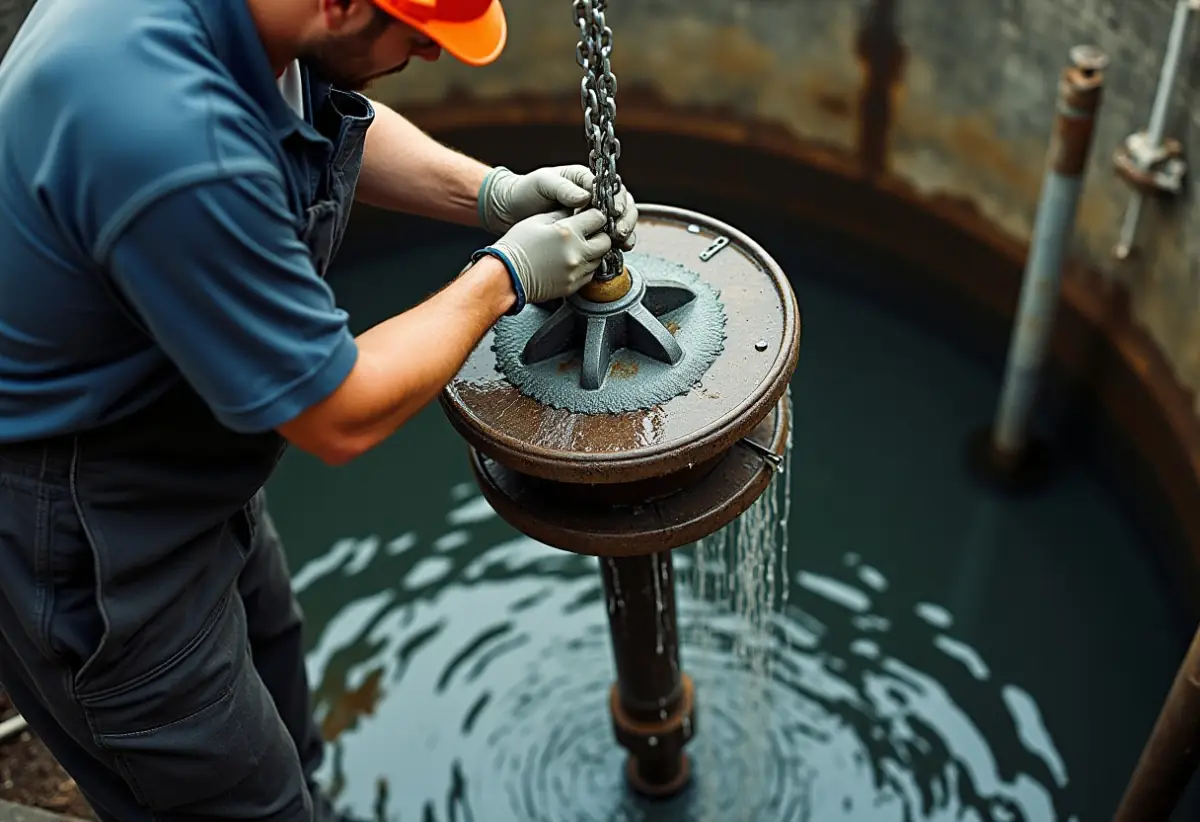
Sewer lift stations fail for four main reasons: solids that clog or wrap the pump, lost power, stormwater that overloads the basin, and corrosion from sewer gas. The first three cause most homeowner alarms, and each is preventable or survivable if you know your storage window.
- Wipes, rags and grease. E/One’s do-not-flush list includes wipes of any kind, fat, oil and grease, rags, hair, cotton swabs, cat litter, latex, syringes and pharmaceuticals.
- Power outages. EPA says lost power stops flow and can flood upstream; city stations add dual power lines, generators or standby engine pumps. A home grinder station rides on its roughly 24 hours of reserve.
- Rainwater inflow. E/One says an alarm that sounds when it rains means rainwater may be overloading the system; have a plumber look for roof or sump lines tied in.
- Corrosion. The city of Arlington, Texas rehabilitated two lift stations whose condition it tied to age and corrosion from gases inside the station.
What should you do when a lift station alarm goes off?
When a residential lift station alarm goes off, silence the horn, stop using water, wait one hour, and call your service provider if the light is still on. Those are the four steps in E/One’s owners guide. With about 24 hours of reserve depending on use, a quick response usually prevents a backup into the house.
- Press the silence button under the alarm panel. The horn stops; the light stays on.
- Stop laundry, dishwashing, showers and extra flushing.
- After an hour, check the light. If it is off, the system cleared itself.
- If it is still lit, call the number on your panel with your name, address and phone number.
After a power failure, call if the alarm stays on more than an hour after power returns. If the discharge pipe breaks, turn off power to the pump, the only time E/One says to. The panel behaves much like a septic tank alarm, but your clock is the basin’s reserve. Do not touch the valves, block the vent or cover the lid. Before a long trip, run clean water in until the pump cycles off.
How we sourced this
We consulted 12 sources in October 2026 and cited 7: EPA fact sheet 832-F-00-073 (September 2000), the E/One Owners Guide (LM000403 Rev G, October 2022), the St. Johns County affidavit, Central San, Rigby, Idaho’s city code, the City of Arlington, Texas, and the Cape Cod Chronicle. EPA costs are 1999 dollars. We left out pump horsepower, flow ratings, tank volumes and model numbers for E/One, Zoeller and Liberty units because no primary source we reached confirmed them, and we excluded online cost guides whose figures conflicted.
Frequently asked questions
What is the purpose of a sewer lift station?
A sewer lift station pumps wastewater uphill where gravity flow will not work or would need very deep pipe. EPA notes that gravity sewers laid deeper than 10 feet cost much more to build, so utilities pump instead. At home, a grinder pump or ejector basin does the same job when the house sits below the sewer.
What happens to a lift station when the power goes out?
The pumps stop and the basin starts filling. EPA warns that lost power halts flow and can flood upstream, which is why city stations carry generators or dual feeds. E/One says its home stations hold about 24 hours of emergency storage depending on water use, so cut water use until power returns.
Who is responsible for a residential lift station?
In many areas the homeowner is. St. Johns County, Florida, makes operation and maintenance of a private residential pump station the sole responsibility of the homeowner, and Central San in California requires the owner to install and maintain the pump. Rules vary by utility, so read your sewer ordinance or easement before paying for repairs.
How much does a residential lift station cost?
Costs swing widely by site. A Chatham, Massachusetts committee estimated $16,100 to $25,970 to connect a home through a grinder pump, against $5,800 to $11,870 for a gravity connection, per the Cape Cod Chronicle. Pump electrical work alone ran about $1,500 in that estimate.
What is the difference between a lift station and a grinder pump?
A lift station is any pumping station that raises sewage to a higher pipe, from a single-home basin to a city plant. A grinder pump is one pump type used in home stations. It shreds solids into a slurry that fits through the narrow pipes of a low-pressure sewer, which a standard ejector cannot do.
Do sewer lift stations smell?
A working station should not smell much. EPA says wet wells should always hold some sewage, with detention kept to 20 to 30 minutes on constant-speed pumps, to limit odor. E/One says a normal home unit has no noticeable odor and suggests running clean water down a sink for about 10 minutes if one appears.
Can you flush wipes into a grinder pump?
No. E/One puts wipes of any kind on its do-not-flush list and tells owners to bin anything labeled flushable. Wipes, rags, grease and hair wrap impellers and trip alarms. EPA notes that city stations install bar screens or grinders ahead of the wet well for the same reason.