Plumbing Terms: A Glossary of 80 Words Plumbers Use
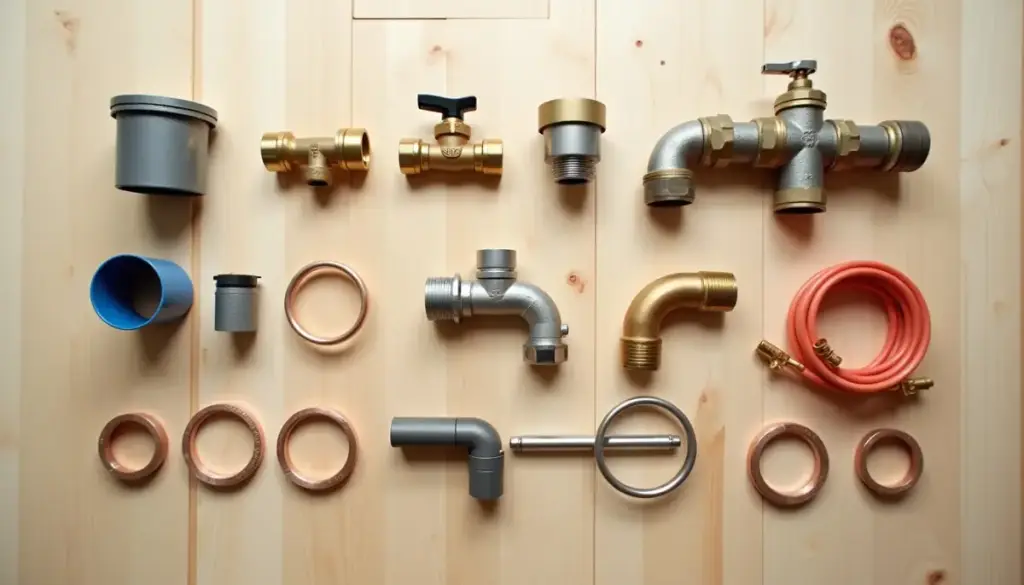
Plumbing terms fall into six families: supply, drain-waste-vent (DWV), fittings and threads, fixture parts, code and testing language, and tools, and every word below comes with a real number you can use.
Key Takeaways
- DWV means drain, waste and vent. IPC Table 709.1 rates a 1.6 gpf private toilet at 3 DFU, a lavatory at 1.
- Per ASTM B88, 1/2 inch CTS copper is 0.625 inch across. 1/2 inch IPS is 0.840 inch.
- NPT threads taper 1 in 16 on the diameter under ASME B1.20.1, with 14 threads per inch on 1/2 inch pipe.
- IPC Section 604.8 calls for a PRV where static pressure exceeds 80 psi.
- IRC Table P3105.1 caps a 1-1/2 inch trap arm at 6 feet from its vent.
Quick jump, A to Z: AAV, Aerator, Air gap, Angle stop, ASSE, Backflow, Basin wrench, Bathroom group, Bend, Branch vent, Building drain, Building sewer, Cartridge, Circuit vent, Cleanout, Closet auger, Closet flange, Combo, Compression, Crimp ring, Cross connection, CTS, Curb stop, Developed length, DFU, Dielectric union, DWV, Escutcheon, Fall, Ferrule, Fill valve, Final, FIP, Flapper, Flare, Flood level rim, Flush valve, GHT, Hose bib, Individual vent, IPC, IPS, IRC, Main shutoff, MIP, Nipple, NPT, Overflow tube, PEX, PEX crimp tool, Pipe wrench, PRV, PTFE tape, Push-fit, Refill tube, Rough-in, RPZ, Sanitary tee, Slip joint, Soil pipe, Stack, Stack vent, Supply line, Sweat, Tailpiece, Top-out, TPI, Trap, Trap arm, Trap seal, Trap weir, Tubing cutter, Union, UPC, Vacuum breaker, Vent stack, Waste pipe, Water service pipe, WHA, Wye
Why do plumbing terms trip up homeowners?
Plumbing terms trip people up because one part has three names and the box size is rarely the real measurement. A “1/2 inch” copper line is 0.625 inch across, a “1/2 inch” threaded pipe is 0.840 inch, and a counter clerk may call one female fitting FIP, FPT or FNPT.
IPC definitions quote Chapter 2 in the Ohio adoption of IPC 2021 on UpCodes.

What are the water supply plumbing terms?
Supply terms cover the pressurized pipe from the main to each faucet. Sizing is the catch. CTS (copper tube size) and IPS (iron pipe size) put different outside diameters behind the same nominal number, so a 1/2 inch IPS escutcheon rattles on copper and a 1/2 inch CTS plate will not pass over a steel nipple.
| Term | Plain meaning | Spec or example |
|---|---|---|
| Angle stop | 90 degree shutoff under a fixture | BrassCraft G2CR19X: 1/2 in in, 3/8 in OD compression out |
| CTS | Copper tube size | OD is nominal plus 1/8 in (ASTM B88) |
| Curb stop | Utility valve near the property line | Some utilities seal or fine tampering |
| Hose bib | Outdoor faucet | 3/4 in GHT spout, 11.5 TPI |
| IPS | Iron pipe size | 1/2 in IPS is 0.840 in OD |
| Main shutoff | House valve past the meter | Angi: $180 to $220 to replace, basement access |
| PEX | Cross-linked polyethylene tubing | ASTM F876 requires 65% to 89% crosslinking |
| PRV | Pressure-reducing valve | Required above 80 psi (IPC 604.8) |
| Supply line | Braided hose from stop to fixture | 3/8 in OD compression at the stop |
| WHA | Water hammer arrestor | ASSE 1010, PDI sizes A to F |
| Water service pipe | Pipe from the main or well into the house | Starts at the curb stop on city water |
What does DWV stand for in plumbing, and what are its parts?
DWV stands for drain, waste and vent, the gravity system that carries used water out and lets air in behind it. The IPC defines a drainage system as piping that “conveys sewage, rainwater or other liquid waste to a point of disposal.” A plumbing vent diagram shows how they connect.
| Term | Plain meaning (IPC wording in quotes) | Spec or example |
|---|---|---|
| AAV | “One-way valve” admitting air under negative pressure | ASSE 1051 fixture or branch, 1050 stack |
| Bathroom group | Toilet, lavatory and tub or shower together | 5 DFU at 1.6 gpf, 6 above it |
| Branch vent | Joins individual vents to a vent stack or stack vent | Gathers a bathroom’s vents |
| Building drain | Lowest drainage piping in the building | Ends where the building sewer starts |
| Building sewer | Building drain to public sewer or septic | 4 in falls at least 1/8 in per foot |
| Circuit vent | Branch vent serving a battery of traps | Commercial restroom rows |
| Cleanout | “An access opening” for clearing obstructions | Plug at the stack base |
| Combo | Wye plus 1/8 bend in one fitting | Turns a branch horizontal |
| Developed length | Length along the pipe and fitting centerline | How trap arms are measured |
| DFU | Drainage fixture unit, “probable discharge” | Lavatory 1, kitchen sink 2 |
| DWV | Drain, waste and vent | Printed on PVC and ABS drain pipe |
| Fall | Slope of a horizontal drain | 1/4 in per foot at 2-1/2 in and under (IPC Table 704.1) |
| Individual vent | Vents one trap, ties in above the fixture | Also called a back vent |
| Sanitary tee | Tee with a curved branch into a vertical pipe | Lav arm into a 2 in stack |
| Soil pipe | Carries sewage “containing fecal matter” | Toilet line, often 3 in |
| Stack | Any vertical soil, waste or vent line | Basement to roof |
| Stack vent | Stack extended above the highest horizontal drain | The pipe through most roofs |
| Trap | Fitting holding a liquid seal against sewer gas | Lav 1-1/4 in, bathtub 1-1/2 in (Table 709.1) |
| Trap arm | Fixture drain from trap weir to vent | 6 ft max on 1-1/2 in |
| Trap seal | “Vertical distance between the weir and the top of the dip” | Commonly 2 to 4 in |
| Trap weir | Lip where water leaves the trap | Trap arm length starts here |
| Vent stack | Vertical vent built only to circulate air | Parallels tall soil stacks |
| Waste pipe | “A pipe that conveys only waste” | Sink, tub and washer lines |
| Wye | Y fitting with a 45 degree branch | Horizontal joins |
See how a P-trap holds its seal for why the arm must reach a vent. IRC Table P3105.1, read on the Texas adoption on UpCodes, sets these limits.
| Trap size | Fall per foot | Max trap to vent |
|---|---|---|
| 1-1/4 in | 1/4 in | 5 ft |
| 1-1/2 in | 1/4 in | 6 ft |
| 2 in | 1/4 in | 8 ft |
| 3 in | 1/8 in | 12 ft |
| 4 in | 1/8 in | 16 ft |
Toilets and other self-siphoning fixtures are exempt. Their length “shall not be limited.”

How many drainage fixture units does each fixture count as?
Each fixture counts for its value in IPC Table 709.1, which the code says designates “the relative load weight of different kinds of fixtures.” A lavatory is 1, a kitchen sink, bathtub or shower up to 5.7 gpm is 2, and a private 1.6 gpf toilet is 3. A bathroom group with that toilet totals 5, not the 7 you get by adding parts.
The table, read on UpCodes in Maryland’s 2024 adoption, puts a residential clothes washer at 2 DFU. Showers climb with flow, reaching 6 DFU and a 4 inch trap above 25.8 gpm.
What plumbing terminology describes fittings and threads?
Fitting terms tell you how two pieces join: thread, solder, compression, flare or push. NPT is the tapered US pipe thread under ASME B1.20.1, narrowing 3/4 inch per foot so the flanks wedge tight, and FIP or MIP only says whether the threads sit inside or outside.
| Term | Plain meaning | Spec or example |
|---|---|---|
| Bend | Fitting named by fraction of a circle | 1/4 bend 90 degrees, 1/8 bend 45 |
| Compression | Nut squeezes a ring onto the tube | No PTFE tape on the threads |
| Crimp ring | Copper ring pressed over a PEX barb | Check with a go/no-go gauge |
| Dielectric union | Insulated union between copper and steel | IPC accepts a brass fitting instead |
| Ferrule | The ring inside a compression joint | Single use, it deforms onto the tube |
| FIP | Female iron pipe, threads inside | Same as FPT, FNPT |
| Flare | Tube end spread into a cone, held by a nut | Soft copper gas lines |
| GHT | Garden hose thread, straight | 3/4 in, 11.5 TPI (ASME B1.20.7) |
| MIP | Male iron pipe, threads outside | Same as MPT, MNPT |
| Nipple | Short pipe, male threads both ends | Close nipple is threaded full length |
| NPT | National Pipe Thread, tapered | 60 degree thread, 1 in 16 taper |
| Push-fit | Grab ring and O-ring joint | ASSE 1061, 100 psi at 180°F |
| Slip joint | Joint sealed by a washer or packing (IPC) | Trap nuts, hand tight |
| Sweat | Soldered copper joint | Solder on potable lines max 0.2% lead |
| TPI | Threads per inch | 14 on 1/2 and 3/4 in NPT |
| Union | Three-piece joint opened without turning pipe | Water heater connections |
Our guide to NPT pipe threads covers taper and sealant, and FIP vs MIP thread genders explains why 1/2 inch MIP measures 0.840 inch.
What are the names of toilet and faucet parts?
Fixture terms name the parts you replace most: the flush valve, flapper, fill valve and tubes in a toilet tank, and the cartridge, aerator, escutcheon and tailpiece at a faucet. Part numbers matter, because Delta’s RP46074 and RP19804 cartridges differ by 5/16 inch in height.
| Term | Plain meaning | Spec or example |
|---|---|---|
| Aerator | Spout screen mixing air into the stream | WaterSense bath faucets 1.5 gpm or less |
| Cartridge | Valve insert controlling flow and mix | Delta RP46074 4-7/16 in, RP19804 4-1/8 in |
| Closet flange | Floor ring anchoring the toilet | Usually 12 in from the finished wall |
| Escutcheon | Trim plate over a pipe hole | CTS hole 5/8 in, IPS about 27/32 in |
| Fill valve | Refills the tank after a flush | Fluidmaster 400H, water 1/2 in below overflow |
| Flapper | Rubber seal over the flush valve | WaterSense says replace every 5 years |
| Flush valve | Opening between tank and bowl | 2, 3 or 4 in class |
| Overflow tube | Pipe that stops tank overfill | 1 in or more below the handle hole |
| Refill tube | Small hose topping up the bowl | Must drain into the overflow pipe |
| Tailpiece | Straight pipe from sink drain to trap | 1-1/2 in kitchen, 1-1/4 in lavatory |
To size a flapper, measure the drain hole. Fluidmaster says about 2.5 inches means a 2 inch flapper, 3.5 inches a 3 inch.

Which plumbing terms come from codes and inspections?
Code terms name the rulebooks and inspection stages. Most states adopt the IPC or UPC, and many apply the IRC to one and two family homes, where plumbing sections carry a P prefix. Inspections usually run rough-in, top-out and final.
| Term | Plain meaning | Spec or example |
|---|---|---|
| Air gap | Open space between an outlet and the flood level rim | Spout above the sink rim |
| ASSE | Standards body for plumbing devices | 1010 arrestors, 1051 AAVs, 1061 push-fit |
| Backflow | Water running backward into the potable supply | From backsiphonage or backpressure |
| Cross connection | Link between potable and other piping | Hose in a bucket of weed killer |
| Final | Last inspection, fixtures working | Closes the permit |
| Flood level rim | “The edge of the receptacle from which water overflows” | Datum for measuring air gaps |
| IPC | International Plumbing Code, by the ICC | DFUs in Table 709.1 |
| IRC | International Residential Code, by the ICC | Trap arms in Table P3105.1 |
| Rough-in | Parts installed before the fixtures (IPC) | Pipe in open walls |
| RPZ | Reduced pressure principle backflow assembly | Two independent checks plus a relief valve |
| Top-out | Inspection of pipe run up through walls | Before insulation and drywall |
| UPC | Uniform Plumbing Code, by IAPMO | Common in Western states |
| Vacuum breaker | Backflow preventer open to atmosphere | AVB is ASSE 1001, PVB is ASSE 1020 |
Which plumbing tools have names worth knowing?
Six tool names cover most homeowner repairs: pipe wrench, basin wrench, tubing cutter, PEX crimp tool, closet auger and PTFE tape. Oatey calls for 3 to 5 wraps of tape on 1/2 to 1 inch threads, and an NPT joint usually seals at hand tight plus 1 to 2 wrench turns.
| Term | Plain meaning | Spec or example |
|---|---|---|
| Basin wrench | Long-shank jaw for nuts behind a sink | Faucet mounting nuts |
| Closet auger | Short sleeved snake for toilets | Sleeve protects the porcelain |
| PEX crimp tool | Presses copper rings onto PEX fittings | Gauge every ring |
| Pipe wrench | Toothed wrench for threaded pipe | Use two, one backing up the fitting |
| PTFE tape | Thread seal tape | Clockwise, male threads only |
| Tubing cutter | Wheel cutter for copper and plastic | Ream the burr before soldering |
How we sourced this
In October 2026 we read IPC Table 709.1 on UpCodes (Maryland’s 2024 adoption), IPC 2021 Chapter 2 definitions (Ohio’s 2024 code) and IRC Table P3105.1 (Texas, 2018). Other specs come from our earlier sourced guides citing ASME B1.20.1, ASTM B88, ASTM F876, ASSE, Oatey, Fluidmaster, Delta, BrassCraft and EPA WaterSense. Local amendments vary.
Frequently asked questions
What does DWV stand for in plumbing?
DWV stands for drain, waste and vent. It is the gravity side of a house, the pipes carrying used water out plus the vents letting air in. The IPC calls the drain part the drainage system, piping that conveys sewage or other liquid waste to a point of disposal.
What is the difference between CTS and IPS?
CTS means copper tube size and IPS means iron pipe size, two different outside diameters behind the same nominal number. ASTM B88 copper runs 1/8 inch over its name, so 1/2 inch CTS is 0.625 inch across, while 1/2 inch IPS pipe is 0.840 inch.
What is a DFU in plumbing?
A DFU, or drainage fixture unit, is the IPC’s measure of the probable discharge a fixture sends into the drain. Table 709.1 lists a lavatory at 1, a domestic kitchen sink at 2, a private 1.6 gpf toilet at 3 and a bathroom group at 5.
What is the difference between a stack vent and a vent stack?
A stack vent is the top of the drain stack itself, the stretch above the highest horizontal drain that runs up through the roof. A vent stack is a separate vertical pipe installed only to circulate air. Most one-story houses have a stack vent but no vent stack.
What does rough-in mean in plumbing?
The IPC defines rough-in as the parts of the plumbing system installed before the fixtures. That means drains, vents and supply pipes run through open walls and stubbed out. It is inspected before insulation or drywall goes up, so a failed test costs minutes instead of a torn-out wall.
What is an RPZ valve?
An RPZ is a reduced pressure principle backflow prevention assembly, which the IPC describes as two independently acting check valves. A relief valve between them dumps water if either check leaks. It stops backsiphonage and backpressure, so utilities often require one on irrigation and boiler feeds.