How to Find Your Sewer Line (and How Deep It Is Buried)
To find the sewer line on your property, start at the cleanout, follow it from the main stack toward the street, pull city records, then confirm the path and depth with a camera and sonde.
Key Takeaways
- Residential sewer lines are typically buried 2 to 8 feet deep, per eLocal, with the deepest runs (4 to 8 feet) in the Midwest.
- The International Code Council’s IPC guide lists a minimum slope of 1/4 inch per foot for drain pipe 2.5 inches or smaller and 1/8 inch per foot for 3 to 6 inch pipe, so the line gets deeper the farther it runs.
- 811 is free, but the City of South Bend notes that Indiana 811 does not locate individual private lines, only public mains.
- Angi puts a standalone sewer camera inspection at about $150 to $500 in 2026, which is the usual way a plumber finds a lateral with no records.
- Push cameras such as RIDGID SeeSnake systems carry a 512 Hz sonde that a handheld receiver tracks from above ground to mark path and depth.
- Home Depot tool rental lists a sewer camera at about $73 a day, a DIY option if the unit includes a locator.
How do you find the sewer line on your property?
Finding the sewer line on your property takes four moves in order. Find the cleanout, note where the main drain stack leaves the house, check public records for the tap location, then confirm the route with a camera and sonde locate. The first three are free and take an afternoon. The fourth gives you a painted line and a depth reading you can dig to. Once you’ve got the route and depth marked, check who pays for repairs on that stretch before calling a contractor.
- Find the cleanout.
- Find where the main stack exits the house.
- Pull the city sewer tap card, permit file or as-built drawing.
- Call 811 so the public main and other utilities get marked.
- Locate the exact path and depth with a camera and sonde.
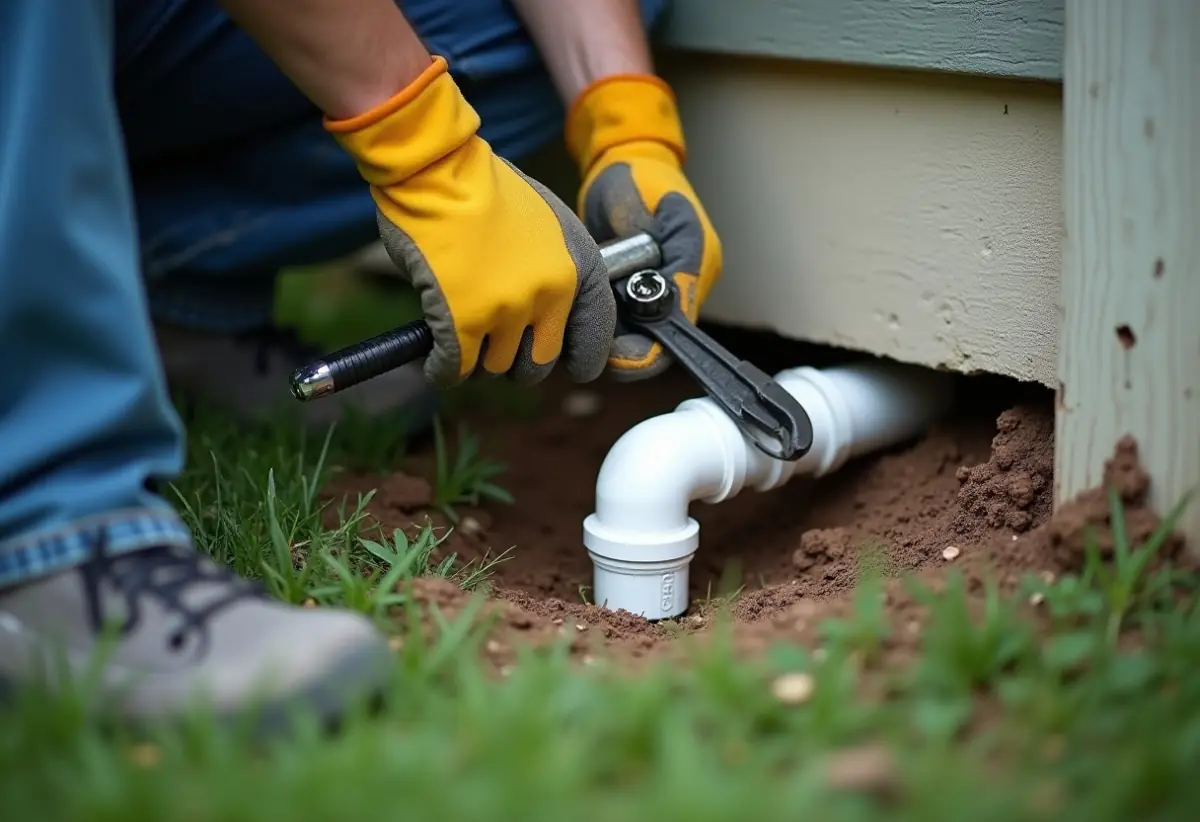
Where is the sewer cleanout, and why start there?
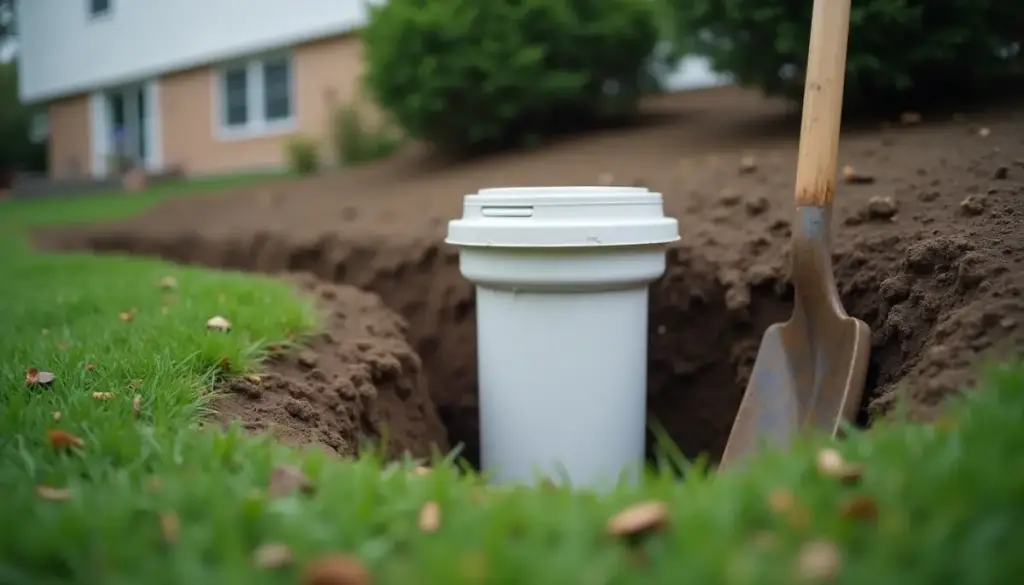
The sewer cleanout is the capped pipe that opens straight into your main line, so it is the fastest way to find the sewer line on your property. Look for a 3 or 4 inch round cap, white PVC or black ABS, sticking a few inches out of the ground near the foundation. Many homes also have one at the property line or curb.
A cleanout tells you two things at once. It marks a point on the line, and its fitting usually angles toward the downstream direction. A two-way cleanout, two caps side by side, means the line runs between the house and the street right below it.
Inside, check for a threaded plug on the main stack in the basement or crawlspace. Our guide on how a sewer cleanout works shows every common location and cap type.
If you find no cleanout at all, the line still exists. Older homes often have none, and a plumber can enter through a toilet flange or roof vent instead. Angi puts the cost to add a two-way cleanout at $2,000 to $5,000, which most owners only pay once a line needs repeat work.
How do you trace the sewer line from the house to the street?
Trace the sewer line by finding where the main drain stack leaves the foundation, then drawing a line from that point toward the city main, usually under the street or an alley. Residential laterals tend to run as straight as the builder could make them, because every bend is a clog point. That gives you a working guess before any equipment comes out.
- Find the main stack, the largest vertical drain in the house, usually 3 or 4 inches.
- Note where it exits the basement wall, crawlspace or slab. The roof vent above it confirms the side.
- Find the city main by spotting sewer manholes in the street, alley or rear easement.
- Connect the points with a straight line unless a cleanout says otherwise.
- Read the yard. A sunken strip or a stripe of greener grass can show an old trench or a leak.
Treat this as an estimate, not a dig line. Laterals sometimes angle to a shared tap, jog around a tree, or tie in to a neighbor’s line on older lots. A slow drain or a soggy strip along that path can also point to one of the common sewer line problems, such as roots or a broken joint.
Can city records or permit drawings show where your sewer line is?
Yes, often. Many cities and counties keep a sewer tap card, permit file or as-built drawing showing where your lateral connects to the main, and sometimes its route and depth. Start with the public works or sewer utility office, then the building department. Records are thinnest for homes built before the 1960s and most complete for newer subdivisions.
Ask for these by your street address and parcel number:
- Sewer tap or connection card: the distance from a manhole or lot corner to your tap, recorded when the line was connected.
- Building and plumbing permits: site plans for additions, repairs or replacements may show the lateral.
- As-built or record drawings: subdivision plans that show every lateral stub off the main.
- Prior sewer scope reports: often include a locate and footage.
Many offices provide copies free or for a small fee, and some post sewer maps in an online GIS viewer. Treat the lateral on any plan as approximate, because builders did not always install it where the plan said.
Will 811 mark your sewer line?
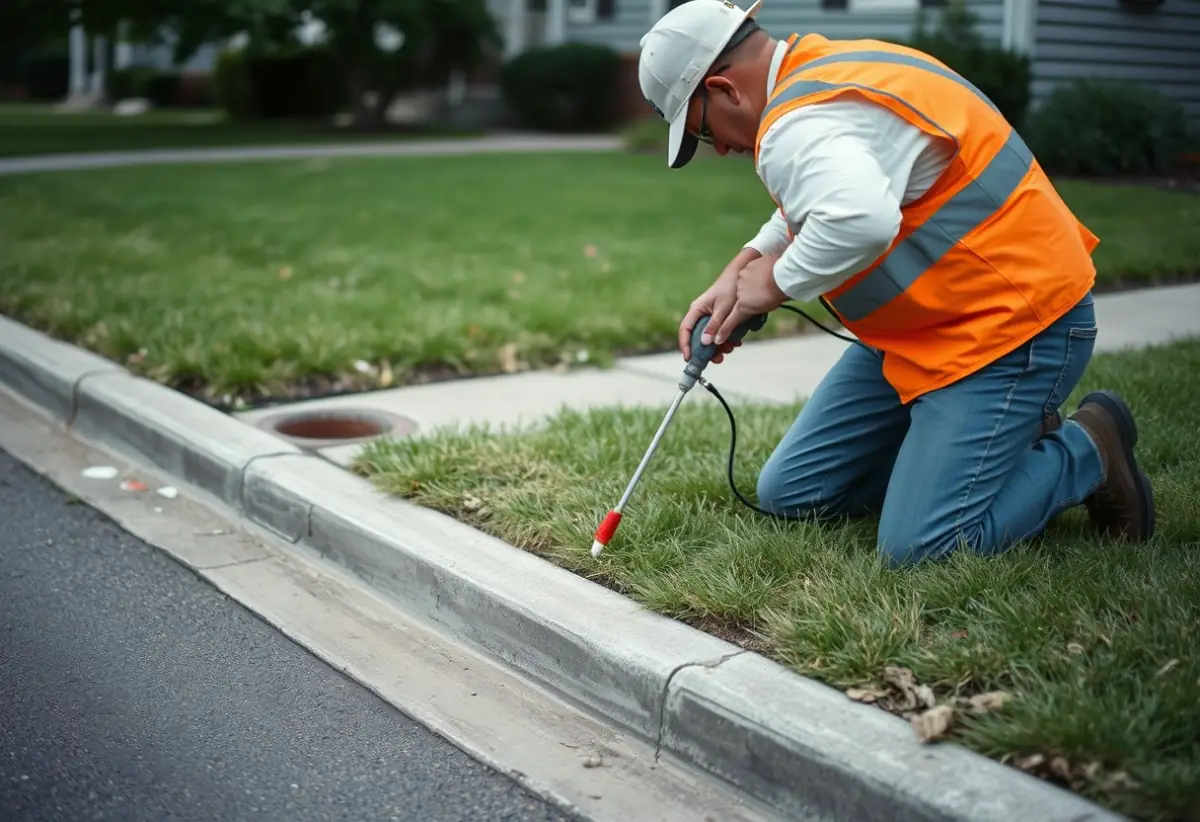
Usually not the part you own. 811 is the free national call-before-you-dig number that notifies member utilities, and they mark their own public lines. Private sewer laterals belong to the homeowner, so in most areas they go unmarked. The City of South Bend states that Indiana 811 does not locate individual private lines and only locates water or sewer mains in the public right-of-way. Since locating your own line often means digging by hand, it helps to know how deep water lines are typically buried before you start.
So a painted 811 map can look complete when it is not. Green paint marks sewer under the American Public Works Association color code, and a missing green line in your yard does not mean no pipe.
Still call 811 before you dig, because it marks gas, electric and communication lines that could hurt you. Wait times are set by state law. South Bend’s guidance points owners to a licensed plumber for the private lateral.
How does a sewer camera with a sonde locate the line?
A sewer camera with a sonde finds the line by sending a small radio transmitter through the pipe while a receiver above ground follows the signal. The sonde, built into or just behind the camera head, broadcasts at 512 Hz on most push cameras, including RIDGID SeeSnake systems. The locator shows where the signal is strongest and estimates its depth.
- Open the cleanout and push the camera in until it passes the foundation.
- Stop every 5 to 10 feet. The locator walks the surface until the signal peaks, then marks the spot with a flag or paint.
- Take a depth reading at each mark. Many receivers display depth in feet and inches.
- Watch the screen for roots, cracks, offsets or sags and note the footage at each.
- Continue to the main or as far as the camera reel allows, usually 100 to 200 feet on residential rigs.
Depth readings can drift in wet clay, near metal fences or above parallel pipes, so pros take readings from two directions. A locate is usually bundled into a professional sewer camera inspection, which Angi prices at about $150 to $500 in 2026. Renting a camera costs about $73 a day at Home Depot tool rental, but cheaper units may lack a sonde or receiver, so ask before you pay.
With no access point, private utility locators may use a conductive tracing rod or ground-penetrating radar, though radar struggles in wet clay.
| Method | What it finds | Typical cost | DIY or pro |
|---|---|---|---|
| Find the cleanout | One point on the line and its direction | $0 | DIY |
| Trace from the stack exit | Exit point and likely heading to the main | $0 | DIY |
| City or county records, permits, as-builts | Tap location, sometimes route and depth | Often free or a copy fee (varies by city) | DIY |
| 811 locate request | Public sewer main and other utilities, usually not the private lateral | Free | DIY call, utility marks |
| Rented camera with sonde | Exact path, depth, visible defects | About $73/day (Home Depot tool rental) | DIY |
| Plumber camera inspection and locate | Exact path, depth, condition report | About $150 to $500 (Angi, 2026) | Pro |
| Private locator with GPR or tracing rod | Lines with no access, plus other private utilities | Quote-based, varies by site | Pro |
How deep are sewer lines buried?
Sewer lines are usually buried 2 to 8 feet deep, according to eLocal, and the depth changes along the run. The pipe leaves the house shallow and drops as it slopes toward the city main, which often sits deeper under the street. Cold regions bury deeper because of frost. eLocal puts the Midwest at 4 to 8 feet and the Southwest at 2 to 4 feet.
Slope sets most of the depth change. The International Code Council’s guide to the IPC lists minimum slopes of 1/4 inch per foot for drain pipe 2.5 inches and smaller, 1/8 inch per foot for 3 to 6 inch pipe, and 1/16 inch per foot for 8 inch and larger, and notes that 1/4 inch per foot is the most common in practice. A 4 inch lateral at 1/8 inch per foot drops about 12.5 inches over 100 feet. At 1/4 inch per foot, it drops the same amount in 50 feet.
You can use that math to estimate depth anywhere on the run. Take the depth where the pipe leaves the foundation, then add the slope times the distance. A line that exits 2 feet down and runs 60 feet at 1/4 inch per foot sits about 3 feet 3 inches deep at the street end, before the drop into the main.
Frost depth pushes the starting point down in cold places. Local codes set the minimum burial depth for building sewers, and it varies by jurisdiction, so ask your building department before you trench.
Who owns which part of the sewer lateral?
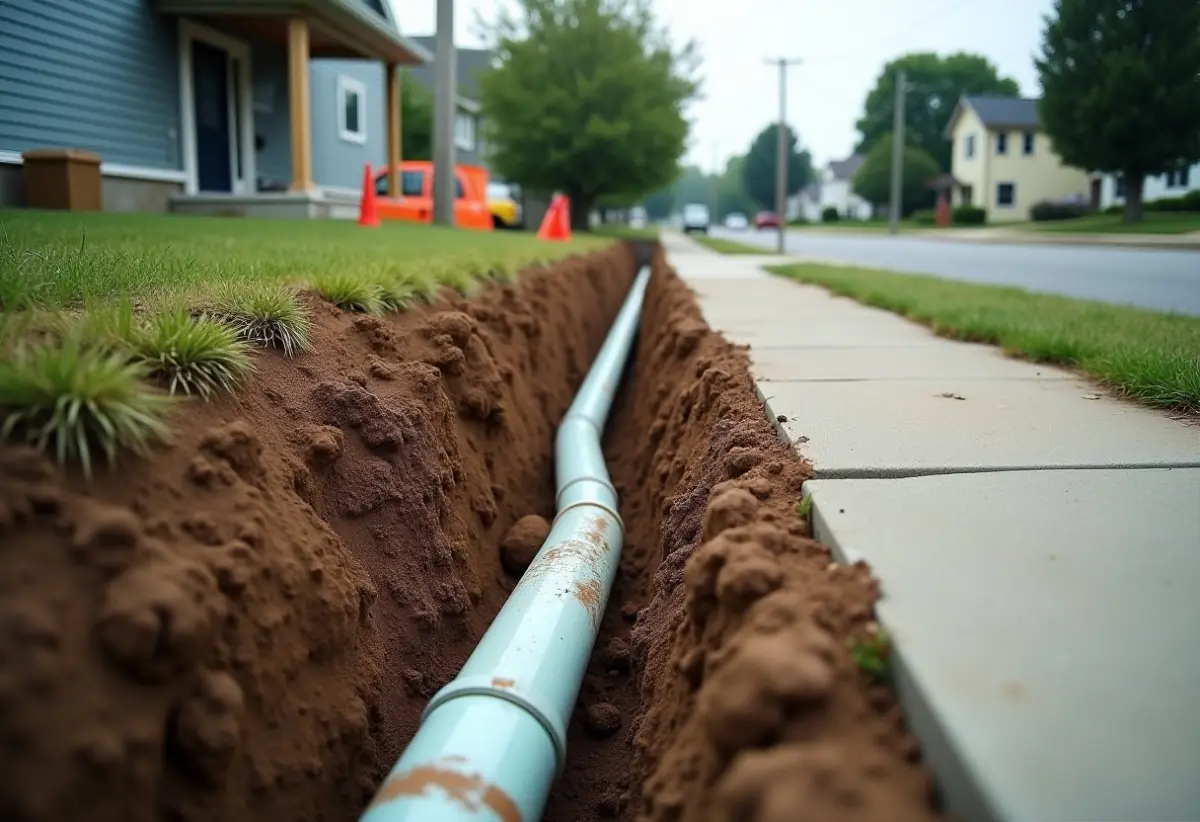
In most US cities, the homeowner owns the sewer lateral from the house to the point where it connects to the public main, and the city owns the main. Some cities take over responsibility at the property line, the sidewalk, or a curb cleanout instead. The split matters because you pay to locate, repair and replace everything on your side of it.
| Segment | Typical owner | Who locates it |
|---|---|---|
| House drain and main stack (inside) | Homeowner | Homeowner or plumber |
| Upper lateral (foundation to property line) | Homeowner | Plumber or private locator, not 811 |
| Lower lateral (property line to main) | Homeowner in many cities, city in some | Plumber, sometimes city crews |
| Tap or wye at the main | Varies by city | City records, plumber |
| Public sewer main | City or sewer district | 811 member utility |
Check your city’s sewer lateral page or call public works before a repair or sale, because the split point varies.
How can you tell if you have a septic system instead of a sewer line?
If your utility bill has no sewer charge, the street has no sewer manholes, and the yard has a buried tank lid or a drainfield, you probably have septic, not sewer. In that case the line from your house runs to a tank on your lot, not to the street, and you trace it the same way but stop at the tank.
- Bills: municipal sewer customers usually see a sewer or wastewater line item.
- Street: sewer manholes, usually marked “sewer” or “sanitary,” mean a main runs nearby.
- Yard: a round or rectangular lid, a riser, or a patch of lush grass over a drainfield points to septic.
- Records: county health departments keep septic permits.
Some homes switched from septic to sewer decades ago and still have an abandoned tank in the yard, so confirm before you assume. Our breakdown of septic vs sewer differences covers costs, upkeep and how to confirm which one you have.
How we sourced this
We reviewed the top-ranking pages and People Also Ask questions for “how to find sewer line on property” and “how deep are sewer lines buried” in October 2026, then cited a named source for every figure. Depths come from eLocal, slope minimums from the International Code Council’s IPC guide (Table 704.1), the 811 limit from the City of South Bend, costs from Angi’s 2026 guides and the rental rate from Home Depot tool rental. We excluded undated cost aggregators. Codes, ownership rules and prices vary by city.
Frequently asked questions
How do I find out where my sewer line runs?
Start at the sewer cleanout or the spot where the main drain stack leaves your foundation, then look toward the street or alley for the city main. Ask your city or county public works office for the sewer tap record or as-built drawing. If records are missing, a plumber can push a camera with a 512 Hz sonde through the line and mark its exact path and depth.
How deep are sewer lines buried?
Residential sewer lines are usually buried about 2 to 8 feet deep, according to eLocal, and they get deeper as they run toward the street because the pipe must slope downhill. eLocal puts typical depths at 4 to 8 feet in the Midwest and 2 to 4 feet in the Southwest, mostly because colder regions have deeper frost lines.
Does 811 locate sewer lines?
Usually not the part you own. 811 is a free call that sends member utilities to mark their public lines, and in most areas that means the city sewer main, not your private lateral. The City of South Bend notes that Indiana 811 does not locate individual private lines. Plan on a plumber or private locator for the lateral itself.
How much does it cost to locate a sewer line?
Checking the cleanout, tracing the stack and calling 811 cost nothing. Angi puts a standalone sewer camera inspection at about $150 to $500 in 2026, and most plumbers can run a sonde locate during that visit. Renting a camera yourself runs about $73 a day at Home Depot tool rental, though not every rental unit includes a working locator.
Who is responsible for the sewer line from the house to the street?
In most US cities the property owner owns and maintains the lateral from the house to the connection at the city main, sometimes including the section under the sidewalk or street. Some cities take over at the property line or a curb cleanout instead. Check your local public works or sewer utility page, because the split point varies by city and by when the line was built.
How do I know if my house is on sewer or septic?
Look at your water or utility bill for a sewer charge, check the street for sewer manholes, and walk the yard for a septic tank lid or a drainfield area. Your property records, home inspection report or county health department can also confirm it. A house on septic has a line that runs to a tank on your lot instead of to the street.
Is the sewer line usually in the front or back yard?
Most laterals run from the house toward the street, because that is where the city main usually sits. Some neighborhoods have mains in a rear alley or a utility easement behind the lots, so the line exits the back of the house instead. The direction your cleanout faces and the side of the house where the main stack exits are the best early clues.