How Deep Are Water Lines Buried? Depth by Region
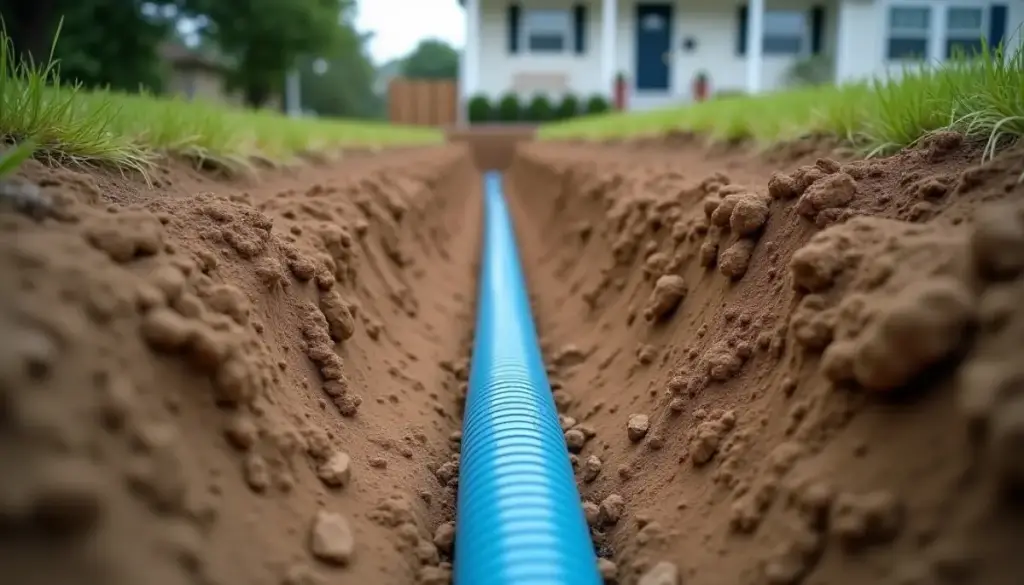
How deep are water lines buried? Under the IRC, at least 12 inches and at least 6 inches below your local frost line, and many utilities ask for more, up to 5 feet of cover in Des Moines.
Key Takeaways
- IRC Section P2603.5 sets the floor: water service pipe not less than 12 inches deep and not less than 6 inches below the frost line, per the ICC’s 2021 IRC Chapter 26 text.
- The ICC commentary’s worked example: with a 24 inch frost depth, the top of the pipe must sit at least 30 inches below grade.
- Des Moines Water Works rule 505.3.3 requires at least 5 feet of cover over service lines wherever feasible.
- Bothell, Washington sets 30 inches below finish grade for service connections in the right-of-way, and Waco, Texas calls for 42 inches over lines 12 inches and smaller.
- Des Moines Water Works requires No. 12 AWG copper tracer wire on every PEX service, with 45 mil blue HDPE insulation and a 150 pound minimum tensile strength.
- Call 811 before you dig. Locate marks show the line’s path, not its depth.
How deep are water lines buried in most of the US?
Water lines are buried at whichever is deeper, 12 inches or 6 inches below the local frost line, in the many jurisdictions that adopt the International Residential Code (IRC). Utilities then add their own minimums on top. In practice that means about a foot of cover where the ground barely freezes and 5 feet or more under cold-climate utility rules like Des Moines Water Works. Before digging that deep to repair or replace a line, it’s worth weighing trenchless water line replacement against a traditional trench. Choosing between trenchless and open-trench methods also raises the question of which pipe material to install, covered in burying PEX water lines.
Three layers of rules set the depth. The model plumbing code sets the floor, your city or county fills in the local frost line depth, and your water utility can require more cover on the part it controls, from the main to the curb stop.
What does the plumbing code say about water line depth?
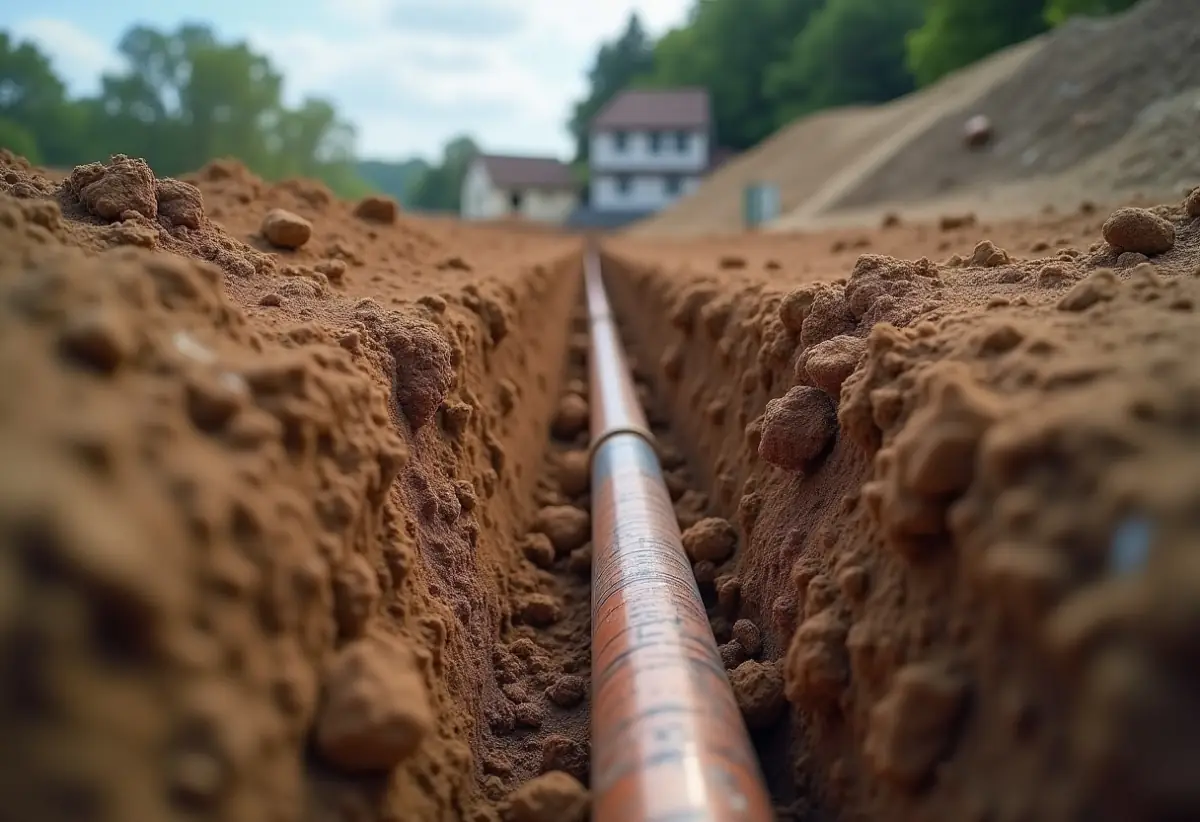
The IRC says water service pipe “shall be installed not less than 12 inches (305 mm) deep and not less than 6 inches (152 mm) below the frost line.” That sentence sits in Section P2603.5, the freezing section of Chapter 26, and South Carolina reprints the same language in its state regulation for IRC P2603.5. Both numbers apply, so the deeper one controls.
The ICC commentary explains the logic. The 12 inch floor guards against routine digging, and the 6 inch margin keeps the pipe below frost heave. Its example: a 24 inch frost depth puts the top of the pipe at least 30 inches below grade.
Other codes run the same idea with different margins:
- International Plumbing Code (IPC) Section 305.4: covers exterior water supply piping with a frost line rule and a below-grade minimum that track the IRC numbers.
- Uniform Plumbing Code (UPC) Section 609.1: used in much of the West, it sets the margin at 12 inches below the average local frost depth, double the IRC’s 6 inch margin.
The same freezing section bars water piping from spots exposed to freezing unless it is protected, so a line forced shallow by ledge rock needs insulation or heat your inspector approves.
How deep is a water line buried in your region?
A water line in your region is buried 6 inches below your local design frost depth, or 12 inches, whichever is greater, under the IRC. The frost depth itself comes from your building department, which fills it into the “frost line depth” column of IRC Table R301.2(1), the climate table every adopting jurisdiction completes. Ask the permit counter for that number before you trench.
The table applies the IRC and UPC formulas to frost depths from zero to 60 inches. Read across from your frost depth to the minimum depth to the top of the pipe.
| Local frost depth | IRC P2603.5 minimum (deeper of 12 in or frost + 6 in) | UPC 609.1 minimum (frost + 12 in) |
|---|---|---|
| 0 to 6 in (little or no frost) | 12 in | 12 in to 18 in |
| 12 in | 18 in | 24 in |
| 24 in | 30 in (the ICC commentary example) | 36 in |
| 36 in | 42 in | 48 in |
| 48 in | 54 in | 60 in |
| 60 in | 66 in | 72 in |
Frost depth tracks winter severity, so the deep rows belong to the northern tier and the shallow rows to the Gulf Coast and desert Southwest. Our frozen pipe risk by metro data shows which cities see the hard freezes that push frost lines down. Older lines laid before current codes may be shallower than the table says.
What cover do water utilities require for service lines?
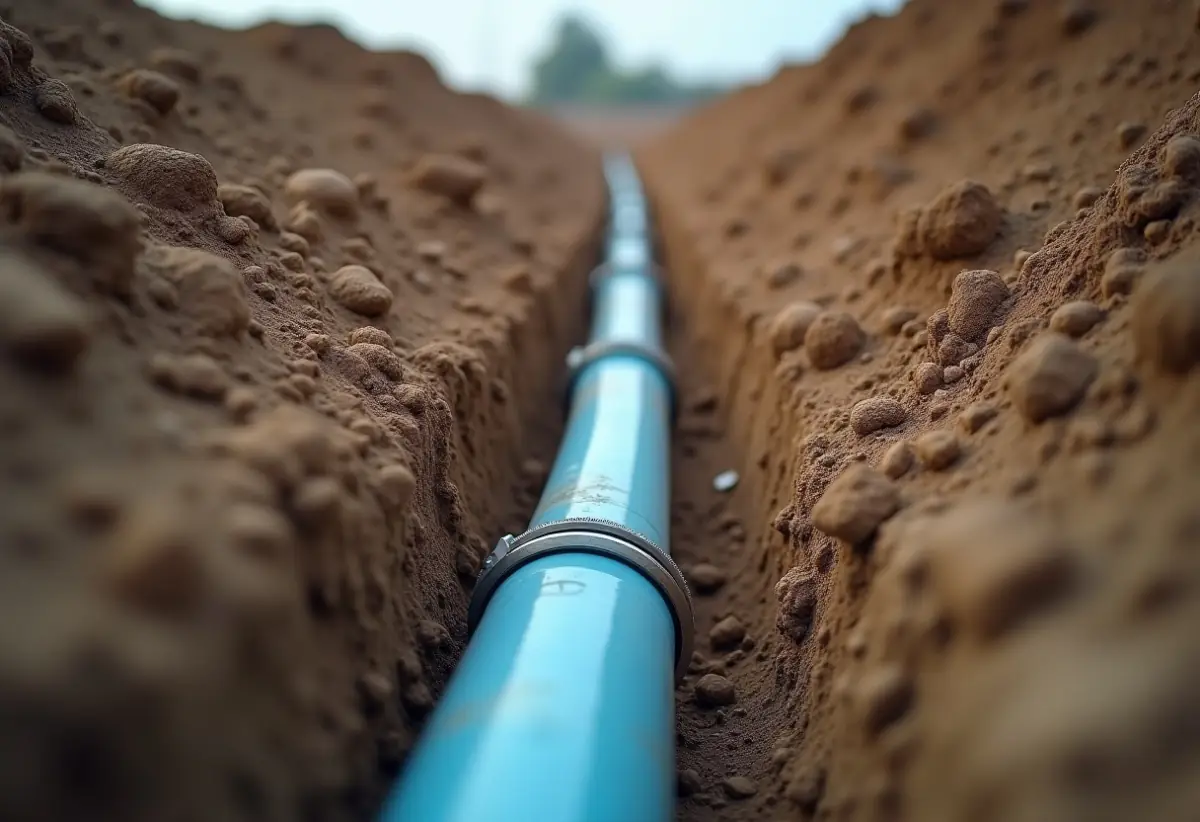
Water utilities often require more cover than the plumbing code, at least on the section from the main to the curb stop. Required cover in the standards we reviewed ranges from 30 inches in Bothell, Washington to 5 feet in Des Moines, Iowa. Your utility’s construction standards list the number.
| Utility or city | Required cover | Applies to | Source |
|---|---|---|---|
| Model code floor (IRC) | 12 in, and 6 in below frost line | Water service pipe | IRC P2603.5 |
| Bothell, Washington | 30 in below finish grade | Service connections in the right-of-way | Bothell Design and Construction Standards, Ch. 5 |
| Flagstaff, Arizona | 3 ft minimum | Water mains | Flagstaff Code 13-09-001 |
| Waco, Texas | 42 in (60 in for larger lines) | Water lines 12 in and smaller | Waco Water and Sanitary Sewer Design Manual (2023) |
| Des Moines, Iowa | 5 ft wherever feasible | Service lines (rule 505.3.3) | Des Moines Water Works Section 505 |
| Des Moines, Iowa | 5 to 6 ft | Public mains on private property | Des Moines Water Works Section 505.9 |
Des Moines Water Works adds a line that matters for every utility rule: “Whenever the local plumbing code conflicts with this section, the plumbing code shall be followed.” The utility’s number is a target, and the adopted plumbing code still governs where the two disagree.
The same document sets the curb stop, the shut-off valve near the property line, 5 to 7 feet below the surface, with the top of its operating rod 12 to 24 inches below grade so a curb key can reach it.
How far should a water line be from the sewer line and other utilities?
A water line has to keep a set distance from the building sewer, and the exact gap depends on your code. IPC Section 603.2 and the matching IRC section require earth separation between the underground water service and the building sewer, with exceptions that allow closer spacing when the water pipe sits on a raised shelf above the sewer and the sewer pipe meets listed material standards. Your plumbing inspector applies the edition your state adopted.
Utilities add their own spacing. Des Moines Water Works requires at least 12 inches of clearance between the service line and any pipe, cable or conduit sharing the trench (rule 505.3.2). Its public mains on private property should be spaced 5 feet from parallel utilities.
Before you trench a new water service, learn how to find your sewer line so the new pipe does not land on an old clay lateral.
Do plastic water lines need tracer wire?
Yes, in many jurisdictions. Plastic pipe such as PEX or polyethylene cannot be found by a standard pipe locator, so codes and utilities require a copper tracer wire buried alongside it. The Virginia plumbing code, built on the ICC model, calls for at least 18 AWG wire with one end terminating above grade, and many utilities specify heavier wire.
Des Moines Water Works gives one of the most detailed specs we found. Rule 505.5.2.5 requires tracer wire on every service line except Type K copper or red brass, built like this:
- Open cut trench: No. 12 AWG solid single copper conductor, 150 pound minimum tensile strength, 45 mil high-density polyethylene insulation rated for direct burial and 30 volts, blue.
- Directional drilling or boring: No. 12 AWG extra-high strength copper clad steel (EHS-CCS) with a 1,150 pound minimum break load and the same insulation.
- Fastening: inside the conduit if one is used, otherwise zip-tied to the pipe at least every 5 feet.
- Grounding: an anode ground rod at least 3/8 inch in diameter and 8 feet long, copper bonded, clamped to the wire.
- Access: Rhino TriView, TracerPed or an approved equal connector, 5 feet long, white and triangular.
The same rules allow 200 psi PEX-A for 1 to 2 inch services, with joints meeting ASTM F1960, F2080 or F1807, and require a tracer wire inspection on every PEX service. Lacey, Washington goes a step further and requires continuous 3 inch tracer tape 12 to 18 inches below the surface, on top of the wire.

How do you find where your water line is buried?
You find a buried water line by locating its two ends, the meter or curb stop near the street and the entry point at your foundation, then tracing the path between them. Call 811 first. The free national call-before-you-dig line routes you to your state’s one-call center, which sends member utilities to paint or flag their lines. Those marks show where a line runs, not how deep.
- Call 811 or file online at call811.com and wait the number of days your state requires before you dig.
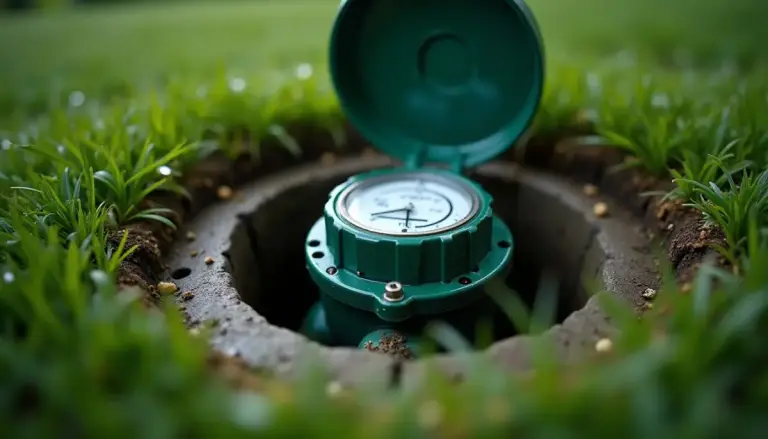
- Find the curb stop or meter box. Look for a round or rectangular lid near the sidewalk or property line. In Des Moines it sits 1 to 6 feet out from the property line.
- Find the entry point. Look for the main shut-off where the pipe comes through the foundation wall or rises through the floor.
- Trace the path. Service lines usually run straight between the two ends. A plumber with an electronic locator can follow copper pipe or tracer wire.
- Confirm depth by hand. Pothole with a shovel or vacuum excavation inside the marked zone. Do not swing a mattock or run a trencher until you see the pipe.
Expect gaps in the marks. The run from the meter or curb stop to the house is often private and yours to find.
What happens if a water line is buried too shallow?
A shallow water line freezes, cracks or gets cut. Frost that reaches the pipe can stop flow for days in a cold snap, and ice expansion can split the pipe or pop a fitting.
The fix depends on what failed:
- Short shallow section: lower that piece to code depth, or protect it with insulation or heat if your inspector approves.
- Repeated winter freezes: start with the low-cost steps in our guide on how to prevent frozen pipes, then plan to lower the line before next winter.
- Cracked or leaking line: compare costs and methods in our guide to repairing or replacing a buried water service line. A full replacement is the time to bring depth, tracer wire and separation up to current code.
If you replace the line, pull a permit so the inspector checks depth and tracer wire with the trench open.
How we sourced this
We read the IRC Section P2603.5 language as published in the ICC’s 2021 IRC Chapter 26 commentary text and in South Carolina’s regulation adopting P2603.5, the Des Moines Water Works Section 505 Water Service Installation rules (revised through January 2026), and construction standards from Bothell, Flagstaff, Waco and Lacey. IPC 305.4, IPC 603.2 and UPC 609.1 are described generally because we did not review their full current text. We left out regional frost depths from secondary sites, since each building department sets its own. Research current to October 2026.
Frequently asked questions
How deep should a water line be buried?
Under IRC Section P2603.5, water service pipe goes at least 12 inches deep and at least 6 inches below the frost line, whichever is deeper. Your local building department sets the frost line depth in its adopted climate table. Many utilities ask for more, such as the 5 feet of cover Des Moines Water Works requires wherever feasible.
How deep is the main water line from the street?
Public mains usually sit deeper than the pipe to your house. Des Moines Water Works installs private-property mains at 5 to 6 feet, and Waco’s design manual calls for 42 inches of cover over lines 12 inches and smaller. Flagstaff, Arizona sets a 3 foot minimum over water mains. Your utility’s construction standards give the exact figure for your street.
How deep is the water shut off valve at the curb?
It follows your utility’s frost depth rule. Des Moines Water Works requires the curb stop to sit 5 to 7 feet below the ground surface, with the top of the operating rod 12 to 24 inches below grade inside an Erie style stop box. Expect a shallower valve in warm climates where the service line itself runs shallower.
Do I need to call 811 before digging in my own yard?
Yes. 811 is the free national call-before-you-dig number, and it routes your request to your state one-call center, which notifies member utilities to mark their buried lines. State law sets how many days you must wait. Utility marks show where a line runs, not how deep it is, so hand dig near any paint or flags.
Can a water line and sewer line go in the same trench?
Sometimes, but the plumbing code limits it. IPC Section 603.2 and the matching IRC section require separation between the underground water service and the building sewer, with exceptions tied to pipe material and vertical offset. Utilities add their own rules, such as the 12 inch clearance Des Moines Water Works requires between a service line and any other pipe in the trench.
What happens if a water line is not buried deep enough?
A shallow line can freeze, split, or get cut by a shovel, fence post auger or aerator tines. A cracked line under the yard may leak for weeks before you notice a soggy strip of lawn or a jump on the water bill. The fix is to lower the pipe below the frost line, protect it with insulation where your inspector allows, or replace the run.
How do I find out how deep my water line is?
Look at the curb stop or meter box and at the point where the pipe enters your foundation, since those two ends show the depth of the run. A plumber can trace a copper line, or a plastic line with tracer wire, using an electronic locator. For depth along the run, pothole by hand after 811 crews mark the public utilities.