Closet Bolts: Sizes, Types, and How to Replace Them
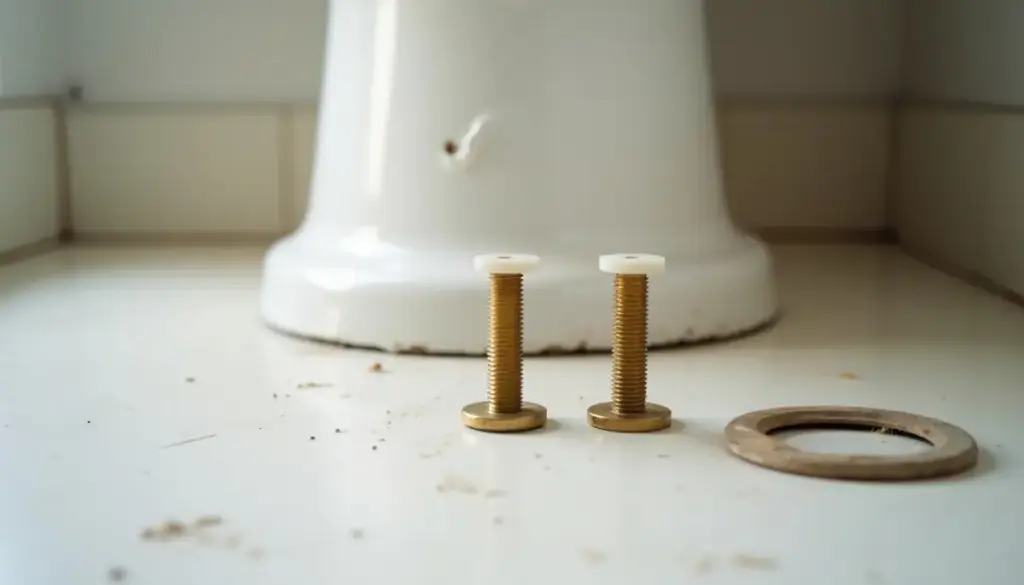
Closet bolts come in two standard diameters, 1/4 inch (1/4-20 thread) and 5/16 inch (5/16-18), usually 2-1/4 inches long, and you tighten them alternately until the toilet stops rocking, never past snug.
Key Takeaways
- Sioux Chief sells closet bolts in 1/4-20 and 5/16-18 threads, taking a 7/16 inch and a 9/16 inch hex nut respectively.
- 2-1/4 inches is the stock length in Sioux Chief, Danco and Jones Stephens lines; Sioux Chief and Harvey also sell 3-1/2 inch bolts for thick bases.
- American Standard sets the two bolts 6 inches (152 mm) apart in the flange channel and says to tighten the nuts alternately.
- Kohler’s K-3394 manual says hand-tighten, then add a half turn with a wrench; Kohler warns overtightening can chip vitreous china.
- Kohler’s installation guide says to cut bolts that stand more than 1/4 inch (6 mm) above the nut before the caps go on.
- A spinning bolt in a broken flange slot needs a repair ring, such as the Danco HydroSeat 10672X (6.88 inch OD, bolts included).
What Are Closet Bolts and What Do They Do?
Closet bolts are the two upright bolts that hold a floor-mount toilet to its flange. A flat oval head slides into the slots on the toilet flange, the bolt passes up through holes in the toilet base, and a washer and nut clamp the bowl down. That clamp also compresses the wax seal between the horn and the drain.
Retailers also sell them as toilet bolts, floor bolts or T-bolts. They are separate from the smaller tank bolts that join a two-piece tank to its bowl. Wall-hung toilets use a carrier system and have no closet bolts at all.
What Size Are Closet Bolts?
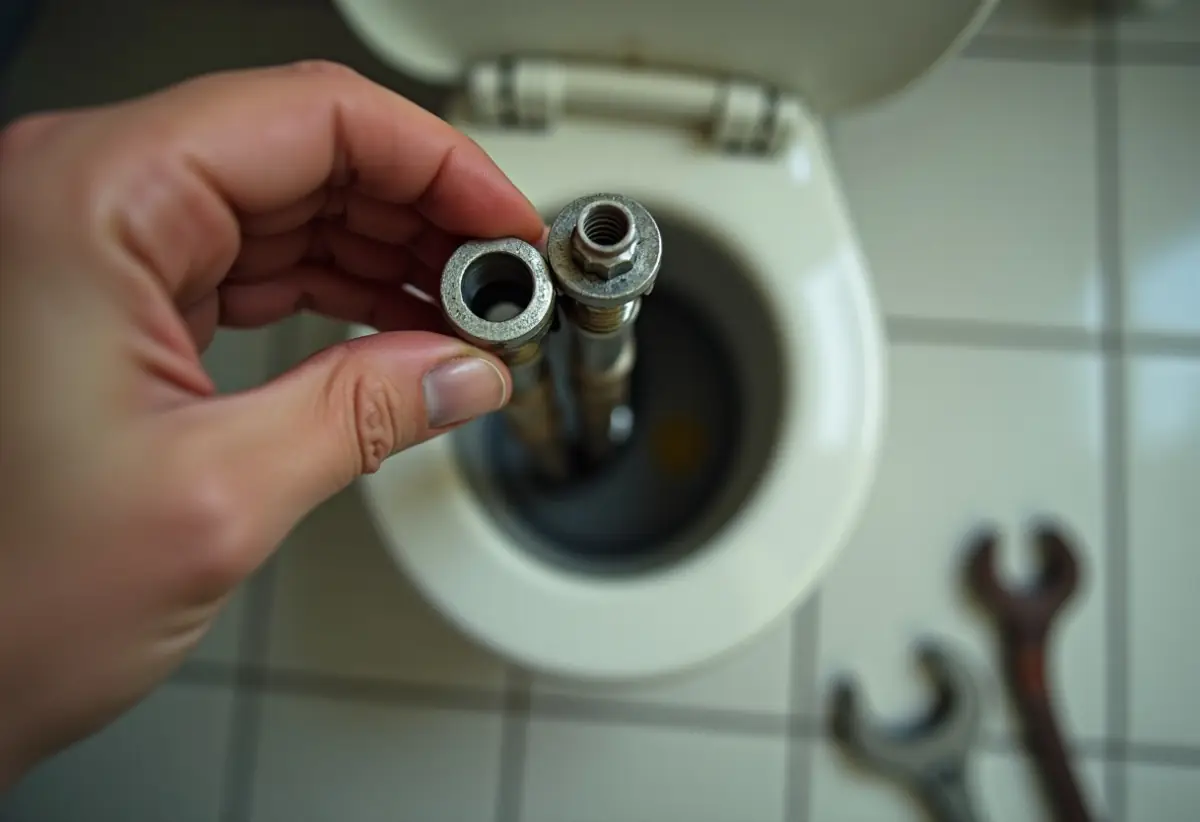
Closet bolts come in two diameters, 1/4 inch and 5/16 inch, and the usual length is 2-1/4 inches. Sioux Chief lists 1/4 inch bolts with 20 threads per inch and 5/16 inch bolts with 18. Kohler’s K-3394 manual tells installers to use new 1/4 or 5/16 inch T-bolts, so either diameter fits a standard flange slot.
The diameter decides the nut and the wrench. Per Sioux Chief’s closet bolt catalog, the 1/4-20 bolt takes a 7/16 inch hex nut (part 417) and the 5/16-18 bolt takes a 9/16 inch hex nut (part 418).
Length decides whether the cap fits. Measure from the floor to the top of the bolt hole on the toilet base, add the washer and nut, and you want roughly 1/4 inch of thread above the nut. Sioux Chief’s solid brass line shows the spread:
- 415-PB: 5/16 x 1-3/4 inches, for thin bases or a flange that sits low.
- 410-PB and 416-PB: 1/4 x 2-1/4 and 5/16 x 2-1/4 inches, the stock size for most residential toilets.
- 411-PB: 1/4 x 3-1/2 inches, for tall or skirted bases and toilets set on an added spacer or tile.
If the old bolts came out intact, match them with a tape measure before you shop.
Lengths come from the Sioux Chief catalog and from Danco, Jones Stephens and Harvey part listings at SupplyHouse and Ferguson, checked October 2026.
Which Type of Closet Bolt Should You Buy?
Buy solid brass or stainless closet bolts in the diameter your flange and toilet holes take, and pick a style based on how you will deal with the extra length. Plain brass T-bolts are the default. Snap-off bolts save you a hacksaw cut. Captive-washer and retainer styles hold the bolts upright while you lower a heavy toilet onto them.
| Bolt type (example part) | Diameter x length | Best use | Notes |
|---|---|---|---|
| Solid brass T-bolt (Sioux Chief 410-PB / 416-PB) | 1/4 or 5/16 x 2-1/4 in | Most floor-mount toilet resets | Nickel-plated steel nut and zinc-plated washer included, 2 per bag |
| Short brass T-bolt (Sioux Chief 415-PB) | 5/16 x 1-3/4 in | Thin bases, low flanges | Less to cut off under a low-profile cap |
| Long brass T-bolt (Sioux Chief 411-PB, Harvey H56245) | 1/4 or 5/16 x 3-1/2 in | Tall bases, flange spacers, thick tile | Almost always needs cutting above the nut |
| Captive-washer brass (Sioux Chief SnapIt 412-PB / 414-PB) | 1/4 or 5/16 x 2-1/4 in | Bolts that will not stand up on their own | Washer locks the bolt to the flange before the toilet goes on |
| Snap-off brass (Lincoln Products 1/4-20) | 1/4 x 2-1/4 in | Standard caps without sawing | Snap-off slot 1/2 in below the top |
| Snap-off stainless with retainers (Jones Stephens JC02423SS) | 5/16 x 2-1/4 in | Damp floors, basements, rental turnovers | Retainers hold bolts plumb; stainless will not corrode |
| Repair-ring kit (Danco HydroSeat 10672X) | Bolts included | Broken or rusted flange slots | Stainless ring, 6.88 in OD, 4.25 in ID, 5-year limited warranty |
Skip uncoated steel. It rusts and welds the nut to the bolt, which is why old bolts often have to be cut out.
How Do You Replace Toilet Floor Bolts?
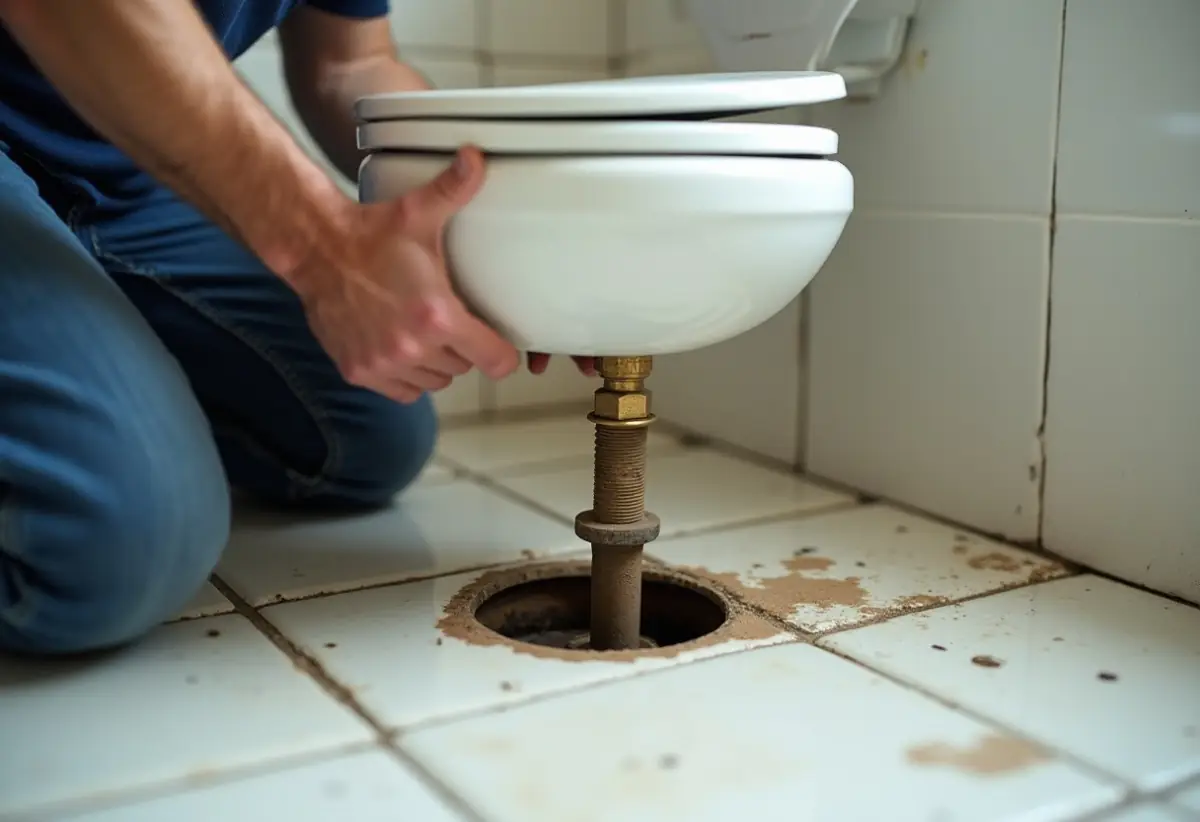
To replace toilet floor bolts, shut off and drain the toilet, disconnect the supply, remove the nuts, lift the toilet off, scrape the old wax, slide the new T-bolts into the flange slots, turn them 90 degrees, set a new wax ring, lower the toilet straight down, and tighten the nuts alternately. Budget one new wax ring per job, since lifting the bowl breaks the seal.
- Close the angle stop, flush, and sponge the last water from the tank and bowl.
- Disconnect the supply line at the tank. Pop the caps off the base.
- Remove the nuts with a 7/16 or 9/16 inch wrench. If a nut spins the bolt or will not move, cut the bolt (next section).
- Rock the toilet to break the wax and lift it straight up. Lay it on a towel or cardboard.
- Scrape the old wax off the flange and the toilet horn with a putty knife. Plug the drain with a rag.
- Slide each new T-bolt head into the flange channel and turn it 90 degrees. American Standard’s guide sets them 6 inches (152 mm) apart and says putty can hold them upright.
- Seat a new wax ring on the horn or flange, pull the rag, and lower the toilet so both bolts pass through the base holes.
- Press down with your weight, then add the washers and nuts and tighten alternately (next section).
- Cut excess bolt length, snap on the caps, reconnect the supply and check for leaks after several flushes.
The American Standard installation guide for its floor-mount models 2529, 2530 and 2531 adds one detail people miss: the tapered retainer washers have a side marked “THIS SIDE UP” that must face you. For setting a brand-new toilet from scratch, including the rough-in check, follow our full toilet installation guide.
How Tight Should Closet Bolts Be?
Closet bolts should be tight enough that the toilet does not rock, and no tighter. Kohler’s K-3394 manual has you hand-tighten each nut, then turn it one more half turn with a wrench. American Standard says to tighten the nuts alternately until the toilet is firmly anchored, with a caution that overtightening may damage the base.
No manufacturer document we reviewed gives a torque figure for closet bolts. The limit is the china. Kohler’s guides warn that overtightening may cause breakage or chipping of vitreous china, and Grainger’s closet bolt instructions say to apply the nuts firmly, but not so tight as to crack the edge of the bowl base.
- Thread both nuts down by hand until they touch the washers.
- Give the left nut a quarter turn with the wrench, then the right nut a quarter turn.
- Rock the bowl. Repeat alternating quarter turns until it stops moving, stopping at a half turn past hand tight per nut.
- If it still rocks at that point, the floor is uneven. Shim under the base instead of turning the nuts further.
A bowl that loosens again weeks later usually has a crushed wax ring, a high flange or a soft subfloor, not bad bolts. Our guide to fixing a wobbly toilet covers shimming and when to pull the toilet to reset the seal.
How Do You Cut Closet Bolts to Length?
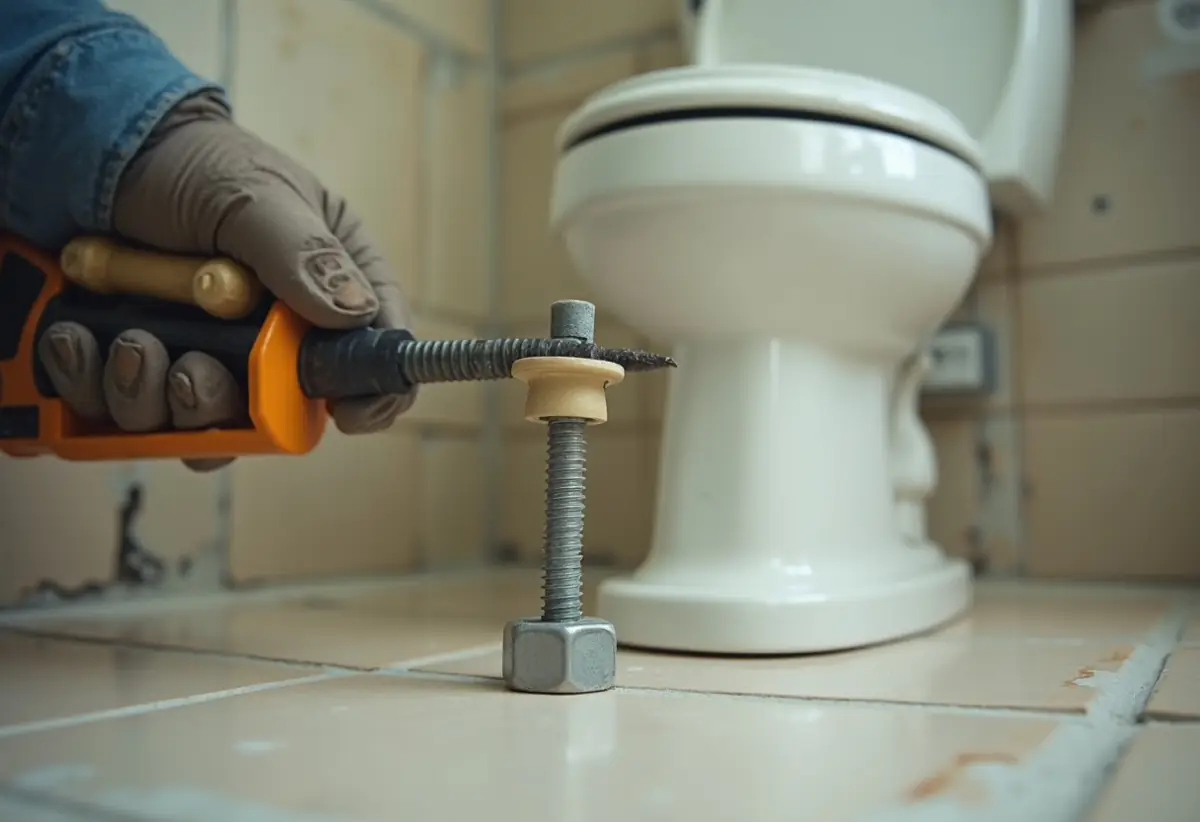
Cut closet bolts after the toilet is fully tightened, and only if they stand too tall for the caps. Kohler’s installation guide says to cut off the excess when the bolts extend more than 1/4 inch (6 mm) above the top of the nuts. A hacksaw or a close-quarters mini hacksaw does the job; snap-off bolts break at a scored line instead.
- Protect the china. Kohler warns to keep the vitreous china clear of the saw blade. Wrap painter’s tape or cardboard around the bolt at the base.
- Hold the nut. Keep a wrench on the nut while you saw so the bolt does not spin and loosen the bowl.
- Dress the cut. Kohler’s K-3394 manual says to file the cut edges after using the hacksaw, so the cap seats and threads stay clean for the next removal.
- Snap-off option. On the Lincoln Products 1/4-20 bolt the snap-off slot sits 1/2 inch below the top, so the stub breaks off with pliers.
Many cap kits come in two parts, a plastic base that clips over the washer and a dome that snaps onto it. American Standard says to cut the bolt to size before installing the caps.
What Do You Do When a Closet Bolt Spins or Breaks?
A closet bolt that spins has lost its grip in the flange slot, either because the head slid out of the channel or because the slot itself broke or rusted away. If the slot is intact, pull the toilet and reseat the bolt. If the slot is gone, add a stainless repair ring over the old flange and use the new bolts that come with it.
Old cast iron and steel-ringed flanges are the usual offenders, because the thin metal around the bolt slot rusts thin. Three fixes, from least to most work:
- Bolt spins while removing a seized nut. Clamp locking pliers on the bolt above the nut, or saw the bolt off just above the nut and lift the toilet. The bolt is being replaced anyway.
- Slot cracked on one side. Screw a repair ring over the flange. Oatey’s Fix-It repair ring now comes in stainless, with a thicker wall between the bolt slot and the ring edge that Oatey says reduces weak points.
- Flange rusted through or broken all around. A full repair kit such as the Danco HydroSeat 10672X (stainless, 6.88 inch outer diameter, 4.25 inch inner diameter) includes closet bolts, stainless washers and nuts. Oatey’s 1/4 inch stainless replacement ring measures 7.01 inches across, has two bolt slots and six countersunk floor holes, and fits 3 or 4 inch flanges.
Model plumbing codes generally require floor-outlet fixtures to be fastened to the floor or flange with corrosion-resistant bolts or screws, so check your local code before reusing rusty hardware.
How we sourced this
Two live searches mapped what ranking pages cover; every number then came from a maker document or a distributor’s part listing: Sioux Chief’s closet bolt catalog (parts 410-PB through 419), American Standard installation guide 7301816-100 Rev. B, Kohler toilet installation guides including the K-3394 manual, Grainger closet bolt instructions, Oatey’s Fix-It announcement, and Ferguson, SupplyHouse, HD Supply and distributor listings for Lincoln Products, Jones Stephens, Harvey, Danco and Oatey parts, checked October 2026. We left out torque values (no maker publishes one), retail prices, and any code section text we did not read in the code itself.
Frequently asked questions
What size are toilet closet bolts?
Closet bolts come in two diameters, 1/4 inch with 20 threads per inch and 5/16 inch with 18 threads per inch, per Sioux Chief’s catalog. Kohler’s K-3394 manual says to install new 1/4 or 5/16 inch T-bolts. The common length is 2-1/4 inches, with 1-3/4 inch and 3-1/2 inch bolts sold for thin and thick bases.
How tight should toilet bolts be?
Tight enough that the bowl stops rocking, and no tighter. American Standard says to tighten the nuts alternately until the toilet is firmly anchored and warns that overtightening may damage the base. Kohler’s K-3394 manual has you hand-tighten each nut, then add a half turn with a wrench. Kohler warns that overtightening can break or chip vitreous china.
Can you replace closet bolts without removing the toilet?
Usually not. The T-bolt head sits in the flange slot under the toilet base, so a new bolt can only go in with the bowl lifted off. Pulling the toilet breaks the wax seal, which means you also need a new wax ring before you reset it. Plan for both parts and a putty knife to scrape the old wax.
Are 1/4 and 5/16 closet bolts interchangeable?
Not with the same nuts. A 1/4 inch bolt uses 1/4-20 threads and a 7/16 inch hex nut, while a 5/16 inch bolt uses 5/16-18 threads and a 9/16 inch nut, per Sioux Chief. Most flange slots accept either head. The 5/16 inch bolt is thicker and stiffer, so it is the safer pick when the old diameter is unknown.
Why does my closet bolt spin when I try to tighten it?
The T-head has slipped out of its slot or the slot has broken away, so the bolt turns with the nut. If the flange is intact, pull the toilet and reseat the head. If the slot is cracked or rusted through, add a repair ring such as the Oatey Fix-It ring or the Danco HydroSeat 10672X, which comes with new bolts.
Do I need to cut toilet bolts?
Yes, if they stand too tall for the caps. Kohler’s installation guide says to cut off the excess when a bolt extends more than 1/4 inch (6 mm) above the nut, and to shield the china from the saw blade. Snap-off bolts such as the Lincoln Products 1/4-20 brass bolt have a slot 1/2 inch below the top that breaks off instead.
Are brass or stainless closet bolts better?
Both resist rust far better than plain steel, which matters because the bolts sit in a damp spot under the toilet. Solid brass, like Sioux Chief’s 410-PB and 416-PB, is the plumbing-supply standard. Stainless, like Jones Stephens JC02423SS, is stiffer and holds up where floors stay wet. Avoid uncoated steel bolts, which rust and seize.