Shower Drain Still Not Draining After Snaking? 5 Reasons the Clog Is Still There
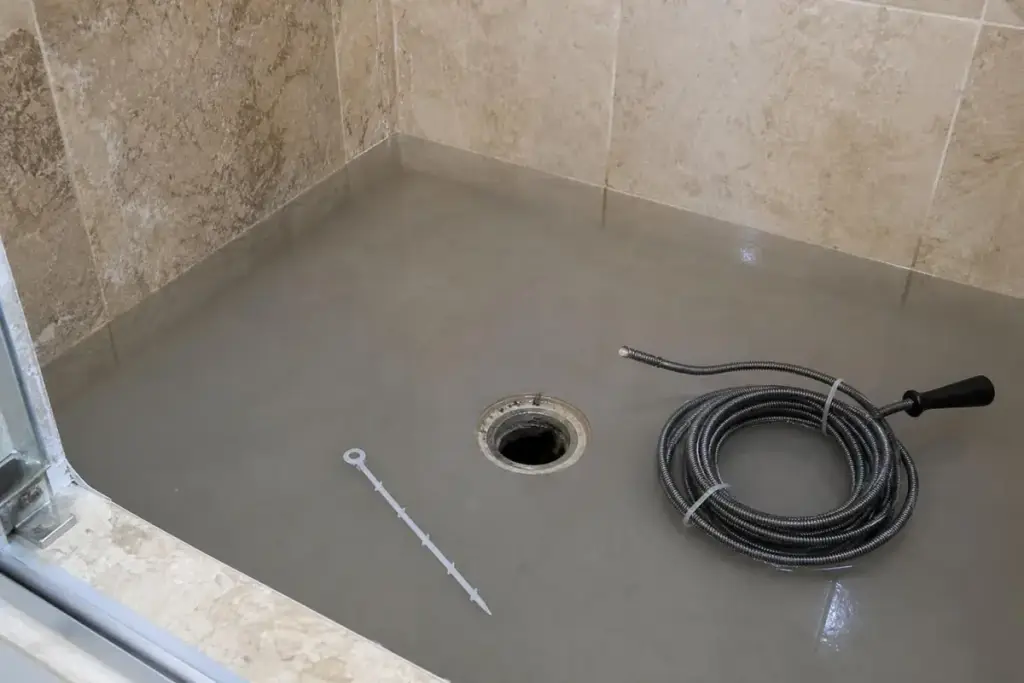
A shower drain not draining after a snake usually means the cable never reached the clog or only bored a hole through it: it bounced off the trap bend, punched a 1/4 in channel through a hair mat, missed a clog in the branch shared with the tub, or the real problem is a blocked vent or a hair-wrapped strainer.
What came back on the cable tells you where it stopped: a clean tip after a short run means the trap bend, a few strands means it went through the mat. If you skipped the hand and barbed strip steps, the basic shower unclogging sequence comes first.
Which of the 5 places did your snake stop?
Match the symptom to one of 6 locations before renting a $75 a day machine.
| Symptom after snaking | Likely location | Tool | Cost (2026 national ranges) |
|---|---|---|---|
| Drains fast for 30 to 60 seconds, then the pan fills | Hair mat in the trap or first 2 ft of trap arm, with a cable hole through it | Barbed strip from the top, then 5/16 in inner core cable retrieved while turning | About $20 for a small snake; $175 to $600 for a pro |
| Cable stops hard at a shallow depth and will not turn the bend | P-trap bend; the clog is still past it | Same cable with sharp thrusts or a few seconds of reverse, per the RIDGID K-45 manual | About $20 DIY |
| Water rises in the tub or a floor drain while the shower runs | Shared bathroom branch below where the tub and shower join | Drum machine through the tub drain or a branch cleanout | $75 to $150 per day to rent; $150 to $650 motorized service |
| Gurgling, bubbles in the toilet bowl, sewer smell | Vent above the sanitary tee or at the roof | Vent clearing with a cable fed down from the roof | $125 to $300 service call if cleared within 1 hour |
| Still slow and the sink and toilet are slow too | Main line, not the shower | Cable through the main cleanout, camera if it returns | $125 to $500 for a video inspection |
| Water stands at the grate but runs freely once the grate is off | Strainer crossbars or the drain body throat | Hands, gloves and a brush | $0 |
Prices: Inch Calculator drain unclogging cost guide, 2026 table, retrieved November 2026. The cheapest test is the last row: pull the grate and pour 1 gallon from a bucket into the open drain body. If it goes down as fast as you pour, the pipe is open and the hair was packed under the grate.
Why does a cable hole through a hair mat drain for a minute, then back up?
A cable bores a hole about the size of its tip and leaves the rest of the mat, and that hole passes far less water than a showerhead delivers. The table works it for 3 small-drain cable sizes in nominal 2 in and 1 1/2 in pipe.
| Opening | Area (sq in) | Share of 2 in bore | Share of 1 1/2 in bore | Est. flow, 6 in water above hole | Est. flow, 24 in above hole | Water depth needed to pass 2.5 gpm |
|---|---|---|---|---|---|---|
| Open 2 in pipe | 3.142 | 100% | n/a | Full bore, not limited by an orifice | ||
| Open 1 1/2 in pipe | 1.767 | 56% | 100% | Full bore, not limited by an orifice | ||
| 1/4 in cable hole | 0.049 | 1.6% | 2.8% | 0.53 gpm | 1.06 gpm | 134 in |
| 5/16 in cable hole | 0.077 | 2.4% | 4.3% | 0.83 gpm | 1.66 gpm | 55 in |
| 3/8 in cable hole | 0.110 | 3.5% | 6.3% | 1.19 gpm | 2.38 gpm | 26 in |
Estimate, inputs shown: area equals 3.1416 times diameter squared divided by 4, using nominal sizes. Flow uses the orifice equation Q = C times A times the square root of 2gh, with C = 0.61, the coefficient the USBR Water Measurement Manual gives for a sharp-edged opening with full contraction, g = 9.81 m/s2, and 1 m3/s = 15,850 gpm. A ragged hole in wet hair passes less than a machined orifice, so each flow is an upper bound. The 2.5 gpm target is EPA WaterSense‘s figure for a standard showerhead.
The 24 in column is the worst realistic case, because IPC Section 1002.1.1 caps the vertical distance from fixture outlet to trap weir at 24 in. Even there, a 1/4 in hole passes about 1.06 gpm, under half of a 2.5 gpm head, so the pan fills within minutes. Count a snaking as done only when the shower runs at full flow for several minutes with nothing collecting on the pan.
How do you pull the hair out of a shower drain instead of pushing it down?
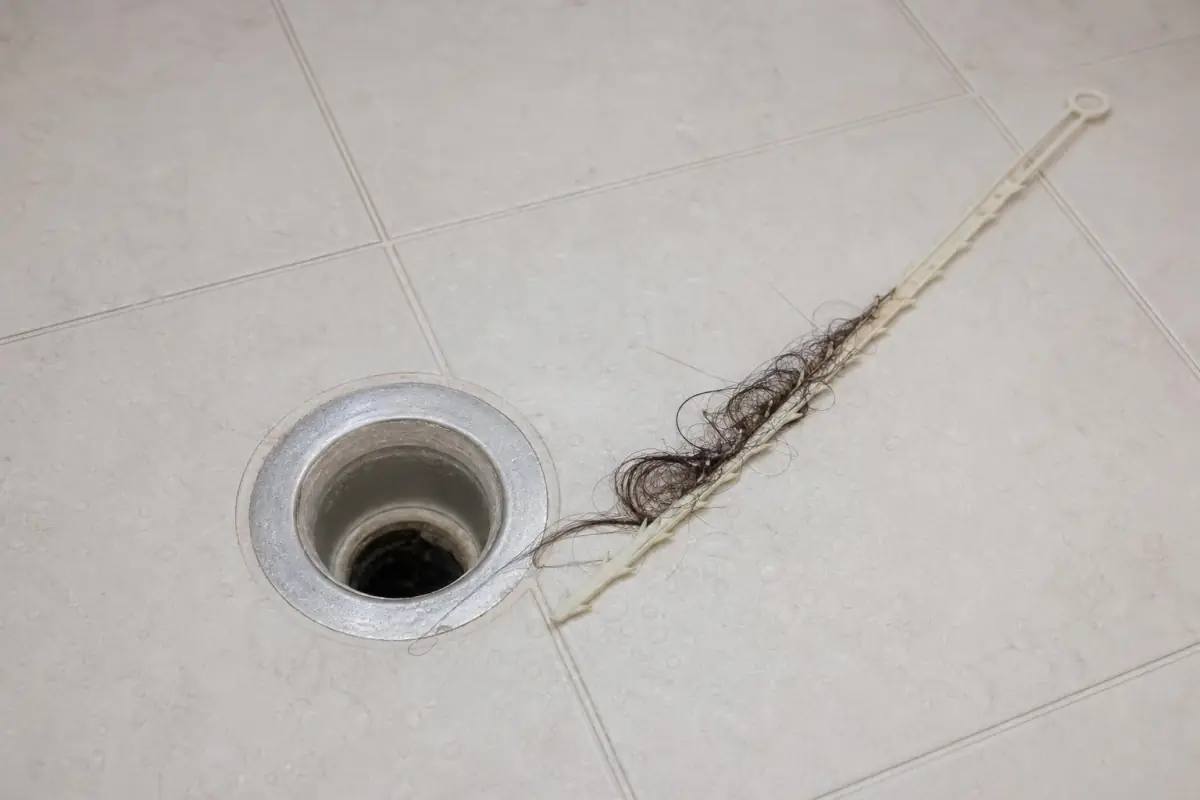
Pull the strainer first, so whatever the tool grabs leaves through the top instead of being driven toward the trap arm. IPC 2024 Section 421.3 requires shower strainers to be removable, at least 3 in across, with openings of at least 1/4 in.
- Screw-down grate: remove the screws with a Phillips driver and lift the grate.
- Snap-in or friction grate: slide a putty knife under the rim at two opposite points and lift evenly; prying one side cracks plastic tabs.
- Run a barbed plastic strip down the throat, twist it and pull slowly, repeating from different sides of the opening. Stop when two passes in a row come up clean.
- Only then feed the cable, and retrieve it while it still turns slowly so the tip winds hair onto itself instead of shedding it in the trap.
Cable size matters more than most guides admit. The RIDGID drain cleaning catalog lists 1/4 in and 5/16 in cables as best for 3/4 to 1 1/2 in lines and 3/8 in cable for 1 1/4 to 2 1/2 in lines, and the K-45 specifications add 5/16 in inner core for 1 1/4 to 2 in. A 1/4 in cable inside a 2 in shower trap is outside its rated range, which is why it bounces off the bend or bores a 1.6% hole instead of clearing the pipe.
When the cable stalls at the bend, the RIDGID K-45 operator’s manual gives 2 methods: sharp thrusts with and without rotation, or a few seconds of reverse while pushing, just enough to start through the trap. It also warns that feeding cable into a larger drain or transition can kink or knot it.
What if the tub fills or the drain gurgles while the shower runs?
Water rising in a tub, or bubbles in a toilet, puts the restriction downstream of where those fixtures join the shower, so more shower-side snaking cannot help. Under IPC 2021 Table 709.1 a shower up to 5.7 gpm rates 2 drainage fixture units on a 1 1/2 in minimum trap and a bathtub 2 units on 1 1/2 in, and in a typical bathroom group both drain into one shared branch.
Cable a shared branch from the tub with its overflow plate off, or from a branch cleanout. A backup in a lower floor drain means the main, where a 4 in line needs a 2 in cutter on the first pass, not a sink cable; that is covered in why a main line stays clogged after a cutter pass.
Gurgling with a drain that is only a little slow points to the vent. IPC Table 909.1 limits a 2 in trap to 8 ft from its vent at 1/4 in per ft, and 1 1/2 in traps to 6 ft; past those limits, or with a vent blocked at the roof, falling water pulls air through the trap seal instead. Our page on what a gurgle at each fixture means separates one-fixture gurgles from whole-house ones. Book roof-side vent clearing when gurgling continues after the branch is cabled clean.
Under a sink, the open trap arm test for a drain that stays slow with a clean trap answers the same question with the trap off. A shower trap sits under the floor, so the 1 gallon pour into the open drain body stands in for it.
Does a linear shower drain need a different approach?
Yes: many linear drains hide a removable trap insert in the channel, and a cable fed through the grate hits that insert instead of the pipe. The Schluter KERDI-LINE product data sheet describes an odour trap integrated into the drain body, with a water trap height of 25 to 50 mm depending on version, and a set that includes a cleaning brush for periodic cleaning of the odour trap and channel body.
Lift the grate, pull the hair strainer, then lift out the two-piece trap insert before any cable goes in. The same data sheet rates its lowest listed DN 40 version at 0.5 l/s (30 l/min, about 7.9 gpm) with 20 mm of water above it, which is triple a 2.5 gpm head, so a linear drain still slow after cleaning has a restriction below the channel.
Are chemical cleaners or a camera worth it after a failed snake?
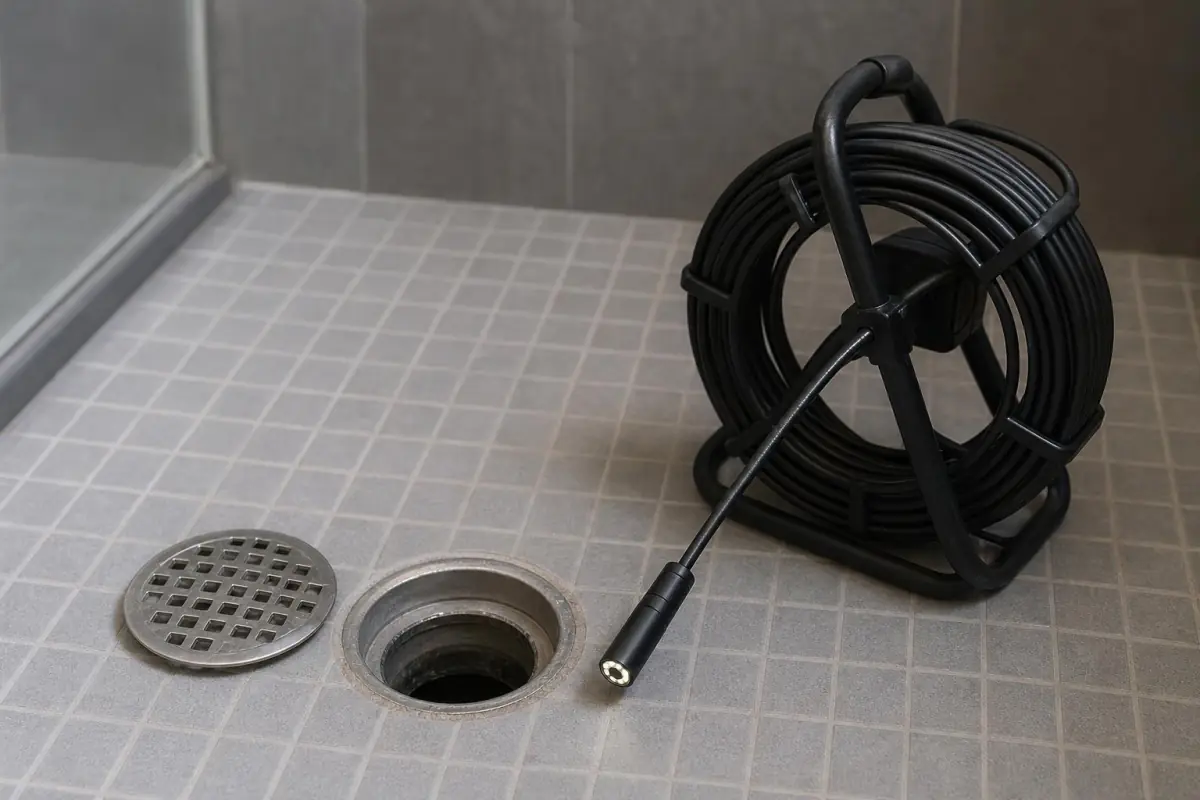
Skip chemicals after a failed snaking, and pay for a camera only when the clog returns. Poison Control lists sulfuric and hydrochloric acid and sodium or potassium hydroxide as common ingredients, and warns that splash-back is more likely when product goes into a completely blocked drain, the standing pool a failed snaking leaves.
Schluter also requires cleaning agents on its drains to be free of hydrochloric and hydrofluoric acid. A camera, $125 to $500 per the Inch Calculator guide, is justified when the shower slows again within weeks of a clean snaking, or when the full 25 ft of a C-1IC cable reaches the branch and returns clean. Enzyme products are maintenance for soap film after the hair is out, not a fix for a mat already punched through.
Questions about a shower that is still clogged after snaking
Should I snake the shower drain a second time right away?
Only after you change something. Pull the strainer, run a barbed strip first so the hair comes up instead of going down, and use a 5/16 in inner core cable, which RIDGID rates for 1 1/4 to 2 in lines. Repeating the same 1/4 in cable usually bores the same hole again.
Why does my shower drain fine for a minute and then fill up?
The pipe below is holding water faster than a small opening lets it pass. A 1/4 in hole through a hair mat passes roughly 0.5 to 1.1 gpm by orifice math, while a standard showerhead delivers 2.5 gpm, so the level climbs after the first minute of running water.
Do enzyme drain cleaners dissolve hair in a shower drain?
They are a maintenance product, not a fix for a hair mat. Poison Control describes enzymatic cleaners as bacteria and enzymes that dissolve clogs, and they work slowly on soap film. A mat with a 1/4 in cable hole through it needs to be pulled out with barbs or a cable head first.
How do I get a snap-in shower strainer out without breaking it?
Remove any screws first. Then slide a putty knife under the rim and lift evenly at 2 opposite points, since prying one side cracks plastic tabs. IPC 2024 Section 421.3 requires shower strainers to be removable, so a grate that will not lift is usually held by soap scum or grout.
How we sourced this
Code text: IPC 2021 Table 709.1, Sections 1002.1.1 and 1002.4, Table 909.1, and IPC 2024 Section 421.3, from state adoption editions on UpCodes; local amendments vary. Tool ratings: RIDGID drain cleaning catalog and K-45 operator’s manual and specifications. Linear drain details: Schluter KERDI-LINE data sheet. Chemical facts: Poison Control. Prices: Inch Calculator 2026 table, retrieved November 2026. The hole-area and flow table is our own arithmetic with the inputs shown. We did not test or measure any drain. Product-specific enzyme dosing and strainer screw counts by brand could not be confirmed from manufacturer documents and were left out.