P Trap Clear but Sink Still Not Draining? Look Past the Trap
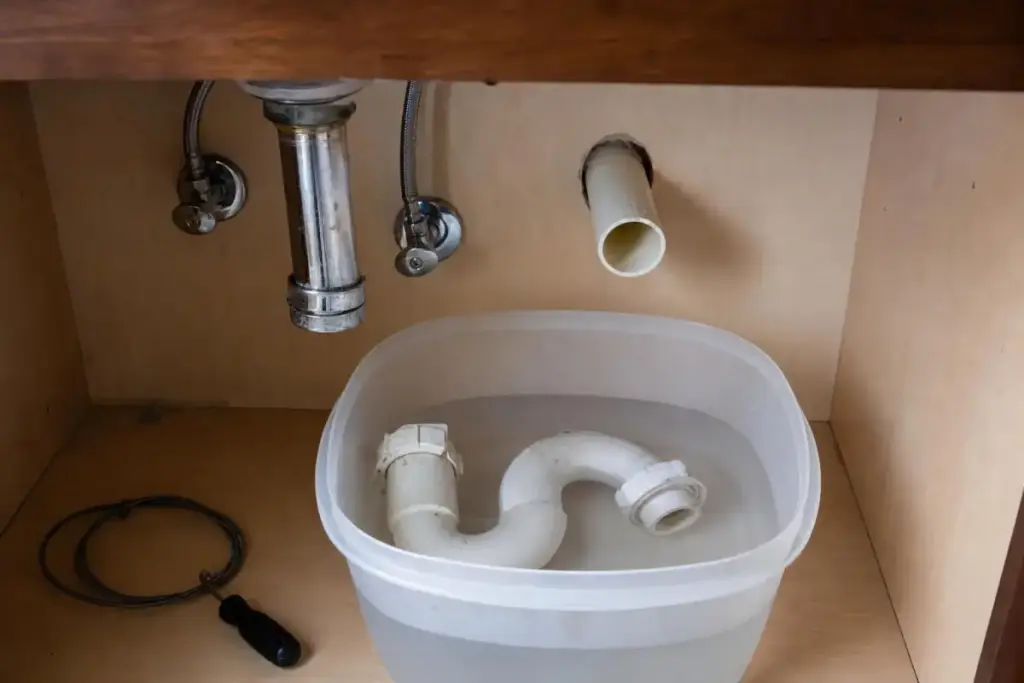
If the P trap is clear but the sink is still not draining, the clog is past the trap: in the trap arm, the sanitary tee in the wall, the shared branch, the vent, or the main. Pour 2 cups of water into the open trap arm and watch whether it backs up, drains slowly, or drains fast.
That test, done with the trap off and a bucket under the stub, picks which of five places to work on and whether a $20 hand spinner reaches it. The how a P-trap and its trap arm are laid out page covers the trap itself.
What does water poured into the open trap arm tell you?
Water poured into the open trap arm sorts the clog into above or below the trap. Pour from a 2 cup measure, steadily, so you see the moment the level rises in the arm.
| What the water does in the open trap arm | Where the blockage is | Tool to use | Cost range (Nov 2026) |
|---|---|---|---|
| Disappears as fast as you pour, no sound | Above the trap: tailpiece, pop-up stopper, pivot rod, or a kitchen disposal outlet | Pull the stopper and lift rod; clear the tailpiece by hand | $0 to about $20 for a small snake |
| Rises in the arm within the first cup and stays | Trap arm or the sanitary tee where the arm meets the wall pipe | Hand spinner, 1/4 in or 5/16 in cable | About $20 DIY; $175 to $600 for a pro snake |
| Takes several cups, then backs up into the arm | Farther down the branch line; more water before backup means a more distant clog | 5/16 in inner core cable, 25 ft or longer | $75 to $125 per day to rent a machine |
| Drains slowly and gurgles, or another fixture’s trap bubbles | Vent blocked, or the shared branch partly closed below the vent tie-in | Roof vent check and a cable fed down the stack from the roof | $125 to $300 service call if cleared within an hour |
| Shows up in the other bowl, a tub or a floor drain | Branch or main below where those fixtures join | Drum machine through the cleanout | $150 to $650 motorized snake; $125 to $500 camera |
Prices are national 2026 ranges from the Inch Calculator drain cleaning cost guide (retrieved November 2026); hydro jetting starts near $700 there and is a main line fix. On bathroom sinks the pop-up stopper, pivot rod and tailpiece sit above the trap, so hair wrapped on the rod survives a perfect trap cleaning. RIDGID’s KWIK-SPIN+ hand spinner instructions list “remove lift rod and drain plug” as the setup for a pop-up drain for exactly this reason. The lavatory overflow channel also joins above the trap; flush it with 1 cup of hot water while the bucket sits under the tailpiece.
How do you clear a trap arm or sanitary tee clog in the wall?
Feed a hand spinner straight into the open trap arm, not down the sink, because the bare stub skips the tailpiece and the trap bends. The RIDGID K-45 manual rates 1/4 in and plain 5/16 in cable for 3/4 to 1 1/2 in lines, 5/16 in inner core cable for 1 1/4 to 2 in lines, and 3/8 in cable for 1 1/4 to 2 1/2 in lines.
A cable that stops dead a hand’s width past the wall face is usually hitting the back of the sanitary tee, not the clog. Pull back slightly, keep cranking clockwise, and let the tip turn the 90 degree bend downward. See feeding and retrieving a hand snake for the crank sequence.
| Tool (RIDGID document) | Cable | Rated line size | Use it for |
|---|---|---|---|
| KWIK-SPIN+ hand spinner | Cable retained in the drum | Up to 1 1/2 in | Lavatory tailpiece and 1 1/4 in trap arm |
| K-26 hand spinner | 5/16 in x 25 ft hollow core, bulb head | 3/4 to 1 1/2 in | Bathroom or kitchen arm, sanitary tee, first stretch of branch |
| K-25 hand spinner | Drum holds 5/16 in x 35 ft | 3/4 to 1 1/2 in | Longer 1 1/2 in branch runs |
| K-45 sink machine, C-1IC cable | 5/16 in x 25 ft inner core | 1 1/4 to 2 in | Packed grease in a kitchen branch |
| K-45AF-5 sink machine, C-6 cable | 3/8 in x 35 ft | 1 1/4 to 2 1/2 in | 2 in kitchen and laundry branches |
Sizes come from the K-45 manual and RIDGID drain cleaning catalog. The decision rule: a 1 1/4 or 1 1/2 in line within 25 ft is hand spinner work; a 2 in kitchen branch packed with grease, or any line past 2 1/2 in, needs a powered drum machine, because the K-45 manual caps that machine at 2 1/2 in. The catalog lists a grease cutter head “for lines which have become badly greased.”
Is the trap arm too long, too flat or sloped backward?
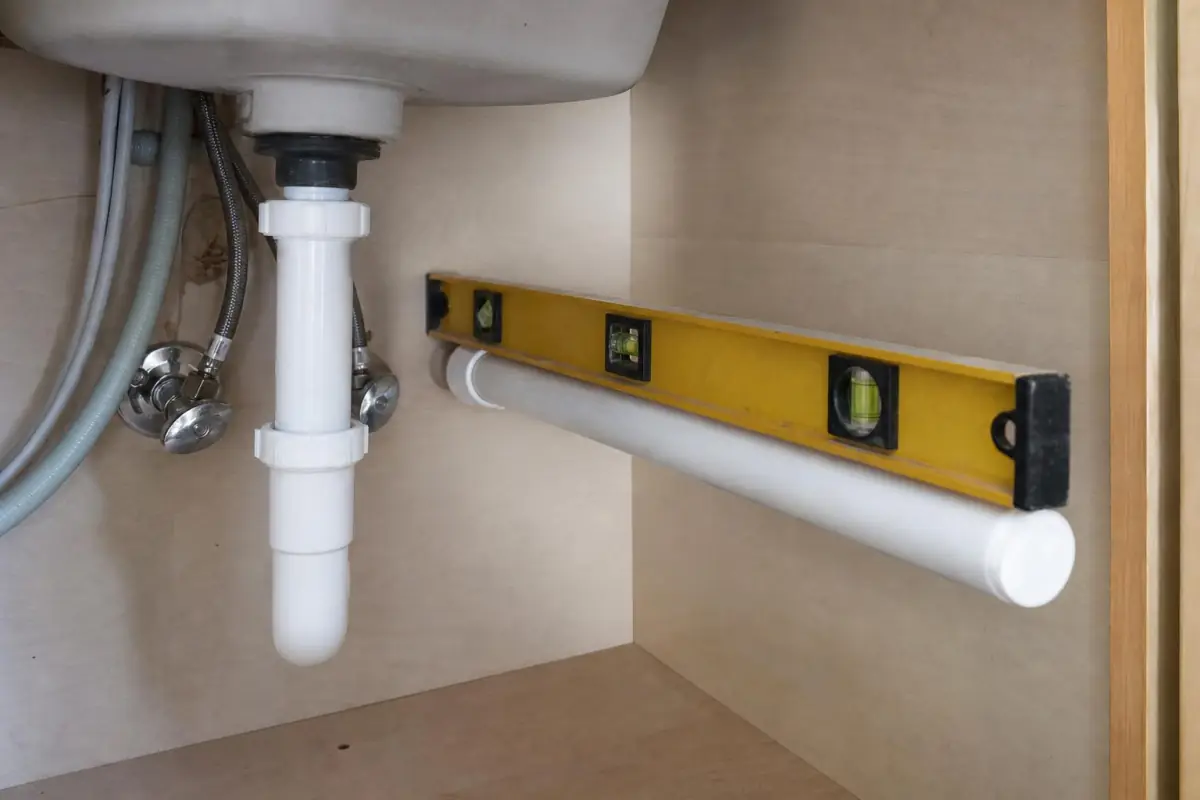
A trap arm that is too long, too flat or reversed drains slowly with no clog at all, and the open arm test shows it as water lingering in the stub. IPC 2021 Table 909.1 caps the arm from trap weir to vent at 5 ft for 1 1/4 in pipe, 6 ft for 1 1/2 in and 8 ft for 2 in, each at 1/4 in per ft. Section 909.2 adds that the total fall “shall not exceed the diameter of the fixture drain.”
| Trap arm size | Max length, Table 909.1 | Fall over max length at 1/4 in per ft | Fall cap, Section 909.2 | Longest legal arm at 1/2 in per ft | Fall needed on a 24 in arm |
|---|---|---|---|---|---|
| 1 1/4 in (lavatory) | 5 ft (60 in) | 5 x 0.25 = 1.25 in | 1.25 in | 1.25 / 0.5 = 2.5 ft | 2 x 0.25 = 0.5 in |
| 1 1/2 in (kitchen sink) | 6 ft (72 in) | 6 x 0.25 = 1.5 in | 1.5 in | 1.5 / 0.5 = 3 ft | 0.5 in |
| 2 in | 8 ft (96 in) | 8 x 0.25 = 2.0 in | 2.0 in | 2.0 / 0.5 = 4 ft | 0.5 in |
Inputs: Table 909.1 lengths and slope, Section 909.2 fall cap equal to nominal diameter, fall equals length times slope. At full length the arm uses its entire fall allowance, so a too-long arm cannot be rescued by steepening it, and doubling the slope to 1/2 in per ft halves the legal length.
To check yours, measure the arm’s developed length L in inches and the drop F in inches from the trap outlet centerline to the wall stub centerline. F divided by L, times 12, is the slope in inches per foot. Under 0.25 is flatter than the 1/4 in per ft minimum in IPC Table 704.1 for pipe 2 1/2 in and smaller; a negative number means the arm runs uphill into the wall and holds water. A trap set too low for the stub causes this; a longer tailpiece raises it. See drain pipe slope rules by pipe size for longer runs.
Can a sanitary tee installed backwards keep a sink from draining?
Yes: IPC Section 706.3 requires fittings to “guide sewage and waste in the direction of flow,” and Table 706.3 permits a sanitary tee only for a horizontal to vertical change. A tee turned upside down points its curved sweep up, so the arm’s flow enters against the curve instead of along it. A cable that stops at the same depth every time after a remodel is the clue; the fix means opening the wall.
Why does a double sink back up into the other bowl?
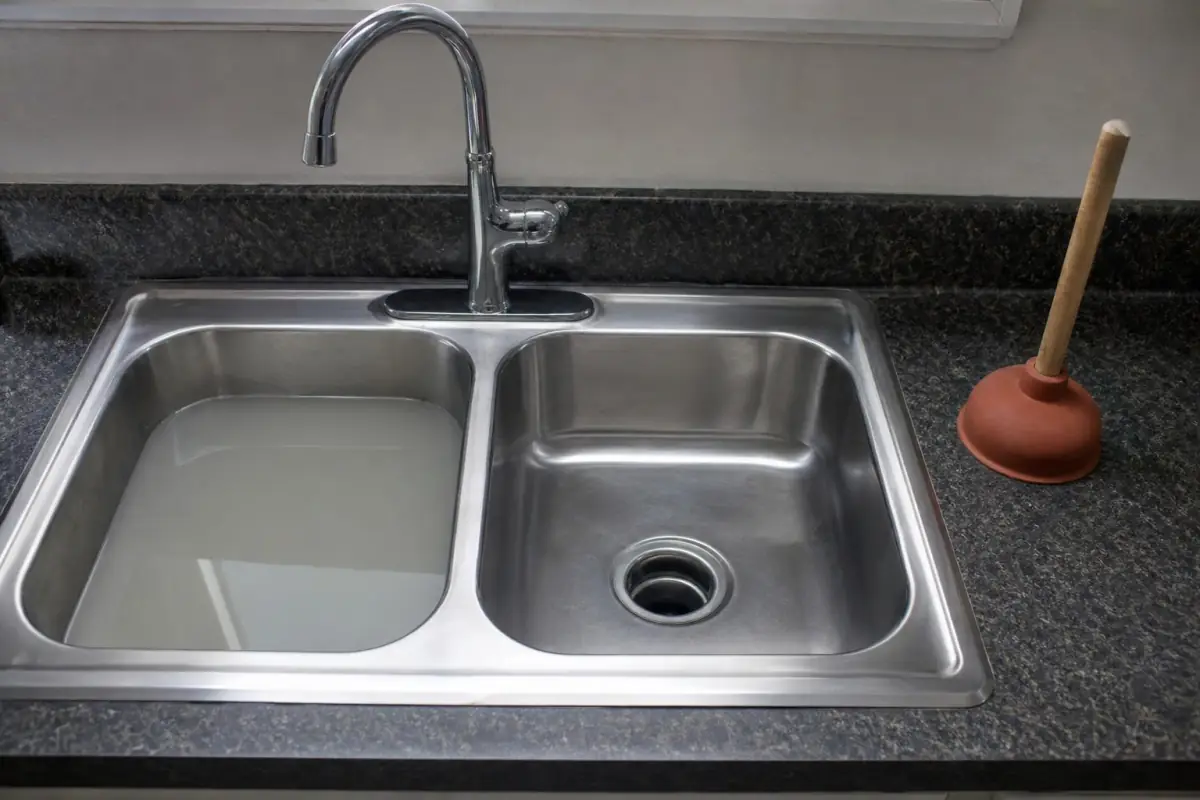
A double sink on one trap backs up into the second bowl when the clog is below the tee where the two bowls join, which with a clean trap means the arm or branch. IPC Section 1002.1 allows one trap for a combination fixture only when one compartment is not more than 6 in deeper than the other and the waste outlets are not more than 30 in apart, and it bans double trapping outright. A trap under each bowl feeding a third trap is a double trap that slows both bowls even when every trap is clean.
What does a blocked vent look like at the sink?
A blocked vent shows up as slow draining with gurgling, or as water in a nearby fixture’s trap bobbing when the sink runs, while the open trap arm takes water without a hard backup. IPC Section 904.1 requires at least one vent pipe to the outdoors for each building drain, and Section 903.2, titled Frost Closure, requires vent extensions at least 3 in in diameter where the 97.5 percent outdoor design temperature is 0°F or lower. Leaves, nests and frost at the roof terminal block it. The plumbing vent diagram shows how the sink vent ties into the stack. If the roof cannot be walked, ask a plumber to cable the vent from the roof terminal down to the sink tee.
When is the main drain the problem, not the sink?
The main is the problem when two or more fixtures on different branches drain slowly, or when the lowest fixture in the house, usually a tub, shower or basement floor drain, rises while the sink runs. No sink-side cable reaches that blockage. Ask for a main line cable job through the cleanout plus a camera pass; Inch Calculator’s 2026 ranges are $150 to $650 for the motorized snake and $125 to $500 for the camera.
Why chemical cleaner comes after the snake, never before
A sink that will not drain holds whatever chemical goes in, and the open arm aims it at your hands and eyes. The RIDGID K-45 operator’s manual tells users to determine the “presence of drain cleaning chemicals” before cleaning and to contact the chemical manufacturer for handling rules if any are present.
Questions about a sink that drains badly with a clean trap
Can a blocked vent stop a sink from draining completely?
A blocked vent usually slows a sink and makes it gurgle rather than stopping it dead. Water that will not move at all through a 1 1/4 or 1 1/2 in open trap arm points to a solid blockage in the arm, tee or branch, so snake that first and check the roof vent second.
How far into the wall can a hand snake reach from the trap arm?
A hand spinner such as the RIDGID K-26 carries 25 ft of 5/16 in cable, which reaches past the sanitary tee and well down a typical bathroom or kitchen branch. Beyond that length, or in pipe larger than 2 in, a drum machine or a plumber is the next step.
Is it safe to use drain cleaner after taking the P-trap off?
No. With the trap off, the 1 1/4 or 1 1/2 in open arm points the chemical back at your hands and face, and a standing clog keeps the caustic in the pipe. The RIDGID K-45 manual tells users to find out whether drain chemicals are present before any cable goes in, so snake first.
When should I stop and call a plumber for a sink that will not drain?
Stop when water backs up in a tub or floor drain while the sink runs, when 25 ft of cable will not pass the blockage, or when the vent sits on a steep roof. Ask for a main line cable job through the cleanout with a camera inspection.
How we sourced this
Code text: IPC 2021 Chapter 9 (Table 909.1, Sections 909.2, 903.2, 904.1), Chapter 7 (Table 704.1, Section 706.3) and Chapter 10 (Sections 1002.1 and 1002.4), viewed on UpCodes; local amendments and UPC jurisdictions set their own trap arm limits, so check the adopted code. Tool ratings come from RIDGID’s K-45 manual, KWIK-SPIN+ instructions and drain cleaning catalog. Costs are the 2026 national ranges on Inch Calculator’s drain cleaning guide, retrieved November 2026. The trap arm fall table is our arithmetic from Table 909.1 and Section 909.2. Nothing here was tested on a fixture. We found no sourced price for a roof vent clearing alone, so none is given.