Types of Shower Drains: Point vs Linear and How to Choose
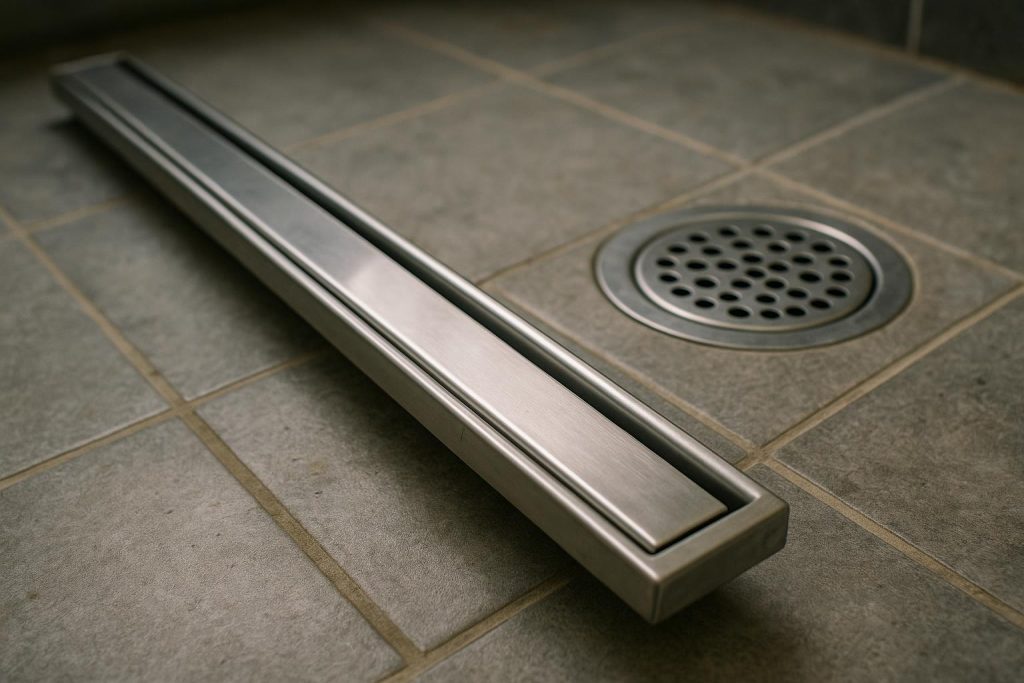
Shower drain types split into four families: the point or center drain, the linear or channel drain, the tile-in drain, and the multi-piece clamping drain, and the right one depends on your pan and your slope.
Key Takeaways
- Two inches is the standard shower drain size in practice and the minimum shower trap under the Uniform Plumbing Code; the International Plumbing Code allows 1.5 inches only when total shower flow is 5.7 gpm or less.
- A point or center drain needs the floor sloped toward it from all four directions at 1/4 inch per foot (a 2 percent grade), per IPC Section 417.5.2.
- A linear or channel drain uses a single-plane slope in one direction, which supports large-format tile and curbless, ADA-style entries, per Schluter.
- Tile-in drains take a cover you fill with matching tile so the grate nearly disappears; they come on both point and linear bodies.
- Multi-piece clamping drains bolt a waterproofing membrane or pan liner between flanges and add weep holes, for custom mortar-bed tiled pans, per Oatey.
- A center drain part can cost 15 to 20 dollars while a linear part often runs 200 dollars or more; installed, roughly 100 to 250 dollars versus 300 to 800 dollars, per Angi.
What are the main types of shower drains?
Shower drains come in four main types: the point or center drain, the linear or channel drain, the tile-in or tileable drain, and the multi-piece clamping drain. They differ in where the water exits the floor, how the pan has to slope, and how the look reads once the tile is down. Every one of them lands on the same standard 2-inch outlet, so the choice is about the pan and the aesthetic, not the pipe. Since the outlet size stays constant across every style, picking a drain often happens alongside a bigger remodel like a tub to shower conversion. Before committing to a drain style for that conversion, it helps to understand how shower pan leaks are diagnosed.
The drain is one piece of the shower rough-in. The valve behind the wall sets temperature and flow; see our guide to shower valve types for that side. To see how the drain, trap, and supply tie together before you pick a style, the shower plumbing diagram lays out the whole assembly.
How do point and linear drains compare?
The core split is point versus linear. A point or center drain sits in the middle and pulls water from every side, so the floor pitches in four directions. A linear or channel drain runs along one wall or the entry, so the floor tilts on one plane. The table below compares the four drain types on slope, the pan they suit, the look, cost, and who each is for.
| Drain type | Slope needed | Best pan | Look | Cost | Best for |
|---|---|---|---|---|---|
| Point / center | Four-way, 1/4 in per ft toward center | Prefab base or a square tiled pan | Round or square grate in the middle | Low ($100-250 installed) | Budgets, standard remodels, prefab bases |
| Linear (channel) | Single plane toward one edge | Curbless or large-format tile pan | Long slot at a wall or the entry | High ($300-800 installed) | Barrier-free and ADA entries, big tiles |
| Tile-in (tileable) | Follows its body (point or linear) | Tiled pan where the drain should vanish | Tile-filled cover hides the grate | Mid to high | A near-invisible, continuous tile floor |
| Multi-piece clamping | Four-way (point) for a mortar bed | Mortar-bed pan with a membrane liner | Round grate plus weep holes | Mid | Custom tiled pans built over a liner |
The practical rule: a point drain is the simplest and cheapest and works with most prefab bases, but its four-way cone forces small mosaic tile near the center. A linear drain costs more and asks for careful install, but its single slope lets you run large tile and skip the curb. Tile-in and clamping are not rivals to the first two so much as versions of them, a cover option and a waterproofing method you layer on.
What slope does each drain type need?
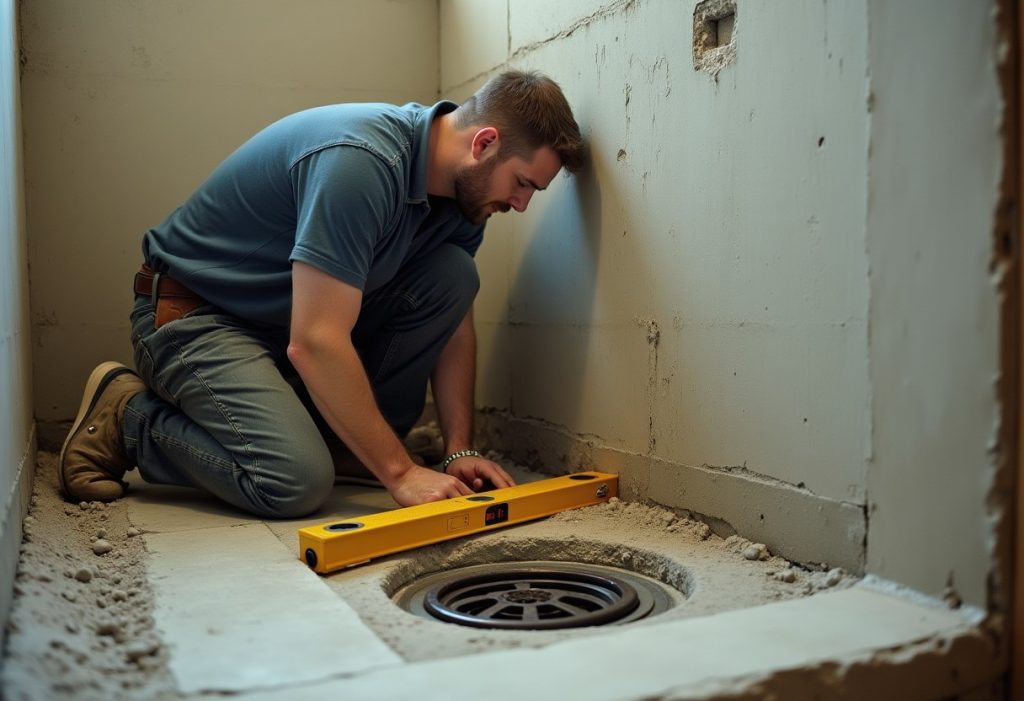
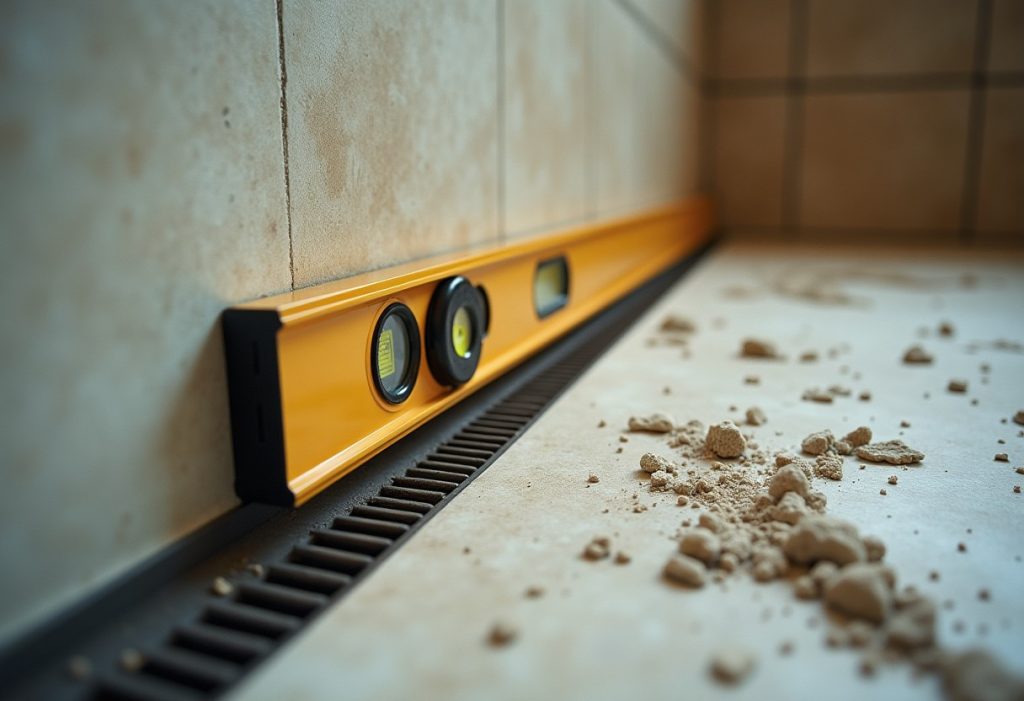
Slope is the deciding factor. A shower floor must drop 1/4 inch per foot, a 2 percent grade, toward the drain under IPC Section 417.5.2. A point drain needs that pitch from all four directions, forming a shallow cone. A linear drain needs it on a single plane, because the water only has to reach one long edge. That difference is why linear drains pair with curbless, barrier-free entries.
The single-plane slope is the reason linear drains work with large-format tile. A big tile cannot bend over the four-way cone a point drain creates, so a center drain pushes you toward small mosaic tile around it. Tilt the whole floor one way to a linear drain and a 24-inch tile lies flat the entire run. The trade is that a linear drain asks the tile setter and plumber to coordinate the exact drain height.
What are tile-in and multi-piece clamping drains?
Tile-in and clamping drains are built for custom tiled pans, not prefab bases. A tile-in or tileable drain has a cover tray you fill with a cut piece of the floor tile, so the grate reads as part of the pattern instead of a metal disc. The style is offered on both point and linear bodies, and it gives the cleanest look when you want the drain to disappear into a continuous tile floor.
A multi-piece clamping drain solves waterproofing. Its body bolts a flexible pan liner or membrane between a base and a clamping collar, and Oatey clamping-ring drains include weep holes so water that soaks into the mortar bed can drain into the waste pipe below. Bonded systems work differently: a Schluter drain uses a bonding flange laminated with membrane rather than a clamp ring. Both lock the waterproofing layer to the drain, which is where tiled pans leak when it is done wrong.
What material and connection should you choose?
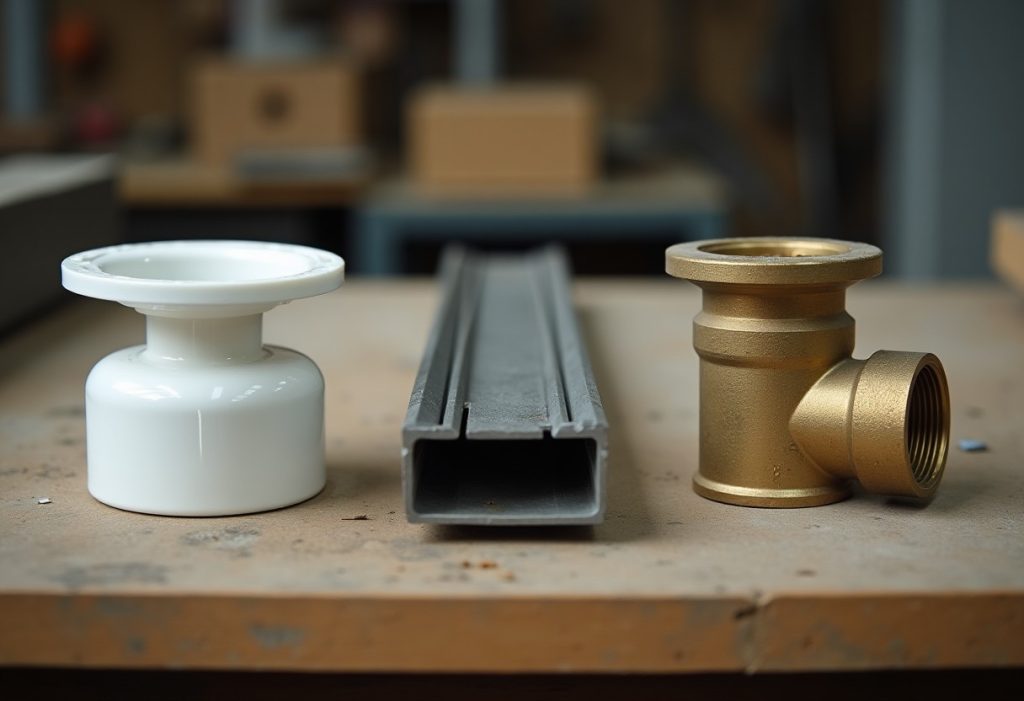
Drain bodies come in PVC, ABS, stainless steel, and brass, and they join the pipe one of three ways. PVC and ABS bodies are the budget standard for point drains and prefab bases. Stainless steel is the common body for linear and premium tile drains because it resists corrosion and takes a brushed or matte finish. Brass shows up on heavier commercial-grade and some decorative grates.
Match the material to the pipe and the pan. A PVC drain must solvent-weld (glue) to PVC pipe and an ABS drain to ABS pipe, per Oatey, so the body has to match your existing waste line. Linear and stainless bodies usually carry a 2-inch no-hub outlet that clamps to the pipe with a rubber coupling, which is handy when you cannot glue. Compression-gasket drains seal around the pipe without glue or a clamp, useful on a tight retrofit.
The three connection styles
- Solvent weld (glued): the outlet is cemented to PVC or ABS pipe, a permanent bond; the body material must match the pipe.
- Compression: a rubber gasket inside the outlet squeezes around the pipe when tightened, so no glue is needed, good for retrofits.
- No-hub: the outlet butts to the pipe and a stainless-banded rubber coupling clamps them, common on stainless linear bodies and cast-iron tie-ins.
How much does each shower drain type cost?
Cost tracks complexity. A point or center drain is the cheapest, with the part as low as 15 to 20 dollars and installed cost around 100 to 250 dollars, per Angi. A linear drain part often runs 200 dollars or more, and installed cost lands near 300 to 800 dollars because the single-plane slope and tile coordination add labor. Tile-in covers and clamping bodies sit in between and depend on the pan build.
Those are drain-only figures. A linear drain usually comes as part of a larger tiled-shower or curbless build, so the total project runs well past the drain line itself; see our guide to bathroom remodel plumbing for what moving or adding a shower drain does to a remodel budget. Ranges shift by brand, finish, drain length, and whether a plumber and tile setter both bill the job.
Which shower drain should you choose?
Match the drain to the pan you are building. For a prefab acrylic or fiberglass base, a point drain is the default, cheap and quick. For a curbless, barrier-free, or large-format tile shower, a linear drain earns its higher cost with the single-plane slope. For a custom tiled pan, pick a clamping or bonded body to lock the waterproofing, and add a tile-in cover if you want the grate to disappear.
Confirm three things before you buy: the body material matches your waste pipe (PVC to PVC, ABS to ABS), the outlet is the standard 2 inches, and the connection style fits your access (glue, compression, or no-hub). Get those right and the drain itself rarely gives trouble; most shower-drain headaches later are clogs, which our guide on how to unclog a shower drain walks through.
How we sourced this
Sizing and slope figures are from code and manufacturer sources: the 1/4 inch per foot (2 percent) four-way floor slope come from the International Plumbing Code, Section 417.5.2; drain sizing follows IPC Table 709.1, which ties the size to total shower flow, and the Uniform Plumbing Code minimum trap size. The single-plane slope for linear drains, the curbless and ADA-compatible use, the 2-inch no-hub outlet with a membrane-bonding flange, and the 20-to-72-inch length range are from Schluter KERDI-LINE product documentation. The clamping-ring, weep-hole, and PVC-to-PVC or ABS-to-ABS matching details are from Oatey shower-drain product pages. Cost figures (a point-drain part at 15 to 20 dollars, a linear part at 200 dollars or more, and installed ranges of roughly 100 to 250 dollars for a center drain and 300 to 800 dollars for a linear drain) are typical US ranges reported by Angi; the tile-in and clamping installed range is given as an approximate mid band and varies with the pan build. All prices are ranges, not fixed quotes, and shift by brand, finish, drain length, and local labor.
Frequently asked questions
What are the main types of shower drains?
The main types are the point or center drain (a round or square grate in the middle of the floor), the linear or channel drain (a long slot at a wall or the entry), the tile-in or tileable drain (a cover you fill with matching tile), and the multi-piece clamping drain that locks a waterproof membrane in a custom tiled pan. All use a standard 2-inch outlet.
What size is a standard shower drain?
Two inches is the standard shower drain size. The Uniform Plumbing Code sets a 2-inch minimum shower trap, and the International Plumbing Code (IPC) allows 1.5 inches only when total shower flow is 5.7 gpm or less, so most installers run 2 inches because a shallow pan has to clear water fast to avoid pooling. The 2-inch outlet is near universal, so most drain bodies connect to the same 2-inch pipe.
What is the difference between a point drain and a linear drain?
A point or center drain sits in the middle of the floor, so the pan must slope toward it from all four directions at 1/4 inch per foot. A linear or channel drain is a long slot at one wall or the entry, so the whole floor slopes on a single plane in one direction. That single slope makes linear drains friendly to large-format tile and curbless, ADA-style entries.
Do linear shower drains need only one slope?
Yes. Because a linear drain runs along one edge, the shower floor tilts on a single plane toward it, per Schluter and other manufacturers. A single slope lets you use large-format tiles that would crack or rock over the four-way cone a point drain needs, and it supports curbless, barrier-free entries. A point drain instead needs the floor pitched toward the center from every direction.
What is a tile-in or tileable shower drain?
A tile-in drain has a cover you fill with a piece of the same tile as the floor, so the grate nearly disappears and the drain blends into the pattern. Tileable covers are offered on both point and linear drains. They cost more and need careful tile cutting, but they give the cleanest look when you want the drain to read as part of the floor.
What is a clamping or membrane shower drain?
A clamping drain is a multi-piece body that bolts a flexible waterproofing membrane or shower-pan liner between two flanges, sealing a custom tiled pan. Oatey clamping-ring drains add weep holes so water that soaks into the mortar bed drains into the waste pipe. They suit traditional mortar-bed pans; bonded systems like Schluter instead use a membrane-bonding flange.
How are shower drains connected to the pipe?
Most shower drains use a 2-inch outlet joined one of three ways: solvent weld (glued) to PVC or ABS pipe, a compression gasket that seals around the pipe, or a no-hub outlet clamped with a rubber coupling. A PVC drain must glue to PVC pipe and an ABS drain to ABS pipe, per Oatey. Stainless and brass linear bodies usually carry a 2-inch no-hub outlet.
How much does a shower drain cost?
A point or center drain part can cost as little as 15 to 20 dollars, while a linear drain part often runs 200 dollars or more, per Angi. Installed, a center drain is roughly 100 to 250 dollars and a linear drain 300 to 800 dollars, because the single-plane slope and tile coordination add labor. Figures are typical US ranges and vary by brand and layout.