How Long Does PVC Glue Need to Set Before You Turn the Water On? Cure Times by Pipe Size and Temperature
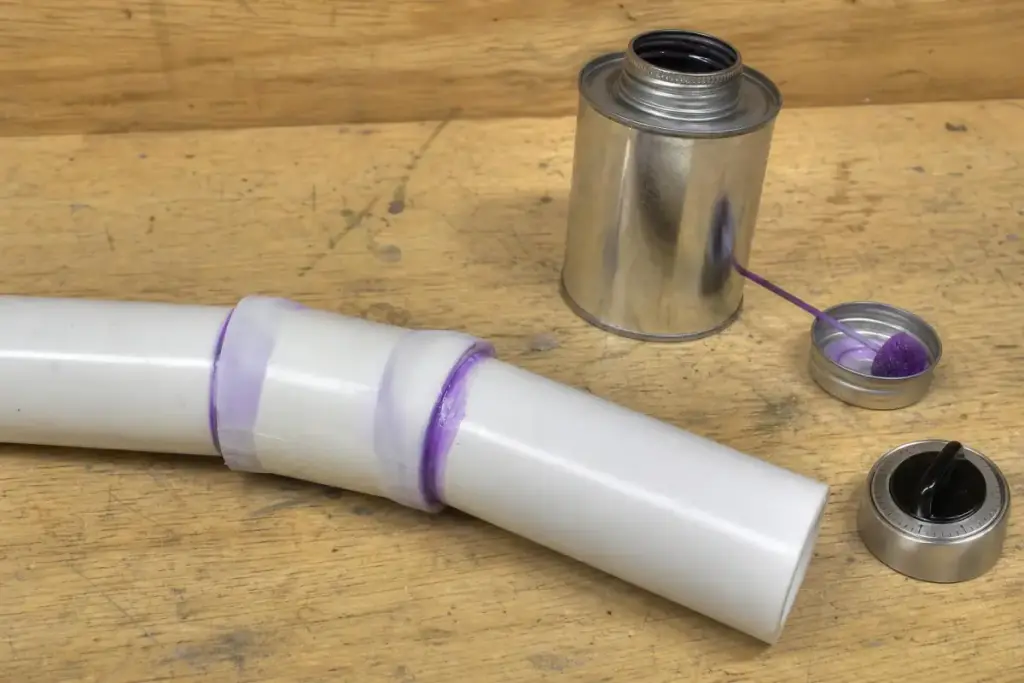
PVC glue needs 15 minutes before you turn the water on for 1/2 to 1 1/4 in pipe at 60 to 100F and up to 160 psi, per both Oatey and IPS Weld-On. Cold air, humidity over 60%, larger pipe or CPVC stretch that to hours, and a 4 in joint near 40F can need 36 to 72 hours.
The two numbers on every can are different clocks. Set time is when the joint can be handled without pulling apart: 2 minutes for 1/2 to 1 1/4 in pipe at 60 to 100F on the Weld-On initial set and cure table. Cure time is when it can take pressure, and Weld-On defines it as “the necessary time to allow before pressurizing system.” Opening the main valve pressurizes the system, so the cure column is the one that decides when the water goes back on.
What do the Oatey and Weld-On cure charts say for each pipe size?
Both charts give 15 minutes for small pipe in warm weather and diverge for everything larger, because they split the sizes and the pressures differently. Oatey breaks pressure at 180 psi and sizes at 1 1/4, 3, 5 and 8 in on its current PVC and ABS cure table. Weld-On breaks pressure at 160 psi and sizes at 1 1/4, 2 and 8 in. Every figure assumes relative humidity of 60% or less.
| Pipe size (maker) | Pressure band | 60 to 100F | 40 to 60F | Below 40F |
|---|---|---|---|---|
| 1/2 to 1 1/4 in (Oatey PVC/ABS) | Up to 180 psi | 15 min | 20 min | 30 min (20 to 40F) |
| 1/2 to 1 1/4 in (Oatey PVC/ABS) | Over 180 psi | 4 hr | 8 hr | 36 hr |
| 1/2 to 1 1/4 in (Weld-On PVC/CPVC) | Up to 160 psi | 15 min | 20 min | 30 min (0 to 40F) |
| 1/2 to 1 1/4 in (Weld-On PVC/CPVC) | 160 to 370 psi | 6 hr | 12 hr | 48 hr |
| 1/2 to 1 1/4 in (Oatey CPVC) | Up to 180 psi | 1 hr | 2 hr | Call Oatey |
| 1 1/2 to 3 in (Oatey PVC/ABS) | Up to 180 psi | 30 min | 45 min | 60 min |
| 1 1/2 to 2 in (Weld-On) | Up to 160 psi | 30 min | 45 min | 1 hr |
| 4 to 5 in (Oatey PVC/ABS) | Up to 180 psi | 2 hr | 4 hr | 36 hr |
| 2 1/2 to 8 in (Weld-On) | Up to 160 psi | 1 1/2 hr | 4 hr | 72 hr |
| 6 to 8 in (Oatey PVC/ABS) | Up to 180 psi | 8 hr | 16 hr | 3 days |
| 2 1/2 to 8 in (Weld-On) | 160 to 315 psi | 24 hr | 48 hr | 8 days |
Set times run far shorter. Oatey’s handling table (form LCS358H, 10/22) lists 2 minutes for 1/2 to 1 1/4 in at 60 to 100F, 10 minutes for 1 1/2 to 3 in at 40 to 60F, and 1 hour for 4 to 5 in at 20 to 40F. Weld-On’s set column jumps from 2 hours to 12 hours for 2 1/2 to 8 in pipe when the temperature falls below 40F. Oatey sends anything from 0 to 20F, anything over 8 in, and repair or cut-in work on hot and cold water lines to Oatey Technical Services at 800-321-9532.
Which pressure column applies to a house?
A house water line sits in the lowest column: up to 180 psi on Oatey’s chart and up to 160 psi on Weld-On’s. The higher columns exist for industrial and irrigation mains, so a homeowner reading the 6 hour or 4 hour figures for 1/2 in pipe is reading the wrong row. If a pressure gauge on a hose bib reads above 160 psi, the house needs a pressure-reducing valve before it needs a longer cure.
Hot water adds a second variable. Oatey’s FlowGuard Gold 1-Step label says cure times are calculated from pipe material, size, pressure, temperature of fluids passing through the pipes, humidity and ambient temperature, and it points users to the Oatey number when unsure. Oatey’s LCS358H sheet also says its CPVC rows apply to new installations and are not recommended for repair or cut-ins on hot and cold water distribution systems, so a cut-in repair on a CPVC hot line is a call to Oatey Technical Services at 800-321-9532 before the valve opens.
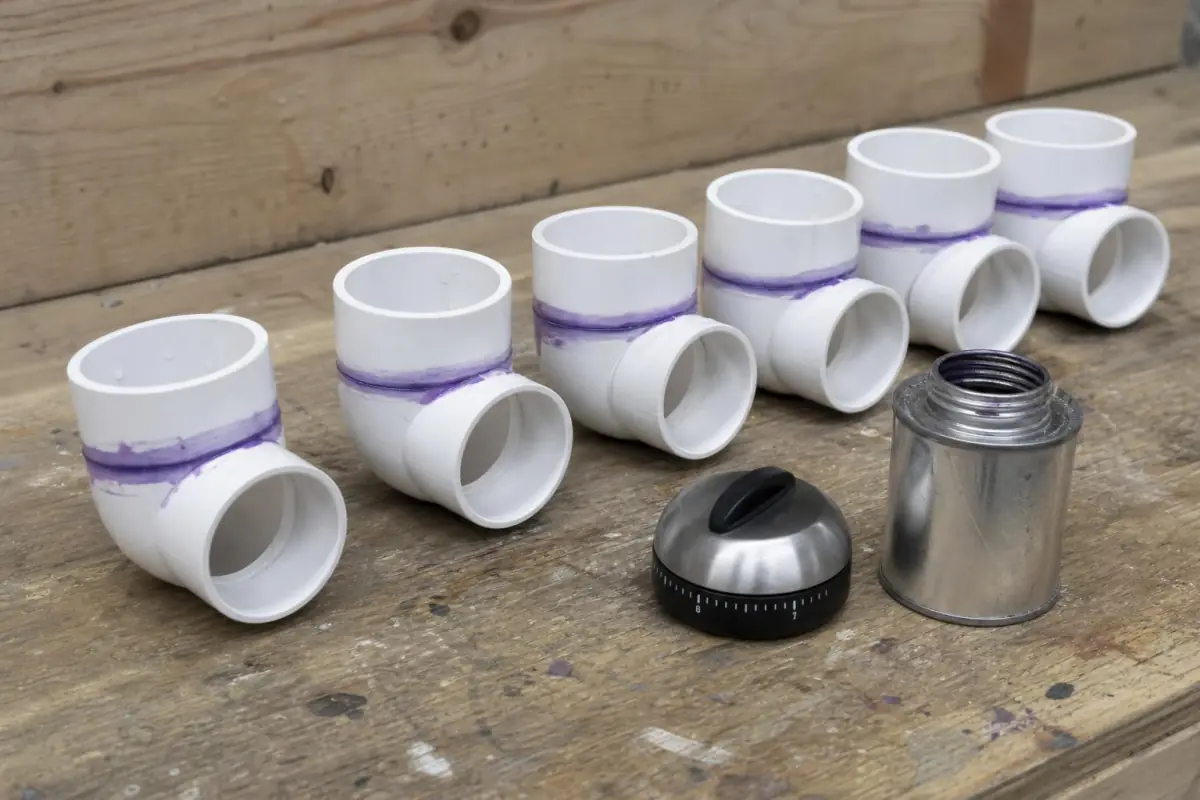
Three real jobs, computed from the charts
The table below runs three common jobs through both charts, with the inputs shown so the arithmetic can be checked. “Humid” applies the 50% extension that both makers print for damp weather or relative humidity over 60%.
| Job and inputs | Chart row used | Set before handling | Cure before water on | Same job, humid (x1.5) |
|---|---|---|---|---|
| 1/2 in CPVC supply, 70F, house pressure under 160 psi | Oatey CPVC 1/2 to 1 1/4 in, 60 to 100F; Weld-On 1/2 to 1 1/4 in, 60 to 100F | 2 min (both) | Oatey 1 hr; Weld-On 15 min | Oatey 1 hr 30 min; Weld-On 22.5 min |
| 2 in PVC drain, 50F, water test only | Oatey 1 1/2 to 3 in, 40 to 60F; Weld-On 1 1/2 to 2 in, 40 to 60F | 10 min (both) | 45 min (both) | 67.5 min (both) |
| 4 in PVC, 40F at assembly, colder overnight | Oatey 4 to 5 in, 20 to 40F; Weld-On 2 1/2 to 8 in, 0 to 40F | Oatey 1 hr; Weld-On 12 hr | Oatey 36 hr; Weld-On 72 hr | Oatey 54 hr; Weld-On 108 hr |
| Same 4 in joint, held at 40 to 60F the whole time | Oatey 4 to 5 in, 40 to 60F; Weld-On 2 1/2 to 8 in, 40 to 60F | Oatey 30 min; Weld-On 2 hr | 4 hr (both) | 6 hr (both) |
Two decisions fall out of that table. First, the brand on the can sets the CPVC answer: Weld-On allows 15 minutes for a 1/2 in CPVC joint at 70F, while Oatey’s CPVC row asks for 1 hour, a 4 to 1 gap for the same joint. Second, 40F is a cliff for 4 in pipe. Moving from the 40 to 60F column to the colder one multiplies the Oatey cure by 9 (4 hr to 36 hr) and the Weld-On cure by 18 (4 hr to 72 hr). Both charts label the columns “temperature during assembly and cure period,” so a basement joint glued at 45F that drops to 35F overnight belongs in the cold column.
A space heater that holds the 4 in joint above 40F for the full cure period moves it back into the 4 hour row on both charts. Oatey’s note that airflow “does not replace or shorten the required cure time” covers fans, not heat: the rule is to read the column for the temperature the joint really sat at.
Why a 4 in drain joint still waits before an inspection test
A gravity drain never runs under supply pressure, so a 2 or 4 in DWV joint only has to sit undisturbed until it passes its set time before the next joint goes on. The cure chart comes back the moment the inspector fills the stack: Oatey’s note on form LCS358H says the cure schedule “is the time required before pressure testing the system,” and a stack full of standing water is a pressure test. Read the lowest pressure row for that size and temperature before filling.
The same note bans the shortcut some crews reach for. Oatey prints “DO NOT test PVC and CPVC piping systems with compressed air or gas” on the cure chart, and the FlowGuard Gold 1-Step label repeats “DO NOT TEST WITH AIR OR COMPRESSED GAS.” If an inspector asks for an air test on a PVC drain, ask whether a water test is accepted instead and quote the manufacturer’s instruction.
ABS drain joints use their own one-step cement with no primer, and Oatey lists ABS in the same cure table as PVC, so the times above apply to both. The joining differences between the two drain plastics are laid out in our comparison of PVC versus ABS drain pipe.
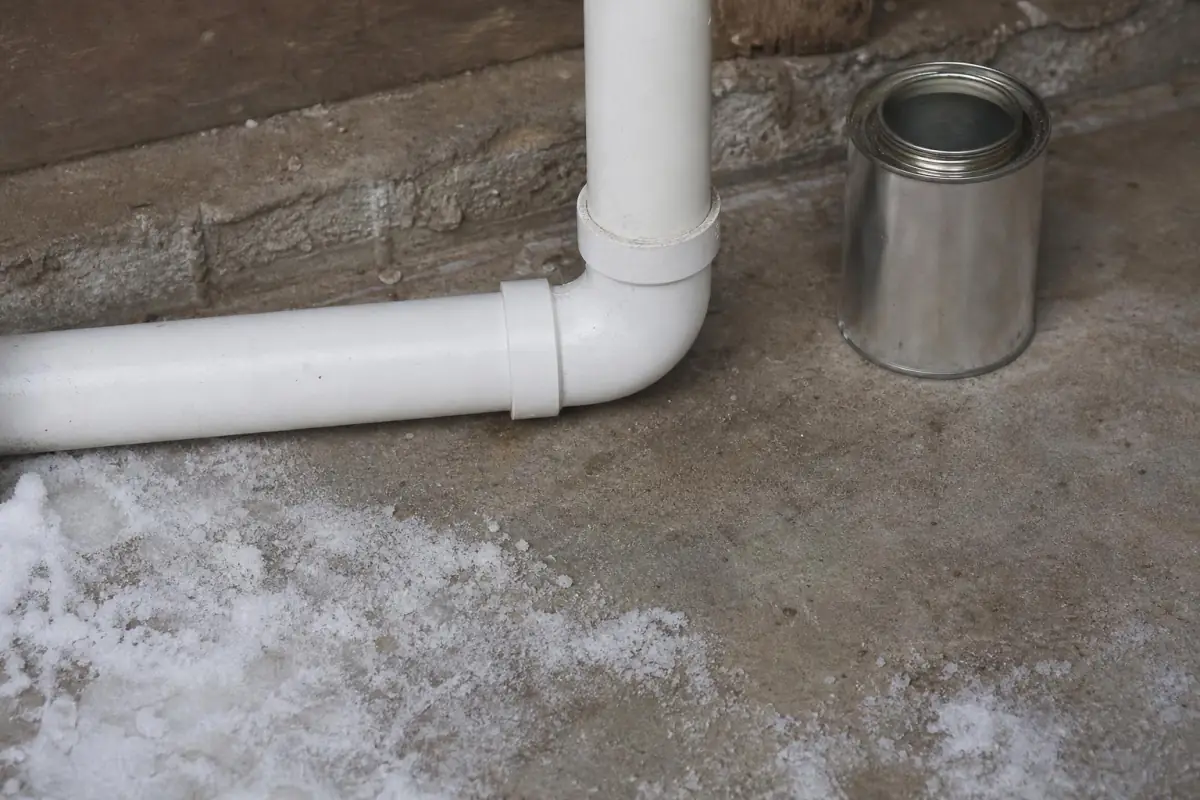
What changes the clock: primer, cement type and cold-weather cans
Primer has its own deadline. Oatey’s solvent-weld instructions say cement must go on within 5 minutes of priming, or both surfaces must be primed again, and they say not to use primer on ABS. The Connecticut State Building Inspector’s 2018 advisory explains the one code exception: the 2015 IPC dropped the primer requirement only where the cement is third-party certified to ASTM D2564 and the joint is PVC drain, waste and vent pipe in nonpressure use up to 4 in. Pressure water lines still get primer. The full step-by-step method for gluing PVC pipe covers the cut, deburr and dry-fit steps that come before the clock starts.
CPVC needs CPVC cement made to ASTM F493, not PVC cement made to D2564, which is the subject of our page on why CPVC cement and PVC cement are not interchangeable. Oatey’s FlowGuard Gold 1-Step submittal (part numbers 31910 to 31914) lists its own set times: 4 to 5 minutes at 30 to 50F, 2 to 3 minutes at 50 to 70F and 1 to 2 minutes at 70 to 90F, then 15 minutes for good handling strength. It may be used without primer only where local codes permit, and it is listed for CTS CPVC up to 2 in and water up to 200F.
Cold-weather claims on a can need checking against the fine print. Oatey’s product page lists a 0 to 110F application range for FlowGuard Gold 1-Step, while the same product’s submittal (LCS1837, 06/23) says to store and use it between 40 and 110F and to take “special care” outside that range. Either way, the cure chart still governs, and Oatey has no published CPVC cure figure below 40F. If the copper-tube-size CPVC run is long, the choice between solvent weld and crimp fittings is covered in how CPVC compares with PEX for supply lines, since PEX joints take pressure as soon as the fitting is made.
What does a joint that was pressurized too early look like?
An early-pressure failure shows at the socket edge: a bead of water weeping from the hub, or the pipe backed partway out of the fitting. Oatey’s label explains the push-out mechanism: the tapered socket pushes a fresh pipe back out unless it is held, “longer at low temperatures,” and puddled cement “can cause weakening and premature failure.” A dry joint has a second tell before the water goes on: the pipe slides to the socket bottom with no resistance, which Oatey says means “proper fusion may not be achieved.”
A cemented joint cannot be reglued. Cut the pipe on both sides of the fitting, cement in a new fitting with couplings, and restart the cure clock for the new joint’s size and temperature. For a 1/2 in line at 70F, that means 2 minutes before handling and 15 minutes (Weld-On) or 1 hour (Oatey CPVC) before the valve opens.
How we sourced this
Cure and set times come from the Weld-On “Solvent Cement Average Initial Set and Cure Times” table (PDF, 2024), Oatey’s August 2026 PVC and ABS cure table on oatey.com, and Oatey’s “How to Solvent Weld” sheet LCS358H (10/22), which also carries the CPVC cure rows and the compressed-air warning. FlowGuard Gold set times, primer and temperature notes come from Oatey submittal LCS1837 (06/23). The primer exception comes from the Connecticut State Building Inspector advisory dated August 6, 2018. The computed table applies those rows and the makers’ 50% humidity extension; nothing was tested. We could not open the current IPC text, so we do not quote 2021 or 2024 section numbers, and we left out a CPVC cure figure below 40F because Oatey does not publish one.
Questions about PVC glue cure time
Can I turn the water on after 15 minutes?
Only if the joint is PVC between 1/2 and 1 1/4 in, the air stayed between 60 and 100F, humidity was 60% or lower, and pressure stays at or under 160 psi. Those are the conditions behind the 15 minute figure in both the Oatey and Weld-On charts. CPVC under the Oatey chart needs 1 hour.
Does a fan or heat gun make PVC cement cure faster?
Oatey says adequate ventilation supports normal evaporation, but airflow does not replace or shorten the required cure time. Use the chart column for the temperature the joint actually sat at, and if the room dropped below 40F overnight, read the colder column instead of the warm one.
Does a drain line need the same cure time as a water line?
A drain that never holds pressure only needs the joint undisturbed until it is set, about 10 minutes for 2 in pipe at 40 to 60F. Before any inspection water test, wait the lowest pressure column of the chart, which is 45 minutes for that same 2 in joint at 50F.
Can I pressure test new PVC with air from a compressor?
No. Oatey prints DO NOT test PVC and CPVC piping systems with compressed air or gas on its cure chart, and repeats it on the FlowGuard Gold 1-Step label. Test with water once the cure time for the highest pressure the test reaches has passed.
How long does PVC glue last once the can is opened?
Weld-On lists a shelf life of 3 years for PVC cement and primer and 2 years for CPVC cement. Oatey lists 2 years from the manufacture date for FlowGuard Gold 1-Step. Oatey says not to use cement that has turned jelly-like, and not to thin it.