Bathtub Leaks Only When Draining? A 3-Level Fill Test to Find the Drain Shoe, Overflow or Slip Joint
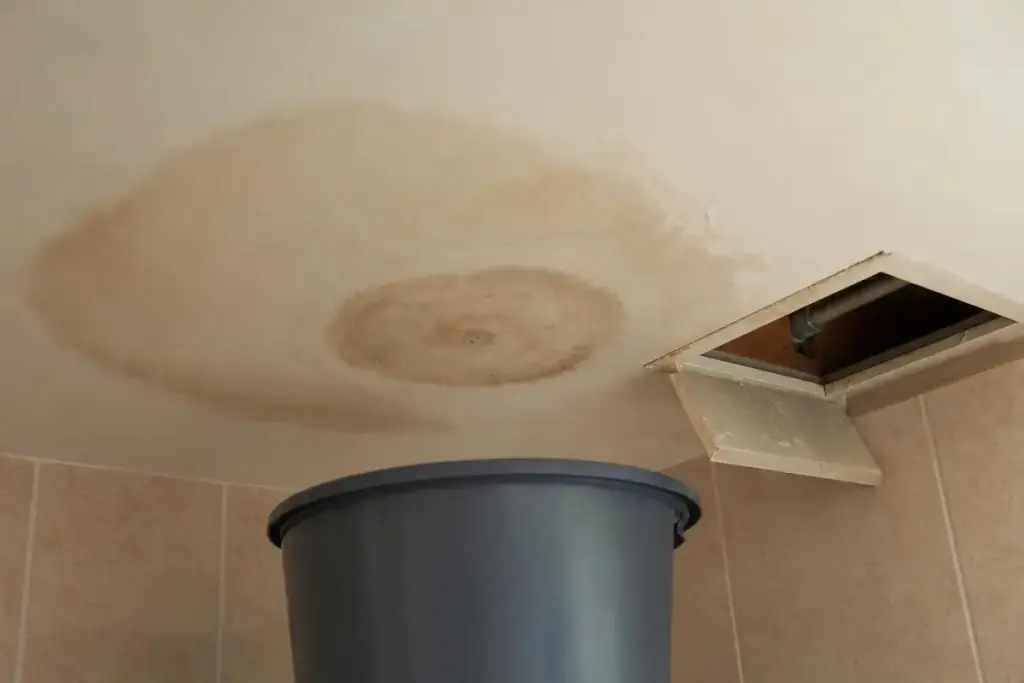
A bathtub that leaks only when draining has a failed drain assembly, not a supply leak: the strainer putty or shoe gasket, a slip nut at the waste-and-overflow tee, a cracked drain shoe, or the overflow gasket if the tub was filled past the overflow. A 3-level fill test names the part.
The supply valve, spout and shower arm are pressurized at all times, so a leak in any of them shows up whether or not the stopper is open. A stain that grows only after the tub empties is gravity water moving through the 1-1/2 inch drain parts under the tub floor, and every one of those parts can be checked with a bucket, a flashlight and 3 fills.
Which fill level makes the ceiling drip?
The water level at the moment the drip starts tells you which seal failed, because each seal only gets wet at its own height. Run the 3 fills in order, look at the ceiling or open access panel after each one, and stop at the first row that drips.
| Fill and action | Drip appears? | Leaking part | Fix | Part and listed price (seen 24 Nov 2026) |
|---|---|---|---|---|
| A. Stopper closed, 3 in of water, wait 15 min, do not drain | Yes, before draining | Putty or sealant under the strainer flange, or the shoe gasket against the tub underside | Unscrew the strainer with a drain key, clean both faces, reseal with the maker’s named sealant, fit a new shoe gasket | Danco 88349 bath shoe gasket, 1-7/8 in ID x 2-15/16 in OD, $4.85 at Zoro; the 1-11/16 in ID size is Danco 88348, $3.85 |
| B. Same 3 in, then open the stopper | Yes, only while it empties | Shoe-to-tee slip nut, tee-to-tailpiece joint, trap slip nuts, or a cracked shoe body | Re-seat the washer and tighten the nut hand-tight plus 1/8 turn; replace a cracked shoe or the half kit | Oatey TruBlu P9960CP 1-1/2 in bath waste half kit, $31.13 at PDI |
| C. Fill 1 in above the overflow opening, then drain | Yes, and A and B were dry | Overflow gasket, overflow faceplate screws, or the overflow tube slip nut at the tee | Replace the gasket from inside the tub; reseat the overflow tube nut from below | Gasket matched to the kit brand (Watco 900 series uses a foam gasket, Item 12; Oatey TruBlu ships a blue gasket) |
| D. Stand in the empty tub over the drain, shift weight | Flange or floor moves | Cracked or unsupported fiberglass or acrylic tub floor at the drain | Tub repair or replacement; a new gasket will not hold on a flexing floor | Full kit swap is wasted money until the floor is solid |
| Brass waste, any row, threads crusted or shoe wall pitted | Any | Corroded tubular brass | Replace the whole waste and overflow | Watco 501-TQ-BRS-CP, 17-gauge brass trip lever kit, $115.76 at SupplyHouse |
Row B is the classic “leaks only when draining” result: the stopper holds the water above the strainer, so nothing below the flange gets wet until the plug lifts. Row C fools people who take deep baths, because a 3 in test never wets the overflow gasket; our page on how the bathtub overflow drain and its gasket work covers that gasket swap in full. Prices above are retailer listings seen on 24 November 2026 and change often.
Where are the 5 leak points under a tub?
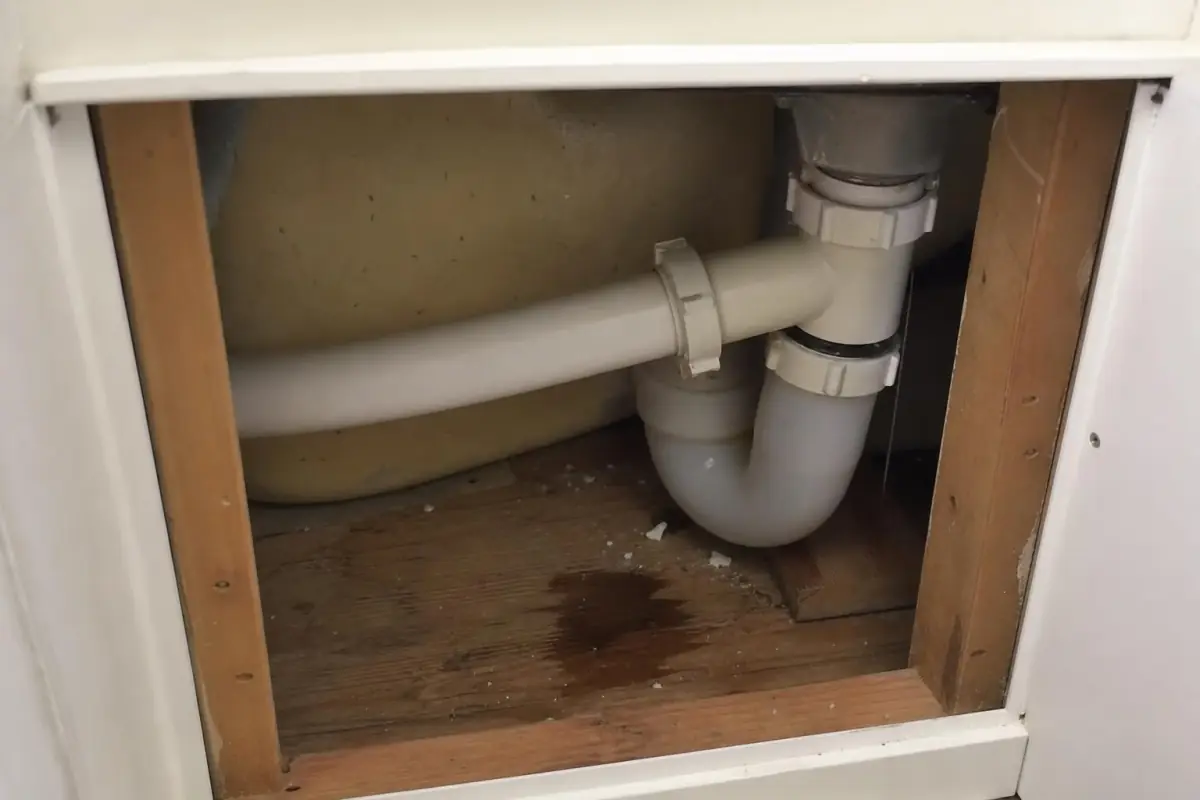
A tub drain has 5 places that can leak during a drain, all within about 18 in of the drain hole. The diagram numbers them in the order the fill test reaches them.
If the drawing does not match what you see through the panel, compare it with our full bathtub drain plumbing diagram, which labels the trap arm and vent beyond point 5.
How much water passes a leaking tub drain joint per bath?
A drain-only leak releases a short pulse, roughly 0.5 to 2.5 gallons in 2 to 4 minutes per 50 gallon bath, which is why the stain appears hours later and then grows. No competitor page puts numbers on that pulse, so the table below estimates it from the orifice equation, Q = Cd x A x the square root of 2gh.
| Water depth over the drain (head) | Estimated flow, gpm | Minutes to pass 50 gal at that rate | Leak rate at 1% | Leak rate at 2% | Leak rate at 5% |
|---|---|---|---|---|---|
| 3 in | 13.3 | 3.8 | 0.13 gpm | 0.27 gpm | 0.66 gpm |
| 6 in | 18.8 | 2.7 | 0.19 gpm | 0.38 gpm | 0.94 gpm |
| 12 in | 26.5 | 1.9 | 0.27 gpm | 0.53 gpm | 1.33 gpm |
Estimate, inputs shown: a 1-1/2 in (0.0123 sq ft) opening, discharge coefficient 0.6 for a sharp-edged orifice, g = 32.2 ft/s squared, head held constant at each depth, 1 cubic foot per second = 448.83 gpm. The stopper, strainer crossbars and trap friction cut real flow below these figures, so treat them as upper bounds. The leak fractions of 1, 2 and 5 percent are assumptions, not measurements.
Whatever the flow rate, the total that escapes depends only on the fraction and the volume drained. A 50 gallon drain loses 0.5 gallon at 1 percent (4.2 lb of water), 1 gallon at 2 percent (8.3 lb) and 2.5 gallons at 5 percent (20.9 lb). At 7 baths a week that becomes 3.5, 7 and 17.5 gallons landing on the same patch of drywall, which matches the pattern of a ceiling that looks dry in the morning and sags after a month.
A partial clog changes the math, because water stacks up in the shoe and tee during the drain and puts head on joints that normally carry a thin stream. If the tub takes longer than 5 minutes to empty, clear the clog through the stopper or overflow before you replace any part, then repeat test B.
Plumber’s putty or silicone under the strainer: what the drain makers say
The drain maker’s instruction sheet decides the sealant, and the 3 big kit makers do not agree. Read the sheet for your kit before you reseal row A.
- Kohler: installation guide 1101729-2-D lists plumbers putty and 100% silicone sealant, says to apply putty to the flange and silicone to the gasket, then fill the bath past the overflow and check for leaks.
- Oatey: TruBlu instruction sheet 7003966B says to apply Oatey silicone sealant or plumber’s putty to the drain spud flange, and notes that plumber’s putty should never be used on ABS components.
- Watco: the 900 series sheet says do not use oil-based putty products and that Watco does not warranty the product when oil or petroleum based products are used. The 501 brass sheet warns to keep putty off ABS parts.
Decision rule: on an ABS shoe, a Watco 900 or Flex kit, or any acrylic or fiberglass tub where the sheet is lost, use 100 percent silicone and let it cure for the time printed on the tube before test A. Putty stays an option only on a brass or PVC shoe whose sheet names it.
How tight should the slip nuts and strainer be?
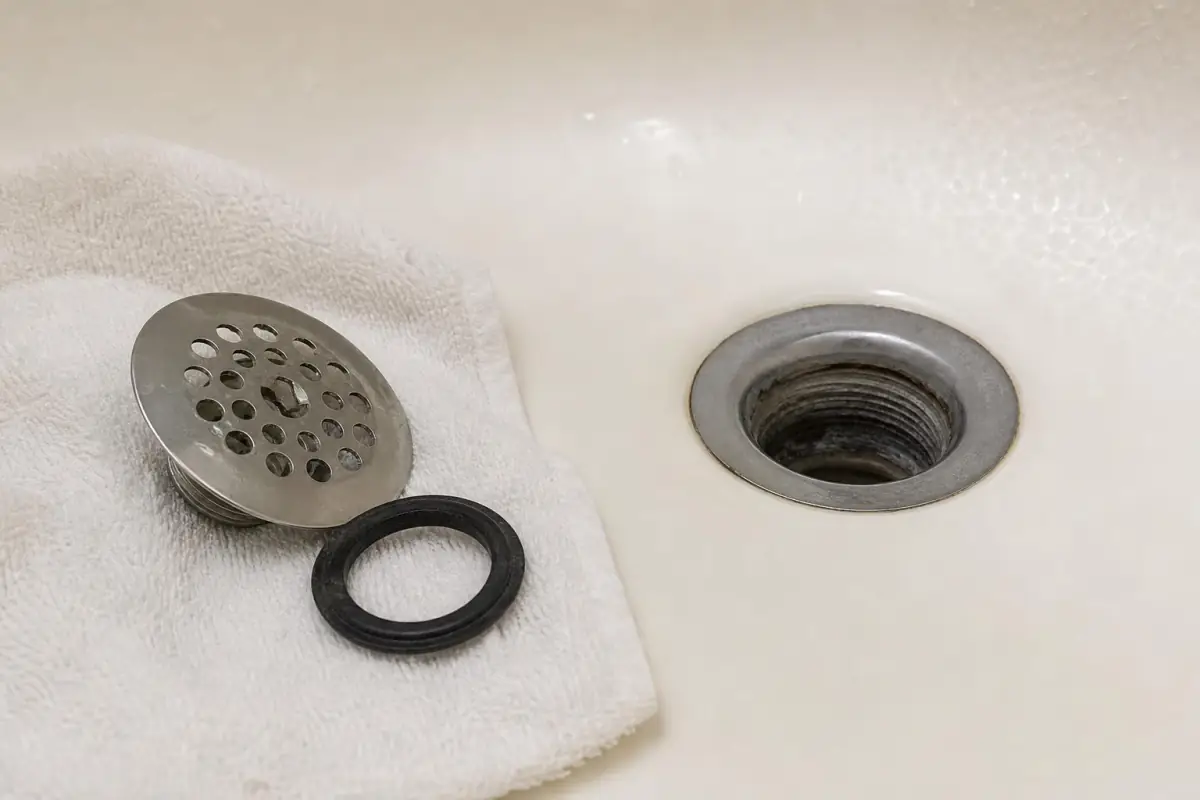
Watco’s 501 instructions set the slip nut at hand-tight plus 1/8 turn with a wrench, and a nut cranked past that splits plastic washers or distorts tubular brass. The Watco 900 overflow retainer nut is marked hand-tighten only, and Oatey’s TruBlu sheet has the drain elbow hand-tightened onto the spud from under the tub before final tightening.
The strainer threads into the shoe from inside the tub; tighten it with a drain key until the gasket compresses evenly, with the shoe held from below so it does not spin and tear the gasket. Wipe away the squeeze-out, then run test A before you close anything up.
Do you need an access panel to fix a tub drain leak?
Yes, when the slip joints are hidden: IRC Section P2704.1 requires slip-joint connections to be accessible through an opening not less than 12 in in its smallest dimension. The IPC puts the same rule in Section 405.9 in the 2018 edition (405.8 in 2015), adding that concealed slip joints need an access panel or utility space, according to an Oklahoma code document quoting that section. Local amendments vary, and Topeka, for one, requires a 12 x 18 in framed access area.
If the joint sits over a finished ceiling with no panel, cut a 14 x 14 in hole centered under the drain, fix the joint, then frame and fit a removable panel instead of patching solid drywall. Points 1 and 2 never need that hole, because both are serviced from inside the tub.
Ceiling damage, mold and when to replace the whole waste and overflow
Dry the ceiling cavity within 24 to 48 hours of finding the leak, the window EPA’s mold and moisture guide gives for drying wet materials to prevent mold growth. EPA’s guide also says a homeowner can usually clean a moldy area under about 10 square feet; larger areas call for a remediation contractor following EPA guidance.
Replace the whole waste and overflow, not one gasket, in 4 cases: the strainer will not unthread from a corroded brass shoe, the shoe or tee is cracked, the kit is solvent-welded plastic and the cracked piece is glued in, or test B still drips after a new washer and 1/8 turn. A Kohler K-7271 or K-7272 Clearflo drain can be pressure-tested before the ceiling goes back with the seal test in Kohler guide 1112219, which uses a test plug, pressure gauge and soapy water.
Water that runs down the outside of the tub from a failed wall joint can mimic a drain leak at row C; if the overflow gasket is new and dry, recaulk the tub-to-wall joint and rerun the fill test.
Ask a plumber for a “tub waste and overflow reseal or replacement with access panel” and say which test row failed; the call should stop at the drain parts, with no supply-valve work quoted, unless the meter dial moves with every fixture off for 15 minutes.
Bathtub drain leak questions
Why does water come through the ceiling only when I drain the bathtub?
Draining is the only time water runs through the shoe, the tee and the trap below the tub floor. A failed slip-joint washer, a cracked shoe or a strainer that lost its putty seal stays dry while the stopper holds water and drips once 13 to 27 gallons a minute start moving past it.
Can a slow drain make a tub drain leak worse?
Yes. A partial clog backs water up into the shoe and overflow tube while the tub empties, so joints that normally carry a thin stream sit under several inches of water. Clear the clog first, then repeat the drain test before you buy any parts.
Should I use plumber’s putty or silicone under the tub strainer?
Use whatever the drain maker’s sheet names. Kohler guide 1101729 calls for putty on the flange, Oatey allows silicone or putty but bans putty on ABS parts, and Watco 900 series sheets forbid oil-based putty. On an ABS shoe or a plastic tub, 100 percent silicone is the safe default.
How long can I keep using a tub that leaks when it drains?
Stop using it until the joint is fixed. Each 50 gallon drain at a 2 percent leak sends about 1 gallon, or 8.3 pounds of water, onto the ceiling below, and EPA says wet materials must be dried within 24 to 48 hours to prevent mold growth.
Do I need to cut the ceiling to fix a tub drain leak?
Only when there is no access panel or open floor bay. The strainer and overflow gasket are both serviced from inside the tub, while the shoe-to-tee and trap slip nuts need an opening, and IRC P2704.1 sets that opening at 12 inches or more in its smallest dimension.
How we sourced this
Read: Watco install sheets for the 900 PP ABS, Flex924 and 501 TQ brass bath wastes; Oatey TruBlu instruction sheet 7003966B; Kohler installation guide 1101729-2-D and seal test guide 1112219; IRC P2704.1 on UpCodes; an Oklahoma code document quoting IPC 2018 Section 405.9; EPA’s mold and moisture guide. Computed: orifice-equation flow at 3 heads and leak volumes at assumed 1, 2 and 5 percent fractions, inputs shown. Prices are retailer listings seen 24 November 2026. Left out: Moen tub drain sealant steps and a priced overflow gasket, which we could not confirm from a primary page.