Septic Safe Toilet Paper: What the Label Means and How Brands Break Down in Published Tests
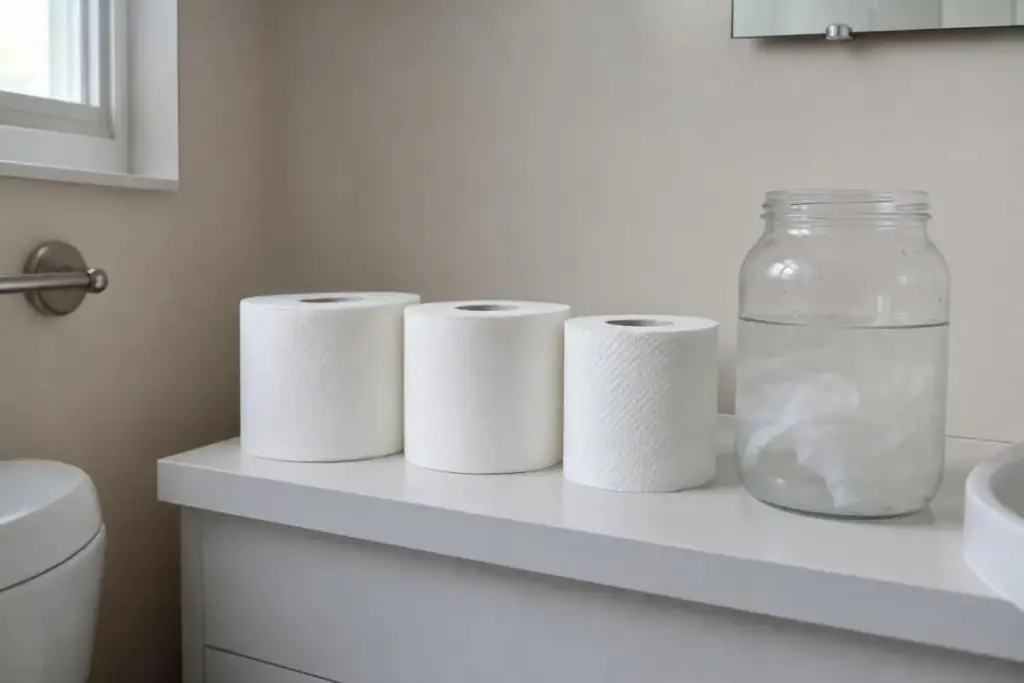
Septic safe toilet paper is a maker’s label, not a federal standard. EPA tells septic owners to flush only human waste and toilet paper, and Consumer Reports’ beaker tests show ordinary rolls range from seconds to more than a minute to break apart, so choose a fast-disintegrating roll and pump on schedule.
Who decides what “septic safe” means on a toilet paper package?
The manufacturer decides, using its own test. EPA’s SepticSmart page on caring for a septic system gives one rule for every brand: flush nothing besides human waste and toilet paper. It does not grade rolls or define a septic safe label, and the 13-item never-flush list on the same page names paper towels and non-flushable wipes, not any type of toilet paper.
The one published industry protocol for flushability does not cover toilet paper either. The INDA and EDANA Guidelines for Assessing the Flushability of Disposable Nonwoven Products, Edition 4 (GD4, May 2018) state in Section 3.2 that the assessment “has been designed for disposable nonwoven wipes.” Its FG502 slosh box rocks a single wipe at 26 rpm in 2 liters of water for 60 minutes, and a wipe passes only if more than 60% of its dry mass goes through a 12.5 mm sieve in at least 80% of replicates. Toilet tissue appears in GD4 only as the background load in the FG501 drain-line test.
So each brand writes its own definition. Charmin says its paper is evaluated at the Procter & Gamble flushability lab in Cincinnati and offers a refund of the pack price if its paper causes a clog. Angel Soft describes 3 methods: shaking paper in a jar, rocking it in a box, and flushing it through a length of clear pipe. Neither page publishes a pass time or a pass threshold. Consumer Reports’ April 2009 release reported that some of the slowest-disintegrating rolls and wipes in its tests carried “flushable” and “septic safe” labels.
Which brands broke apart fastest in published disintegration tests?
Store and value brands did as well as or better than premium brands in every Consumer Reports result that names brands publicly. CR’s method, described in its toilet paper buying guide (updated January 9, 2025), drops a 2 by 2 inch square of one sheet and a 2 inch stir bar into a water-filled beaker on a stirring plate and scores the time until the square comes apart. CR’s December 2025 ratings of 15 papers are paywalled, so the table uses only public results.
| Product | What the source states | Source, year | Method |
|---|---|---|---|
| Scott Extra Soft (1-ply) | Did best in the disintegration test of 21 papers | CR report via WKMG, Sept. 15, 2015 | CR disintegration test |
| White Cloud Ultra Soft & Thick | Top overall, with high scores for softness, strength and disintegration | CR via WKMG, 2015 | CR disintegration test |
| Great Value (Walmart) | Bottom of the ratings, “didn’t disintegrate very quickly” | CR via WKMG, 2015 | CR disintegration test |
| Charmin Ultra Strong | Took the longest of 25 papers, more than 1 minute | CR report via ABC7 Los Angeles, undated | CR disintegration test |
| White Cloud 3-ply Ultra | Topped the charts and “breaks down quickly” | CR via ABC7 | CR disintegration test |
| Seventh Generation | Rated excellent for disintegration | CR via ABC7; CR release, 2009 | CR disintegration test |
| Kirkland Signature, White Cloud | Very good or better for disintegration | CR release, April 2009 | CR disintegration test |
| 3 wet wipe brands | None broke apart | CR release, April 2009 | CR disintegration test |
| Charmin (all toilet paper) | Maker claim: septic safe, settles in the tank, then biodegrades | Charmin.com | P&G lab, method not published |
| Angel Soft 2-ply | Maker claim: septic safe “in standard, well-maintained” systems | Angelsoft.com | Jar shake, rocking box, clear pipe |
| Cottonelle Ultra Clean | Maker claim: septic-safe and sewer-safe | Cottonelle.com | Not published |
A maker’s septic safe claim says the brand ran its own test, not how fast the roll breaks apart against rivals. Store brands Kirkland Signature and White Cloud scored very good or better for disintegration at 12 to 15 cents per 100 sheets in 2009, and a roll CR names as slow, such as Charmin Ultra Strong, is the one to swap first if a tank has a history of thick scum or a clogged outlet tee.
Does 1-ply, 3-ply or quilted paper change how fast it breaks down?
Ply count alone does not predict disintegration in CR’s published results. White Cloud 3-ply Ultra broke down quickly in the ABC7-reported test, and White Cloud Ultra Soft & Thick scored high for disintegration in 2015, while the 1-ply Scott Extra Soft led the 2015 test. CR’s 2009 release also found that 3-ply Quilted Northern Ultra Plus was “neither thickest nor strongest,” and that 1-ply Scott Extra Soft was about as strong as many 2-ply rolls.
Strength is the trait to watch. Charmin states that its paper is built not to break down “as soon as it hits the water” so it protects the hand, and the product CR timed slowest, at more than 1 minute, carries “Ultra Strong” in its name. If a package sells wet strength, expect slower break-up in a tank that K-State sizes for at least 24 hours of wastewater detention, and pick a roll CR rated very good or better for disintegration instead.
How much toilet paper does a household send into the tank between pumpings?
A family of 4 with a 1,000-gallon tank flushes about 132 kg of dry paper between pumpings, roughly the same dry mass as every solid in an average full pump-out. The inputs are Statista’s 2018 estimate of 141 rolls, or 12.7 kg, per American per year, pumping intervals from Table 1 of Kansas State University Extension’s MF-947, Septic Tank Maintenance (August 2010), and the average septage total solids of 34,106 mg/L in Table 2-2 of EPA’s Guide to Septage Treatment and Disposal (EPA/625/R-94/002).
| People, 1,000-gal tank | K-State pump interval | Rolls flushed in that interval | Dry paper in (kg) | Dry solids in a full pump-out (kg) | Paper as % of pump-out solids |
|---|---|---|---|---|---|
| 1 | 12.4 yr | 1,748 | 157.5 | 129.1 | 122% |
| 2 | 5.9 yr | 1,664 | 149.9 | 129.1 | 116% |
| 3 | 3.7 yr | 1,565 | 141.0 | 129.1 | 109% |
| 4 | 2.6 yr | 1,466 | 132.1 | 129.1 | 102% |
| 6 | 1.5 yr | 1,269 | 114.3 | 129.1 | 89% |
The arithmetic: paper in = people × 12.7 kg × years; rolls = people × 141 × years; pump-out solids = 1,000 gal × 3.785 L per gal × 34.106 g/L = 129.1 kg. K-State built Table 1 on 50 gallons of sewage per person per day, 24 hours of detention and 50% digestion of retained solids, and working the table backward gives about 77 gallons of stored sludge and scum per person per year in every row.
The meaning for a tank owner: the paper flushed between pumpings weighs about as much as everything a pumper removes, so the system only works because most paper fiber breaks apart and is digested in the tank. Paper that stays in sheets keeps its mass in the scum and sludge, and those layers set the pump date. K-State says to cut the interval by one-third if a garbage disposal is used. Statista’s figure is a national per-capita estimate and EPA’s average spans loads from 1,132 to 130,475 mg/L, so read the percentages as order-of-magnitude.
Where paper ends up in the tank, and when EPA says to pump
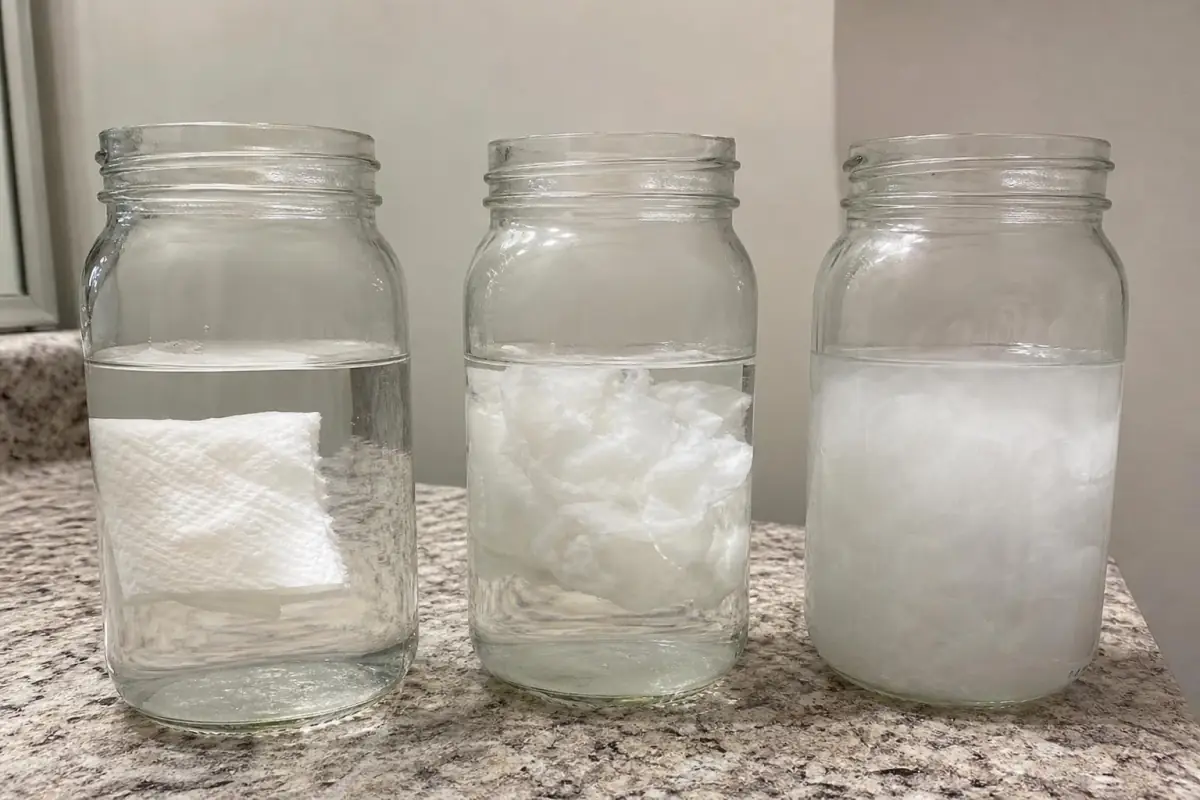
Paper fragments that do not digest settle into the bottom sludge layer, and EPA’s three pump triggers measure that layer and the floating scum against the outlet tee. The diagram below shows the layers that how a septic system separates scum, effluent and sludge explains in full.
EPA’s schedule is an inspection at least every 3 years and pumping typically every 3 to 5 years, with yearly inspection for alternative systems that have float switches, pumps or other mechanical parts. Charmin’s flushability page gives 2 to 4 years, so where a maker and EPA differ, use EPA’s measured triggers. Pump interval also depends on tank volume, and the tank sizes that state codes require by bedroom count run from 900 to 1,500 gallons for a 3-bedroom home.
How to run a jar test as a side-by-side comparison
A jar test can rank 2 rolls you own against each other; it cannot certify either one, because no standard sets its jar size, water volume, shake count or pass time. Published home versions disagree: InspectAPedia’s photo test shook 1 square in about 100 ml of tap water for about 30 seconds, and Roto-Rooter’s version checks the paper after 30 seconds.
- Use 2 identical lidded jars, each filled with the same volume of room-temperature tap water, for example 500 ml.
- Cut a 2 by 2 inch square from each roll, the same size CR uses, so ply and sheet size do not skew the result.
- Shake both jars the same number of times, for example 10 shakes, and time how long each square takes to fall into fragments.
- Keep the roll whose square breaks into fragments first, and repeat the run 3 times before switching brands, since a single shake is easy to vary by hand.
Tap water lacks tank bacteria, which InspectAPedia notes its 30-second test excluded, so a jar shows mechanical break-up only, not digestion.
RV and marine toilet paper vs regular paper
RV and marine paper is a faster-breaking 1-ply product meant for holding tanks, and a house septic tank does not need it. GD4 Section 3.2 places portable toilets, motor homes, recreational vehicles and boats outside its scope, so even the wipe protocol does not address those tanks. Scott sells its Rapid-Dissolving 1-ply roll for RVs and boats; in CR’s 2015 household test, the ordinary Scott Extra Soft 1-ply already ranked first of 21 for disintegration.
Wipes belong in the trash regardless of label. EPA’s never-flush list names baby wipes and other wet wipes, CR’s 2009 test found that none of 3 wipe brands broke apart, and the full record is in what lab tests found when flushable wipes were run through a model sewer. K-State’s MF-947 also lists facial tissues among materials that do not decompose in the tank and take up sludge storage, so keep tissues out of the toilet too. Products sold to speed breakdown are covered in our review of septic tank additives, which K-State’s MF-947 warns can push solids out to the drainfield.
How we sourced this
We read EPA’s SepticSmart care page, EPA/625/R-94/002 Table 2-2, Kansas State University MF-947 Table 1, the INDA/EDANA GD4 guideline (Edition 4, May 2018), Consumer Reports’ 2009 release and 2025 buying guide, CR results syndicated by WKMG (2015) and ABC7, and the Charmin, Angel Soft and Cottonelle claim pages. The paper-versus-pump-out table is our arithmetic from Statista, K-State and EPA figures. CR’s current paywalled brand scores, any ASTM method for toilet tissue, and Scott’s published speed claim could not be confirmed at the source and were left out. The Plumbing Brief did not test any product.
Septic safe toilet paper questions
Is all toilet paper septic safe?
EPA’s SepticSmart guidance treats toilet paper as one of only two things that belong in a septic system, the other being human waste. Speed still differs by roll. Consumer Reports found some papers break apart in seconds while Charmin Ultra Strong needed more than a minute, and its 2015 bottom-ranked roll, Great Value, was slow to disintegrate.
Is RV toilet paper better than regular toilet paper for a house septic tank?
RV paper such as Scott Rapid-Dissolving is built to break up fast, and that does no harm in a home tank. A 2015 Consumer Reports test, though, ranked ordinary Scott Extra Soft best of 21 household rolls for disintegration, so a fast household roll serves a home tank as well without the RV price.
How fast does toilet paper dissolve in water?
In Consumer Reports’ stir-plate test some papers came apart within seconds and Charmin Ultra Strong took more than one minute. Toilet paper breaks into fibers rather than dissolving like sugar. A 2 by 2 inch square in a stirred beaker is how CR scores it, and the fragments that remain settle into the sludge layer of a tank.
Can I flush flushable wipes into a septic tank?
EPA lists wet wipes such as baby wipes among items never to flush into a septic system. In Consumer Reports’ 2009 tests none of the 3 wipe brands broke apart in the disintegration test, and their sheets were thicker than nearly every roll tested. Bag wipes for the trash even when the package says septic safe.
Do septic tank additives help toilet paper break down faster?
Kansas State University Extension bulletin MF-947 warns that an additive which works as advertised can push solids out to the absorption field and hasten its failure. A tank is meant to hold solids until a pumper removes them, so the fix for paper buildup is the pumping interval set by tank size and household size.