Pressure Balance Valve vs Thermostatic: How Each Stops Scalds at the 120°F Limit
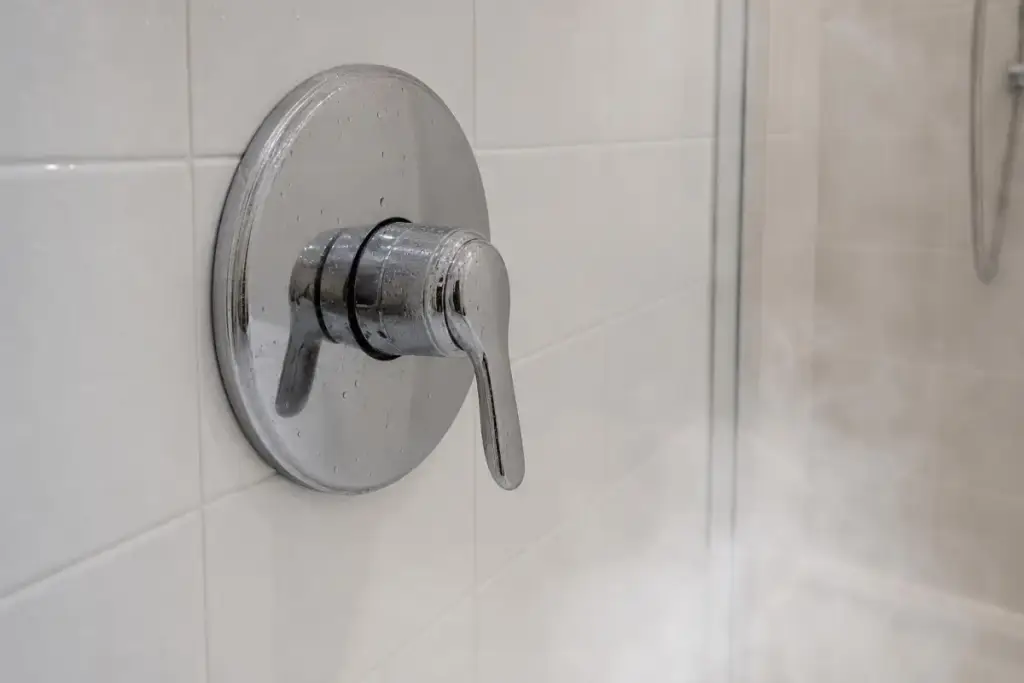
A pressure balance valve is an ASSE 1016 Type P shower valve: a spool senses hot and cold supply pressure and throttles the stronger side, holding outlet temperature within 3.6°F after a 50% pressure swing. A thermostatic valve senses the mixed water temperature instead, so it also corrects hot supply temperature changes.
What ASSE 1016 Type P, Type T and Type T/P valves each sense
ASSE 1016 (published jointly as ASME A112.1016 and CSA B125.16) defines three automatic compensating valves for individual showers and tub/showers, and the difference is the input each one reads. Definitions come from the ASSE International Scald Awareness Task Group white paper, test figures from a Watts training summary of ASSE 1016-2005, the edition that widened the tolerance from 3°F to 3.6°F.
| ASSE 1016 type | What it senses | Pressure swing in the test | Hot supply temperature test | Recovery to ±3.6°F (2.0°C) | Example product lines | Maintenance part |
|---|---|---|---|---|---|---|
| Type P, pressure balancing | Hot and cold inlet pressure, before mixing | Hot and cold supply raised and cut by 50% | None required | Within 1 second | Moen Posi-Temp, Moen Moentrol, Delta Monitor 13/14 and 17 Series, Symmons Temptrol | Balancing cartridge or spool: Moen 1222; Delta RP46074 ($94.68) and RP46463 ($123.20) on deltafaucet.com |
| Type T, thermostatic | Mixed water temperature at the outlet | Hot and cold supply raised and cut by 20% | Hot supply raised 25°F at 5°F per minute | Within 5 seconds | Moen ExactTemp | Thermostatic cartridge with a temperature element |
| Type T/P, combination | Inlet pressures and outlet temperature | Hot and cold supply raised and cut by 50% | Hot supply raised 25°F at 5°F per minute | Within 1 second | Sold as a separate valve body by each maker | Combination cartridge |
Read it this way. A Type P valve has no temperature compensation requirement, so if the water heater swings 10°F the shower swings with it. A Type T valve faces only a 20% pressure test, but it alone corrects a hotter or cooler supply. All three must cut flow below 0.5 gpm if the cold supply fails, per the Watts summary.
Delta prices are online prices on November 12, 2026 (list $118.35 and $154.00). The RP46074 is the single-function Monitor cartridge for 13/14 Series valves made after March 2006; the RP46463 is the dual-function 17 Series cartridge with separate volume and temperature control. Symmons describes Temptrol as a pressure-balancing valve introduced in 1968, so all three brands named in most comparisons are Type P lines, not thermostatic ones.
How a pressure balance spool shifts when a toilet flush drops cold pressure
When a toilet refills, the cold branch to the shower loses pressure, and the higher hot pressure pushes the balancing spool toward the cold side, narrowing the hot port until the two pressures match again. Temperature holds; total flow drops until the fill valve shuts off.
ASSE 1016 gives a Type P valve 1 second to settle back within 3.6°F, so a brief flicker on a flush is within the standard; a burst lasting several seconds is not. A flush steals cold water, so a failing valve sends a hot spike. A shower that turns cold points the other way: hot pressure falling when a dishwasher or second shower opens, or a water heater running out.
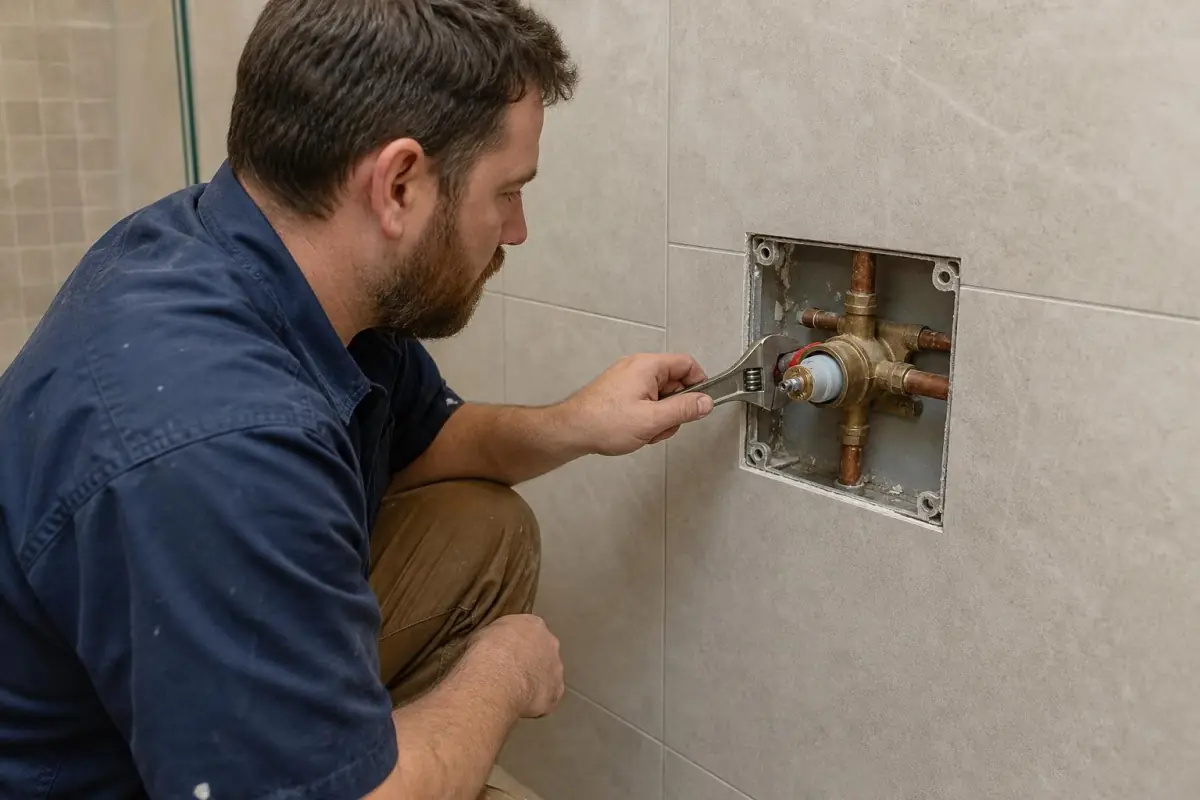
Which code sections require the ASSE 1016 valve and the 120°F stop
All three model codes require a Type P, T or T/P valve at every individual shower and tub-shower, with a maximum-temperature stop field-set to 120°F (49°C). The section numbers moved between editions, which is why older articles disagree. Limits for tubs, bidets and lavatories are on the fixture-by-fixture hot water temperature limits page.
| Code and edition | Section | What the text requires |
|---|---|---|
| IPC 2021 | 412.3 Individual shower valves (424.3 in pre-2021 editions) | Balanced-pressure, thermostatic or combination valve to ASSE 1016/ASME A112.1016/CSA B125.16 or ASME A112.18.1/CSA B125.1, at the point of use, rated for the installed head’s flow; limit set to 120°F max; no in-line thermostatic valves |
| IPC 2021 | 412.4 Multiple (gang) showers | An ASSE 1069 or CSA B125.3 valve on the shared tempered pipe, or an ASSE 1016 valve at each head, with the same 120°F setting |
| IRC (as adopted in South Carolina) | P2708.4 Shower control valves | Same valve types, standards and 120°F limit; no in-line thermostatic valves |
| UPC 2021 | 408.3 (408.4 in the 2024 UPC) | ASSE 1016 or ASME A112.18.1 valve adjusted per the maker’s instructions to 120°F max; a water heater thermostat is not a suitable control |
The IPC wording comes from the ICC excerpt Significant Changes to the IPC, 2021 Edition, 412.3; the IRC wording from S.C. Code Regs. 8-1243; the UPC water heater note from the Minnesota DLI water temperature device chart. Two consequences follow. Turning the tank down to 120°F does not make a non-compensating valve legal under the UPC, and an ASSE 1017 thermostatic mixing valve at the water heater does not replace the shower valve, because the IPC and IRC both bar in-line thermostatic valves from meeting the shower rule.
The 2021 IPC added the flow-rating clause because, in ICC’s words, lower flows “might not provide enough motive power within a mixing valve” to correct a pressure or temperature change. Moen’s INS13333 tub/shower instructions put numbers on it: Posi-Temp valves are for showerheads rated 1.5 gpm or higher, Moentrol 1.3 gpm or higher, and ExactTemp 2.5 gpm or higher. A 1.2 gpm head on a Posi-Temp body sits below the rating.
Setting the rotational limit stop on Moen Posi-Temp and Delta Monitor valves
The limit stop is a notched ring or tab behind the handle that stops it short of full hot, and it ships at a factory position unrelated to your water heater. The ASSE white paper notes installers often skip it because hot water is not yet on at rough-in.
- Run the shower at full hot for 2 to 3 minutes and read the stream with a cooking or digital thermometer.
- Moen Posi-Temp (INS13333, step 5): turn on both supplies, rotate the lever counterclockwise until the water reaches the maximum you want, not over 120°F (49°C). If it passes 120°F, remove the lever and handle adapter, note the stop’s position, reposition the adjustable temperature limit stop so the lever halts at that point, refit the adapter, adapter screw and lever, and tighten the hex screw with a 7/64 inch hex wrench.
- Delta Monitor 13/14 Series: Delta describes the RP46074 limit stop as a pull and turn adjustment on the cartridge; the 17 Series RP46463 carries its own adjustable stop. Follow the trim’s printed sheet for which way each notch moves.
- Retest at full hot. Moen and Delta both warn of seasonal adjustment; the ASSE paper says to check full hot in the coldest and hottest months.
Pressure balance valve problems and the cartridge fix
Most pressure balance valve problems trace to the cartridge, and Moen’s own troubleshooting table in INS13333 names the cause for one-temperature-only symptoms: “Balancing spool stuck,” remedy “Replace cartridge.”
| Symptom | Likely cause | Fix |
|---|---|---|
| Hot burst lasting several seconds on a toilet flush | Spool sluggish from scale or debris, so it misses the 1 second recovery | Replace the balancing cartridge (Moen 1222, Delta RP46074 or RP46463 by series) |
| Only hot or only cold at any handle position | Balancing spool stuck (Moen INS13333 table) | Replace cartridge |
| Never gets hot enough | Limit stop set in summer or for an older heater | Reset the stop with a thermometer, max 120°F |
| Temperature hunts with a new low-flow head | Head flow below the valve’s rating | Use a head at or above the rating (1.5 gpm for Posi-Temp) |
Before pulling a Moen cartridge, INS13333 says to shut off both supplies and turn the stem so the notch flat points up to relieve pressure. After any new cartridge goes in, the limit stop must be set again, since the stop rides on the cartridge in both the Moen and Delta designs. If you hire it out, ask for a cartridge swap and limit-stop reset by part number, not a valve replacement.
Thermostatic cartridge scaling and tub/shower diverter combinations
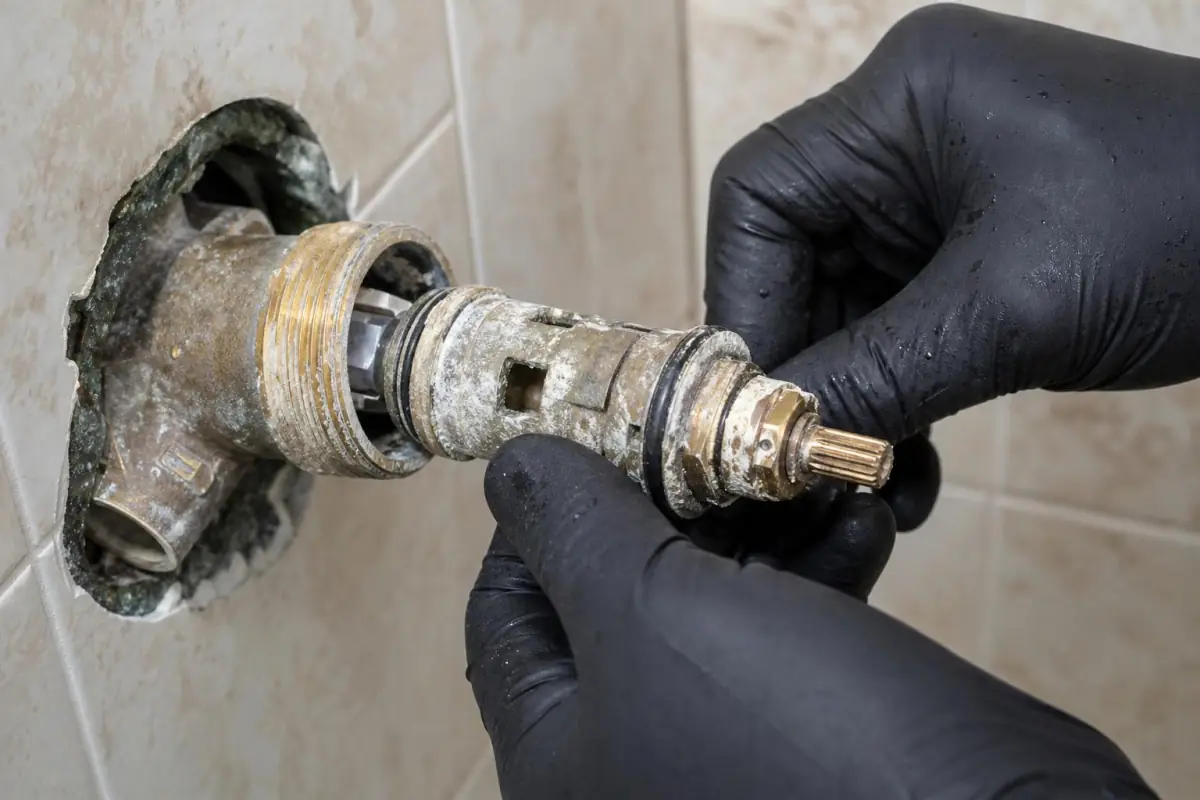
A Type T valve has to respond to a 25°F hot supply rise within 5 seconds, and that response depends on a temperature element and a moving shuttle staying free. In hard water, scale on those parts slows the correction. Read full hot with a thermometer twice a year and clean or replace the cartridge per the maker’s sheet when it drifts.
On a tub/shower, one ASSE 1016 valve feeds both outlets and the diverter sits downstream in the tub spout or a separate transfer valve, so the single limit stop protects the spout and the head. ASSE 1016-2005 assumes no further mixing downstream of the valve. A tub with no shower is a different rule: 2021 IPC 412.5 calls for an ASSE 1070 limiting device instead. Layouts with body sprays are covered under every shower valve type, including diverters and manual mixers.
The stakes are measured: CPSC emergency room data on tap water scalds puts tap water scald ER visits near 3,532 a year for 2021 to 2025, with bathtubs and showers named in 86.9% of cases among people 65 and older.
Pressure balance valve questions
Is a pressure balance valve the same as an anti-scald valve?
Yes, in code terms. Any shower valve listed to ASSE 1016 as Type P, Type T or Type T/P counts as the automatic compensating valve the IPC, IRC and UPC require. Anti-scald is the marketing name. The scald protection still depends on the installer setting the limit stop to 120°F or lower.
Can I replace a pressure balance cartridge without opening the wall?
Usually. Shut off the supply stops or the house main, pull the handle and trim, remove the retaining clip or bonnet nut, and swap the cartridge for the same part number. Moen 1222 fits Posi-Temp bodies, and Delta lists RP46074 for 13/14 Series and RP46463 for 17 Series valves.
Why does my new shower valve not get hot enough?
The limit stop is probably set for summer water or for a hotter heater setting. Moen tells installers to expect seasonal resets because groundwater temperature changes. Check the outlet with a thermometer, then move the stop one notch toward hot and retest, never letting the maximum pass 120°F.
Does a thermostatic shower valve need a mixing valve at the water heater too?
No. A Type T shower valve already limits the shower outlet. A heater-mounted ASSE 1017 valve only tempers the whole house supply, and model codes do not accept it as the shower control. Homes that store water at 140°F for Legionella control often use both, each doing a separate job.
Is an old two-handle shower valve legal to keep?
Codes apply the ASSE 1016 rule to new and replacement valves, so an existing two-handle valve can usually stay until the valve body is replaced. The ASSE scald task group recommends swapping any non-compensating shower valve for a listed compensating one, which means opening the wall to change the body.
How we sourced this
Definitions come from the ASSE Scald Awareness Task Group white paper; test figures from a Watts summary of ASSE 1016-2005, because the standard is paywalled. Code text was read in ICC’s 2021 IPC excerpt, the South Carolina IRC adoption and the Minnesota DLI chart. Limit-stop steps, head ratings and troubleshooting come from Moen INS13333 and INS746J; prices from deltafaucet.com on November 12, 2026. A Moen 1222 price, a Symmons Temptrol stop procedure and the Delta stop’s turning direction could not be read from a primary page and were left out.