White Flakes in Water: What They Are and How to Stop Them
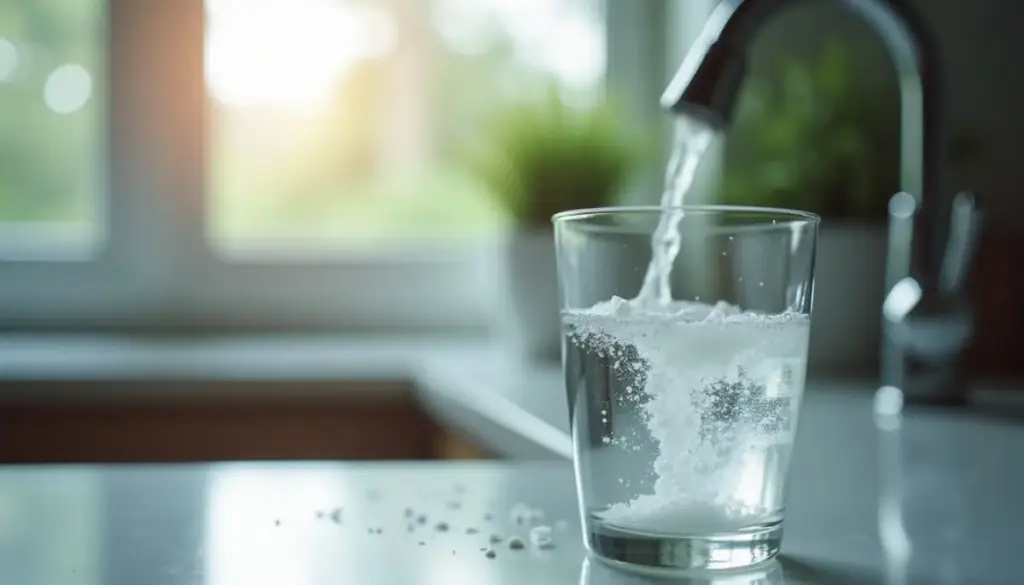
White flakes in water almost always come from one of three places, hard-water scale, a crumbling water heater dip tube, or escaped softener resin, and a glass of white vinegar sorts them in minutes.
Key Takeaways
- The USGS classes water as hard at 121 to 180 mg/L as calcium carbonate and very hard above 180 mg/L, the mineral most white flakes are made of (USGS Water Science School).
- Perfection Corporation supplied defective dip tubes to water heater makers from August 1993 to October 1996, according to A.O. Smith’s July 2004 SEC filing.
- A.O. Smith Technical Bulletin 14 says water at pH 8 or higher can turn an aluminum anode into green, blue or gray gel that shows up at the drain valve and faucet aerators.
- Escaped resin beads run about 0.5 to 1.0 mm and point to a cracked distributor or riser tube, parts SoftPro prices at $30 to $150.
- Scale fizzes in white vinegar; dip tube plastic floats and stays hard. Flakes at hot taps only point at the water heater.
What are the white flakes in water?
White flakes in water are usually calcium carbonate scale that hard water drops when it heats up. The other common sources are plastic from a failing water heater dip tube, resin beads from a broken water softener, and aluminum hydroxide gel from an aluminum anode rod. Each one looks different, reacts differently to vinegar, and needs a different fix, so identify the flake before you buy any part.
Calcium carbonate gets less soluble as water heats, which is why scale piles up inside water heaters and breaks loose as chips.
| Flake type | Look and feel | Vinegar test | Where it comes from | Fix |
|---|---|---|---|---|
| Calcium carbonate scale | White or off-white chalky chips, irregular edges, gritty between fingers | Fizzes, softens, and dissolves over a few hours | Hard water dropping minerals in the heater, kettle, or pipes | Clean aerators, flush or delime the heater, soften water above 120 mg/L |
| Dip tube plastic | Thin white or gray slivers, hard, often curled | Floats, no fizz, stays hard | Polypropylene dip tube breaking down, the classic case being tanks built with Perfection tubes from 1993 to 1996 | Replace with a PEX dip tube of the same length, then flush the tank |
| Softener resin beads | Round amber, yellow, or translucent beads about 0.5 to 1.0 mm (SoftPro) | Unchanged (softener salt, by contrast, dissolves) | Cracked distributor, riser tube, or basket screen in the resin tank | Bypass the softener, replace the distributor or riser, flush lines |
| Aluminum hydroxide gel | “Jelly beads” or green, blue, or gray gel (A.O. Smith) | Skip the vinegar, the soft gel texture identifies it | Aluminum anode reacting with water at pH 8 or higher | Remove the anode, flush, install a magnesium anode |
Are white flakes in tap water safe to drink?
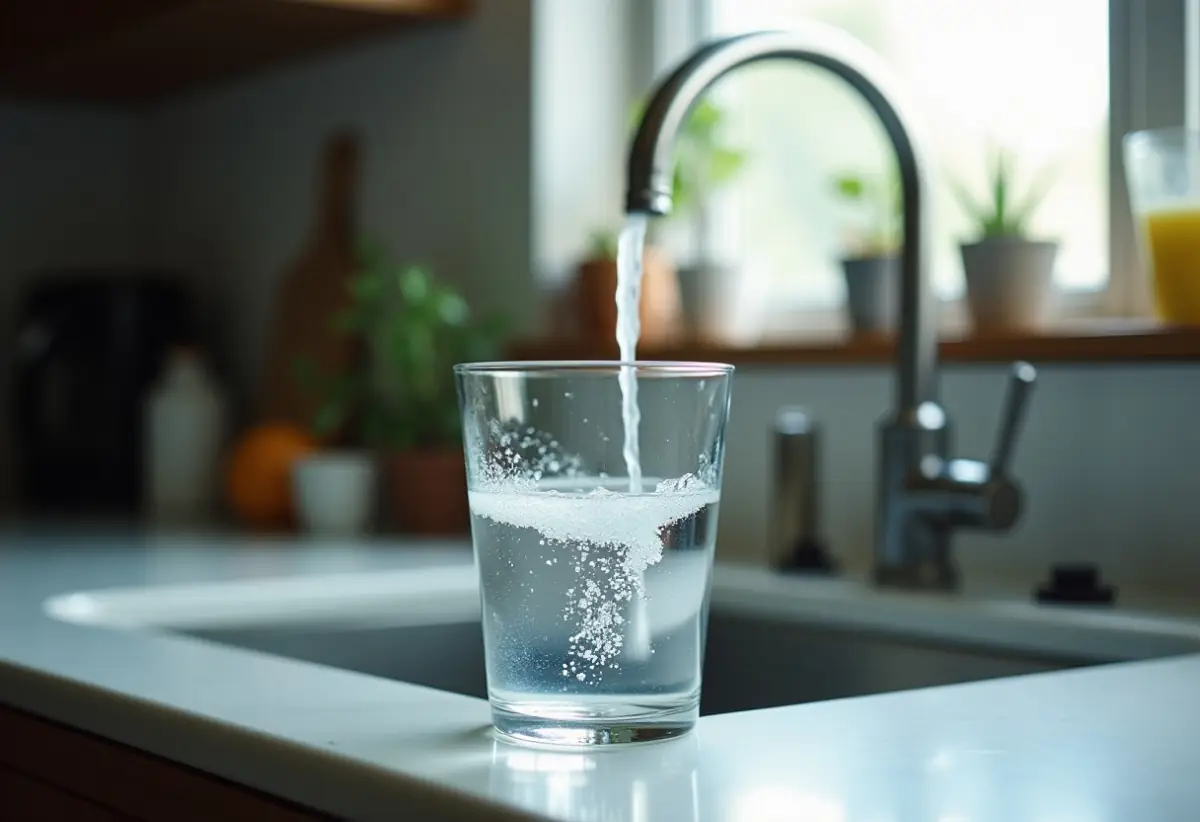
Calcium carbonate flakes are generally not a health concern. The EPA sets no national drinking water limit for hardness, because hardness causes scale and soap problems rather than safety ones. Plastic and resin are a different story. They do not belong in a drinking glass, they clog screens, and they mean a part has broken, so fix the source rather than filtering around it.
Two of the EPA’s non-enforceable secondary drinking water standards matter here. Aluminum is 0.05 to 0.2 mg/L, and the recommended pH range is 6.5 to 8.5, the high end of which overlaps where A.O. Smith says aluminum anodes turn to gel.
Drink from the cold tap while you troubleshoot. On a private well, flakes with a smell, color, or cloudiness call for a lab test; the Wisconsin State Laboratory of Hygiene charges $46 for hardness.
How do you tell white particles in water apart with a vinegar test?
Collect the white particles in water from a faucet aerator, drop them into plain white vinegar, and watch. Calcium carbonate fizzes and softens because the acid dissolves it. Polypropylene from a dip tube floats and stays hard. Softener resin beads keep their round shape. The whole test takes a few minutes to read the first result and a few hours to confirm.
- Pick the faucet with the most debris and unscrew its aerator by hand or with a rag over pliers.
- Tap the screen and insert onto a white paper towel and sort the debris by shape: chips, slivers, round beads, or gel.
- Drop a pinch into a clear glass of white vinegar. For flakes already floating in a glass of tap water, Mother Earth News suggests stirring in 1/2 teaspoon of clear white vinegar.
- Watch the first minute for fizzing, then leave the glass for a few hours.
- Read the result. Dissolved means scale (Mother Earth News calls this preliminary evidence). Floating hard pieces mean plastic. Unchanged round beads mean resin.
Why are there white flakes in hot water only?
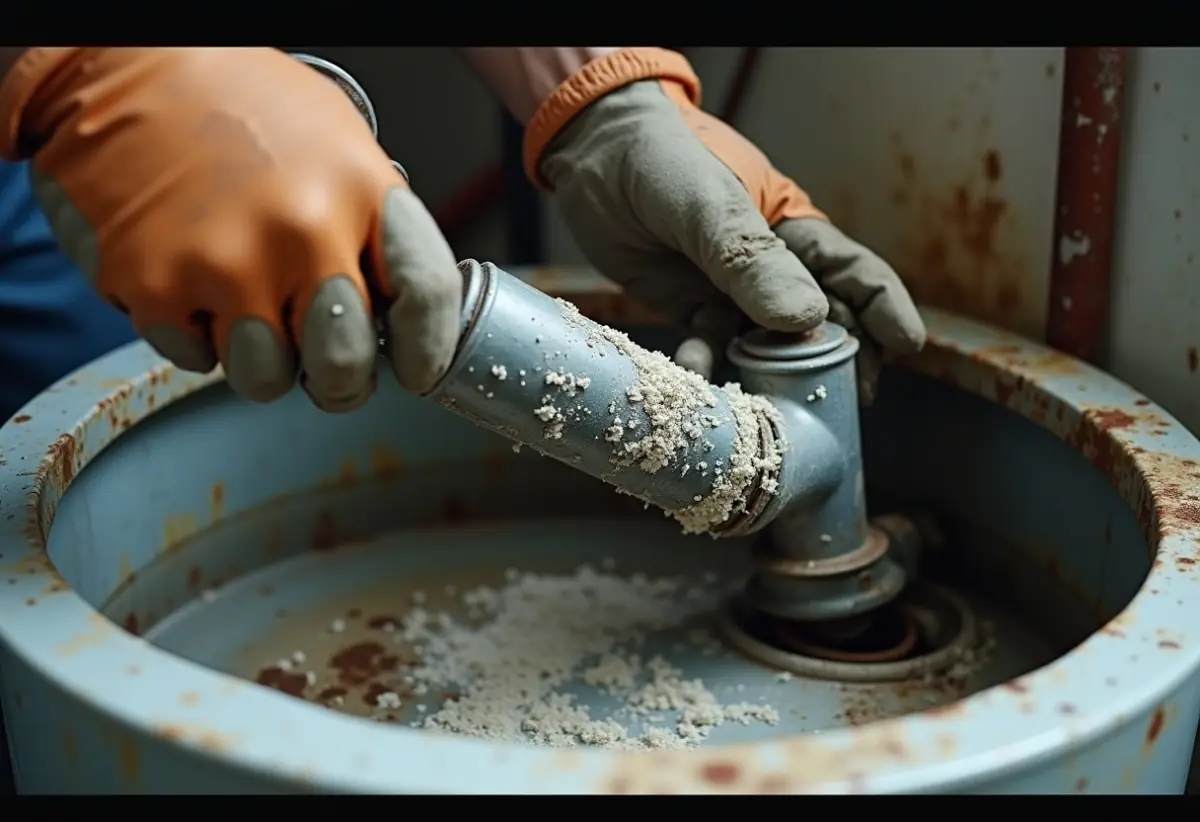
White flakes in hot water only point at the water heater, because three of the four culprits live inside the tank. Heat drives calcium carbonate out of solution onto the tank floor, the dip tube hangs inside the tank, and the anode rod screws into its top. Flakes at both hot and cold taps point upstream, at a softener or at the water supply itself.
Fill one glass from the cold tap and one from the hot, then compare.
| Where the flakes show | What they do in vinegar | Most likely source | First check |
|---|---|---|---|
| Hot taps only | Fizz and dissolve | Scale from the water heater | Drain a bucket from the tank and look for grit |
| Hot taps only | Float, stay hard | Dip tube plastic | Does hot water turn lukewarm within minutes? |
| Hot taps only | Soft gel, green, blue, or gray | Aluminum anode reacting with high-pH water | Pull the anode and check the plug |
| Hot and cold taps | Round beads, unchanged | Softener resin | Put the softener in bypass and see if beads stop |
| Hot and cold taps | Fizz and dissolve | Very hard supply water, or scale loosened by main work | Test hardness at a cold tap |
One trap: resin from a whole-house softener can lodge in the water heater and show at hot taps first, so check the cold side before blaming the tank.
Which water heaters shed plastic dip tube flakes?
The well-known cases are tanks built with polypropylene dip tubes from Perfection Corporation of Madison, Ohio, supplied from August 1993 to October 1996, per A.O. Smith’s July 13, 2004 Form 8-K. A 2000 manufacturer notice reported by PM Magazine stretched the window to 1997. Any dip tube can crack with age, though.
Supply House Times lists Rheem, A.O. Smith, Bradford White, American Water Heater, Lochinvar, and State Industries among the makers whose tanks used those tubes. The settlement paid $175 toward a qualifying replacement, and new claims closed December 31, 2000. PM Magazine reported that Michigan’s Attorney General alleged Perfection made more than 23 million polypropylene tubes in 1993 to 1996.
The second tell is hot water that turns lukewarm within minutes, since a broken tube dumps cold inlet water at the top of the tank. Our guide to replacing a water heater dip tube walks through the swap.
- Material: cross-linked polyethylene (PEX), not polypropylene.
- Length: Rheem tubes run 24 inches (SP11625C, helix), 28 inches (SP13763F, 3/4 inch), and 53 inches (AP12933, 3/4 inch), per Malachy Parts Plus listings. Order by the model number on the rating plate.
- Cost: HomeServe, citing HomeGuide, puts the part at $10 to $20 and a plumber’s job at $100 to $300, or 1 to 4 hours DIY.
- Cleanup: flush the full tank afterward, or old pieces keep clogging aerators.
A tank from that window is about 30 years old, so price a new heater first.
What is the white or gray gel from an aluminum anode?
It is aluminum hydroxide. A.O. Smith Technical Bulletin 14 says that in a few isolated parts of the US where water runs at pH 8 or higher, the aluminum anode reacts to form excessive aluminum hydroxide on the rod and the tank bottom. It looks like “jelly beads” or green, blue, or gray gel at the drain or aerators, and the heater may crackle or pop.
The noise symptom applies to heaters installed less than six months, and the bulletin says treatment is not a warranty item. A smooth anode plug means aluminum; a weld bead on the plug means magnesium. For a new tank with no lime build-up, A.O. Smith gives four steps.
- Turn off the heater.
- Remove the anode.
- Flush the tank thoroughly with water.
- Replace the aluminum anode with a magnesium anode.
With lime build-up, the bulletin adds UN-LIME delimer to the drained tank (3 gallons for 20 to 40 gallon models, 5 for 41 to 65, 7 for 66 to 100), heats it to 140 to 160°F for 7 to 10 minutes, lets it stand up to 12 minutes, then drains, flushes, and swaps in the magnesium anode. A.O. Smith limits this to someone with the abilities of a licensed tradesman, so hire a plumber for it.
How hard does water have to be to leave white flakes in tap water?
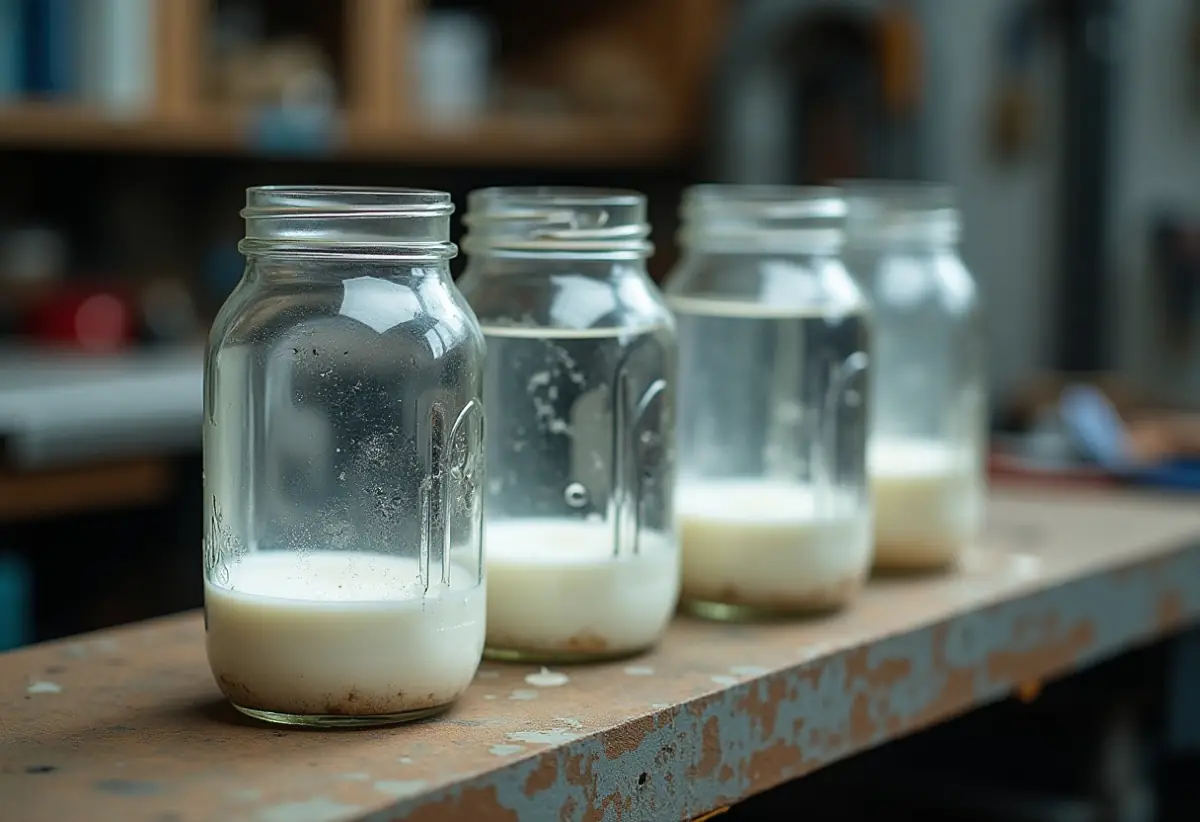
There is no single flake threshold, but the USGS bands tell you how much scale to expect. Water up to 60 mg/L is soft, 61 to 120 mg/L is moderately hard, 121 to 180 mg/L is hard, and above 180 mg/L is very hard. One grain per gallon equals 17.1 mg/L, so the hard line at 120 mg/L is about 7 grains per gallon.
A Battelle study for the Water Quality Association found scale cut water heater efficiency by up to 48%. Our explainer on hard water covers its effects on pipes and fixtures.
Get a number before you buy anything. Your utility’s Consumer Confidence Report usually lists hardness. On the Hach HA-71A kit, each drop of titrant equals 1 grain per gallon across a 1 to 20 gpg range. Our walkthrough on how to test water hardness covers strips, kits, and lab tests.
How do you stop white flakes in water for good?
Stop white flakes in water by fixing the source the vinegar test named. Scale needs clean aerators, a flushed or delimed heater, and softening if water tests above about 120 mg/L. Plastic needs a new PEX dip tube and a full flush. Resin needs a softener distributor or riser repair. Anode gel needs a magnesium anode.
Clean every aerator first
Every source lands in the faucet aerator first. The common regular size is a 15/16 inch-27 male thread with a 55/64 inch-27 female match, per Neoperl specifications. Soak the screen and insert in plain white vinegar for a few hours, brush with an old toothbrush, rinse, and reinstall.
Flush the water heater
- Turn off the breaker, or set the gas control to off, and let the tank cool.
- Close the cold inlet and open a hot tap to vent.
- Run a hose from the drain valve to a floor drain and open it.
- Open the cold inlet in short bursts to stir sediment until the hose runs clear.
- Close the drain and refill. On an electric tank, run a hot faucet full stream for three minutes before restoring power, as A.O. Smith directs, so the upper element does not dry fire.
Repair the softener
For resin, SoftPro says to bypass the softener, shut off the water heater, and avoid hot water until the lines are clear. It prices distributor tubes and screens at $30 to $150 and says units 8 to 12 years old with worn resin may justify replacement. SoftPro sells softeners, so weigh that last point accordingly.
How we sourced this
We reviewed the October 2026 top results for “white flakes in water” and “white flakes in hot water only.” Hardness classes come from the USGS, the 17.1 conversion from the Hach HA-71A manual, dip tube dates and makers from A.O. Smith’s 2004 Form 8-K, PM Magazine, and Supply House Times, part lengths from Malachy Parts Plus, and costs from HomeServe. Anode gel facts and the delime procedure come from A.O. Smith Bulletin 14; resin size and prices come from SoftPro, a softener seller. We left out health claims and tank-size dip tube charts no primary source gave.
Frequently asked questions
Are white flakes in tap water harmful?
Usually not. Most white flakes are calcium carbonate, the mineral that makes water hard, and the EPA sets no national drinking water limit for hardness. Dip tube plastic and softener resin are nuisances that clog screens and signal a broken part, so fix the source and drink from the cold tap meanwhile.
Why are there white flakes in my hot water but not my cold?
Hot-only flakes point at the water heater. Heating pushes calcium carbonate out of solution onto the tank floor, and the dip tube and anode rod both sit inside the tank. Flakes at hot and cold taps point upstream, at a water softener or at the water supply itself.
Does vinegar dissolve white flakes in water?
It dissolves the most common kind. Calcium carbonate scale fizzes and softens in plain white vinegar within a few hours. Polypropylene dip tube plastic floats and stays hard, and softener resin beads stay round and unchanged. If vinegar does nothing, check the water heater or softener next.
What are the white flakes in my faucet aerator?
They are scale, dip tube plastic, or softener resin, and the aerator catches all three first. Tip the debris onto a white paper towel and sort by shape. Chalky chips are scale, thin hard slivers are plastic, and round amber beads of about 0.5 to 1.0 mm are resin, per SoftPro.
Can a water softener cause white flakes in water?
A working softener reduces scale, but a broken one can send resin into the pipes. SoftPro describes escaped resin as amber or translucent beads about 0.5 to 1.0 mm across, usually from a cracked distributor, riser tube, or basket screen. Bypass the softener and clean every aerator.
Do white flakes mean my water heater is failing?
Not always. Scale flakes mean hard water, and a flush or delime usually fixes them. Plastic flakes plus hot water that turns lukewarm within minutes point to a cheap dip tube. Anode gel needs a magnesium anode. Rusty water or a leak at the tank bottom means the tank itself is failing.
How do I get rid of white flakes in my water for good?
Match the fix to the flake. For scale, clean aerators, flush the heater, and soften water above about 120 mg/L, the USGS hard line. For plastic, install a PEX dip tube of the same length and flush. For resin, repair the softener distributor or riser. For anode gel, install a magnesium anode.